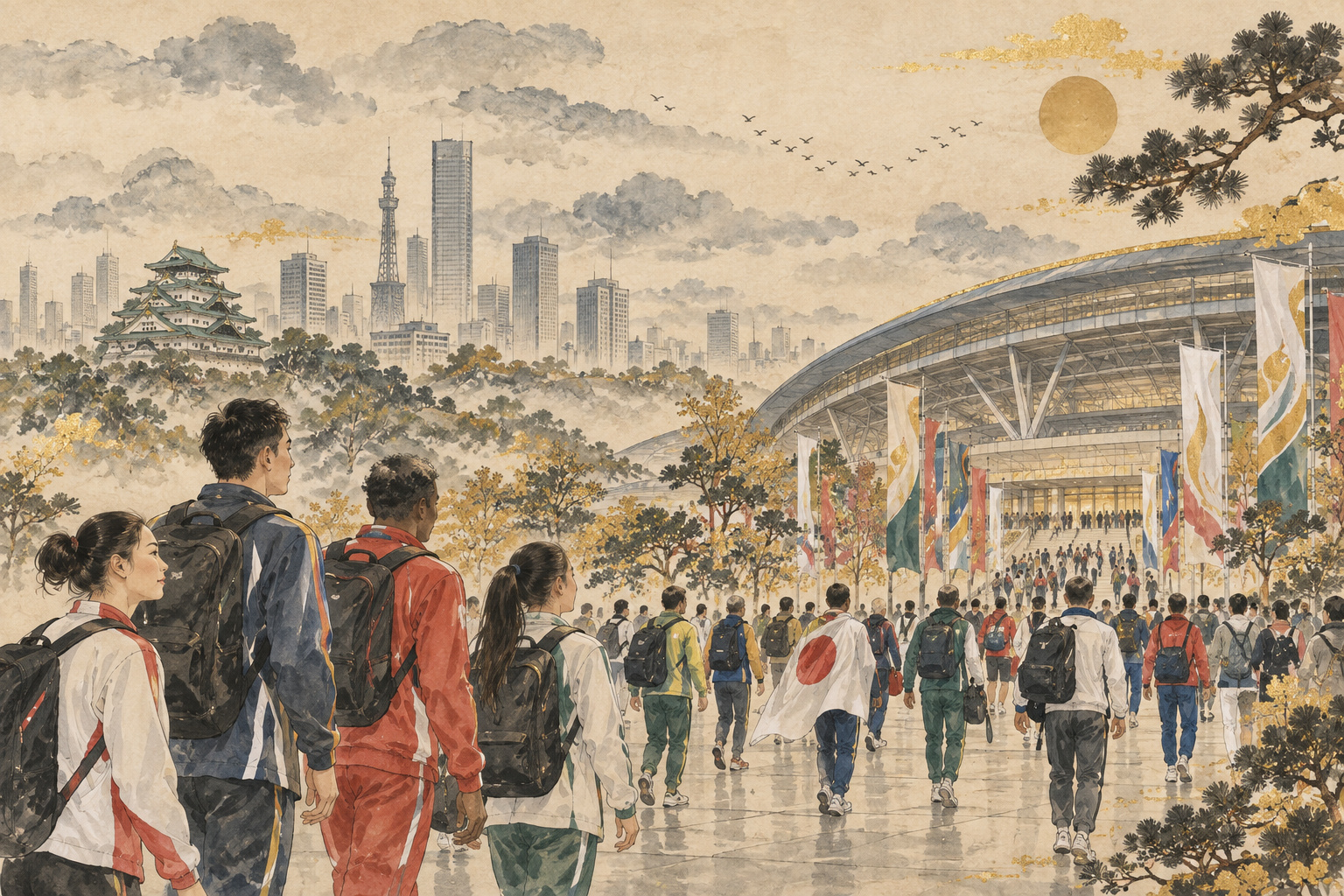
Six days remain until the Asian Games opening ceremony, but Aichi’s welcome cannot wait for the stadium lights. It begins with a journey: finding the right train, reaching the right entrance and arriving with enough time to settle into a seat—or prepare to compete.
On September 19, the ceremony at Nagoya’s Mizuho Park Athletics Stadium will mark Japan’s third hosting of the Games, and its first since Hiroshima in 1994. The official Games period runs through October 4. [1][13]For this September 13 Sunday edition, “six days” means six days to that ceremony. The Japan Basketball Association’s schedule places the start of the men’s five-a-side tournament on September 10, before the formal opening. [2]
That distinction captures the larger challenge. A ceremony can introduce a host in an evening. A tournament tests it repeatedly, through the ordinary arrangements that allow extraordinary performances to happen.
Japan’s third turn, 75 years into the story
The first Asian Games took place in New Delhi in 1951. The Japanese Olympic Committee’s historical record lists 11 participating National Olympic Committees and six sports. It describes a postwar project intended to develop friendship and lasting peace through sport. [4]
Tokyo hosted in 1958; Hiroshima followed in 1994. Aichi-Nagoya now joins that short Japanese list. [5]For many residents, this will be a rare chance to encounter a continental multisport event without first making an international journey. The significance extends beyond watching a familiar national team at home.
Aichi’s published venue guide includes kabaddi, sepak takraw and wushu alongside sports widely followed through the Olympics. [3]For a newcomer, part of the pleasure can be learning when another crowd cheers and why: recognizing a difficult move, understanding a tactical exchange, discovering that an unfamiliar sport has its own established heroes and traditions.
The Games’ historical aspiration should not be confused with a result already achieved. An international gathering creates opportunities for contact. What participants remember depends on what happens within it, including the welcome they receive when competition is over for the day.
A decision made almost a decade ago
Aichi-Nagoya was selected on September 25, 2016, at the Olympic Council of Asia’s general assembly in Da Nang, Vietnam. [6]Nearly ten years later, a decision once expressed in presentations and plans is becoming a series of immediate obligations to athletes and spectators.
A prefectural preparation document records test events from May 2025 onward, revisions to venue operating plans and consultation with technical delegates and an athletes’ committee. [7]These are evidence of a preparation process. They are not, on their own, proof that every element will work smoothly under tournament conditions.
The distinction matters in an opening preview. Readiness is more than a finished building. It includes the handover between organizations: a transport instruction that matches a ticket, a venue entrance that matches the route map, a change to the schedule that reaches the person who needs it. The final days are when those connections become especially consequential.
The host is bigger than central Nagoya
The competition map spreads across the prefecture and beyond. Aichi’s guide places badminton at Ichinomiya City General Gymnasium, football at venues including Toyota Stadium and sailing at Kaiyo Yacht Harbor. Swimming and diving at Tokyo Aquatics Centre illustrate the Games’ reach outside Aichi itself. [3]
For spectators, the practical implication is simple: the host’s name does not describe a single compact venue park. Seeing different sports may involve different cities, different rail connections and substantial time between sessions. Planning from the event name alone can produce a very different itinerary from planning from the actual address.
For the region, that spread gives more communities a direct relationship with the Games. A familiar sports hall or waterfront can become the place where residents watch international competition. Whether that encounter encourages later participation in sport will depend on opportunities that remain after the temporary signs come down.
The welcome at the station
Aichi’s spectator-access guidance makes public transport the basic approach. Some venues have shuttle services, including a reservable accessible-shuttle service. The prefecture also warns that opening- and closing-ceremony access differs from access during sporting competition. [3]
Such details are part of the sporting experience. A spectator who cannot confidently find a route may never reach the contest they hoped to see. A route that works for someone traveling lightly may not answer the needs of a wheelchair user or a visitor who cannot walk far. Useful hospitality means making those differences visible in advance.
Nagoya’s municipal volunteer program, なごやウェルカムサポーター, assigns roles that include tourism and transport information around major stations and stations serving athlete accommodation, as well as support for ceremonies and cultural events. The city intends to carry the experience into later international meetings, sports events and community activities. [8]
That gives “legacy” a concrete test. Will someone who learns to explain a transfer, assist a visitor or coordinate an event have another opportunity to use those skills? A volunteer network becomes a lasting asset through continued activity, rather than simply through having existed during the Games.
A festival beyond the ticketed seat
Nagoya’s torch-relay plan reaches all 16 wards, with routes chosen to include familiar community places as well as landmarks. [9]It offers a way for the event to enter neighborhoods whose residents may never attend the main stadium.
The cultural program provides another point of contact. Its main site at Mizuho Park’s southern plaza is scheduled to offer free admission on designated dates, with local products, performances and participatory activities. Programs at competition venues and accommodation facilities have different access conditions, including restrictions to ticket holders or Games-related participants. [10]
In central Nagoya, the official celebration and fan zone, ONE ASIA WORLD, is also preparing to welcome visitors. Aichi Prefecture’s announcement schedules a free opening event at Hisaya-odori Park’s Mizube Hiroba from 11 a.m. to noon on September 19, with bag checks and possible admission limits. [11]That is a separate event from the Games opening ceremony at Mizuho.
The distinction between public space and unrestricted access is worth preserving. A free event can still have a timetable, security arrangements and limited capacity. Clear information helps people enjoy the celebration without mistaking one program for another.
October brings another responsibility
The Asian Games’ October 4 closing date is not the end of the host’s autumn. The fifth Asian Para Games are scheduled for October 18–24, the first time Japan will host that event. [1]Only two weeks separate the closing of one Games from the opening of the next.
That makes the ability to learn during operations valuable. If a route is confusing, a sign hard to understand or a service difficult to book, identifying the problem is only the beginning. The meaningful next step is whether an improvement reaches the next visitor.
Aichi’s eventual record will include medals and memorable performances. It will also include less easily counted experiences: a child discovering a sport, a local facility gaining new meaning, a visitor finding help when a journey becomes confusing. None of those outcomes can be declared in advance.
Six days before the ceremony, the opportunity is to make the practical work match the scale of the invitation. The world will see an opening show. The people who come to Aichi will experience the connections around it—and those connections will help determine what they carry home.
Before setting out
| Ceremony and Games dates | Opening ceremony: September 19. Official Games period: September 19–October 4. Some competitions have earlier dates. |
|---|---|
| Sport and session | Follow Nagoya’s official schedule links and match the venue and session to the ticket. |
| Getting there | Use Aichi’s venue-specific access guide. Ceremony routes differ from those used for competition. |
| Public programs | Check each cultural or fan-zone event’s dates and admission conditions separately. |
Dates and times use Japan Standard Time. Official schedule and access links are provided below. [1][3][12]
- Japan Sports Agency: Games dates, host regions and Japanese hosting history
- Japan Basketball Association: 2026 schedule, including pre-ceremony competition
- Aichi Prefecture: venue and spectator-access guide, updated September 10, 2026
- JOC: historical overview and the first Asian Games (1998 archive)
- JOC: summer Asian Games hosting chronology
- Aichi Prefecture: host-selection announcement, September 25, 2016
- Aichi Prefecture: preparation report covering fiscal 2025 work and fiscal 2026 plans (PDF)
- Nagoya City: municipal welcome-supporter roles and post-Games plans
- Nagoya City: torch relay across the city’s 16 wards
- Aichi Prefecture: cultural-program venues and access conditions, August 19, 2026
- Aichi Prefecture release: ONE ASIA WORLD opening event, September 2, 2026, via PR TIMES
- Nagoya City: links to official competition schedules, updated September 11, 2026
- Nagoya City NAGOS: Games and city venue guide