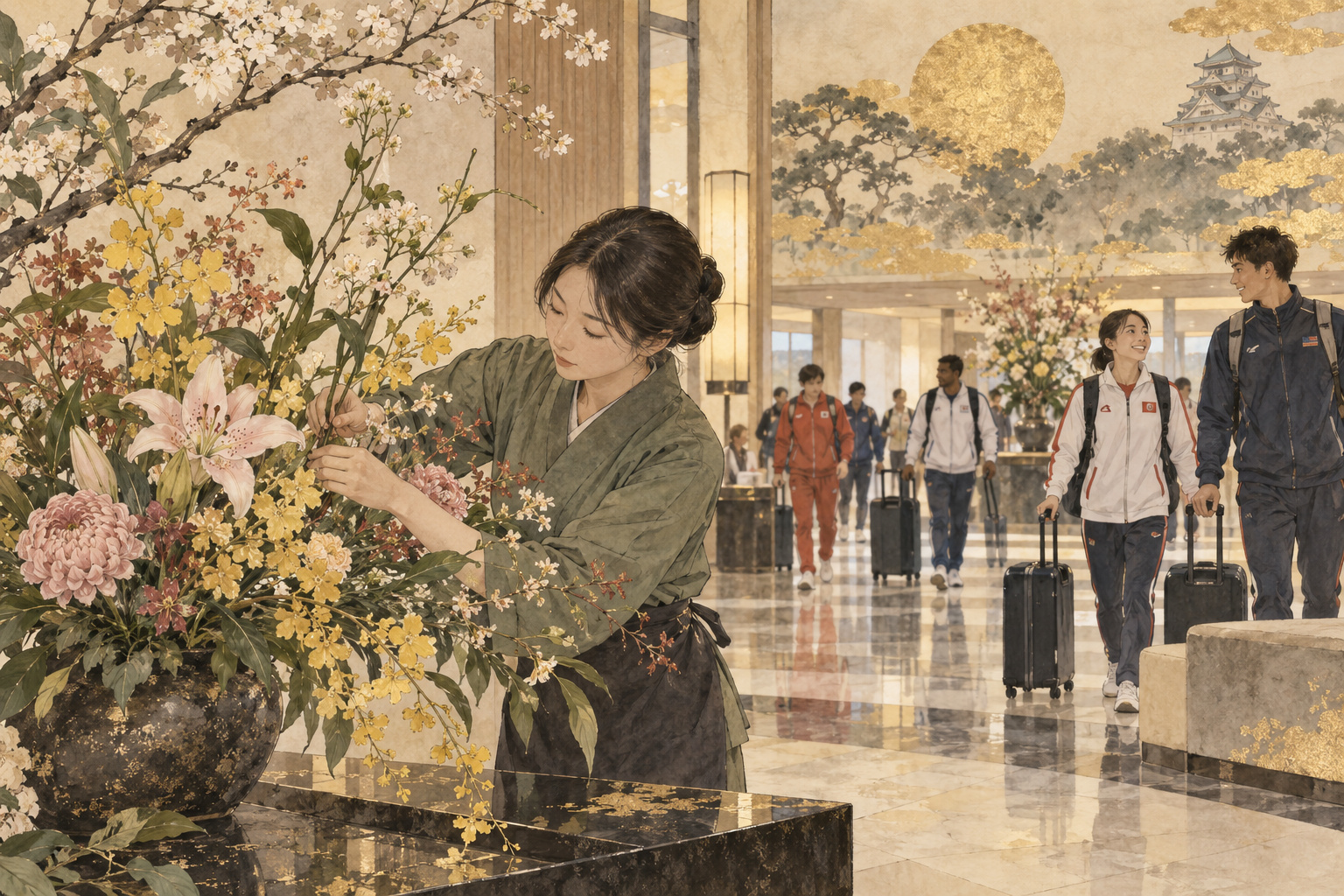
The flowers that welcome an athlete have a timetable of their own. Long before a display is assembled, somebody has to grow a plant to the right size, manage its flowering and bring it to the place where it will be seen. Aichi’s contribution to the coming Games includes that less visible work.
On September 9, the prefecture announced locally grown floral decorations for an athlete accommodation base at Nagoya Port. A large monument is scheduled for September 16–October 25 at Fuji Square on Garden Pier, with separate stage arrangements for delegation welcome ceremonies. For a region closely associated with cars and machinery, the project offers another account of productive skill.[1]
Aichi is also a major flower-growing region. The displays will draw attention to an industry shaped by postwar expansion, greenhouse cultivation and changing ideas about how flowers should be used. Welcoming Asia’s athletes is the immediate purpose. Making the region’s growers more visible is the wider opportunity.
The industry behind the welcome
Aichi’s horticulture department puts the prefecture’s 2024 flower-sector agricultural output value at ¥53.1 billion, or 15.5% of Japan’s total, with 1,909 hectares under cultivation. Its 2026 agricultural review records 63 consecutive years in first place for flower output value, from 1962 through 2024. The publication date should not be confused with the year being measured.[2][3]
That ¥53.1 billion is an industry statistic, not the budget for decorating the Games and not growers’ profit. It also describes a wider business than bouquets. The sector includes potted flowering plants and ornamental foliage as well as cut flowers.
In its account of the 2024 figures, the prefecture lists chrysanthemums and roses among the individual products leading Japan in output value, alongside potted cyclamen, foliage plants and orchids. That range matters to the story: Aichi can present a varied horticultural identity rather than rely on a single signature bloom.[3]
Being the leading producer does not remove commercial pressure. The prefecture’s own industry description identifies weak demand, increased imports of cut flowers and changes in distribution and selling conditions. A flower display at an international event therefore sits within a continuing effort to connect production with demand.[2]
A monument, a ceremony and a restricted site
The planned monument is 2.5 metres high and eight metres wide. It will use Aichi-grown bedding plants to represent a chrysanthemum and a folding fan. The prefecture describes the chrysanthemum as a flower in which Aichi leads national production and the fan as an auspicious traditional Japanese motif. A design depicting a chrysanthemum should not be mistaken for a structure made entirely of cut chrysanthemums.[1]
Welcome-ceremony stage decorations are scheduled for September 16–18 for the Asian Games and October 15–17 for the Asian Para Games. The announced materials include locally produced “colouring mums,” gloriosa and Phalaenopsis orchids. These shorter ceremony installations are distinct from the monument’s longer display period.[1]
Fuji Square is within a restricted Games area. The general public cannot enter to view this installation. It is a welcome for athletes and accredited participants, rather than an open-access flower festival; other projects provide ways for residents and visitors to encounter Aichi’s flowers.[1]
How the growing region took shape
Tahara, on the Atsumi Peninsula, provides a useful starting point for the industry’s history. The city dates the beginning of local standard-chrysanthemum cultivation to the Shōwa 20s, the decade spanning 1945–1954. Production gradually spread through both open fields and protected cultivation. Its current account describes planned, year-round production in growing facilities.[4]
This history complicates the idea that flowers are simply a natural expression of the season. Aichi’s agricultural cooperative federation, JA Aichi Keizairen, describes an industry that combines a mild, sunny climate with protected cultivation and growing expertise. Geography creates possibilities; equipment and skill help turn them into a dependable supply.[5]
Chrysanthemum lighting is one of the clearest examples. The plants form flower buds under short-day conditions. Growers use artificial light to regulate that process and the timing of flowering. As the federation explains, lighting can delay flowering so that shipments can be scheduled. It is not simply a matter of adding light to make flowers appear sooner.[6]
Seen from outside, illuminated growing houses can become part of a landscape; Tahara includes the autumn lighting scene in its description of the city’s flowers. Seen as production infrastructure, those lights are also a way to manage time. A ceremony has a fixed date, and its flowers must be usable on that date.
The documented cultivation system helps explain why dependable horticultural production belongs in a business story. The finished arrangement shows only the last stage of a much longer sequence of decisions.
Reinventing the chrysanthemum
The word chrysanthemum can suggest a single familiar form, but growers work with a much broader range. JA Aichi Keizairen distinguishes standard chrysanthemums, trained to a single bloom by removing buds, from spray mums, which carry multiple flowers on branching stems.[6][7]
The federation dates Japan’s introduction of spray mums to 1974 and identifies Toyokawa in Aichi as the first introduction site. Its account describes a crop used across funerary arrangements, weddings, floral design and home display.[7]
The distinction matters because an established flower does not have to remain tied to one presentation or occasion. Tahara’s city government describes local work with full-bloom chrysanthemums suitable for arrangements alongside other flowers, as well as colouring mums. It also records organised greenhouse carnation production from 1979 under an agricultural development programme.[4]
These are separate developments, but together they show a growing region responding to new opportunities. The industry’s history is about equipment, varieties and uses as well as acreage. Bringing flowers into a welcome ceremony continues that conversation about where an agricultural product can belong.
Flowers meet the city’s crafts
A separate joint project by Aichi Prefecture and Nagoya City pairs local flowers with the city’s traditional crafts at five locations. For the Asian Games display period, the announced combinations include alstroemeria and Nagoya folding fans in Chubu Centrair International Airport’s domestic arrivals lobby, and gerberas with Arimatsu–Narumi shibori at the Nigiwai-no-Oka area of Nagoya’s Mizuho Park athletics stadium.[8]
The pairing allows flowers to communicate more than agricultural abundance. Colour can sit beside dyed cloth; the contour of a bloom can be read against the shape of a fan. Growers, craft workers and floral designers contribute different skills to a presentation of place.
Access still requires attention. One of the five locations is the Main Media Centre at Port Messe Nagoya, an area unavailable to the general public. The prefecture also says display periods vary by location. A list of installations is not a promise that every visitor can enter every site.[8]
A flower to take home this Sunday
There is a more direct public invitation at JR Central Towers. On Sunday, September 13, a flower giveaway is scheduled for 11 a.m., 1:30 p.m. and 4 p.m. on the second-floor bridge above the bank of four escalators. The prefecture’s notice describes individually wrapped Aichi flowers, one free flower per person on a first-come basis, with numbered tickets distributed for these sessions. Visitors should check the on-site ticket and availability information.[8]
Taking a flower home changes the encounter. Instead of passing a display, somebody has to find a place for it and care for it. That experience may encourage a later purchase, although a giveaway cannot itself establish that sales have increased. It is an opportunity to bring consumers into contact with the product.
The longer route into household demand continues through Aichi Hana Marche 2026. The prefecture plans the Nagoya stage at Meijō Park on October 3–4, with free admission, sales and activities. The Mikawa stage follows at Denpark in Anjo on November 21–23; park admission is required there. Workshops may require reservations and separate participation fees. The prefecture says the event began in fiscal 2020 to expand flower consumption.[9]
What remains after the flowers leave
International-event exposure and a sustainable flower business are related possibilities, not interchangeable results. Attention may help people remember a growing region. Growers still need prices that cover production, buyers who return and workable shipment schedules.
The business questions are consequently specific. Do visitors remember that the flowers came from Aichi? Do public activities lead to ordinary purchases? Do producers and retailers gain continuing relationships? These are useful ways to assess the wider initiative; the announcements do not yet answer them.
For an athlete, a floral welcome may be a brief impression between arrival and competition. For a grower, the display belongs to a much longer calendar. The value of Aichi’s gesture lies partly in making that calendar visible: a region’s knowledge of plants, its production skills and its ability to deliver beauty when it is needed. When the ceremony ends, the next crop is still on its way.
- Aichi Prefecture: floral displays at the athlete accommodation base, September 9, 2026 (Japanese)
- Aichi Prefecture, Horticulture and Agricultural Products Division: sector policy and 2024 statistics (Japanese)
- Aichi Prefecture: 2026 agricultural review announcement, May 29, 2026; statistics refer to 2024 (Japanese)
- Tahara City: floriculture, updated October 1, 2025 (Japanese)
- JA Aichi Keizairen: Aichi flowers, production and marketing (Japanese)
- JA Aichi Keizairen: standard chrysanthemums and cultivation with artificial lighting (Japanese)
- JA Aichi Keizairen: spray mums, introduction history and uses (Japanese)
- Aichi Prefecture: five-site flower and craft displays and Nagoya Station activities, September 4, 2026 (Japanese)
- Aichi Prefecture: Aichi Hana Marche 2026, September 1, 2026 (Japanese)