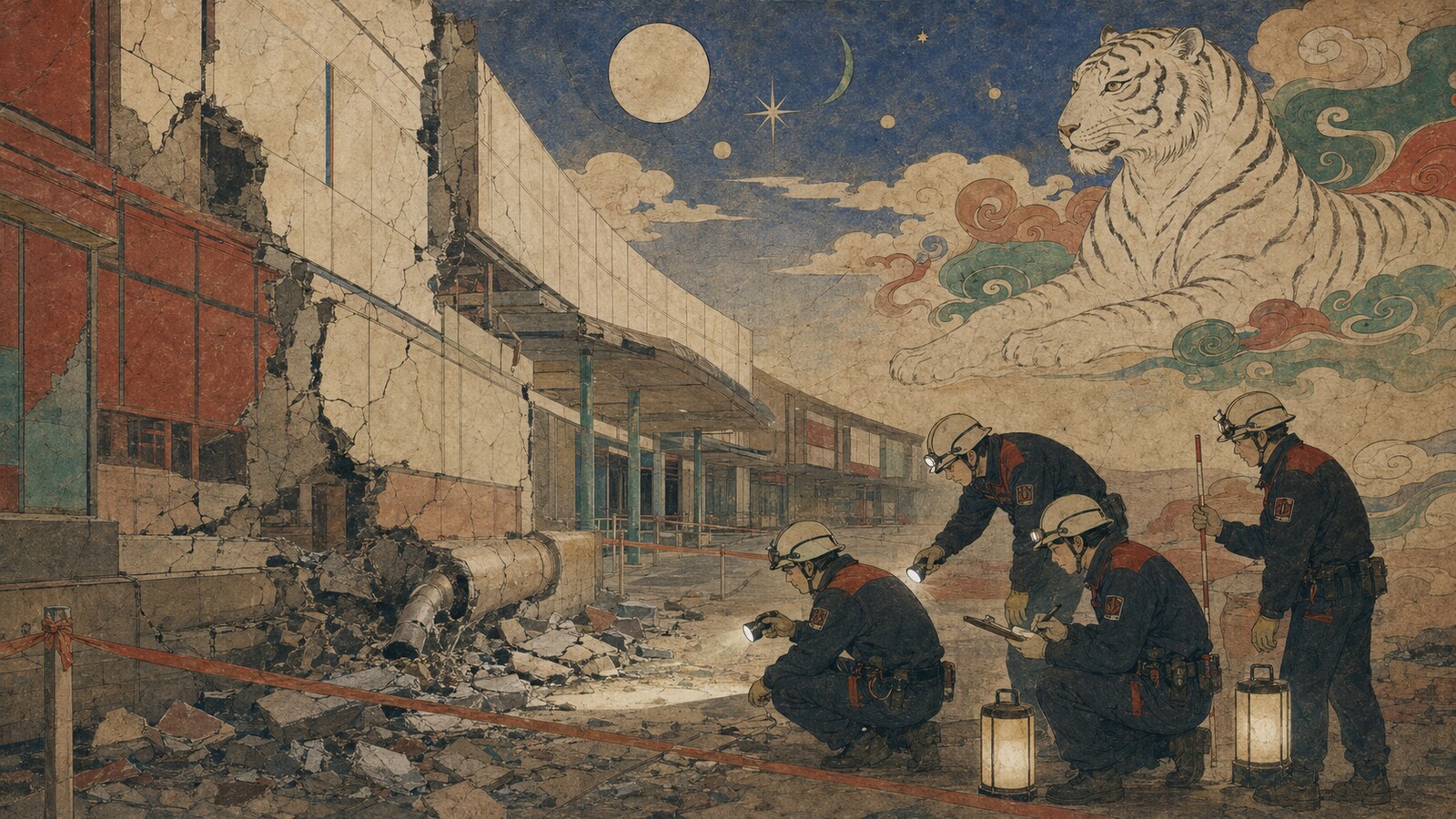
The first clock began at 4:27 p.m., when intensity-7 shaking drove thousands of people toward the exits of Aeon Mall Kumamoto. The second began at 5:00, when the company says customers and its employees had been confirmed outside. The third began at 5:50, when an explosion tore open the rear of the second floor and transformed a successful evacuation into a mass-casualty scene.
Those clocks define the inquiry. The first 33 minutes concern how the mall moved roughly 3,000 customers out of a building with fallen ceilings, damaged exterior walls and activated sprinklers. The next 50 concern a more difficult question: how people came to be inside when the blast occurred, what work or movement took place after evacuation, and whether a damaged fuel system was releasing gas into an enclosed space.
The need for answers is not the same as a license to invent them. A reported gas smell does not identify the broken component. An intact outdoor tank does not clear downstream piping. A safety inspection completed the previous month does not establish how the system behaved under extraordinary shaking. And a statement that some workers may have returned does not prove why each person was inside or that re-entry caused a death.
By Thursday morning, rescuers were still working through rubble while police, fire investigators and the operator assembled separate records: emergency calls, staff lists, access data, building plans, gas-system information and accounts from survivors. The story of the blast will eventually be a chain of evidence. At 10:12 a.m. JST, it was still a chain with missing links.
The timeline Aeon has put on the record
Aeon’s July 29 statement supplies the most detailed corporate chronology available by the cutoff. It should be treated as an important source, not as the final investigative finding. Every time will have to be tested against fire-service logs, security video, public-address recordings, access-control data and witness accounts.
4:27 p.m. The magnitude-7.1 earthquake strikes. Public announcements and staff patrols begin, with customers directed outside.
4:40 p.m. Aeon convenes an internal earthquake-response meeting and contacts police and fire services.
5:00 p.m. Outdoor evacuation is reported complete. Aeon says customers and Aeon Group employees were confirmed outside.
After 5:00 p.m. Damage is checked: fallen ceilings, partial exterior-wall failure and activated sprinklers. Four quake injuries are handled, and the mall is closed.
5:50 p.m. An explosion occurs at the rear of the second floor.
6:00 p.m. Aeon begins another employee safety check.
July 29, 8:00 a.m. Two people found inside are confirmed dead.
July 29, 2:45 p.m. A third death is confirmed. The official toll later rises further.
The 3,000-customer estimate came from Aeon’s next-day press conference. An early prefectural account had said about 200 visitors were guided out. Those figures may describe different scopes or stages of the evacuation; neither source published a turnstile-style count. The later company estimate is used here for the overall mall population, with its source stated. What is well supported is the more consequential point: the great majority of customers were outside before the explosion.
Aeon’s statement says employees from 204 specialty stores and the group evacuated, and that its safety-confirmation system was used after the blast to check roughly 2,700 tenant and group workers. That very large workforce explains why an early “missing” count changed sharply as rosters, shifts and locations were reconciled. A person unanswered in the system was not automatically trapped. Conversely, a general confirmation that employees had evacuated did not guarantee that no one remained or later went back.
The contradiction at the center: outside, then inside
At a press conference, Aeon President Akio Yoshida said the company believed employees had evacuated, but later learned that some people had remained inside or returned. He said interviews had produced references to retrieving car keys or preparing to go home, but emphasized that those accounts had not been verified. He also said company rules prohibit re-entry once a person has evacuated.
That creates several distinct questions. Were some workers never outside? Did others re-enter? Who authorized or observed movement? Were tenant employees receiving the same instructions as group employees? Were staff checking damage, assisting an injured person, securing a shop, retrieving essential belongings or doing something else? Did alarms, radio messages or public announcements warn of gas? Each person’s path must be reconstructed separately.
The word “re-entry” can falsely compress this complexity into an act of disobedience. Large malls are divided among the property operator, anchor stores, hundreds of tenants, contractors, security, cleaning and building-maintenance teams. They may use different supervisors and communication channels. An investigation must test whether one rule was understood the same way across all 204 specialty stores, whether the exclusion zone was physically controlled and whether information about the building’s condition changed after the 5:00 confirmation.
Personal belongings matter because disaster behavior is human. A key may be the only way to move a car from an emergency route or take a child home. A phone may contain family contacts. Medication may be in a locker. None makes re-entry safe, but each can explain why a person under stress might underestimate a secondary hazard after surviving the primary one. The safety lesson cannot stop at “do not go back.” Systems must also reduce the reasons people feel they have to.
Gas is the leading hypothesis, not the final finding
First responders reported smelling gas inside the structure, according to the government’s top spokesperson. Emergency vehicles warned people to keep away because of a possible leak. Aeon confirmed that the mall used liquefied petroleum gas, or LPG, supplied from an outdoor storage tank rather than city gas delivered through a utility network.
Video indicated that the outdoor tank remained intact. That is important evidence, but it answers only one question. A fuel system extends beyond its storage vessel: valves, regulators, meters, supply pipes, branch lines, flexible connections and appliances carry gas to points of use. As a general engineering inference—not a finding about this mall—a break downstream of an undamaged tank can still release fuel.
Aeon said the gas system had received a safety check the previous month. That record will tell investigators what was inspected, by whom, under which standard and whether any repair was outstanding. It cannot by itself show what happened after intensity-7 motion, ceiling failure, wall damage and sprinkler activation. An inspection is a baseline for the inquiry, not an answer to it.
LPG safety systems are designed in layers. Japanese technical standards provide for microcomputer meters that monitor flow and can shut gas when they detect abnormal conditions. Earthquake-sensitive shutoff devices are designed to respond to strong motion; the national LPG disaster manual describes devices that sense shaking equivalent to approximately seismic intensity 5 and close the gas path within seconds. Suppliers may also have remote-shutoff capability.
But “designed to shut” is not the same as “proved to have shut every path in this event.” Investigators will need the mall’s actual configuration: where meters and valves were located, which areas they served, whether shutoff signals were recorded, whether pressure remained in downstream lines and whether physical damage occurred before or after isolation. Until then, it is premature to say a safeguard failed—or that it operated exactly as designed.
How an explosion investigation is built
A credible inquiry must establish a sequence, not simply name a substance. For a fuel-air explosion, investigators generally have to determine whether gas escaped, where it accumulated, how concentrated it became, what ignited it and how the resulting pressure caused structural damage. If one link is unsupported, the account remains a hypothesis.
The physical work begins with scene mapping. Investigators document debris before moving it, identify the apparent origin area and trace piping back toward supply. They examine fracture surfaces to distinguish a pipe pulled apart by shaking from one damaged by the explosion or rescue work. Valve positions, regulator condition, meter memory, alarm logs and remote-monitoring records may show whether and when flow stopped.
Digital evidence can narrow the 50-minute gap. Security video may show who entered particular corridors. Access cards and key logs may identify doors. Public-address and radio recordings can reveal what employees were told. Sprinkler and fire-alarm panels may preserve timestamps. Phone video from the parking lot can establish when dust, odor warnings or visible changes began. Shift rosters and the company’s safety-check system must be reconciled person by person.
Ignition is a separate question. Damaged electrical equipment, a switch, hot surface, cooking appliance or static discharge can ignite a combustible mixture, but listing possibilities is not evidence that any one did so. Investigators must look for electrical arcing, heat patterns and component damage while accounting for post-blast fire, water and rescue operations. The proper headline is not “what must have happened,” but “what the evidence can still distinguish.”
| Established by the cutoff | Still to be established |
|---|---|
| Earthquake at 4:27 p.m.; Aeon says evacuation complete at 5:00; explosion at 5:50. | The movement, task and instructions of every person who remained inside or returned. |
| The mall used LPG; responders reported a gas odor; the outdoor tank appeared intact. | The release point, volume, accumulation area, shutoff performance and ignition source. |
| Ceiling and exterior-wall damage and sprinkler activation were identified before the blast. | Which damage came from shaking, which came from the explosion and how one affected the other. |
| Aeon said the gas system had been checked the previous month. | The inspection scope, actual system configuration and whether any defect or vulnerability existed. |
Why rescue could not simply rush in
For the first hours after the blast, police and firefighters stayed out of parts of the wreckage because aftershocks threatened further collapse. To families, delay can feel unbearable. To a rescue commander, entering an unstable structure with a possible fuel leak can turn one disaster into two and remove the very teams needed to reach survivors.
Firefighters had to manage several hazards at once: structural instability, gas, damaged electrical systems, water from sprinklers and broken lines, falling materials and repeated shaking. The gas supply was reportedly closed, but a shut valve does not instantly remove fuel already accumulated in an enclosed void. Ventilation can reduce concentration, yet moving air or opening a space may alter conditions around trapped people and unstable debris.
By Thursday morning, teams had expanded the area they could search, with dozens of firefighters seen entering after debris was removed. The prefectural update listed 11 people recovered or rescued at the site and another operation continuing. The change from an outside perimeter to interior work reflected engineering and hazard control—not proof that the structure had become broadly safe.
A building rebuilt from 2016
The mall’s history makes the explosion more than a single-site accident. In April 2016, the complex was badly damaged by the Kumamoto earthquakes. Parts reopened in July, a temporary “container mall” followed in September, and the full western area returned in March 2017. Aeon said the reconstruction added reinforcement, strengthened ceilings and reconsidered how lights and equipment were attached.
An expansion announced for 2018 again emphasized ceiling seismic measures and safer equipment placement. The sprawling complex grew to about 200 stores and businesses, a cinema and parking for 5,000 vehicles. Annual visitors rose above eight million as Kumamoto’s economy expanded around new semiconductor investment.
The mall was also remembered as a relief point. Days after the 2016 disaster, the supermarket sold rice balls for 10 yen and low-priced prepared food as damaged supply chains and displacement strained households. The facility was not only retail space; it was part of the region’s emergency and social infrastructure.
On June 13, 2026, Aeon completed another major renewal, framing it as a “re-start” tied to the mall’s 21st year and the tenth anniversary of recovery. Six weeks later, the building was torn open. The symbolism is brutal, but it must not substitute for engineering analysis. Seismic ceiling reinforcement may have prevented injuries in one area while a utility or operational failure occurred elsewhere. A system can work in part and fail catastrophically in another.
The inquiry must therefore resist two easy narratives. The first is that all past investment was meaningless because an explosion occurred. The evacuation of thousands argues otherwise. The second is that the evacuation’s success excuses what followed. Five confirmed deaths and continuing rescue work make that impossible. Resilience is not a label earned once; it is a chain whose weakest unexamined link becomes visible under stress.
The problem of a secondary disaster
Japan’s disaster planning has long recognized that major earthquakes create hazards after the shaking: fire, gas release, damaged ceilings, blocked exits and uncontrolled re-entry. Fire and Disaster Management Agency guidance for large buildings calls for plans that identify dangerous zones, define evacuation timing and routes, account for people who cannot self-evacuate, and address gas, water, communications and transport failures.
What the Aeon case may add is the importance of the period after a nominally complete evacuation. Head counts can establish who reached an assembly area, but they do not create a physical boundary. Employees need access to transport, medication and family communication without going back through a damaged building. Tenant supervisors need one command structure. Doors and perimeter staff must translate a written no-re-entry rule into an environment where returning is difficult, visible and immediately challenged.
Utility isolation must also be connected to occupancy control. If structural inspection requires people to enter, their names, task, route, communications and exit time should be explicit. If a possible gas release is suspected, entry requires monitoring and specialist control. The crucial record is not merely “everyone was out at 5:00,” but who was authorized inside at 5:10, 5:20 and 5:40—and why.
Accountability without a premature verdict
Corporate statements matter because Aeon controlled the facility and many of the relevant records. They are not a substitute for an independent public investigation. Police and fire authorities must preserve evidence; gas-safety specialists must examine the system; structural engineers must separate quake damage from blast damage; labor investigators may need to examine instructions and worker protection.
Aeon’s acknowledgments are significant. Its president said a gas cause was highly likely, said the company had not fully anticipated an explosion of this kind, and confirmed that the no-re-entry rule may not have held. Those are reasons for scrutiny, not final admissions of technical or legal responsibility. The missing facts include whether equipment failed, whether procedures were adequate, whether warnings reached every tenant and whether a reasonable action could have prevented the deaths.
Transparency should include a corrected public timeline as evidence develops; the exact employee categories used in head counts; the gas-system diagram and shutoff records; the June inspection scope; alarm and building-management logs; re-entry rules and training records; and the methodology used to distinguish those missing, trapped, rescued and confirmed dead. Families should not have to infer a loved one’s status from changing press totals.
- Where did fuel first escape, and which evidence identifies that point?
- Which automatic and manual shutoffs operated, at what time, and what gas remained downstream?
- Where did gas accumulate, and what was the ignition source?
- Who remained or re-entered after 5:00 p.m., for what reason and under whose knowledge?
- How were no-re-entry instructions communicated across Aeon, 204 specialty stores and contractors?
- Which damage was caused by the earthquake, the explosion and subsequent collapse?
- What did the June safety inspection cover, and what should future inspections add?
The fifty minutes
A shopping mall is designed around return: customers come back, employees open again tomorrow, damaged communities recover. After the 2016 earthquakes, Aeon Mall Kumamoto embodied that promise more literally than most. It reopened in stages, expanded, strengthened ceilings, supported residents and celebrated another beginning.
On July 28, the first evacuation appears to have fulfilled the most basic promise of emergency planning. Thousands reached the parking lot before the blast. The failure lies in the boundary after that moment—the uncertain traffic back toward a building that had not finished revealing its damage.
At 10:12 a.m. JST Thursday, the cause had not been determined. Gas was the leading hypothesis; the outdoor LPG tank appeared intact; safeguards were supposed to exist; some employees may have remained or returned; rescue continued. The investigation’s duty is to turn those fragments into a tested sequence. The public interest is larger than assigning one dramatic cause. It is learning how to make the next evacuation stay complete.
Reporting Notes and Sources
Information was checked through 10:12 a.m. JST on July 30, 2026. The prefecture’s 7:30 a.m. materials provide the latest mall casualty baseline used here. Aeon’s chronology is attributed to the company and treated as subject to independent verification. Gas, re-entry and ignition remain investigative questions unless specifically identified as confirmed.
- Kumamoto Prefecture: Fifth disaster-response meeting materials, July 30
- Aeon: Explosion statement, casualty status and corporate timeline
- Reuters: Evacuation, re-entry, LPG safeguards and rescue scene
- TV Asahi: Aeon press conference and July 30 rescue update
- Reuters: Mall history, June renewal and regional role
- Aeon Mall: 2017 reopening and seismic-safety changes
- Aeon Mall: 2018 expansion and additional safety measures
- Economy Ministry: LPG disaster-response manual and seismic shutoff systems
- High Pressure Gas Safety Institute of Japan: Microcomputer gas-meter standard
- Fire and Disaster Management Agency: Large-building earthquake planning guidance