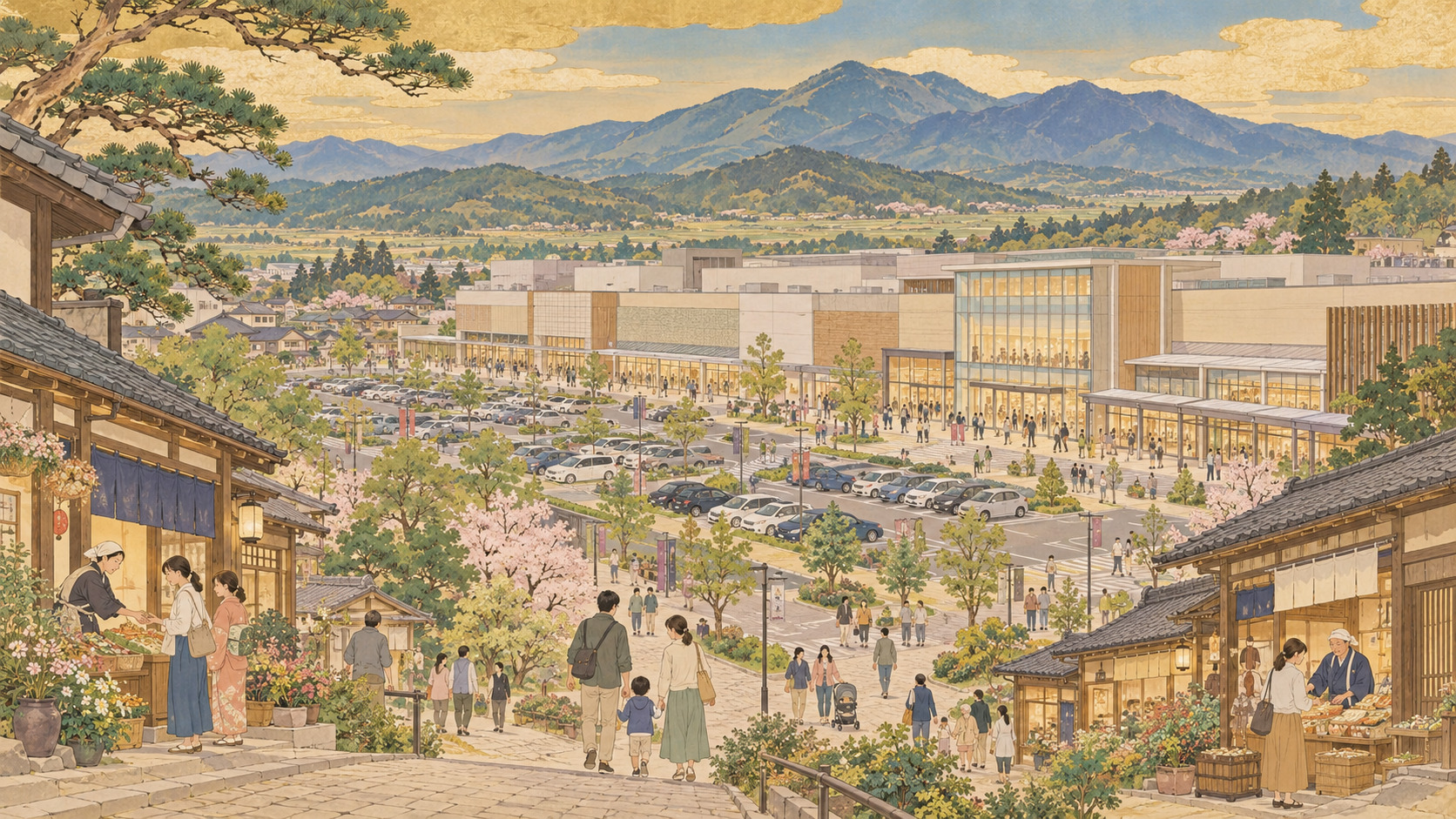
A new center of gravity in northern Fukushima
An enormous new shopping complex is taking shape beside National Route 4 in Date City, Fukushima Prefecture. Aeon Mall Date is scheduled to open at 9 a.m. on November 27, 2026, gathering fashion, food, books, electronics and entertainment in a three-story development. For residents accustomed to shopping across several towns, it could provide a powerful new destination.
But the real story is not the ribbon-cutting. It is how a regional retail economy adjusts when a corporation builds a major hub with the power to draw shoppers from a wide area. Will independent stores benefit from new visitors—or lose the regular customers who sustain them? Both outcomes are possible, and neither should be treated as established before opening.
A large project with precisely defined numbers
In their September 16 announcement, Aeon and its partners described a site of roughly 169,000 square meters, total floor area of 94,000 square meters and leasable space of 62,000 square meters. The development is three stories high with approximately 3,600 parking spaces. Aeon Style Date will anchor the mall; the announced configuration comprises 173 specialty tenants and three in separate external buildings. Some reports abbreviate that as 176 stores.
The operator forecasts roughly 3,000 people working across the complex, about 300 in Aeon Style itself. That is a prospective facility workforce, not proof of 3,000 net new jobs for the surrounding economy. Transfers from existing businesses, recruitment difficulties and part-time patterns could all affect the eventual result.
Why the road network matters
The choice of location is central to the economics. The mall adjoins National Route 4 and is near the Date-Koori interchange on the Tohoku-Chuo Expressway, placing the development within reach of communities beyond Date City. Aeon identifies a primary trading area of about 20 kilometers, 160,000 households and 360,000 residents. Those are company planning assumptions rather than recorded customers.
A highway-linked mall can consolidate journeys that previously required stops in several towns. It can also change traffic patterns for nearby residents and delivery vehicles. Parking capacity is not, by itself, a solution to congestion, pedestrian access or public transport. Those outcomes need to be documented once the mall operates.
A city built from five different towns
Modern Date City came into existence on January 1, 2006, when Date, Yanagawa, Hobara, Ryozen and Tsukidate merged. Their commercial streets and local identities did not disappear with the administrative boundary. Each community retains its own relationship to schools, small businesses, transport and agriculture. A mall positioned for the entire region will encounter this intricate pre-existing geography.
Its history extends much further back. Official city histories trace the medieval Date clan’s presence in the district, while shipping on the Abukuma River later supported commerce in rice, silkworm eggs, raw silk and woven goods. Retail and trade have long shifted with changes in transport. The new interchange-era marketplace is the latest chapter in that longer pattern.
The population paradox
An official regional revitalization plan documents Date City’s population falling from 68,406 in 2006 to 55,769 in 2023. It cites a projection of 41,665 by 2040. Projections are not certainties, but they explain why local leaders must pay close attention to jobs, services and the attractiveness of daily life.
Aeon’s 360,000-person trading area is much larger than Date City itself because it spans neighboring communities. Increased visits to a mall do not automatically mean that more families will settle locally. Retaining residents requires employment quality, healthcare, schools, housing and transport; retail is only one part of that calculation.
A chance for local confectioners
One of the most interesting possibilities lies in the proposed local-products outlet, Ai-na Date. Late-October reporting by Fukushima TV identified local sellers planning to supply the city’s antenna shop inside the new mall. Among them is Sudaya, a confectioner known for its Irikin Monaka, a sweet with a name that plays on the idea of money coming in. Its representative spoke of hoping that shoppers would also visit businesses elsewhere in Date.
The distinction matters. A product sold in a mall brings revenue to a producer; a mall shopper who later visits a traditional shopping street can generate business for a much wider neighborhood. This second effect will require deliberate connections through signposting, local events, tourism information and other ways of turning discovery into real trips.
National chains, local experiments
Aeon’s published tenant roster includes Uniqlo, GU, MUJI, Iwase Shoten, Kojima x Bic Camera and Super Sports Xebio. MUJI separately confirmed that the new store would be its first in Date City. Fukushima TV reported 26 brands entering the Tohoku market for the first time and 48 entering Fukushima Prefecture for the first time, based on the September lineup.
Attracting brands is a competitive advantage, but it is not identical to creating regional character. The more lasting measure may be whether agricultural producers, craftspeople, independent restaurant operators and cultural organizations can use the commercial center to gain customers beyond their established circles.
The mall as a public-looking place
Aeon executives have described a venue intended for dining, entertainment and community interaction as well as shopping. Local reporting describes planned lawns, a dog run and event spaces. Such amenities are part of an increasingly important retail strategy: giving visitors reasons to spend time at a destination, not simply purchase goods.
A privately managed gathering place, however, is not the same as a public square. Who can use it without buying anything? Is it reachable for people who cannot drive? Will neighborhood groups be able to organize activities there? These questions determine whether the social promises extend beyond the customer base.
Jobs created—and workers drawn away
A workforce plan on the scale of 3,000 jobs has obvious importance for northern Fukushima. Employment could span sales, food preparation, maintenance, cleaning, security, logistics and services. But small restaurants and independent retailers may also compete for the same limited labor supply. Hiring by the mall could partly redistribute employees rather than add to the overall workforce.
A meaningful evaluation should follow actual staffing, wages, hours, turnover and the share of employees living locally after six and twelve months. The company’s announced employment figure is a starting benchmark, not the final economic result.
The measures that will matter after opening
As of the November 1 edition, the complex remains unopened. Reports mentioning an expectation of approximately eight million annual visits describe a forecast, not observed foot traffic. Economic success should be assessed through multiple indicators: visitors to older commercial districts, sales by local suppliers, congestion, municipal receipts and the quality of employment.
Date’s history illustrates a region repeatedly transformed by movement along rivers, roads and trade routes. Aeon Mall Date may bring people and money into northern Fukushima from a broader catchment, but it could also concentrate spending away from older centers. The most important reporting will begin after November 27, when expectations can finally be compared with evidence.
Sources and reporting notes
Based on company disclosures, Date City records and local reporting. Japan.co.jp did not interview local merchants directly.