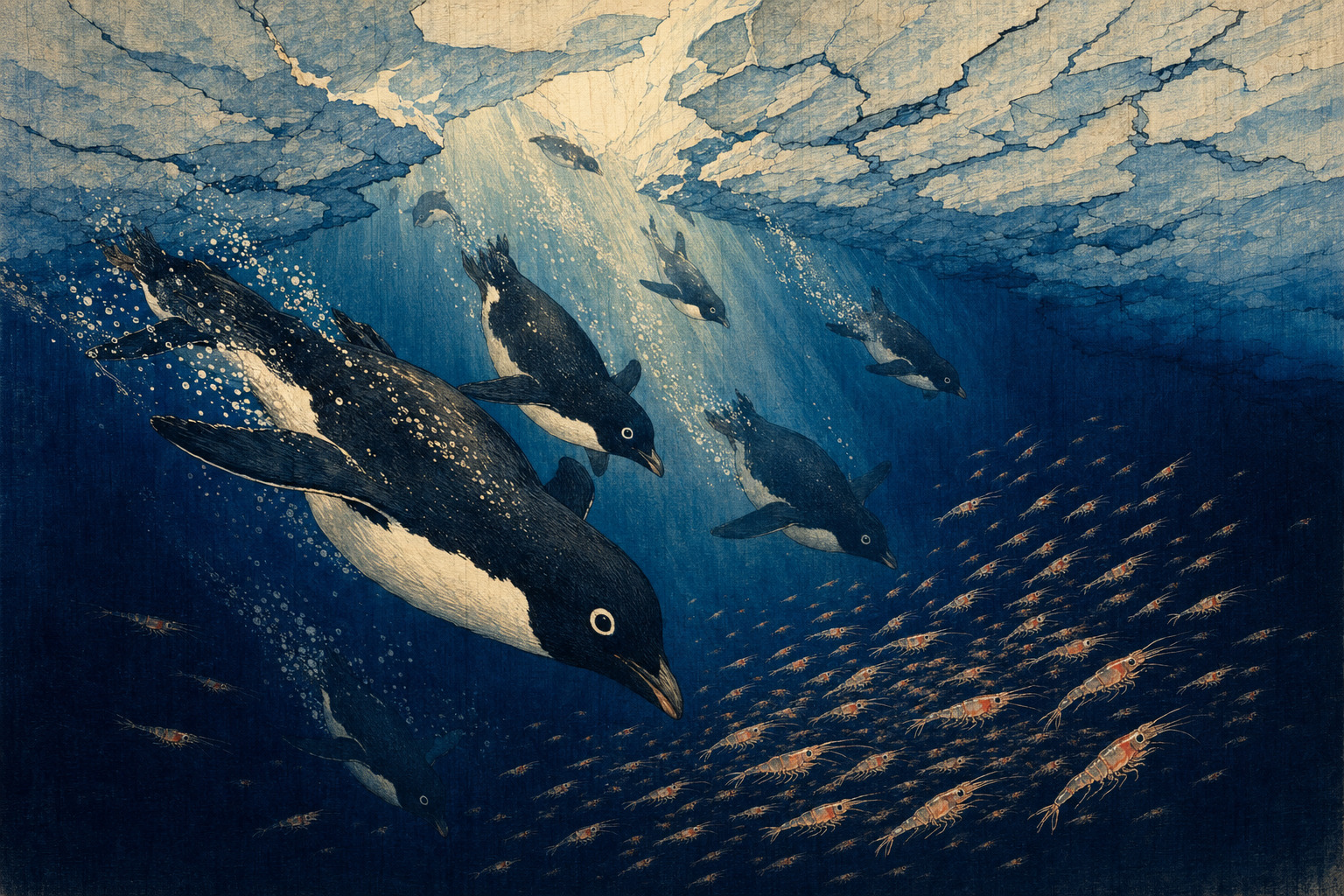
The food had not vanished. It had become harder to reach
A line of Adélie penguins entering the same crack in Antarctic sea ice appears to be returning to the same ocean. Underneath, every hunt may alter the next one. A krill swarm attacked in shallow water on the first dive can shift deeper or farther beneath the ice before the penguin returns.
Hina T. Watanabe and Akinori Takahashi of Japan’s National Institute of Polar Research, with Junichi Takagi of Kyoto University, examined this hidden contest near Syowa Station in East Antarctica. Their paper was published July 15, 2026 in Proceedings of the Royal Society B.
The result changes a familiar ecological explanation. Penguins did work harder as their dives continued, but their feeding rate within a swarm remained broadly stable. That combination fits prey redistribution better than simple local consumption alone. Krill may have stayed abundant in dense patches while moving to positions that cost the birds more time and oxygen to reach.
Landfast ice created a natural experiment
The bay around the colony was covered by thick landfast ice—sea ice attached to the coast. Penguins walked from their nests to a limited number of cracks or openings, dived beneath the ice, and returned through an opening after hunting. Reconstructed tracks often extended tens of meters under the ice before turning back to the same entrance.
That geometry concentrated activity. Many birds repeatedly entered a restricted under-ice area rather than dispersing from an open shoreline. Because the tracked birds were feeding chicks, they were also “central-place foragers”: every trip had to end back at the colony. They could not simply follow prey indefinitely.
Fieldwork was supported by the 60th Japanese Antarctic Research Expedition. Syowa Station, established in 1957, has sustained long-term observations of weather, geophysics, ice, oceans and biology. The dive study is a modern product of nearly seven decades of physical access, logistics and accumulated knowledge in East Antarctica.
GPS alone cannot follow a bird beneath ice
GPS can establish where a penguin crosses the surface, but satellite signals do not penetrate thick sea ice. The researchers combined GPS with depth, geomagnetic and acceleration sensors. Heading, movement and depth allowed them to reconstruct a three-dimensional underwater path that began and ended at an ice opening.
Acceleration signatures revealed rapid head and body movements associated with prey capture. Animal-borne video was used to validate that those signals corresponded to krill feeding. A “feeding event” in the analysis was therefore more than a speculative wiggle in a depth trace; the behavioral signature had been checked against what the camera saw.
| Record | What it revealed | What it could not do alone |
|---|---|---|
| GPS | Surface movement, colony travel and the location of sea-ice openings. | Receive a position beneath the ice. |
| Depth and magnetism | Dive depth, heading and a reconstructed three-dimensional path. | Provide a video-like absolute track without estimation error. |
| Acceleration | Fine body movements used to identify prey-capture events. | Prove ingestion unless the signal is independently validated. |
| Animal-borne video | Krill swarms, pursuit and feeding from the predator’s perspective. | Record every dive; battery and memory remain limited. |
Deeper and farther—but not into thinner swarms
The team focused on three variables. The first was the depth at which a bird captured krill. The second was the under-ice distance between the entry opening and the capture location. The third was the number of feeding events per unit time after the penguin reached a swarm, used as a proxy for patch density or quality.
Within a sequence of repeated dives from one opening, capture depth increased and feeding locations moved farther under the ice. Across the colony, birds using openings closer to the breeding site also had to dive deeper and travel farther. Yet feeding rates inside encountered patches showed little corresponding decline.
If penguins had merely eaten down nearby krill, remaining patches might be expected to become sparser and produce fewer captures per second. Instead, the birds still found productive swarms—but in increasingly inaccessible positions. Predator disturbance may have reorganized the prey field before consumption greatly reduced it.
Ashmole’s halo, redrawn as behavior
Breeding seabirds repeatedly commute from one colony. In 1963, ornithologist N. P. Ashmole proposed that intense feeding near large colonies could reduce local food and help regulate seabird populations. The zone of lower prey availability surrounding a colony became known as “Ashmole’s halo.”
The traditional picture is numerical depletion: birds consume fish or krill, leaving fewer individuals near the center. Evidence accumulated gradually. A 1987 study found lower fish density in bays used by breeding cormorants. In 2021, researchers demonstrated a prey-depletion footprint around the seabird colony on Ascension Island that first inspired the hypothesis.
The 2026 penguin study adds a second layer. Predators can reduce access without first removing most of the prey. Repeated pursuit can push a swarm deeper or laterally away from a shared entrance. Many brief interactions, each lasting minutes, can accumulate where thousands of colony members forage. A short-range escape response becomes a colony-scale gradient.
Krill are not passive particles
Antarctic krill, Euphausia superba, are small crustaceans that form enormous swarms. They connect phytoplankton and ice algae to penguins, whales, seals, fish and flying seabirds, while their feeding and sinking material help move carbon through the Southern Ocean.
Swarming offers safety in numbers, but it also creates a dense target. Krill can rapidly flex their tails, dart backward, turn and reorganize in response to light, water movement, vibration and chemical cues. A 2025 laboratory experiment found that water containing Adélie penguin guano made Antarctic krill swim faster and turn more sharply. That experiment does not prove the field mechanism in 2026, but it independently shows that krill can detect predator-associated cues and alter behavior.
Video released with the new paper also shows rapid changes in krill swimming near an attacking Adélie. The conceptual advance is to treat prey as decision-makers. A swarm is not a fixed patch waiting to be harvested. It senses danger, divides, contracts, moves and changes the map that a predator must search.
From an 1840 discovery to a three-dimensional dive path
Scientists on the French Antarctic expedition led by Jules Dumont d’Urville recorded Adélie penguins in 1840. D’Urville named Adélie Land for his wife, Adèle; expedition naturalists Jacques Hombron and Charles Jacquinot applied the name to the species, now Pygoscelis adeliae.
Adélies stand about 70 centimeters tall and weigh roughly three to six kilograms. Their white eye ring is distinctive. They breed around the Antarctic coast on exposed rock, building pebble nests. During chick rearing, parents commute across sea ice and through the water for krill and fish, then regurgitate food at the nest. Where pack ice remains unbroken, birds may walk more than 50 kilometers just to reach open water.
Nineteenth-century naturalists could watch the colony and inspect stomach contents. Twentieth-century time–depth recorders revealed how long and how deep penguins dived. Satellite and GPS tags mapped travel. Today’s multi-sensor packages recover heading, acceleration, depth, capture attempts and video. The animal has become both the object of study and an observing platform carrying instruments into water humans cannot easily enter.
Japan’s Antarctic record began in 1956
Japan committed to the International Geophysical Year and sent its first Japanese Antarctic Research Expedition south aboard Sōya in November 1956. Syowa Station opened on East Ongul Island on January 29, 1957. From four initial buildings, it grew into a permanent platform for long-term polar science.
The program’s better-known chapters include the survival of sled dogs Taro and Jiro, a round trip to the South Pole, the discovery of Antarctic meteorites, ozone-hole research and deep ice cores. Biological work also expanded: the 21st expedition began the first full-scale underwater biological survey in 1980, building experience in a sea hidden by ice.
The penguin work took place during the 60th expedition. Attaching loggers, waiting for a nesting bird to return, recovering the instruments and doing so safely on landfast ice requires far more than a miniature sensor. It requires ships, a station, trained field teams, animal ethics, ice knowledge and continuity. Six thousand dives are also a product of long-lived public research infrastructure.
From “limitless” krill to ecosystem management
Krill were once imagined as an almost inexhaustible resource. The commercial fishery began in 1961–62, when two Soviet research vessels reported 47 tonnes. By the early to mid-1970s, several nations were fishing. After the Southern Ocean had already suffered intense exploitation of seals, whales and finfish, concern grew that taking the food-web hub could slow recovery throughout the ecosystem.
The Convention on the Conservation of Antarctic Marine Living Resources was signed in 1980 and entered into force in 1982. CCAMLR’s mandate made the needs of dependent predators part of fisheries management. Its Ecosystem Monitoring Program, established in 1989, uses penguins and seals as indicators, following traits such as breeding success, body condition and foraging behavior.
The 2026 finding matters to that history. An acoustic survey may measure the same krill biomass in two places, while a chick-rearing penguin experiences radically different value if one swarm is shallow and near an opening and the other is deep beneath continuous ice. Ecosystem management must eventually ask not only how many tonnes exist, but which predators can reach them, when and at what cost.
Sea ice is obstacle, feeding ground and refuge
In this study, landfast ice restricted penguin access and focused repeated hunting around shared openings. Yet ice is not simply a barrier. Algae grow within and beneath it, feeding young krill. The textured underside provides feeding surfaces and shelter. When ice breaks, penguins gain entrances while krill lose or reorganize habitat. The same sheet can hinder the hunter and sustain the prey.
Antarctic sea ice has shown high year-to-year variability across the satellite record beginning in 1979. Even so, the 2022, 2023, 2024 and 2025 annual minimums were the four lowest in that record and all fell below two million square kilometers. The 2023 minimum remains the record low.
The new penguin paper is not a climate-attribution study. It examined predator–prey behavior at one East Antarctic colony under thick landfast ice. Less ice could create more access points, but it could also alter krill food, shelter, light and circulation. Whether changing ice strengthens or weakens this particular “deeper and farther” pattern requires comparisons across years, colonies and ice conditions.
What the evidence shows—and what it does not
| Supported by the study | Not directly established |
|---|---|
| Capture points became deeper and farther from the opening as dive bouts continued. | The path, speed and direction of individual krill movements. |
| Feeding rate within a found patch changed little. | Direct swarm density or total krill biomass; feeding rate is a proxy. |
| A similar accessibility gradient appeared near the breeding colony. | The size of the effect at other colonies, in other years or under different ice. |
| The pattern is consistent with functional prey depletion. | Added energy expenditure, chick growth or reproductive consequences. |
The authors emphasize the central limitation: krill movement was inferred from penguin behavior, not directly measured. A future test could combine animal-borne loggers with upward-looking acoustics, under-ice sonar, autonomous vehicles or other tools that map the swarm while the bird attacks.
Nor does “deeper” automatically mean starvation. Adélies are capable divers, and the tracked birds still fed successfully once they found a patch. The concern is cumulative cost. A few additional meters, repeated across thousands of dives and thousands of parents, may become ecologically important. This study identified the mechanism; it did not measure the final demographic bill.
Sixty-three years from food consumed to distance escaped
| Date | Milestone | Meaning for today |
|---|---|---|
| 1840 | Adélie penguins recorded by a French Antarctic expedition | Natural history began with the birds visible above the ice. |
| 1956–1957 | Japan’s first expedition departed and Syowa Station opened | A permanent base for East Antarctic observation. |
| 1961–1962 | Early commercial harvest of Antarctic krill | Humans began exploiting the food-web hub. |
| 1963 | Ashmole proposed colony-centered food limitation | The origin of the prey-depletion halo concept. |
| From 1964 | Animal-borne depth recording opened underwater behavior to study | Dives became data rather than guesswork. |
| 1980–1982 | CAMLR Convention signed and entered into force | Fisheries management expanded to dependent predators. |
| 1987–2021 | Numerical prey-depletion halos gained field evidence | Ashmole’s idea was tested around real colonies. |
| 2025 | Penguin-associated chemical cues triggered krill escape behavior | Evidence that prey detect and respond to predator risk. |
| 2026 | More than 6,000 3D dives revealed functional depletion | Individual chases were connected to a colony-scale resource landscape. |
Ocean abundance cannot be measured by quantity alone
An echosounder can show krill and encourage the conclusion that food is present. A breeding Adélie experiences another ocean. It has a limited breath, an entrance it must find again, a chick waiting at a fixed nest and a clock governing every commute. Biomass present is not biomass available.
The distinction reaches beyond Antarctica. Fish flee vessel noise. Zooplankton descend in response to light. Marine heat waves can shift prey to cooler depth. Ice, fishing, climate and predators change not only how much food exists, but when, where and for whom it can be captured.
The 6,000 dives did not map an empty ring around the colony. They mapped krill still present, but a little deeper and a little farther away. That small displacement becomes extra work for one parent and may accumulate into a functional halo around a breeding population. Predation reshapes the sea not only through the lives consumed, but through the distance the survivors escape.
Sources and further reading
- NIPR and Kyoto University: Japanese research announcement: 23 birds, 30 trips, more than 6,000 dives, the three response measures and study limitations.
- National Institute of Polar Research: “Prey accessibility—not abundance—may shape predator behavior”: English institutional account, 3D tracks, video validation and functional depletion.
- Watanabe, Takagi & Takahashi: “Emergence of functional prey depletion halo through penguin–krill behavioural dynamics” (Proceedings of the Royal Society B, 2026): peer-reviewed paper and DOI.
- Royal Society / Figshare: supplementary material: abstract, krill-escape video and associated materials.
- Dryad: study dataset: reusable behavioral data on predator–prey interactions and foraging.
- Australian Antarctic Program: Adélie penguin: the 1840 naming history, size, distribution, breeding and movement.
- Gaston, Ydenberg & Smith: “Ashmole’s halo and population regulation in seabirds”: history and evaluation of the 1963 hypothesis.
- Weber et al.: “Direct evidence of a prey depletion ‘halo’ surrounding a pelagic predator colony” (PNAS, 2021): direct field evidence for numerical depletion.
- Holton et al.: “Animal tag technology keeps coming of age” (Philosophical Transactions B, 2021): history from early depth recorders to modern multi-sensor biologgers.
- Frontiers: Antarctic krill response to penguin-associated chemical cues (2025): laboratory evidence of faster swimming and sharper turns.
- Australian Antarctic Program: Antarctic krill: life cycle, ice algae and Southern Ocean food-web role.
- CCAMLR: Fishery Report—Euphausia superba: commercial krill-fishery history beginning in 1961–62.
- CCAMLR: Ecosystem Monitoring Program: indicator species and monitoring of dependent predators.
- National Institute of Polar Research: About Japanese Antarctic Research: the 1956 departure, 1957 establishment of Syowa and long-term program history.
- National Snow and Ice Data Center: 2025 Antarctic sea-ice minimum: recent low-ice years and uncertainty around the long-term Antarctic trend.
Editor’s note: “The krill escape” is the research team’s interpretation of penguin dive paths and feeding-rate evidence. The krill themselves were not directly tracked, a limitation the authors explicitly identify. The study also did not test whether climate change or fishing caused the observed dive pattern. The hero artwork is an editorial illustration, not a field photograph.