- An Exhibition That Makes Color the Subject
- What a Grain of Pigment Can Change
- The Slow Chemistry of Nikawa
- Five Colors, Many Different Meanings
- Nihonga Was Itself a Modern Question
- A Businessman’s Collection and a Museum in Shimane
- A Garden Outside, Another Kind of Color Within
- How to Look Without an Art-History Degree
- A Practical Guide—and the Questions Still Open
An Exhibition That Makes Color the Subject
It is easy to enter a gallery looking for famous names and recognizable subjects. The Adachi Museum of Art in Yasugi, Shimane Prefecture, is proposing a different starting point: what if visitors looked first at color itself? Its annex exhibition, “Selection of Contemporary Japanese Paintings III: The Beauty of Colors,” opens November 18, 2026, and is scheduled to continue until March 9, 2027.
Works are organized by dominant colors—red, orange, yellow, green and blue—rather than simply by chronology or painter. The premise sounds straightforward, but it changes the questions a visitor asks. Why does one blue seem luminous and another opaque? Why can a red painting feel restrained while an ochre one feels urgent?
The museum is closing only its annex on November 16 and 17 for the changeover, while its main building and gardens remain accessible. Ahead of the opening, published museum materials establish the exhibition’s plan, not the experience of an independent visit to the installed galleries.
What a Grain of Pigment Can Change
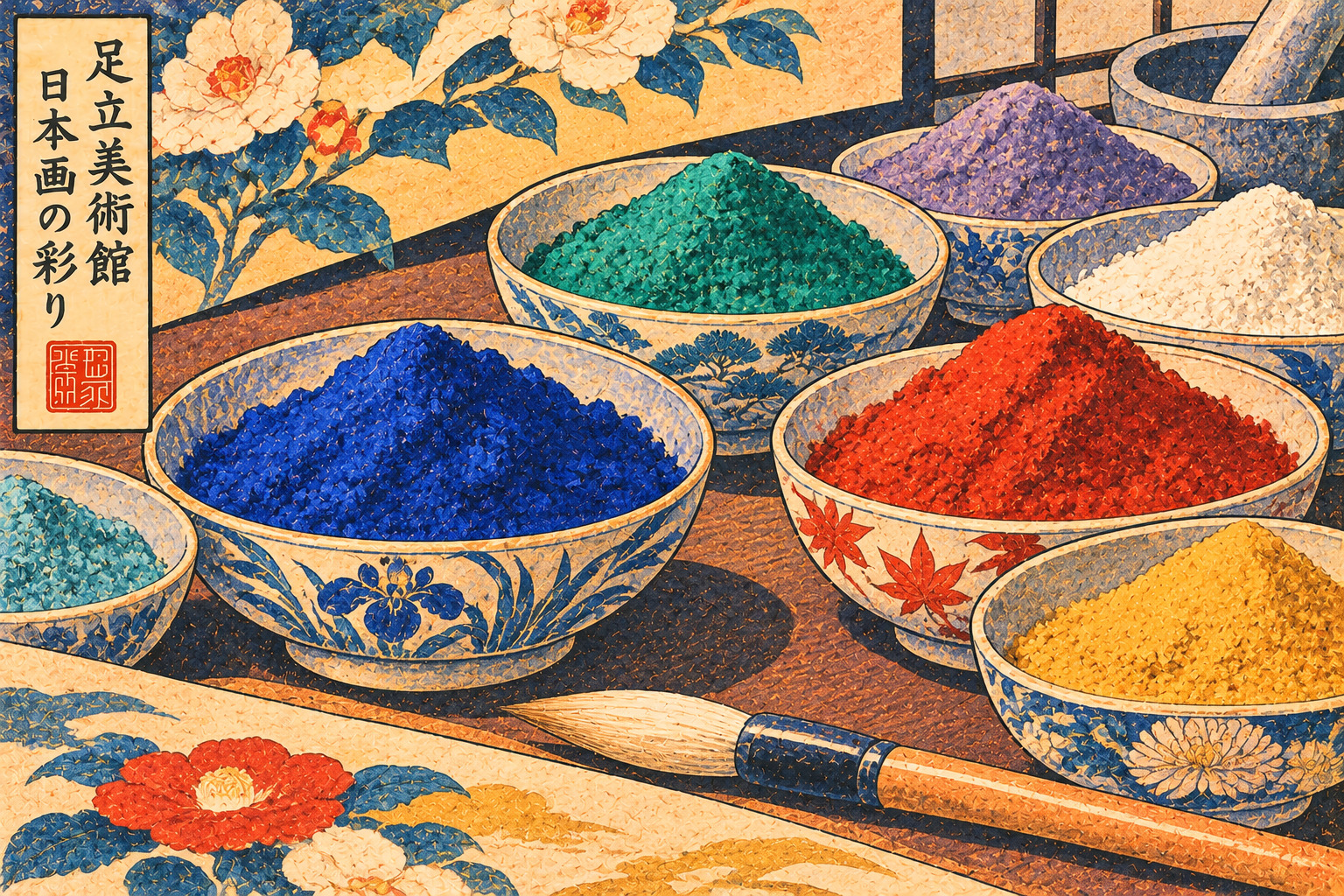
One clue lies in the material. Iwa-enogu, the mineral pigments closely associated with Japanese painting, are made from crushed minerals. Their particles do not behave like perfectly uniform digital color. Grain size and how the grains catch and scatter light help determine the surface’s appearance. The museum describes a granular texture and subtle tonal variation as major attractions of the medium.
Paintings are not simply powdered stone on paper. Pigment typically needs a binder, and artists must consider the surface beneath it, the amount applied and the sequence of layers. Mineral pigments are central to the exhibition’s explanation, but contemporary nihonga also employs other kinds of pigments and materials. It would be inaccurate to imply that every modern Japanese painting contains only natural minerals.
Nor can a visitor determine the exact mineral composition of a particular artwork solely from its color in a reproduction. That takes technical documentation or materials analysis. Such restraint matters when writing about an exhibition whose very subject is the difference between appearances and materials.
The Slow Chemistry of Nikawa
The museum specifically describes the use of nikawa, an animal-derived glue binder, to hold mineral pigments in place. A painter mixes the grains with the binder and applies colors progressively. This is work that demands preparation, patience and attention to how each layer sits upon the one below.
That gradual process can give a painting a density that a backlit phone display is poorly equipped to communicate. Reflective particles and subtle relief respond to the room’s illumination and the visitor’s position. The appeal of seeing nihonga in person is therefore not confined to subject matter: a reproduction may preserve composition while missing the physical character of the surface.
These principles also invite a modern question. As digital images increasingly mediate our encounters with art, what is lost when the object is flattened into pixels? The exhibition creates an unusually accessible occasion to ask it.
Five Colors, Many Different Meanings
Red, orange, yellow, green and blue form a recognizable sequence, but the exhibition does not announce a rigid emotional code for those colors. An arresting crimson may have a quiet role; a pale blue may heighten tension rather than soothe. Scale, adjacency, opacity and the subject all shape the result.
The museum’s promotional page identifies images of Kaori Someya’s “Uncertainty of a Leaf” (一葉の躊躇い) and Chiori Miyakita’s “Evening of Dolls” (雛の宵). Their inclusion in museum publicity provides a starting point for readers, but not a verified catalogue of the entire exhibition. Dates, complete materials and individual positions within the installation should not be inferred from the promotional images.
Looking across works united by a color can draw attention to decisions usually hidden behind biographies or art-historical labels. It makes comparison a tool of discovery.
Nihonga Was Itself a Modern Question
“Japanese painting,” or nihonga, can sound like an unchanging category reaching intact into the distant past. It is not. The modern distinction between Japanese and Western painting took shape amid profound institutional and aesthetic change in the Meiji era. Artists confronted how to preserve inherited techniques while developing images appropriate to a transformed society.
The Japan Art Institute, founded in 1898 under the guiding ideas of Okakura Tenshin and associated with artists such as Yokoyama Taikan and Hishida Shunso, helped make that debate concrete. After Okakura’s death, Taikan and colleagues revived the institution in 1914. The annual Inten exhibitions became a significant arena for experimentation and recognition.
The history is not a simple contest between an “authentic” mineral-pigment tradition and foreign influence. Modern painters repeatedly reconsidered line, space, color and subject matter. The persistence of nihonga reflects active reinvention as well as continuity.
A Businessman’s Collection and a Museum in Shimane
The Adachi Museum opened in November 1970, founded by businessman Zenko Adachi (1899–1990), a native of the Yasugi area. The museum’s account of his life traces a route from early commercial work through art collecting and garden-making. His institution was conceived as a contribution to his home region’s cultural life.
The museum is especially known for its extensive holdings of Yokoyama Taikan, but the breadth of its collections is important to the present story. In 2010 it opened a new annex dedicated to contemporary Japanese painting. According to its current account, the annex holds roughly 350 contemporary works, including winners of the Adachi Museum of Art Award.
A visitor can therefore encounter modern masters in the main building and more recent experiments in the annex. The new color-based exhibition puts an interpretive lens over a collection built across decades—one that insists contemporary painting belongs in the same broad conversation as Japan’s celebrated modern artists.
A Garden Outside, Another Kind of Color Within
Adachi is also famous for its Japanese gardens. They form an instructive counterpoint to the exhibition: a garden’s greens and reds are never fixed. Sunlight, weather, season and vantage point change them continuously. The pigments in a painting, by contrast, are deliberately composed and bound to a surface.
On November 16 the museum reported that autumn coloring across the garden had reached roughly 60 percent and forecast a late-November peak. That is a dated observation, not a promise of conditions on opening day.
Putting the two experiences beside each other invites a useful distinction. Painters do not merely record the colors of a landscape; they select, rearrange and intensify them. A garden designer, too, directs attention through framing and omission. The museum makes that comparison unusually tangible, though no single interpretation is obligatory.
How to Look Without an Art-History Degree
One approach is to stand back from a painting and name the color that first catches the eye. Then move only as close as the gallery rules permit and examine the transitions between colors. Does the surface seem flat or granular? Where do layers appear to overlap? What happens at the boundary between two hues?
Next, compare works that share the same dominant color. Their differences may be more revealing than their similarities. Visitors do not need to know every painter’s biography to discover that color is being used as structure, rhythm or atmosphere rather than decoration.
None of this requires assuming that the artworks use identical pigments or techniques. The point is to look carefully before reaching for an explanation.
A Practical Guide—and the Questions Still Open
The museum lists November 18, 2026, through March 9, 2027, for the first-floor annex exhibition. Its address is 320 Furukawa-cho, Yasugi, Shimane Prefecture. Winter hours are 9 a.m. to 5 p.m., and posted standard adult admission is ¥2,500, with separate student categories. The museum advises checking current visitor information before traveling.
The publicly accessible exhibition announcement does not establish a complete list of exhibited works, the precise pigment makeup of individual paintings or the final installation sequence. Those details should not be fabricated. The museum’s broader English annex overview also contains an inconsistent end date; this report follows the dedicated Japanese exhibition listing.
The exhibition’s invitation is modest and consequential: look at something everybody knows—color—and discover how much knowledge, material and choice is concealed within it. A painting can be familiar in a photograph and startlingly different as an object. That difference is the story here.
Primary sources and reference materials
We did not inspect the complete installed exhibition, obtain the full checklist, or conduct interviews.
- Adachi Museum of Art: The Beauty of Colors
- Adachi Museum: Annex Galleries
- Adachi Museum: Nov. 16–17 Annex Closure
- Adachi Museum: History and Founder
- Adachi Museum: Institutional History
- Japan Art Institute: History
- Japan Art Institute: Founding and Revival
- Adachi Museum: Hours and Admission
- Adachi Museum: Official English Exhibition Page
- Adachi Museum: Contemporary Collection