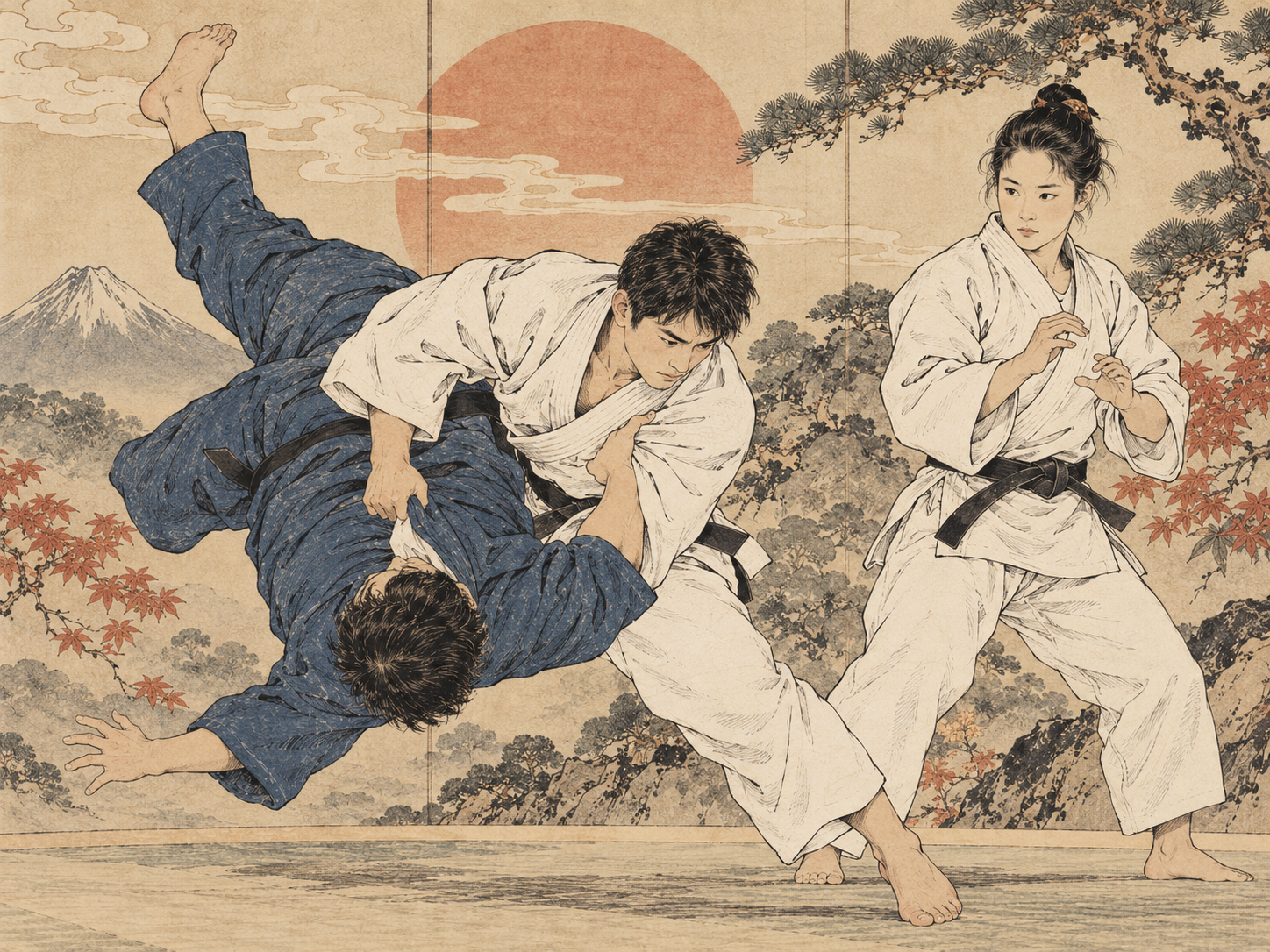
A brother and sister winning world judo titles on the same day would be extraordinary once. For Hifumi and Uta Abe, it has become an achievement they have somehow managed to repeat.
On Oct. 5 at the 2026 World Judo Championships in Baku, Uta Abe won the women’s 52 kg title and her brother Hifumi Abe captured the men’s 66 kg crown. The International Judo Federation called it a “remarkable double.” Uta now has six senior world titles; Hifumi has five. They returned to the top even after years in which every elite opponent has had film, data and time to prepare specifically for them.
Uta’s sixth world title carries the weight of Paris
For Uta Abe, Baku is not simply another addition to a medal collection. She arrived at the Paris 2024 Olympics as the defending Tokyo champion and overwhelming favorite, then lost by ippon in the second round to Diyora Keldiyorova, who went on to become Uzbekistan’s first female Olympic judo champion. Abe’s grief after leaving the tatami became one of the defining images of the judo tournament.
She rebuilt from there. Abe returned to international competition, won the 2025 world title and continued winning in 2026, including the Ulaanbaatar Grand Slam in June. The IJF says that victory was her 12th Grand Slam gold, a women’s record.
Baku still made her work. In the quarterfinal, Germany’s Mascha Ballhaus scored waza-ari and carried the lead deep into the contest. With only seconds remaining, pressure from Abe contributed to Ballhaus receiving a third shido. Abe then beat Spain’s Ayumi Leiva Sanchez to reach the final, where she faced Ariane Toro Soler. The final became a prolonged battle for sleeve control and tactical initiative before Abe emerged with her sixth world championship.
Hifumi won on a day when his usual judo was difficult
Hifumi Abe’s route to gold was striking for the opposite reason. The IJF described a difficult day in which opponents repeatedly prevented him from finding his familiar rhythm. France’s Kelvin Ray, Serbia’s Marko Jorgic and Italy’s Valerio Accogli forced long, tactical contests, with Abe advancing through penalties or narrow scores rather than a stream of decisive ippons.
He still found a way. In the semifinal he faced fellow Japanese 66 kg representative Takeshi Takeoka—the reigning 2025 world champion. The domestic depth of Japanese men’s judo had effectively placed two world champions into the same world-championship bracket. Takeoka ultimately took bronze.
In the final, Abe faced Spain’s David Garcia Torne, appearing in his first world championship final. The IJF wrote that Abe had been made to struggle throughout the day, but in the decisive match he erased the doubts and secured world title number five.
Baku is where the sibling story first became global
The symmetry runs deeper because the 2018 World Championships were also held in Baku. Uta, then 18, won the senior world title on her first attempt. Minutes later Hifumi retained the men’s 66 kg crown. It was the first time their shared success became a global judo story.
Three years later, at the delayed Tokyo 2020 Olympics, the siblings won Olympic gold on the same day—July 25, 2021—inside the Nippon Budokan. Uta won at 52 kg and Hifumi at 66 kg. The IJF called the day historic.
In 2026 they returned to the city where the world-championship double began and did it again: the older brother approaching 30, the younger sister now 26, both carrying histories much more complicated than the teenage prodigies of 2018.
Paris split their paths
Tokyo gave the siblings perfect symmetry. Paris broke it. Uta lost in the second round in 2024; Hifumi defended his 66 kg Olympic title and became a two-time individual Olympic champion.
That difference made Uta’s return important beyond the family story. She had to rebuild an elite career that could no longer be defined only by Tokyo’s triumph or Paris’s collapse. Her 2025 world title started that process. Baku 2026 extended it.
Their careers have not moved in parallel every season. Hifumi took bronze at the 2025 world championships while Uta won gold. In 2026 they converged again at the top. The rarity of that synchronization is precisely why each shared title still matters.
Japan’s opening surge was bigger than the Abe family
Japan’s strong start began before the siblings fought. Wakana Koga won women’s 48 kg gold on the opening day and Ryuju Nagayama took men’s 60 kg bronze. On Day 2, Takeoka joined the Abe siblings on the medal list with a 66 kg bronze.
Having both Hifumi Abe and the reigning world champion Takeoka in one weight class illustrates the internal pressure of Japanese selection. A judoka can be one of the best in the world and still face a compatriot of equal pedigree before reaching an international final.
| Athlete | Category | Status after Oct. 5 |
|---|---|---|
| Wakana Koga | Women -48 kg | Gold |
| Ryuju Nagayama | Men -60 kg | Bronze |
| Uta Abe | Women -52 kg | Gold |
| Hifumi Abe | Men -66 kg | Gold |
| Takeshi Takeoka | Men -66 kg | Bronze |
The longer you dominate, the more everyone studies you
Hifumi’s senior world titles have come in 2017, 2018, 2022, 2023 and 2026. Uta’s have come in 2018, 2019, 2022, 2023, 2025 and 2026. Repeated appearances at the top create an unusual competitive problem: your gripping patterns, entries, preferred throws, transitions and reactions become common knowledge across the international field.
The challenge for a champion is therefore not merely becoming better. It is continuing to win after the world has spent years designing plans specifically to stop you. That is why the IJF cautioned against treating another Abe double as routine.
Judo began in Japan, but Japan does not own the podium
Jigoro Kano founded the Kodokan in Tokyo in 1882, and judo remains one of Japan’s defining sports. Modern world judo, however, is deeply international. European, Central Asian, Caucasus and Latin American programs routinely produce world and Olympic champions.
Both finals on Oct. 5 were Japan against Spain: Toro Soler challenged Uta and Garcia Torne challenged Hifumi. The fact that Japan created the sport gives its athletes history and infrastructure, not entitlement to medals.
That global competition is what gives the Abe records their weight. They are not winning because the rest of the world has failed to learn Japanese judo. They are winning while the rest of the world studies them intensely.
The championships are still unfolding
The individual tournament continues through Oct. 10, with the mixed-team event on Oct. 11. Japan still has Ryuga Tanaka at 73 kg, Akari Omori and Momo Tamaoki at 57 kg and major contenders throughout the heavier divisions.
Japan’s three golds and two bronzes after two days are therefore a starting point, not a final medal table. This report captures the opening surge—and the sibling double at its center.
- Japan’s final individual medal count and position in the medal table
- The Oct. 11 mixed-team result
- How Hifumi and Uta Abe structure the road toward Los Angeles 2028
- Japan’s selection battle at 66 kg with multiple world champions
- Which younger Japanese athletes begin to challenge Uta at 52 kg
The achievement is not the symmetry. It is the return.
The Abe story almost looks too neat: a world-championship double in Baku in 2018, an Olympic double in Tokyo in 2021, another world-championship double in Baku in 2026.
But the more important story is not symmetry. Hifumi won on a day when opponents repeatedly disrupted the kind of judo that made him famous. Uta rebuilt after one of the most painful defeats of the Paris Olympics and has now stacked world titles in consecutive years.
Judo celebrates the clean ippon, the perfect throw that ends a contest at once. Staying champion requires something less photogenic: adaptation. When the favorite technique is blocked, when a lead disappears, when a career suffers a public defeat, the champion has to produce a different answer. In Baku, Hifumi and Uta Abe did exactly that.
Sources & Reference Material
- All Japan Judo Federation, Baku 2026 World Championships schedule and Japanese team.
- All Japan Judo Federation, Japanese team selection for Baku 2026, March 11, 2026.
- International Judo Federation, official Baku 2026 individual results.
- IJF, “A Day of Celebration and a Remarkable Double,” Oct. 5, 2026.
- IJF, women’s -52 kg final report, Oct. 5, 2026.
- IJF, men’s -66 kg final report, Oct. 5, 2026.
- IJF, men’s Day 2 preliminary highlights, Oct. 5, 2026.
- IJF, women’s Day 2 preliminary highlights, Oct. 5, 2026.
- IJF, Abe siblings’ same-day Tokyo Olympic golds, July 25, 2021.
- IJF, 2018 Baku World Championships retrospective.
- IJF, Uta Abe’s post-Paris return, June 20, 2026.
- IJF, Uta Abe World Championship results.
- IJF, Hifumi Abe World Championship results.
Reporting cutoff: Oct. 6, 2026, 1:21 PM JST. The World Championships continue through Oct. 11; Japan’s final medal total, final national ranking and mixed-team result are not yet known. This report also does not treat either Abe sibling’s Los Angeles 2028 participation as settled.