Toyama / Kurobe Gorge

Kurobe Gorge: The Railway, the River, the Dam, and the Long Human Argument With the Mountains

Kurobe Gorge is not only one of Japan’s great scenic rail journeys. It is a mountain corridor where beauty, labor, hydropower, tourism, hot-spring culture, and national memory still overlap. To visit it properly is to read not just a landscape, but a whole chapter of modern Japan.

The Kurobe Gorge Railway officially runs along the Kurobe River from Unazuki into the gorge, and the line’s public identity rests on extraordinary scenery, but its historical identity rests on power development. The route was first laid for the movement of workers and materials into a severe mountain corridor that became central to hydropower construction. That double identity — scenic and industrial, lyrical and hard-won — is what makes Kurobe Gorge so compelling. Unazuki Onsen, the threshold town at the edge of the valley, gives the whole region a human scale and makes it possible to stay not just near the gorge, but inside its atmosphere.

Defining Experience

The Kurobe Gorge Railway from Unazuki into the valley.

Underlying Story

Hydropower, tunnels, transport, and endurance in severe terrain.

Best Base

Unazuki Onsen, where inns, baths, footbaths, and the railway meet.

Best Rule

Do not treat Kurobe as only a train ride. It is a whole landscape of work, weather, and memory.

A Feature Essay

More Than Scenic Japan

Some mountain destinations ask only to be admired. Kurobe Gorge asks to be understood. The first impression is spectacular enough: a turquoise river folding through a V-shaped valley, red bridges suspended over depth, a small orange train gliding out of tunnels and around bends, mountain air, cloud drift, and the kind of vertical scale that instantly corrects city habits of seeing. But Kurobe does not stop at beauty. It keeps insisting on a second reading. Why is the railway here at all? Why do the bridges feel slightly harder, more necessary, less decorative than in other tourist valleys? Why does the place seem haunted by effort?

The answer is that Kurobe Gorge was never merely scenic territory. It became one of the great stages on which modern Japan tested its will against the mountains. Power development on the Kurobe River transformed the valley into a zone of surveys, rail works, tunnels, transport, labor camps, dams, underground plants, and extreme logistics. The gorge railway itself began as an industrial line for materials and workers, not as a picturesque excursion. Later it became both: still tied to the river’s power story, yet also opened to visitors who came to see what could only be reached through this narrow corridor.

That is why Kurobe feels deeper than a standard “beautiful train ride.” Tourism did not invent the place. It inherited it.

Kurobe Gorge is one of the rare Japanese landscapes where tourism never erased the feeling that something serious had to be done here first.

Japan.co.jp — Kurobe Gorge

Photo Essay

Twelve Images That Explain the Gorge

The best way to deepen this page is to let the images do more than decorate it. Each photograph below reveals one layer of Kurobe: movement, threshold, weather, engineering, power, romance, and the slow luxury of staying long enough to read all of them together.

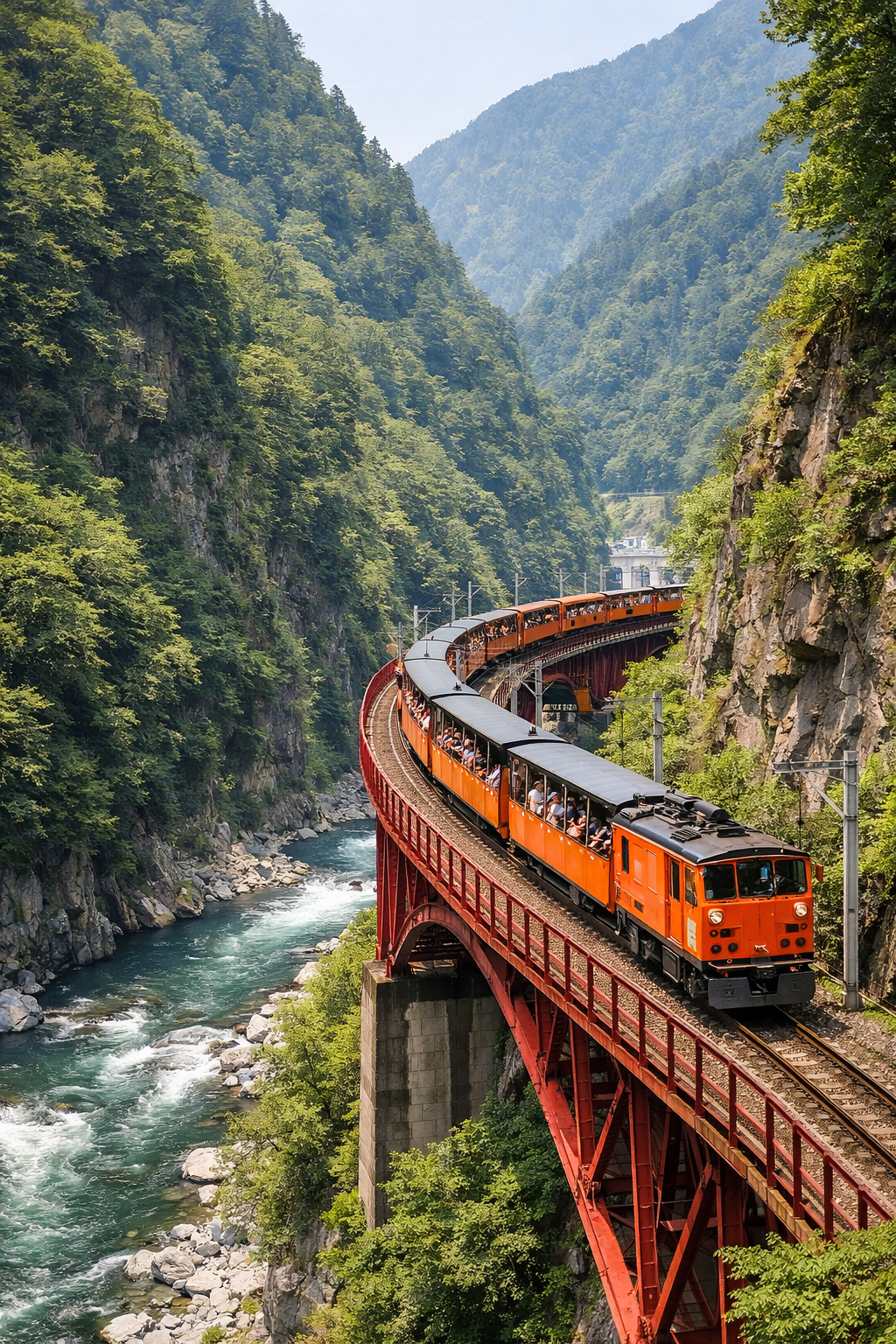
Kurobe Gorge train curving through valley

The Defining Curve

This is the signature Kurobe image because it captures the gorge in one sentence: rail, bridge, river, cliff, and motion. The line does not flatten the valley. It yields to it, bending around the rock and staying narrow where the land allows it. Officially, the route extends 20.1 km from Unazuki to Keyakidaira and takes about 1 hour and 20 minutes one way when fully open; even in reduced-service years, the basic truth of the line remains visible here — it is a railway shaped by terrain rather than imposed over it.

What this photograph says editorially is that Kurobe’s beauty comes from accommodation, not conquest. The train looks brave, but not arrogant.

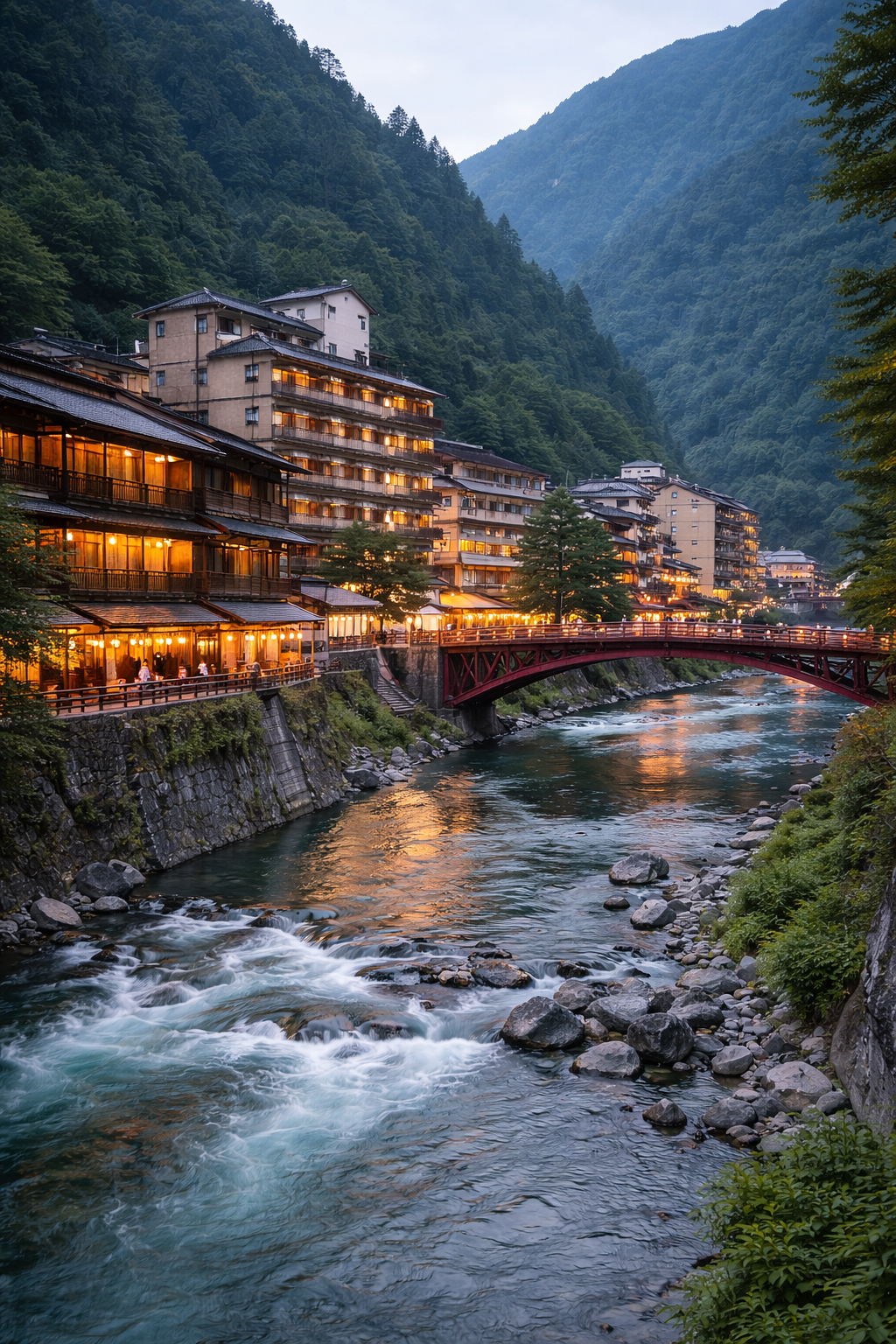
Unazuki Onsen river town evening

Unazuki, the Human Threshold

This image matters because the gorge without Unazuki would risk becoming all scale and no hospitality. Official Toyama tourism materials describe Unazuki as one of the major hot-spring resorts of Toyama and the wider Hokuriku region, compact and easy to walk, with inns along the river, free footbaths, and mountain views that soften the industrial severity of the valley.

The photograph should be read as a threshold image. It says: here the mountain story becomes inhabitable.

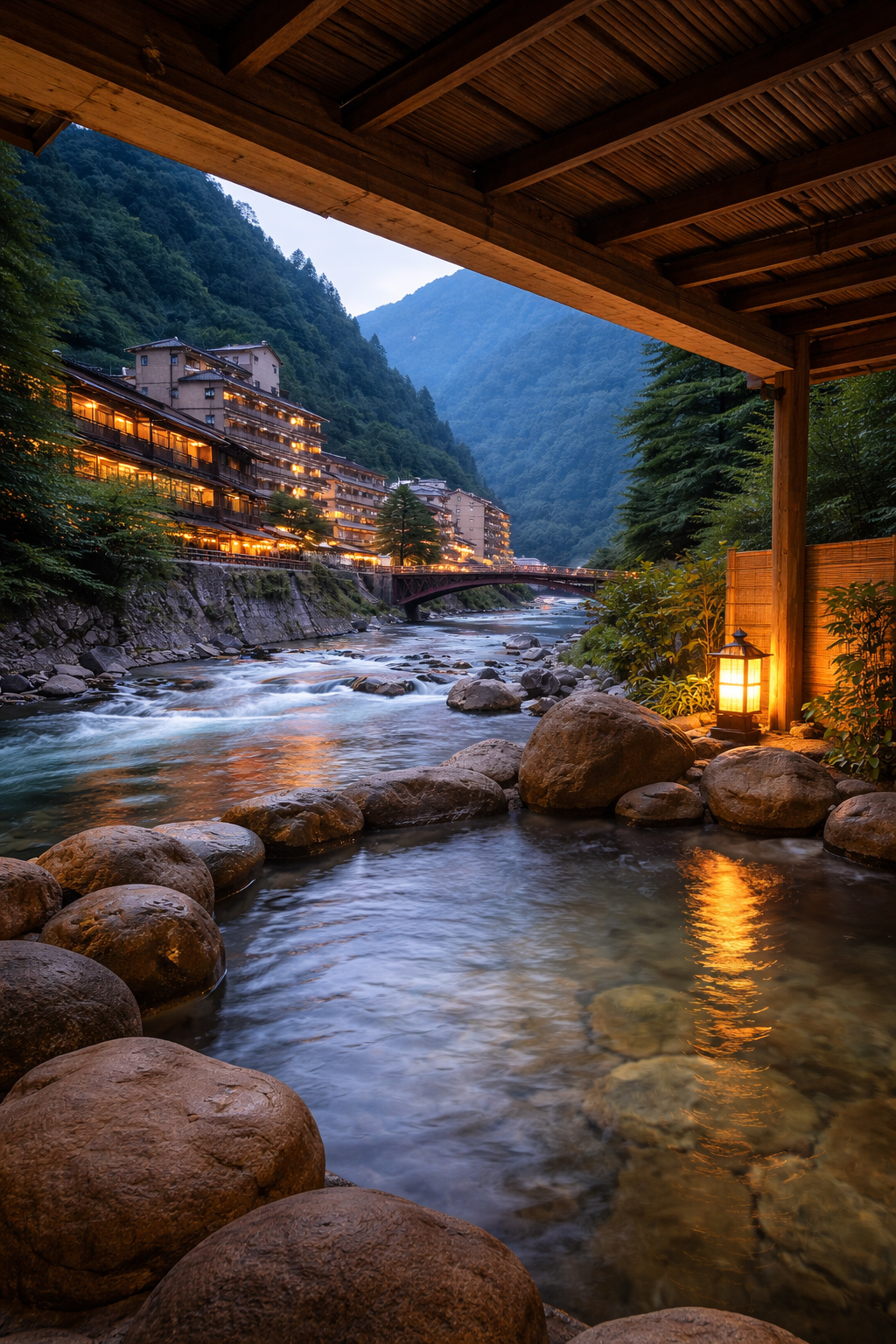
Unazuki onsen open-air bath river view

Why the Night Matters

Kurobe is better as an overnight region than as a single outing. This open-air-bath image explains why. The river remains present, the bridge remains present, the town remains lit across the water, and the traveler finally moves from transit into repose. Unazuki’s whole purpose in the larger Kurobe story is visible here: not to compete with the gorge, but to answer it.

The onsen town is not an accessory. It is the emotional completion of the railway.

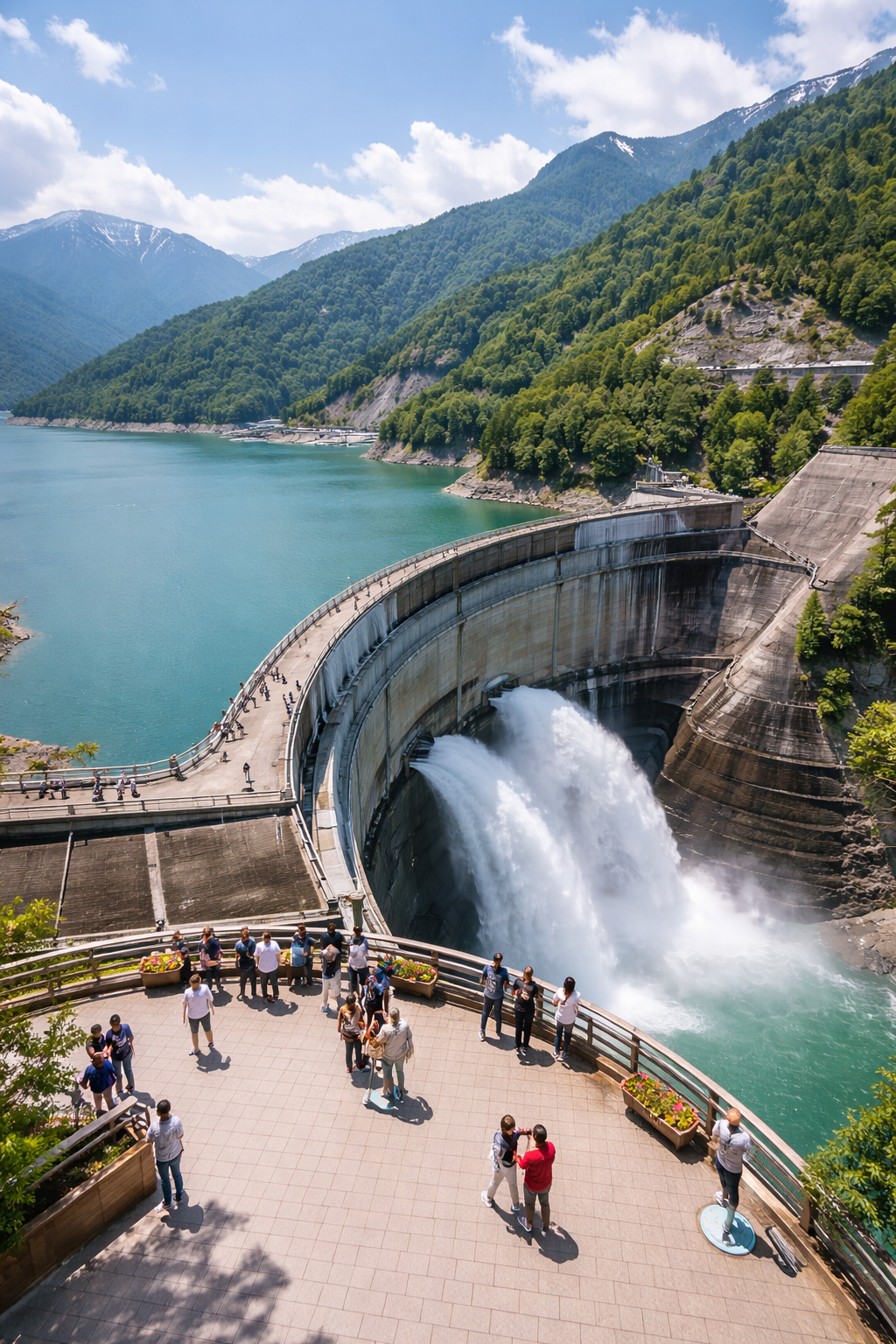
Kurobe Dam observation view

The Public Face of Power

Kurobe Dam is one of the most famous structures in modern Japan, completed in 1963 after seven years of construction. KEPCO’s official history and Japan National Tourism Organization materials both frame it as part of the Kurobe River No. 4 power development, built to help solve postwar electricity shortages. It rises 186 meters and remains the highest dam in Japan.

In the photograph, tourists occupy the foreground, but the true subject is scale. The observation deck turns engineering into public theater without making it trivial.

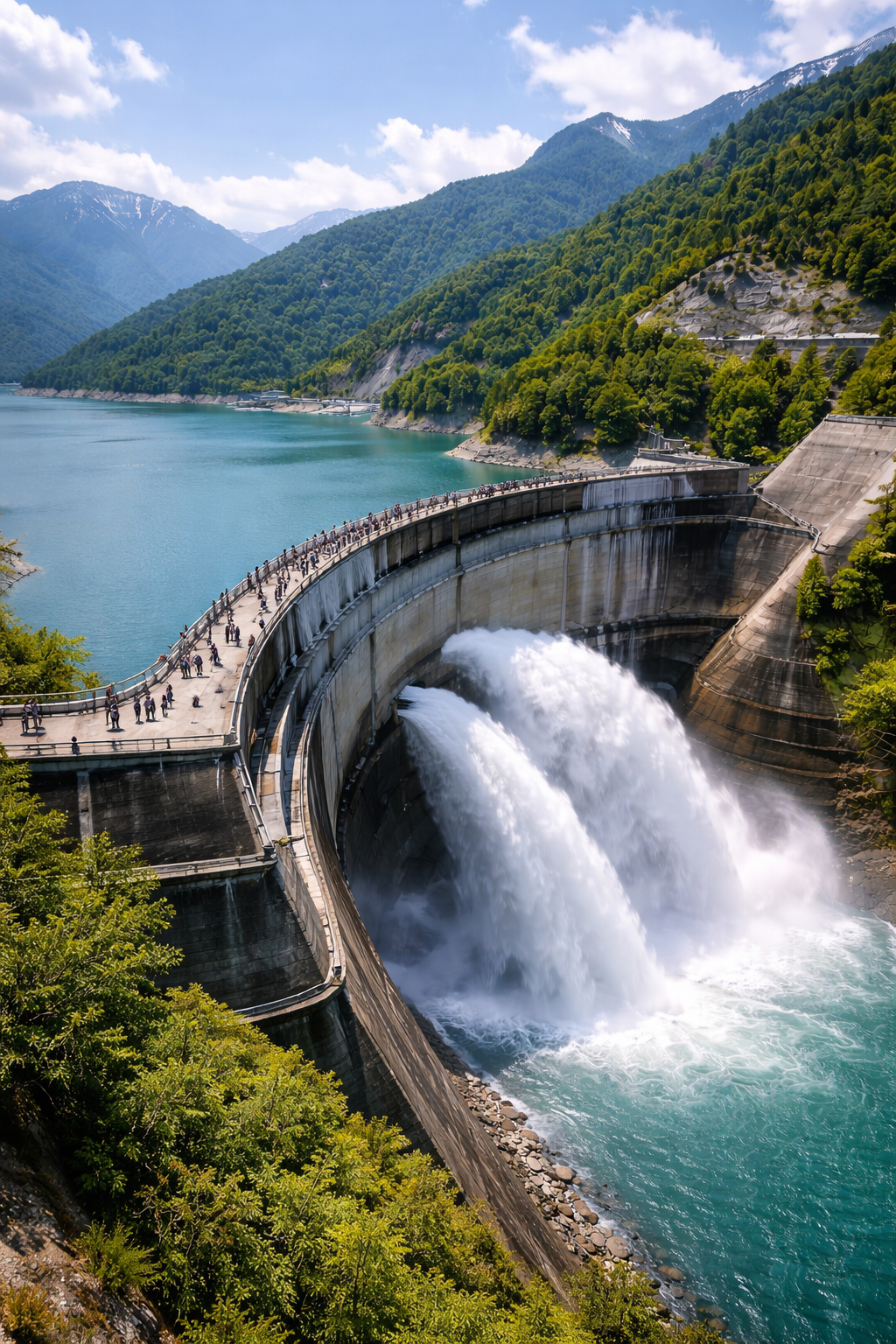
Kurobe Dam water release spectacle

The Dam in Motion

This is the opposite of the still observation view: not structure, but force. Tateyama Kurobe’s official site notes that the sightseeing discharge exceeds 10 tons per second, and Visit Toyama emphasizes the clouds of spray and the continuing spectacle of the release.

Editorially, the image shows why Kurobe entered Japanese popular memory. It was not only because of technical accomplishment. It was because the place looks like human ambition made visible against nature at full volume.

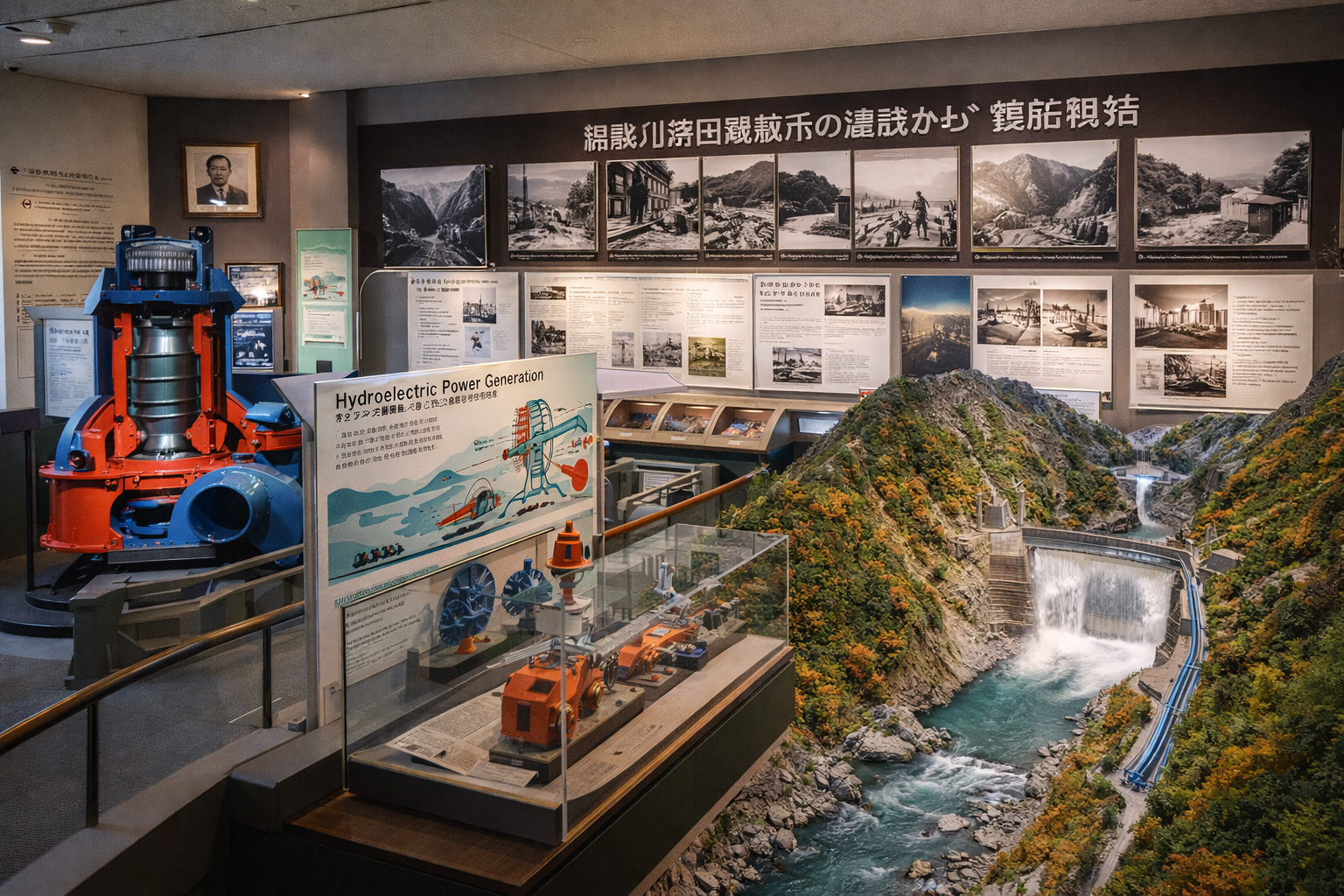
Kurobe Hydropower Museum exhibit

The River Becomes Legible

The Kurobe Hydropower Museum exists so that visitors do not leave the gorge with scenery only. KEPCO’s official English museum page gives its address at Kurobe Kyokoku-guchi and explains that the museum is dedicated to the history of power development on the river. Visit Toyama’s listing for the Kurobe River Electricity Memorial likewise emphasizes models, video, and the severe-and-beautiful challenge of developing electricity in the valley.

This image explains something essential: Kurobe is not only a place to gaze at. It is a place to study.

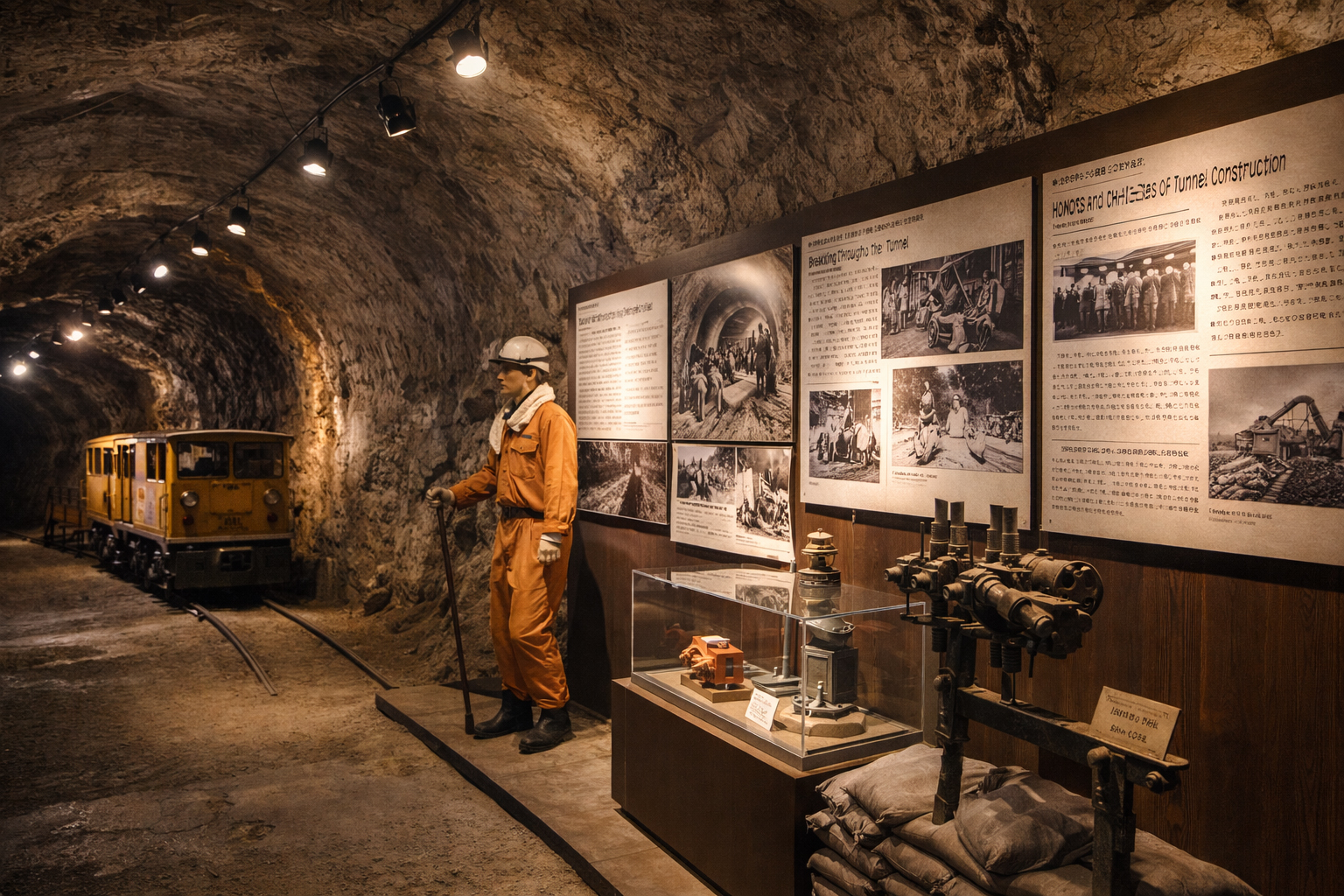
Kurobe engineering tunnel history display

The Tunnel and the Cost of Access

One of the great stories of Kurobe is that the valley could not simply be entered. It had to be reached through enormous transport effort. KEPCO’s official history highlights the Kanden Tunnel and the major fracture zone encountered during tunnel construction in 1957, which became one of the project’s defining hardships.

This image should therefore be read as a correction to purely scenic sentiment. Behind the beautiful train route was excavation, danger, machinery, and the long violence of making access where none naturally existed.

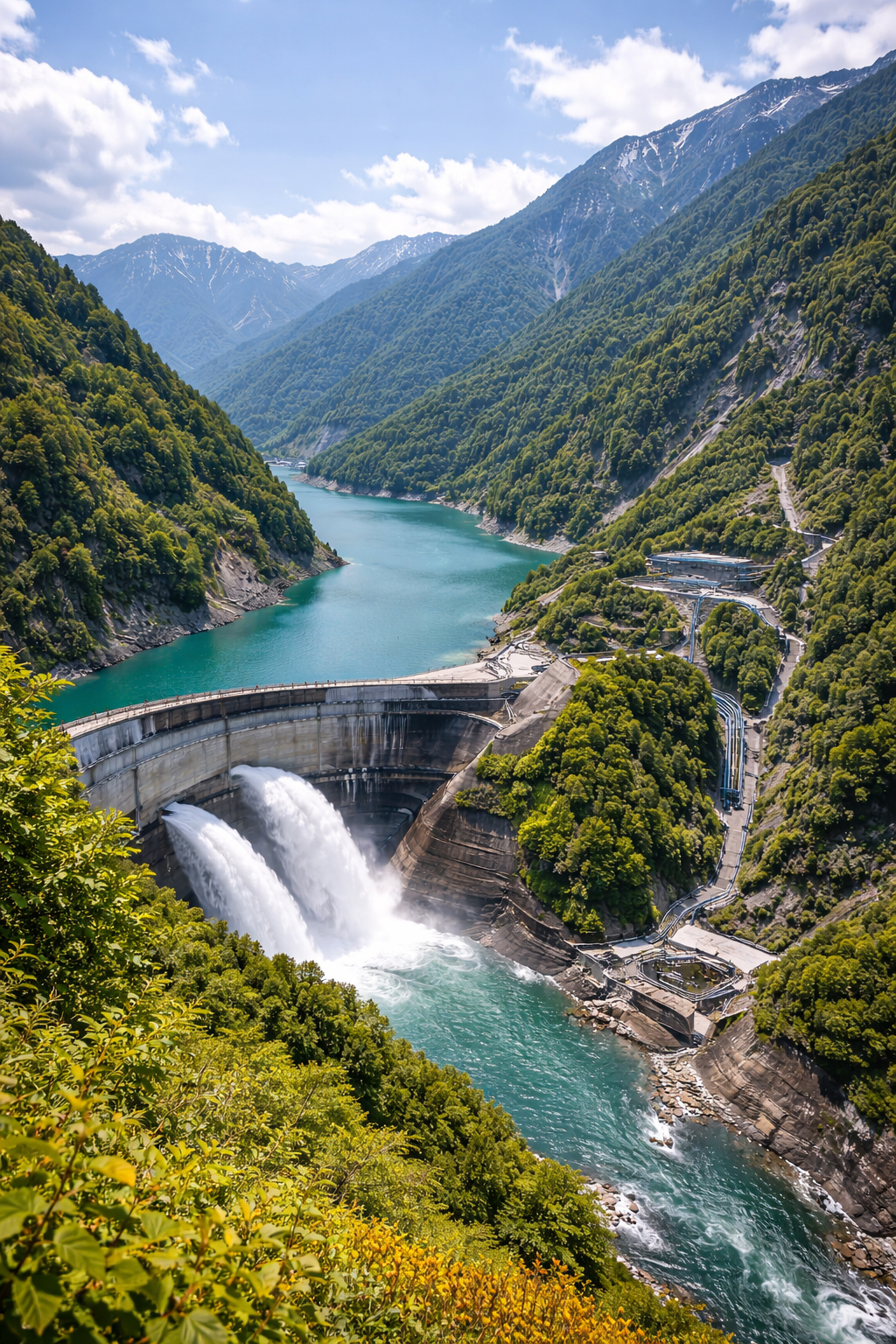
Kurobe mountain power landscape

The Full System

This is perhaps the most intellectually satisfying of the Kurobe images because it shows the larger logic of the region: dam, reservoir, valley, plant infrastructure, pipework, and mountain walls all in one frame. KEPCO’s facilities page explains that the Kurobe River No. 4 plant was built underground to protect the natural environment and that the dam and power station belong to a larger system of river development.

In visual terms, this is where Kurobe ceases to be an attraction and becomes a civilization-scale landscape.

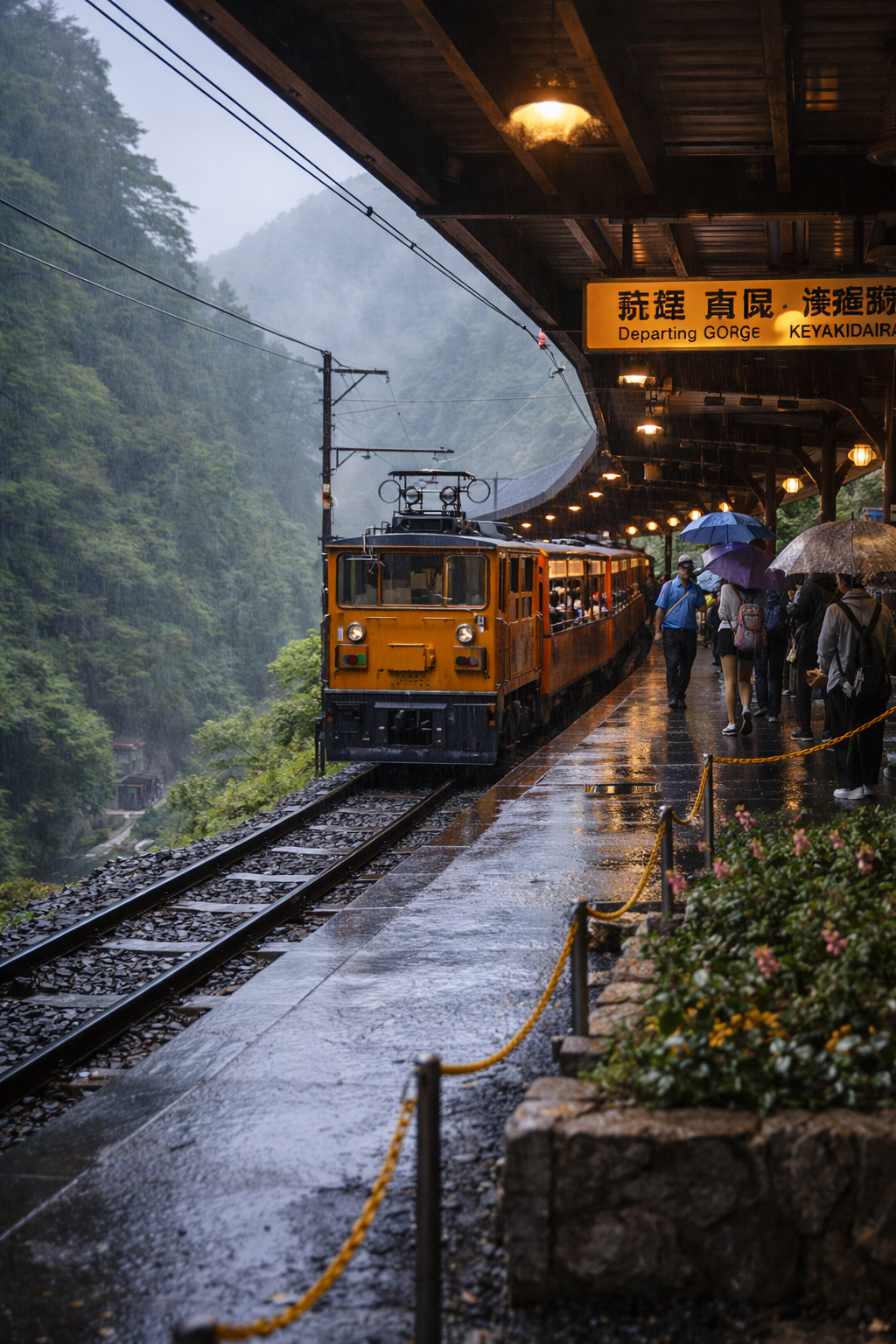
Kurobe Gorge rainy platform departure

Departure in Weather

A crucial mood image. Kurobe should not be all blue-sky triumph. Rain, mist, wet rails, and umbrellas restore the gorge to its proper unpredictability. This photograph also says something about the railway experience itself: Kurobe is not merely a viewpoint. It begins at the platform, in waiting, in weather, in the small excitement of departure.

The signboard, platform canopy, and damp track make the human side of the trip feel immediate and lived.

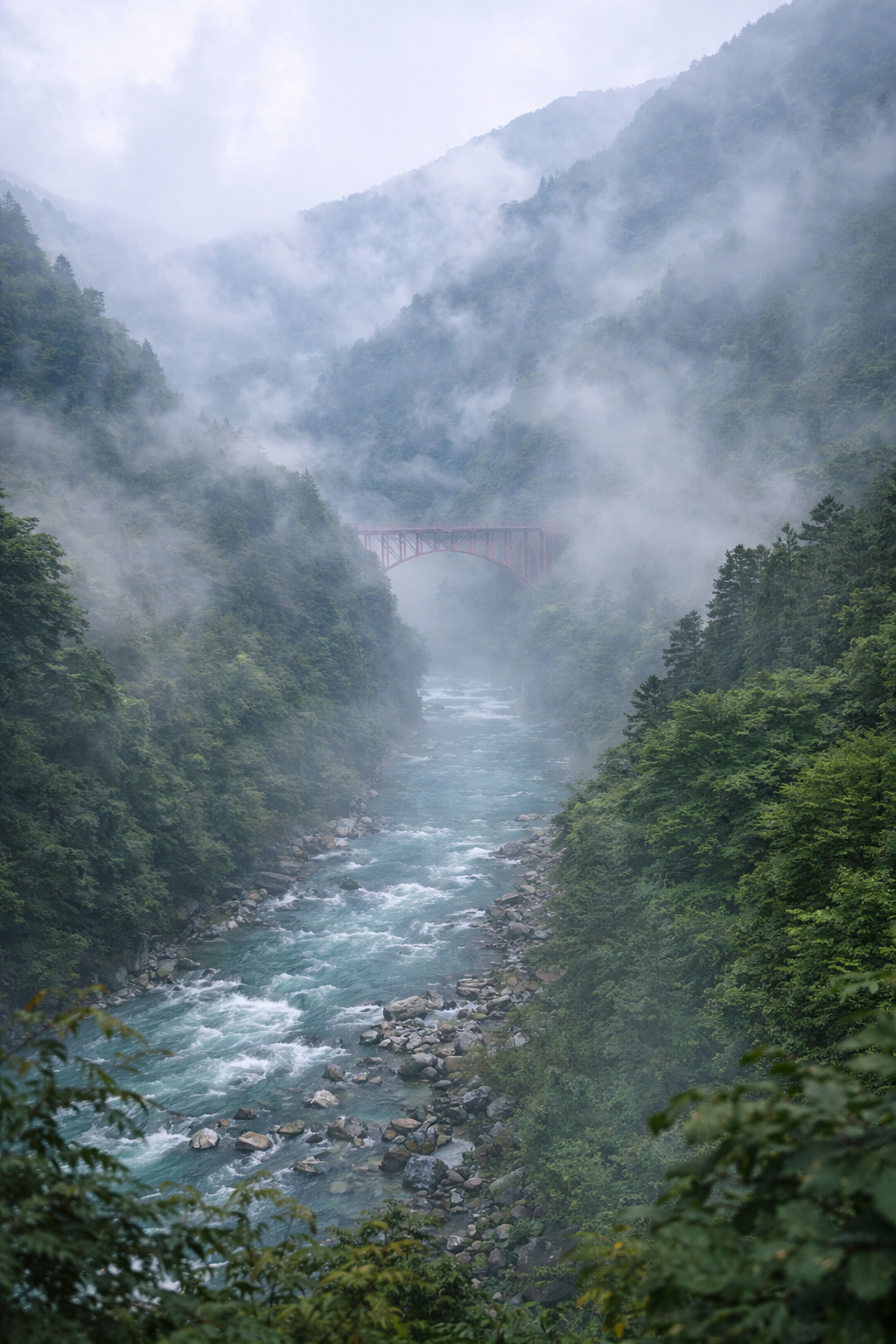
Kurobe Gorge morning fog over river

The Contemplative Kurobe

Without images like this, Kurobe risks becoming only red bridges and orange trains. The mist image restores the river itself to center stage. It also captures something true about mountain valleys: they are not always dramatic in the theatrical sense. Sometimes they are only patient, damp, and nearly silent.

The faint red bridge in the fog matters. It reminds the viewer that human structures in Kurobe are often secondary to atmosphere, even when they are historically monumental.

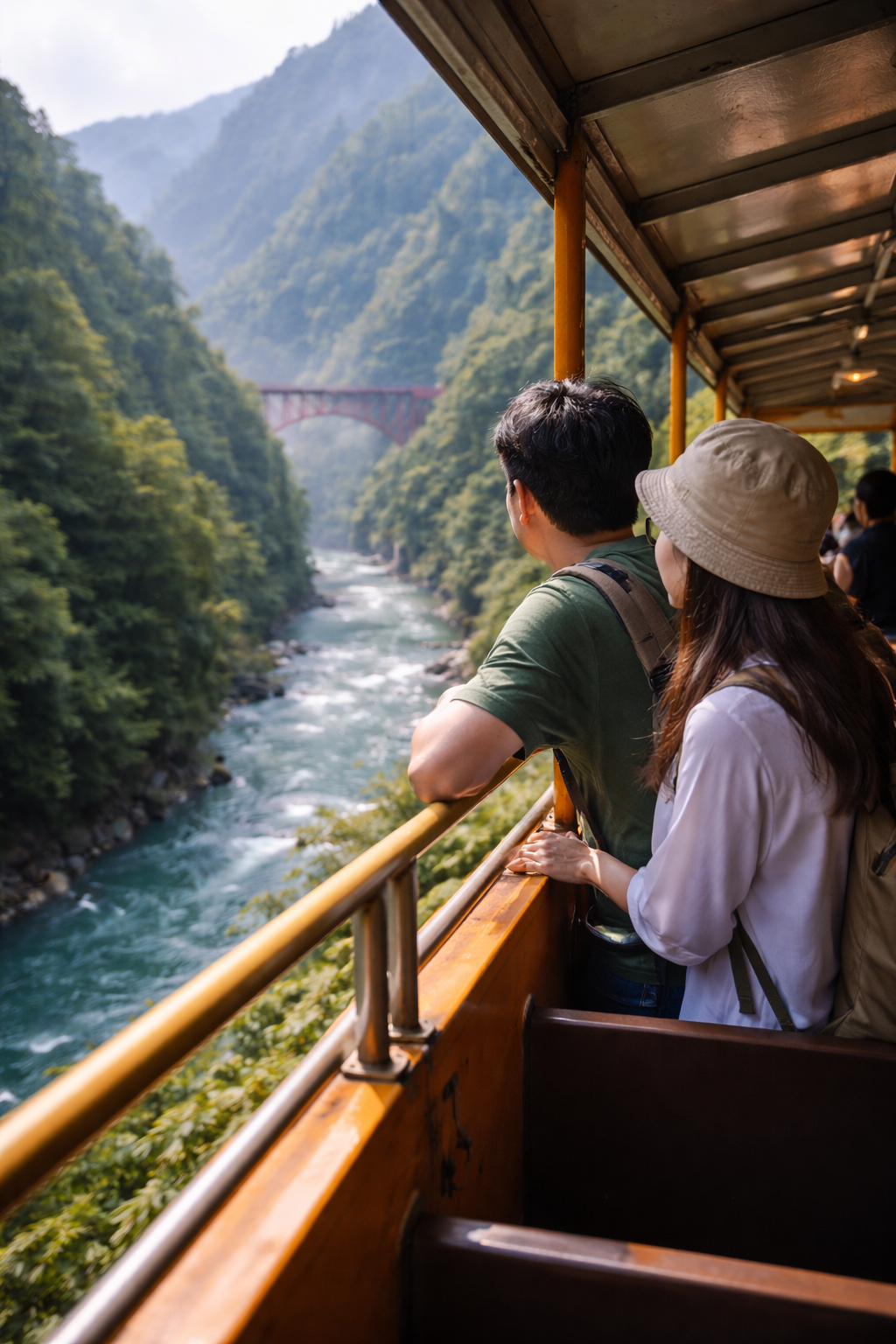
Couple looking from train in Kurobe Gorge

The Railway as Shared Experience

Kurobe has every right to be read as an engineering and labor story, but it would be incomplete to stop there. The railway is also one of the most human travel experiences in Toyama. Open-air cars, river views, and the narrowness of the valley turn sightseeing into something bodily and shared. This image explains why couples, families, and repeat visitors remember the gorge so vividly.

The red bridge ahead works like a promise: the line always has one more reveal.

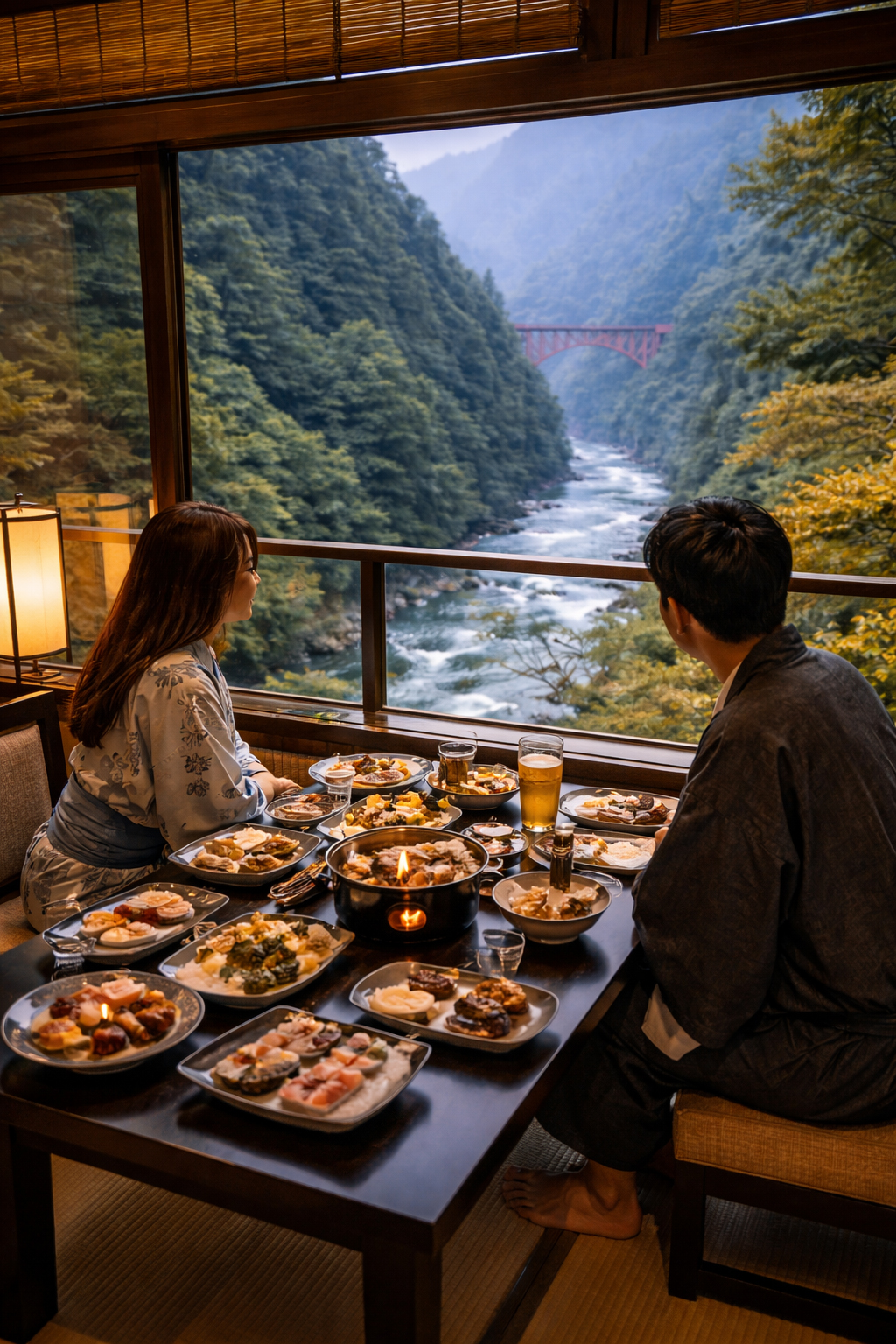
Luxury ryokan dinner by window in Kurobe Gorge

The Region at Table

This is why Kurobe should often be stayed, not merely seen. The river and bridge remain present, but now through a window, at dinner, after the train and the walk. The image says that the valley can be reinterpreted through comfort, cuisine, and stillness without losing dignity.

It also says something subtle and important about Toyama itself: that severity and refinement do not cancel each other out here. They coexist.

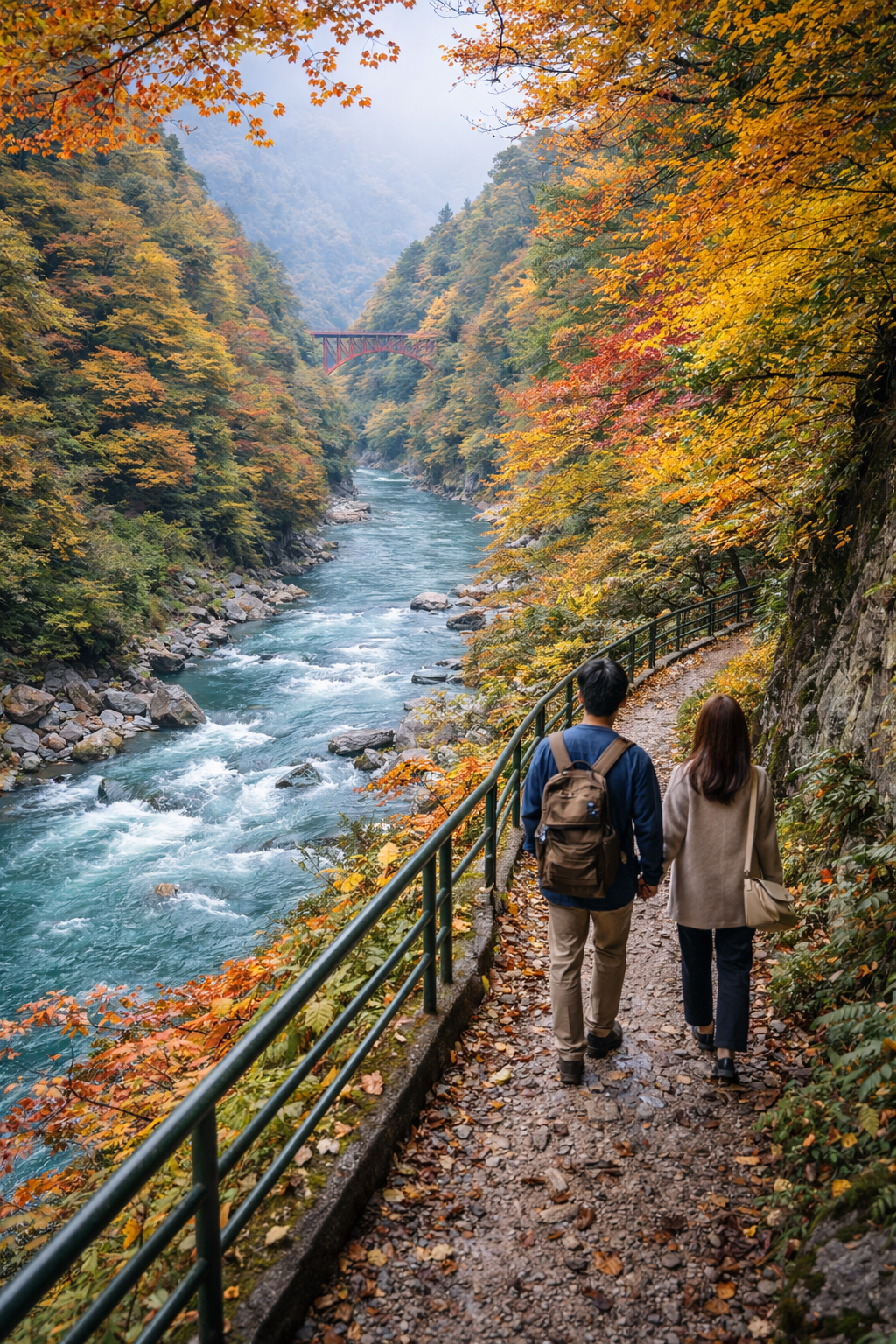
Autumn leaves river walk in Kurobe Gorge

The Walk After the Train

Kurobe is sometimes reduced to the trolley itself, but that is only part of the experience. Visit Toyama’s Kurobe Gorge travel inspiration explicitly notes walks to places like Meiken Onsen and Babadani Onsen, and the Yamabiko Walkway near Unazuki turns old railway infrastructure into a pleasurable short walking route.

This image therefore closes the essay well. Kurobe is not only watched through windows. It is also walked, step by step, beside the river.

History

How Kurobe Became a National Story

The historical arc begins before the famous dam itself. The Kurobe River was recognized as an exceptional river for power development, and by the 1920s railway construction into the gorge was underway to support that work. The line reached deeper into the valley over time, and successive power plants followed. KEPCO’s official timeline places major milestones in the 1950s and early 1960s, when postwar power shortages pushed the company to build the Kurobe River No. 4 system — the dam, the underground power station, and the transport infrastructure needed to get there.

The Kanden Tunnel became one of the decisive episodes. In 1957, workers struck a major fracture zone, delaying progress and making clear how punishing the geology would be. The project nonetheless advanced. The Kurobe River No. 4 Power Plant began operating in 1961, and Kurobe Dam was completed in 1963. Engineering sources and official tourism materials consistently emphasize the project’s national significance, the huge labor force involved, and the fact that 171 people died during construction.

This human cost is one reason Kurobe occupies such a distinctive place in Japanese memory. It is not simply a scenic place where a big dam happens to exist. It is a site where the mountain landscape became inseparable from sacrifice, technical ambition, and postwar necessity.

1920s–1937

The gorge railway penetrates deeper into the valley

The rail line is extended for industrial access and becomes essential to later power development.

1951

Power shortages sharpen the need for major new generation

KEPCO is formed and the pressure to expand capacity in Kansai becomes urgent.

1956

Kurobe Dam construction begins

The “project of the century” phase of Kurobe’s story is underway.

1957

The fracture zone crisis during tunnel construction

The mountain reminds everyone what kind of project this really is.

1961

Kurobe River No. 4 Power Plant commences operation

The underground power station begins to fulfill the logic behind the whole undertaking.

1963

Kurobe Dam is completed

The dam enters public history as both infrastructure and legend.

1971

Kurobe Gorge Railway Company is established

The line’s industrial inheritance and tourism identity become institutionally distinct, though never fully separate.

1987

Kurobe Hydropower Museum opens

The region begins preserving its own modern industrial memory in museum form.

Unazuki and the Valley Today

How to Experience the Gorge as a Region, Not a Snapshot

Unazuki Onsen evening

Unazuki Onsen

Streets of traditional-style inns, footbaths, seafood from Toyama Bay, and mountain views make Unazuki the correct human scale for Kurobe. It is easy to explore on foot and strong enough to reward an overnight or two.

Kurobe Gorge Railway departure

Kurobe Gorge Railway

Official 2026 operations begin April 20. The railway remains the essential route into the valley, and the current official site should always be checked because seasonal operating sections can change. www.kurotetu.co.jp/en/

Yamabiko walkway area

Yamabiko Bridge and Yamabiko Walkway

One of the smartest additions to a Kurobe trip. Visit Toyama calls it the best place to see the trolley crossing the new Yamabiko Bridge, while the walkway repurposes old track-bed and bridge approaches into a pleasurable walking course.

Kurobe Hydropower Museum

Kurobe Hydropower Museum

Best visited either before the railway, to sharpen your eye, or after it, to turn impressions into understanding. The museum sits right near the station area and is one of the most useful interpretive sites in Toyama.

Practical Rhythm

How to Do Kurobe Gorge Well

A rushed version: arrive, ride, return, leave. It works, but it underreads the place.

A better version: arrive in Unazuki, look at the town, visit the hydropower museum, ride the railway, walk the Yamabiko area, take a footbath, eat a proper dinner, sleep, and see the river again in a different light the next morning. Best of all is to let one of those quiet images — fog over the river, rain at the platform, steam over the bath — become part of your own Kurobe memory, not only the famous bridge shot.
Final View

Why Kurobe Gorge Belongs to Toyama’s Soul

Kurobe Gorge is the place where Toyama’s major themes become impossible to separate from one another. Mountains are not background. Water is not decoration. Rail is not nostalgia. Engineering is not abstract. Hospitality is not softness. Everything in Kurobe exists under pressure, and yet the result is not ugliness. It is one of Japan’s most persuasive landscapes.

That is why this page must be long. Kurobe deserves more than a caption and a train timetable. It deserves a full reading.