- Two Olympic gold medalists, two national titles, and a revealing distinction
- A men's final decided by 2.28 points
- Nishiya reverses the semifinal order
- Horigome's route from Tokyo's Olympic debut to a second gold in Paris
- The girl who changed what a Japanese skater could imagine
- How street skateboarding scores can conceal the drama
- The competitors who made the champions work
- Before the Olympics, a language of streets and self-expression
- Why Fukuoka mattered beyond the street podium
- A first national title is a beginning, not a final verdict
Two Olympic gold medalists, two national titles, and a revealing distinction
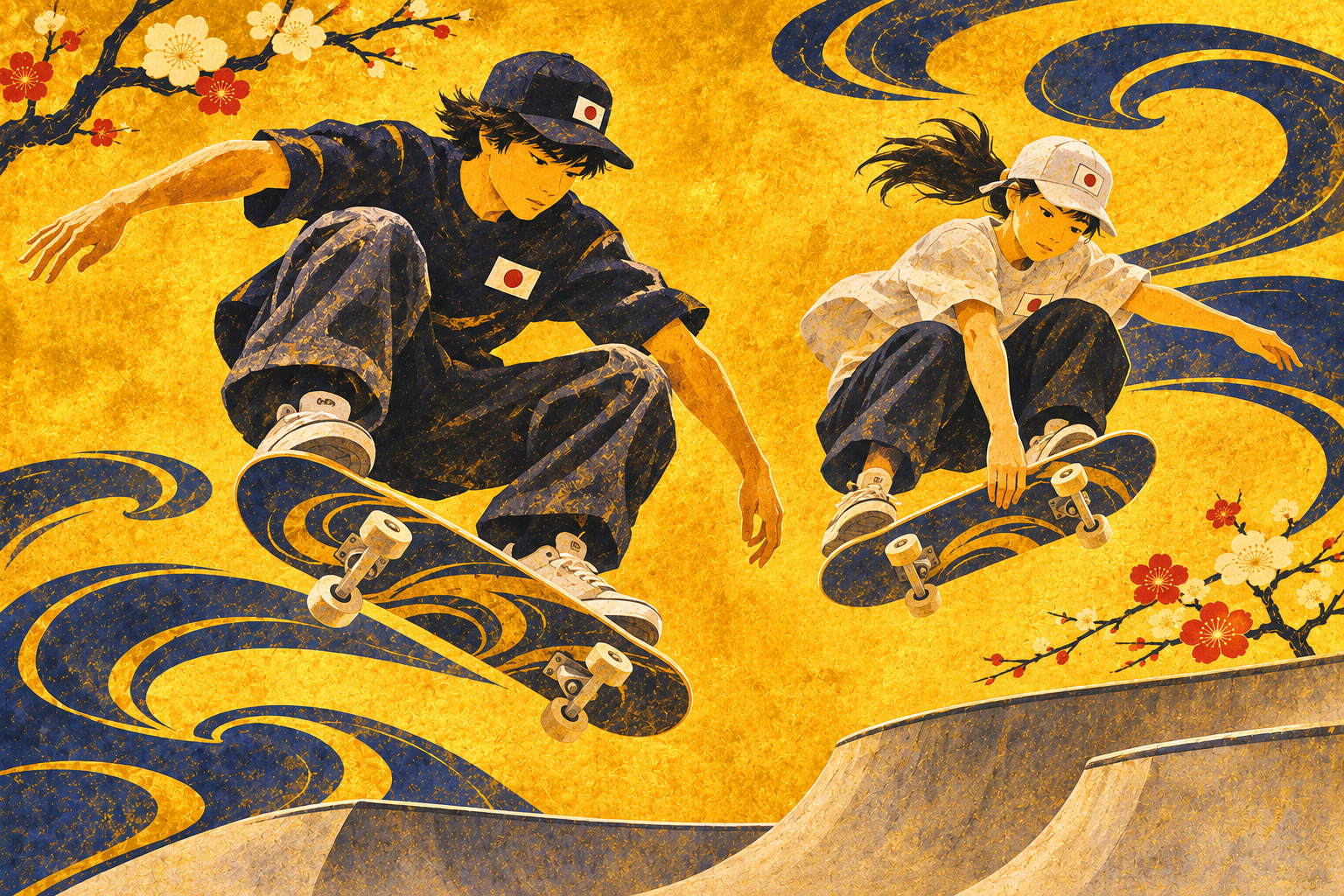
An Olympic gold medal is supposed to mark the summit of a sporting career. Yet on November 8, 2026, two of Japan's best-known Olympic skateboarders collected a different first: their first Japanese national street titles. At Tenjin Street Park in Fukuoka, Yuto Horigome took the men's crown and Momiji Nishiya won the women's competition. Their victories made a striking pairing, but they did not arrive by identical paths.
Horigome, a two-time Olympic champion, was competing at these national championships for the first time. Nishiya, the Tokyo Olympic women's champion, claimed her first national championship. Calling both victories the end of years of unsuccessful national attempts would therefore misstate the record. The better story is how the world's leading skateboarding nation can produce such demanding competition at home that an Olympic champion's first national title remains newsworthy.
A men's final decided by 2.28 points
Official results place Horigome first on 182.72, with 19-year-old Toa Sasaki second on 180.44 and Sora Shirai third on 178.87. All three were separated by just 3.85 points. The winner's margin over Sasaki was 2.28 points—a reminder that a highly accomplished career cannot substitute for executing a difficult maneuver under pressure in the final.
A specialist competition account breaks down Horigome's performance into a 92.07 run and a 90.65 best trick, the latter his decisive scoring contribution. Sasaki posted a 92.22 run, higher than Horigome's. In that sense the championship was not an effortless procession by a famous name. A teenager could beat the eventual champion on one major component, yet still fall narrowly short in the combined result. That is the competitive tension behind the headline.
Nishiya reverses the semifinal order
Nishiya won the women's final with 165.13 points, ahead of Paris 2024 silver medalist Liz Akama on 155.53 and Miyu Ito on 152.73. The day before, Akama had led the semifinal with 146.82, while Nishiya advanced in second with 140.88. The order changed when the title was on the line. The result is evidence of final-day execution, not proof that one athlete has permanently displaced another in the international hierarchy.
Nishiya was 13 when she became an Olympic champion in Tokyo; the national federation listed her as 19 in Fukuoka. That six-year span has transformed the meaning of her presence. Once celebrated principally as an exceptionally young winner, she is now an established competitor surrounded by another wave of capable Japanese teenagers. Akama is only 17. The very athletes testing Nishiya represent the depth the Tokyo breakthrough helped make visible.
Horigome's route from Tokyo's Olympic debut to a second gold in Paris
The International Olympic Committee approved skateboarding for Tokyo 2020 in August 2016. The Games, delayed by the pandemic until 2021, introduced street and park contests to an audience far beyond the sport's existing community. Horigome won the inaugural Olympic men's street gold on home soil. Three years later he defended the title at Paris 2024. Those achievements made him a global ambassador for a discipline that once lived mainly in videos, informal gatherings and local skate spots.
The first-entry national title is not evidence that Fukuoka was harder than an Olympic final: fields, formats, conditions and expectations differ. What it does show is a willingness to enter a domestic contest where reputation does not add points. His closest challenger, Sasaki, had not yet reached 20. Horigome's experience and the next generation's hunger appeared side by side in a result that almost went the other way.
The girl who changed what a Japanese skater could imagine
At Tokyo 2020, Nishiya became one of the Games' defining young champions, taking women's street gold at 13. Her achievement broadened the public image of skateboarding in Japan. An IOC retrospective later described rising interest in skateparks and skateboard sales after the Games, especially among girls. That is a report about a broader social shift, not a controlled demonstration that a single medal caused every new participant to take up the sport.
The deeper legacy is the competitive ecosystem visible in Fukuoka. Akama, a Paris silver medalist, was runner-up; Ito finished third; younger competitors continued down the table. For children watching now, Nishiya is no longer only proof that a teenager can win once. She also illustrates what happens after the extraordinary breakthrough—how a young athlete remains relevant as competitors grow stronger and the novelty of an Olympic debut fades.
How street skateboarding scores can conceal the drama
A street course recreates elements of the built environment—stairs, rails, ledges and banks. Athletes can demonstrate sequences of moves in a run and take additional attempts at technically demanding individual tricks. Olympic scoring was revised between Tokyo and Paris to rebalance the relationship between runs and tricks. It is therefore misleading to compare raw totals from different formats or eras as though they were measurements on an identical scale.
The Fukuoka results speak for this specific competition. Horigome's 182.72 was just ahead of Sasaki's 180.44; Nishiya's 165.13 led Akama's 155.53 by 9.60. Each number compresses risk, precision, creativity, execution and mistakes into a ranking. A high score cannot communicate everything viewers see in a rider's style, but it allows one indispensable comparison: how close the athletes were under the rules applied to that contest.
The competitors who made the champions work
Sasaki and Shirai occupied the other two positions on the men's podium. The finalists also included 17-year-old Momohei Yabushita and 16-year-old Ginwoo Onodera, illustrating how early elite competition begins in the sport. In the women's field, Ito, Ria Tanno and Ibuki Matsumoto added to a broad list of young talent. The official national federation lists Japan's street athletes among prominent names on the world circuit, and Fukuoka offered an unusually concentrated domestic comparison.
Competitive depth also creates practical questions. Athletes need access to places where they can skate regularly, coaching and physiotherapy, affordable travel and space to continue education. A national final tells us who scored highest that weekend; it does not tell us whether opportunities are equally available across Japan. Growth should be judged partly by what happens to talented teenagers after their first promising result.
Before the Olympics, a language of streets and self-expression
Modern skateboarding grew from west-coast American surf and youth cultures into a global practice with its own film, music, fashion and informal architecture. A rail meant for pedestrians can become a line of athletic possibility; a set of stairs becomes a challenge to be interpreted differently by each rider. Much of the activity's identity emerged beyond conventional sporting institutions. That independent history is essential to understanding why judging creativity and movement remains contentious.
Olympic recognition brought valuable facilities, visibility and legitimacy. It also created tension between standardized rules and a culture that prizes personal style. Fukuoka's championship belongs to both worlds: a formally sanctioned event at a dedicated park, showcasing athletes whose movements draw from a much wider street tradition. The future depends on supporting competition without erasing the environment that shaped it.
Why Fukuoka mattered beyond the street podium
The ninth Japanese national championship ran November 5–8 at the skatepark in Tenjin Street Park, Nanonotsu 1, Chuo Ward, Fukuoka. World Skate Japan organized the event with cooperation from Japanese skateboarding bodies and sponsors. The program included park contests as well as street. Fifteen-year-old Izuru Nagahara defended the men's park title, while 13-year-old Hikari Satake took the women's park crown for the first time.
Park skating, with its bowls and transitions, is not interchangeable with street skating's rail-and-stair vocabulary. Still, the presence of so many young finalists across disciplines reinforces the wider picture: Japan's Olympic success is being tested by a new generation rather than safely preserved in an album of historic medals. The national championship is a platform for that comparison—and a reminder that athletes develop at different speeds.
A first national title is a beginning, not a final verdict
Horigome's margin of 2.28 points shows how easily one additional successful trick might have altered the final table. Nishiya's comeback from second in her semifinal showed a different kind of competitive resilience. Neither result predicts the next world championship, nor does either invalidate the record of athletes who finished just behind the winners. The titles describe what happened in Fukuoka, under its own rules, on November 8.
For Japan, that may be the most encouraging conclusion. The country now has Olympic champions who can continue to win, plus challengers young enough to carry the discipline into another era. If parks, schools, community organizers and sports institutions sustain access to skating, the country's competitive standard can grow without losing the creative culture that makes the sport distinctive. Gold medals made Horigome and Nishiya famous. Their latest victories offer a reason to look again at everyone skating alongside them.
Sources and verification
This report uses confirmed November 8 standings from World Skate Japan and official Olympic sources. Scores are attributed to published results and specialist competition reporting; athlete remarks have not been fabricated.
- World Skate Japan: 9th National Championships (official results)
- World Skate Japan: publication of November 8 results
- Japanese Olympic Committee: November 8 championship report
- Japanese Olympic Committee: November 7 semifinals
- World Skate Japan: street athletes
- IOC: 2016 decision to add skateboarding to Tokyo 2020
- IOC: explaining changes to Olympic street scoring
- IOC: skateboarding growth after Tokyo 2020
- Competition specialist account with final score breakdown