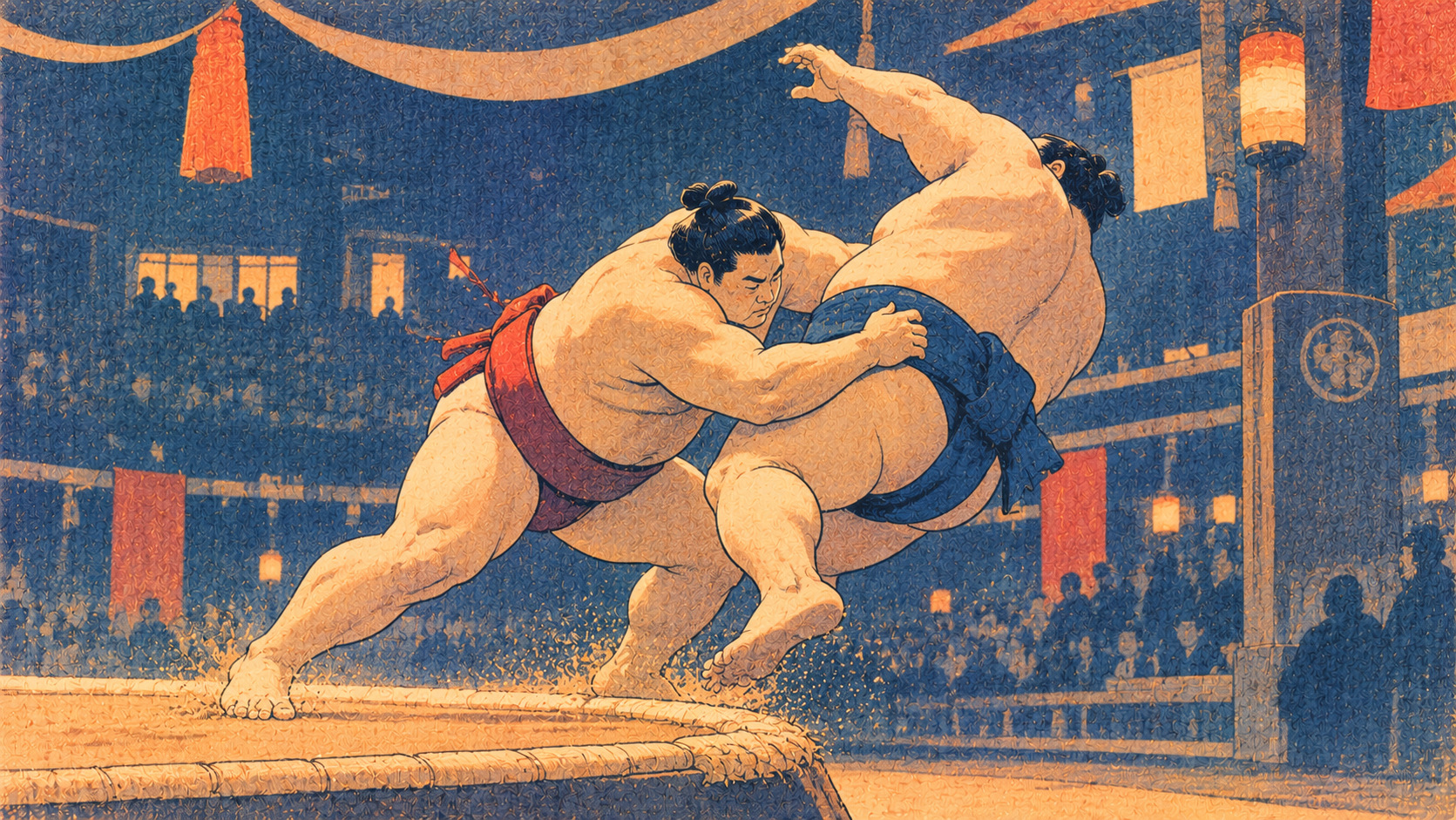
- The instant a yokozuna lost his footing
- The technique behind a sudden reversal
- A referee's raised fan is not always the last word
- The challenger from Kumamoto
- Onosato and the obligations of a yokozuna
- Why this was not technically a kinboshi
- Five wins in six meetings: rivalry or matchup problem?
- Why Fukuoka's November tournament matters
- A turbulent first day for the top ranks
- One bout changes the conversation, not the championship
The instant a yokozuna lost his footing
For most of the final bout on the opening day of the Kyushu Grand Sumo Tournament, the script seemed familiar. Yokozuna Onosato, one of the sport's most formidable forward-moving wrestlers, forced komusubi Yoshinofuji toward the boundary. Then the direction of the contest changed. Yoshinofuji shifted his body and struck down from the left as the wrestlers stumbled together at the edge. The chief referee, the newly installed 40th Kimura Shonosuke, pointed his fan toward the challenger. The ringside judges called a conference.
When the discussion ended, the referee's decision stood: Yoshinofuji had defeated Onosato by tsukiotoshi, commonly described as a thrust down. The match took place on November 8, 2026, at Fukuoka International Center. Reports of the judges' explanation establish that Yoshinofuji's heel remained within the ring while Onosato had already touched down. The precise position of Onosato's hand relative to the straw boundary was not conclusively determined from the video review. This was a narrow call, not an undisputed visual certainty.
Sources: Asakayama judges’ explanation · November 8 results
The technique behind a sudden reversal
The winning technique matters because this was not merely a stumble or a random mistake. Japanese match reporting described Yoshinofuji's early right-hand throat thrust, which lifted Onosato's posture, followed by the yokozuna's powerful forward drive. Yoshinofuji surrendered ground but retained a route to turn and thrust his opponent down. The body that seemed under pressure found a final angle of attack.
Sumo's vocabulary often gets flattened in overseas coverage into “push,” “throw,” and “fall.” Tsukiotoshi is more specific: a wrestler redirects an opponent downward with a thrust, generally without a belt grip defining the finish. Distinguishing a technique from its appearance matters when athletes are separated by a fraction of a second at the ring's edge. Without full biomechanical measurements, it would be misleading to assert precisely which force or foot placement alone caused the result.
Sources: Head-to-head and match analysis · November 8 results
A referee's raised fan is not always the last word
The referee, or gyoji, directs the ceremony and makes the first decision. Five ringside judges may challenge it through a mono-ii, a formal discussion that can confirm the call, reverse it, or order another bout. Video assistance is part of modern adjudication. It is an ancient sport with a structured review process, though not one identical to a modern electronic line-call system.
The historical detail makes this contest unusually memorable. It was the first closing bout handled by the newly elevated 40th Kimura Shonosuke, the highest-ranked gyoji. Japanese newspaper accounts quoted him describing why he believed Yoshinofuji's foot had remained in. The judges' chairman, Asakayama, the former ozeki Kaio, also addressed the sequence. Their explanations offer more responsible evidence than freeze-frame assertions circulating without context.
Sources: Asakayama judges’ explanation · Kimura Shonosuke referee account
The challenger from Kumamoto
Yoshinofuji Naoya was born on June 25, 2001, in Uto, Kumamoto Prefecture. The Isegahama stable identifies his given name as Naoya Kusano and his first professional tournament as May 2024. After a university sumo career, he moved quickly into the professional upper ranks, reaching the top division in July 2025 and making his first appearance among the sanyaku ranks in July 2026. The November tournament marks a return to komusubi.
That pace is important context for understanding the upset. Yoshinofuji was not an unknown outsider who happened to catch a champion on a bad day. He had built a track record against elite opponents and was again facing the difficult schedule that comes with membership of the upper ranks. His stable lists right-hand-inside grappling and forward pressure among his favored techniques, making the last-second thrust down an especially useful example of adaptability rather than a one-move identity.
Sources: JSA — banzuke topics · JSA — Yoshinofuji profile · Isegahama stable — Yoshinofuji
Onosato and the obligations of a yokozuna
Onosato Daiki, a native of Tsubata in Ishikawa Prefecture, began his professional career in May 2023 and became Japan's 75th yokozuna following a promotion decision in May 2025. He had won six top-division championships entering the November 2026 tournament, including the September title with a 12–3 record. His exceptionally rapid rise has made him a centerpiece of sumo's new generation.
A yokozuna cannot simply be demoted after an ordinary poor tournament; the rank carries an expectation of performance, composure, and eventual dignified retirement. That cultural pressure can turn an opening-day defeat into a national talking point. Yet a 15-day tournament does not end with one defeat. Onosato's response across subsequent matches—not speculation about his confidence—is the appropriate test. He told reporters after the bout that he would reset for the next day, according to contemporaneous Japanese coverage.
Sources: JSA — Onosato profile · Ibaraki — September title
Why this was not technically a kinboshi
An English-speaking reader may encounter the word kinboshi whenever a wrestler beats a yokozuna. Its formal use is narrower. The Japan Sumo Association explains that a kinboshi, literally “gold star,” is credited to an unranked or maegashira wrestler who defeats a yokozuna in an eligible bout. Sanyaku competitors such as komusubi and sekiwake do not receive a kinboshi for the same result.
Yoshinofuji was ranked west komusubi. Therefore this remarkable win is not an official gold-star victory. It is still a major achievement against a reigning yokozuna. The distinction is not pedantry: accurate rank terminology helps international audiences understand the economics, symbolism, and competitive hierarchy of sumo without importing the wrong labels from general sports language.
Sources: JSA — kinboshi definition
Five wins in six meetings: rivalry or matchup problem?
On the eve of the tournament, Yoshinofuji held a 4–1 career edge over Onosato. After November 8, Japanese sports coverage reported the tally at 5–1, including one win by forfeit. That caveat matters: a statistical matchup and a tally of completed bouts are not identical. The pattern is unusual given Onosato's dominant record against much of the field, but the sample remains small.
One plausible technical explanation lies in the contrast between Onosato's direct forward force and Yoshinofuji's ability to alter the line of contact, including with the opening throat thrust. It is an interpretation supported by descriptions of this match, not a demonstrated universal weakness in the yokozuna's technique. Rivalry narratives make a compelling read, but should not harden into predictions that future opponents will reproduce the same finish.
Sources: Onosato bout report · Head-to-head and match analysis
Why Fukuoka's November tournament matters
The final honbasho of the year takes place in Fukuoka, far from the Tokyo arena most casual international viewers associate with sumo. The Japan Sumo Association traces the postwar return of top-level tournament sumo to Fukuoka to 1957, when the Kyushu meeting became part of a growing national calendar. Today the six-tournament schedule moves through Tokyo, Osaka, Nagoya, and Fukuoka. In 2026, the Kyushu tournament runs from November 8 through November 22 at Fukuoka International Center.
Yoshinofuji's home prefecture, Kumamoto, gives him an obvious regional connection, and reporting described family ties in the audience. But a crowd's enthusiasm should not be mistaken for a quantified cause of victory. The regional setting adds another layer to the human story: a wrestler who developed far beyond his hometown meets a national champion in front of spectators for whom the word “local” means something personal.
Sources: JSA — official schedule · Kyushu tournament history
A turbulent first day for the top ranks
The opening-day surprises did not stop with Onosato. Ozeki Aonishiki lost to former ozeki Asanoyama by yoritaoshi; ozeki Kotozakura lost to Fujiryoga by oshidashi. Yokozuna Hoshoryu, returning to action, defeated Churanoumi, while ozeki Kirishima beat Ura. Those results underscore why tournament standings cannot be projected from the fanfare around a single match.
There are fifteen scheduled competition days and the field is reshaped continuously by results, health, and pairings. As this article was prepared, the verified record available for citation centered on November 8. This November 11 edition does not invent November 9–10 results. Editors should check the Japan Sumo Association's latest daily results immediately before release and update only with independently verified matches.
Sources: November 8 results · JSA — official schedule
One bout changes the conversation, not the championship
What happened in Fukuoka was a remarkable collision of experience, athletic timing, and adjudication. The yokozuna forced the issue, the challenger found a counter, and the sport's officials had to resolve an extraordinarily tight finish. It offered television drama but also the kind of technical detail that makes sumo more interesting when properly explained.
The rest of the tournament remains to be written. Yoshinofuji must show that the precision and resolve of the first day can be sustained against a changing schedule. Onosato must move beyond a defeat that will be replayed for its closeness. Neither wrestler's fate can be inferred from this match alone. The responsible conclusion is narrower—and more powerful: on November 8, a komusubi turned a seemingly lost position into a victory over one of sumo's defining champions.
Sources: Asakayama judges’ explanation · Onosato bout report
Sources, reporting method and limitations
Official JSA and stable records establish ranks, biographies and tournament dates; contemporaneous Japanese reporting supplies the disputed-finish details and quotations. The verdict is not presented as visually indisputable, and this komusubi victory is not mislabeled a kinboshi. The latest November 9–10 results require checking before publication.
- Japan Sumo Association — November 2026 tournament schedule
- JSA — November banzuke topics
- JSA — Yoshinofuji Naoya profile
- Isegahama stable — Yoshinofuji
- JSA — 75th Yokozuna Onosato
- JSA — official explanation of kinboshi
- Nikkan Sports — judges’ decision, November 8
- Nikkan Sports — referee’s account, November 8
- Nikkan Sports — Onosato opening-day loss
- Sponichi — fight and head-to-head analysis
- Sports Navi — November 8 results
- JSA — Kyushu tournament history
- Ibaraki Prefecture — Onosato September championship