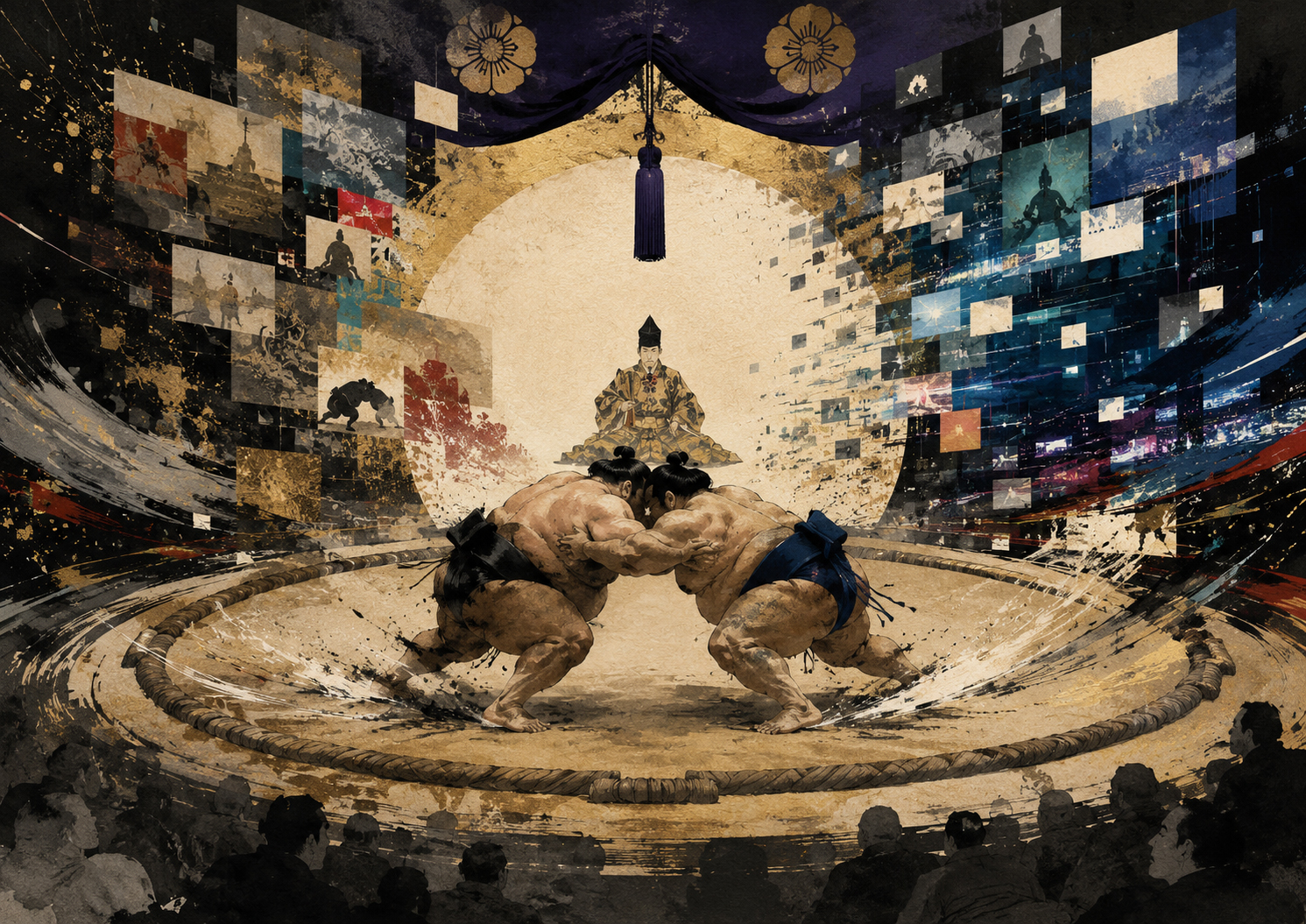
A few seconds can contain a day of story
A sumo bout often lasts only a few seconds. After shiko, salt, ritual crouching, the caller and referee, the actual contest may end almost immediately. Yet fans follow fifteen consecutive days, count winning and losing records and invest emotionally in promotion and championship races.
In an age of streaming, short clips and algorithmic recommendation, sumo can look impossibly old. Its schedule is unusual, terminology dense and hierarchy difficult for newcomers.
Yet sumo continues to gain viewers through television, arenas, digital streams and social media. Its durability comes not simply from short action, but from wrapping that action in ritual, daily continuity, rank and biography. It turns a moment shorter than a social-media clip into a fifteen-day serialized drama.
Sumo began as more than sport
Japan’s earliest chronicles describe mythic contests of strength. In the Nara and Heian periods, sumo appeared in court ceremonies and agricultural rites.
During the medieval era it served as warrior training and public entertainment. In the Edo period, fundraising tournaments associated with temples and shrines became urban spectacles. Wrestler groups, rankings, referees and the formal ring developed in Edo, Kyoto and Osaka.
Sumo was never only an athletic contest. It combined ritual, commerce, hierarchy, regional identity and theater. That layered character still produces unusually rich narrative.
Edo’s media sport
Edo-period sumo adapted to the media of its time. Ranking sheets visualized status. Woodblock prints spread images of famous wrestlers. Popular publications reported matches and personalities.
The banzuke and ukiyo-e performed functions similar to modern rankings, trading cards and social profiles. Fans followed hometown, body size, stable, promotion and rivalry.
Tradition was reinvented after the Meiji Restoration
After 1868, some reformers criticized sumo as a backward spectacle incompatible with Westernization. Imperial tournaments and its association with national ceremony helped redefine it as Japanese tradition.
The first permanent Ryogoku Kokugikan opened in 1909. Tokyo and Osaka organizations merged in 1925, creating the structure that became the modern Japan Sumo Association.
Modern sumo is not an unchanged survival from antiquity. It is an Edo entertainment system repeatedly adapted to the nation-state, newspapers, radio, tourism and urban mass culture.
Radio created the time limit
NHK began radio coverage in 1928. To fit bouts into a broadcast schedule, time limits were introduced for the pre-bout ritual. Today, top-division wrestlers generally have four minutes.
This is a revealing history. A timing structure that feels ancient was reshaped by the new media technology of its day. Sumo did not reject radio; it preserved ritual while making itself broadcastable.
Streaming is therefore not the first medium to challenge tradition. Sumo has negotiated with technology for a century.
Television made it a national daily habit
Postwar television carried sumo into homes, stores, hospitals and workplaces. NHK coverage turned wrestlers into national celebrities.
The six-tournament annual system was established in 1958, creating the current rhythm of Tokyo, Osaka, Nagoya and Fukuoka. Every two months, another fifteen-day story begins.
Unlike a single long baseball or football match, a sumo broadcast contains many brief contests over several hours. Viewers can enter and leave without losing the entire experience. That structure is surprisingly compatible with fragmented modern viewing.
Fifteen days create serialized drama
Top-division wrestlers compete once a day for fifteen days. Eight wins produce a winning record; seven wins and eight losses produce a losing record that affects the next ranking.
The simple system generates meaning every day: an opening loss, three straight wins, a 5–5 record, an endangered ozeki, a championship race or a decisive final day.
Streaming hits use episode-level hooks and season-long arcs. Sumo has long done the same. Each bout is an episode, the tournament is a season, and the career is a long-running series.
The banzuke may be sport’s strongest story engine
The ranking is not merely a table. Yokozuna, ozeki, sekiwake, komusubi, maegashira, juryo and the lower divisions determine salary, clothing, assistants and social status.
Promotion to juryo makes a wrestler a salaried sekitori with privileges and attendants. Demotion removes much of that status. Rank changes everyday life.
This gives every wrestler a meaningful story even outside the championship. An eighth win by a lower-ranked maegashira may transform a career.
A yokozuna is a symbol, not only a winner
Yokozuna is the highest rank but not simply first place. An ozeki must achieve championship-level results and be judged to possess the required dignity.
A yokozuna cannot be demoted. Poor performance leads to absence and eventually retirement. This irreversibility makes the rank more than athletic status.
The ceremonial rope, ring-entering ritual and attendants connect the yokozuna to religious and national symbolism. A clipped bout carries the weight of that institution behind it.
Short bouts fit short-form video
Many bouts last only seconds. The collision, throw and ring-edge reversal fit naturally into short video.
The Japan Sumo Association recognizes 72 winning techniques, giving each clip a clear technical ending.
But a clip alone does not explain importance. Viewers need the wrestler’s record, injury history and promotion stakes. Short action provides the doorway; rank and biography encourage deeper attention.
The long pre-bout ritual creates attention
In a short-attention age, salt throwing and repeated crouching can look slow. Yet waiting creates tension.
Wrestlers control breathing, study one another and search for the moment to charge. The crowd quiets and anticipation rises. Like a baseball pitch or tennis serve, the pause increases the value of the explosion.
Sumo alternates ritual and impact. It creates a rhythm of concentration and release rather than a constant stream of stimulation.
Commentary translates more than rules
NHK coverage combines play-by-play, technique, previous results, stable history, injury and training information. It explains terminology to newcomers while rewarding long-time fans with historical and tactical depth.
English commentary and digital coverage translate rank and ritual for international audiences. Sumo’s images are powerful, but cultural explanation deepens them.
Streaming also allows partial viewing. A fan can follow one wrestler, watch highlights and check the next pairing without consuming the full broadcast.
Social media made wrestlers more accessible
Wrestlers’ daily lives were once visible mainly through newspapers, television and supporter groups. Stables and wrestlers now share training, meals, tours and daily routines online.
Communal living, chanko, practice and junior duties create compelling behind-the-scenes content. Netflix’s drama Sanctuary increased global interest in the harsh stable system and its characters.
The association still must balance intimacy with discipline, image rights and the mystique of the wrestler.
Foreign wrestlers globalized the sport
Postwar sumo became increasingly international. Takamiyama, Konishiki, Akebono and Musashimaru came from Hawaii; Akebono became the first foreign-born yokozuna in 1993.
Mongolian champions including Asashoryu, Hakuho, Harumafuji, Kakuryu and Terunofuji later dominated. Wrestlers also arrived from Europe, Georgia, Bulgaria, Brazil and China.
Their success showed that sumo culture could be entered through training and stable life rather than nationality alone. It also produced debates over dignity, identity and the absence of Japanese-born champions.
The contradiction of women and the ring
Tradition is also the source of criticism. Women are excluded from the professional dohyo, producing controversies involving female politicians and emergency responders.
Women’s amateur sumo exists internationally, yet women cannot become professional wrestlers or participate in central ring rituals.
As streaming opens sumo to the world, the sport is judged against broader expectations. It must continue asking which traditions are essential and which exclusions can change.
Violence, match fixing and gambling damaged trust
Sumo has experienced major crises. In 2007, a young wrestler died after abuse in the Tokitsukaze stable. Baseball gambling emerged in 2010. In 2011, text messages revealed match fixing and the spring tournament was canceled.
Violence involving wrestlers and elders has continued to create controversy.
These scandals show the danger of using tradition to hide closed institutions. Modern support depends on competitive integrity, health, human rights and transparent discipline.
A wrestler’s body is a life, not content
Sumo has no weight divisions, allowing smaller wrestlers to defeat larger opponents through technique. It also creates risks involving extreme weight, joints, cardiac health, diabetes and concussion.
Because absence causes ranking decline, injured wrestlers face pressure to compete. The official injury-protection system was abolished in 2003, and debate continues over whether health safeguards are adequate.
Streaming can turn pain and dramatic return into compelling story. The sport’s sustainability requires medicine, rest and support after retirement rather than using injury as narrative fuel.
The arena is not the opposite of digital
At Kokugikan and regional tournaments, fans can arrive early, watch lower divisions, eat, shop and wait for the ring-entering ceremonies. It is an all-day cultural experience.
Digital viewing can become an entry point rather than a substitute. Overseas fans who discover wrestlers online may later visit Tokyo, attend regional tours or seek stable experiences.
Sumo works across several time scales: a seconds-long clip, a daily broadcast, an all-day arena visit and a career lasting a decade.
Sumo’s time structure by the numbers
What sumo should improve for streaming
- Multilingual explanation: Explain rank, ritual and promotion in concise formats.
- Searchable archives: Organize historical video by wrestler, technique and tournament.
- Official short clips: Deliver action together with context while protecting rights.
- Better data: Visualize matchups, body differences, techniques and rank movement.
- Health and transparency: Improve communication about injury, discipline and governance.
- Younger audiences: Connect through schools, games, manga, tours and participation.
Japan.co.jp view: sumo accumulates attention
Sumo survives not because it never changed, but because it preserved ranking, ritual and stable life while adapting to Edo prints, the Meiji arena, radio, television and streaming.
The short bout fits short attention. But sumo’s deeper strength is not instant satisfaction. It makes viewers remember today’s result, care about tomorrow and follow promotion and decline over years.
It does not demand all attention at once. It accumulates attention in small units: seconds for a bout, fifteen days for a tournament, six tournaments for a year and a decade for a career.
The winners of the streaming age are not only the shortest forms. They are worlds that can lead viewers from a short entrance into deep attachment. Sumo has possessed that architecture for centuries.
Sources and further reading
- Japan Sumo Association: Rankings, wrestlers and results.
- Japan Sumo Association: The 72 official winning techniques.
- Japan Sumo Association: The six-tournament annual schedule.
- National Diet Library: Sumo history, fundraising tournaments and banzuke culture.
- NHK Archives: Radio broadcasting and sports-media history.
- Encyclopaedia Britannica: Sumo history and institutions.
- Japan National Tourism Organization: An introduction to sumo culture.
- Netflix: Sanctuary.