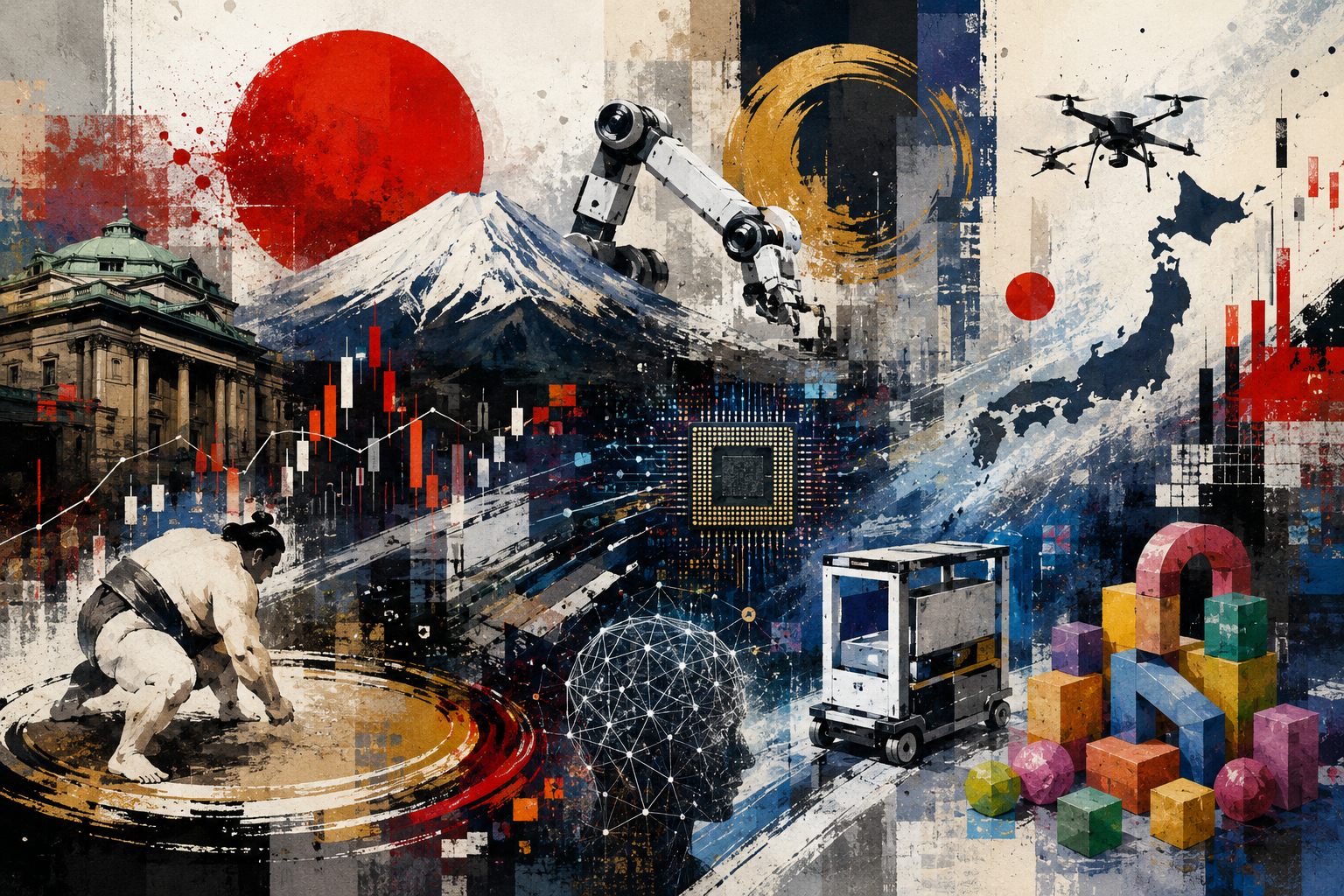
About today’s artwork
Today’s Art Choice, Abstract Japan in the Machine Age, is not a reproduction of a historical masterpiece. It is an original editorial artwork created for Japan.co.jp’s July 11, 2026 technology edition.
Circles, gears, wiring, semiconductor patterns, robot joints, factories and city fragments overlap. At the same time, brush movement, open space, festival color and a sun-like ring introduce the trace of the hand into mechanical order.
The image does not portray one machine or company. It condenses a question Japan has asked repeatedly since industrialization: does technology extend human capacity, turn the human into a component of production, or transform the boundary between person and machine into a new expressive field?
Machines changed the visual world of Meiji Japan
Japan’s late nineteenth-century modernization arrived with railways, steamships, factories, telegraphy, photography and mechanical printing.
Woodblock prints pictured trains, Western buildings, power lines and industrial landscapes. Rail compressed distance, photography mechanized memory and newspapers distributed identical images at scale.
Art expanded from singular handmade objects into a broader visual culture of print, reproduction, advertising, magazines and posters.
Futurism and Constructivism entered Japan
Italian Futurism celebrated speed, electricity, cities and machines. Russian Constructivism joined geometry, photography and industrial materials to revolutionary design.
Japanese artists encountered these movements through magazines, translations and European travel. Cubism, Futurism, Dada and Constructivism became tools for interpreting earthquake-struck Tokyo, labor politics, advertising and urban disorder.
Lines, circles, letters and machine fragments were used not to imitate visible reality, but to assemble the force and fracture of modern life.
Mavo brought machinery into daily life
In 1923, Murayama Tomoyoshi and other artists founded Mavo. Murayama had returned from Berlin carrying the influence of Expressionism, Constructivism and Dada.
Mavo crossed painting, theater, architecture, magazines, performance, clothing and typography. Industrial products, printed matter and scrap material entered its work.
The National Museum of Modern Art, Kyoto describes Murayama as a pioneer of the Japanese avant-garde and holds works including Sadistic Space and issues of MAVO magazine.
For Mavo, the machine was not a clean rational future. It was the unstable energy of rubble, advertising, capitalism, bodily pressure and political revolt.
The magazine became a machine-age artwork
Mavo’s magazines were not merely records. Typography, photographs, prints and empty space collided and disrupted reading order.
Mechanical reproduction carried art from the gallery into the street.
Like digital collage today, fragments were cut, repositioned and made to produce new meaning. Machine-age abstraction was a method of editing information as much as arranging forms.
Koga Harue’s Sea: machine, body and dream
Koga Harue’s 1929 painting Sea is a major work of Japanese machine imagery and Surrealism. In the collection of the National Museum of Modern Art, Tokyo, submarines, industrial structures, a female figure, organisms and geometry coexist.
It is not a seascape. Fragments resembling scientific diagrams and magazine illustrations join inside dream space.
The work suggests that machinery had moved beyond the external environment and into the unconscious. Technology changed not only the landscape, but the appearance of dreams.
Abstraction resembled factory order
Geometric abstraction shares a language with factories, blueprints, parts lists and urban planning: grids, circles, modules, repetition and standardization.
Artists rarely accepted that order unchanged. They broke grids, collided colors, shifted lines and preserved bodily traces.
Today’s artwork similarly layers regular circuitry with irregular gesture, staging tension between mechanical standardization and human difference.
War changed the meaning of the machine
From the 1930s through 1945, machinery shifted from a symbol of productivity into the infrastructure of total war. Aircraft, ships, factories, communications, cinema and propaganda were integrated into national mobilization.
Some avant-garde artists were suppressed; others entered state production and documentation.
The atomic bombings of Hiroshima and Nagasaki demonstrated that scientific progress and destruction could reach their extremes together. Postwar Japanese art could no longer treat machinery as innocent futurism.
Reconstruction and new materials
In the 1950s, Japan moved rapidly from ruins toward industrial power. Steel, vinyl, plastics, fluorescent lighting, motors and television entered ordinary life.
Artists used bulbs, metal, water, smoke, plastic, sound and the body—not only paint and canvas.
The Gutai Art Association, founded in western Japan, stood at the center of this transformation.
Gutai: spirit and matter shake hands
Gutai was founded in Ashiya in 1954 under Yoshihara Jirō. The Guggenheim describes it as Japan’s most influential postwar avant-garde collective, joining the body with material, time, space, nature and technology.
The 1956 Gutai manifesto argued that spirit should not dominate matter, but encounter and activate its properties.
Shiraga Kazuo painted with his feet, Murakami Saburō burst through paper and Shimamoto Shōzō exploded paint from bottles and a cannon.
Machinery became a means of releasing accident, vibration, light and speed rather than enforcing uniformity.
Tanaka Atsuko’s Electric Dress
Tanaka Atsuko’s Electric Dress, created in 1956, is one of the defining machine-age works of Gutai.
Colored light bulbs and wiring became clothing, merging the body with circuits, advertising, neon and danger.
It now appears to anticipate wearable technology, luminous fashion and cyborg imagery. Its deeper power is the simultaneous excitement and fear of wearing an electrical society on the body.
Abstraction began to move, sound and involve viewers
Gutai environments lit up, rang, moved, broke and changed through audience action. Abstraction left the wall and became an environment.
The Guggenheim describes machine-like spaces of sound, light and kinetic form, including Tanaka’s bells, Motonaga Sadamasa’s colored water and Yamazaki Tsuruko’s vinyl structures.
Contemporary interactive installations and immersive digital art belong to this participatory lineage.
Metabolism designed the city as a living machine
At the 1960 World Design Conference, young Japanese architects proposed Metabolism. Kikutake Kiyonori, Kurokawa Kishō, Maki Fumihiko and others imagined buildings and cities as organisms that could grow, exchange components and renew themselves.
Marine cities, space cities, megastructures and replaceable capsules answered rapid population and economic growth.
The Mori Art Museum identifies Metabolism as a Japanese architectural movement born from visions of future cities. It joined mechanical modularity with biological growth.
Expo ’70 and the Tower of the Sun
Expo ’70 in Osaka presented a city of advanced pavilions, communication, transport and industrial confidence under the theme Progress and Harmony for Mankind.
At its center stood Okamoto Tarō’s Tower of the Sun, piercing the enormous roof designed by Tange Kenzō.
Its primitive, unsettling form resisted the smooth technological future around it. The tower did not reject progress; it argued that progress alone could not explain humanity.
High growth and pollution
Japan’s industrial boom created prosperity and also Minamata disease, Yokkaichi asthma, Itai-itai disease and severe pollution.
Machines delivered cars, refrigerators and television while factories externalized damage into water, air and bodies.
Machine-age art must therefore be read through environmental and labor consequences, not only polished metal and geometry.
Mono-ha refused to dominate objects
Mono-ha emerged in the late 1960s, arranging stone, steel, wood, glass and cotton with minimal intervention.
It can be read as a quiet response to mass production and technological gigantism. Rather than transform materials completely, artists emphasized weight, surface and relation.
If Gutai made matter explode, Mono-ha paused before matter. Both questioned complete human mastery of the world.
The electronic city of the 1980s
In the 1980s, Japan appeared to embody the future through semiconductors, electronics, robots, automobiles, neon Tokyo, arcades, the Walkman and home consoles.
The machine moved from heavy factory equipment toward intimate electronic devices. Screens, sound, data and portability produced new aesthetics.
International cyberpunk often imagined Japan as an anonymous hyper-efficient future city, creating a gap between lived Japan and the techno-Japan projected abroad.
After the bubble: from machine to network
After the asset bubble collapsed, the future shifted from megastructures toward networks, software and virtual space.
Works such as Ghost in the Shell and Serial Experiments Lain examined bodies, identity and memory connected to networks.
Machines became less visible as objects and more pervasive as infrastructure. Abstract art expanded into pixels, glitches, data visualization and generative systems.
Are AI and robotics a new machine age?
In 2026, Japan is again placing national hopes in physical AI, ten million robots, semiconductor fabs, unmanned defense systems and hospital logistics.
Today’s machines recognize images, understand language, learn and make decisions. Software matters more than outward form.
Contemporary machine art must therefore address data, surveillance, learning, error and black boxes—not only metal and speed.
The circuits and hand gestures in today’s artwork suggest that loop: AI creates order, the hand disrupts it, and disruption becomes new training data.
The many meanings of the circle
The central circle can resemble the sun, the Japanese flag, a Zen ensō, a wheel, gear, record, semiconductor wafer or robot joint.
The ensō can suggest completion and imperfection, emptiness and fullness. The industrial circle suggests rotation, precision and repetition.
The same form joins spirituality and machinery without reducing either to decoration.
Empty space as room for failure
In Japanese visual culture, empty space is active. It creates relation and leaves room for imagination.
Engineering also requires clearance, redundancy and safety margin. Systems packed without reserve are difficult to repair or adapt.
The open areas in today’s artwork can be read as territory machinery has not occupied: space for rest, uncertainty, failure and redesign.
Color: warning lights and festivals
Red, yellow, blue and black evoke industrial safety signs, wiring, warning lamps and control panels. They also recall festival banners, toys, prints and Gutai’s electric works.
Industrial color standardizes information. Art returns standardized color to emotion.
Red can indicate danger and at the same time life, celebration and the sun.
Five ways to enter the artwork
- As history: A compression of Japan’s machine age from Meiji to AI.
- As body: Gesture and imbalance resist regular circuitry.
- As city: Forms resemble roads, factories, communication and architecture.
- As warning: Beautiful order may become surveillance, war or pollution.
- As hope: Human and machine may collaborate without domination.
Japanese machine art by the numbers
Japan.co.jp view: to portray machines is to portray humans
Today’s Art Choice is not a diagram explaining robots or semiconductors. It attempts to show what those systems are doing to imagination.
Japanese avant-gardes saw machinery in many ways: Mavo as urban shock, Koga Harue as dream fragment, Gutai as collaboration between body and matter, Metabolism as a growing city and Okamoto Tarō as a challenge to technological progress.
Japan in 2026 again places national hope in AI, robots, chips and drones as answers to demographic and industrial stagnation.
That is why art matters. It asks not only what technology can do, but what society should desire.
To portray machines is not to portray their shape. It is to portray the human who works inside them, fears them, dreams through them and changes alongside them.
Sources and further reading
- The National Museum of Modern Art, Kyoto: Murayama Tomoyoshi, MAVO and the Japanese avant-garde.
- The National Museum of Modern Art, Tokyo: Koga Harue’s Sea, 1929.
- Solomon R. Guggenheim Museum: Gutai, material, technology, performance and environment.
- Gutai Art Manifesto: Yoshihara Jirō, 1956.
- Mori Art Museum: Metabolism and Japanese visions of future cities.
- Tower of the Sun Museum: Okamoto Tarō and the Expo ’70 Theme Pavilion.
- Expo ’70 Commemorative Park: The future-city environment and technological pavilions of Expo ’70.