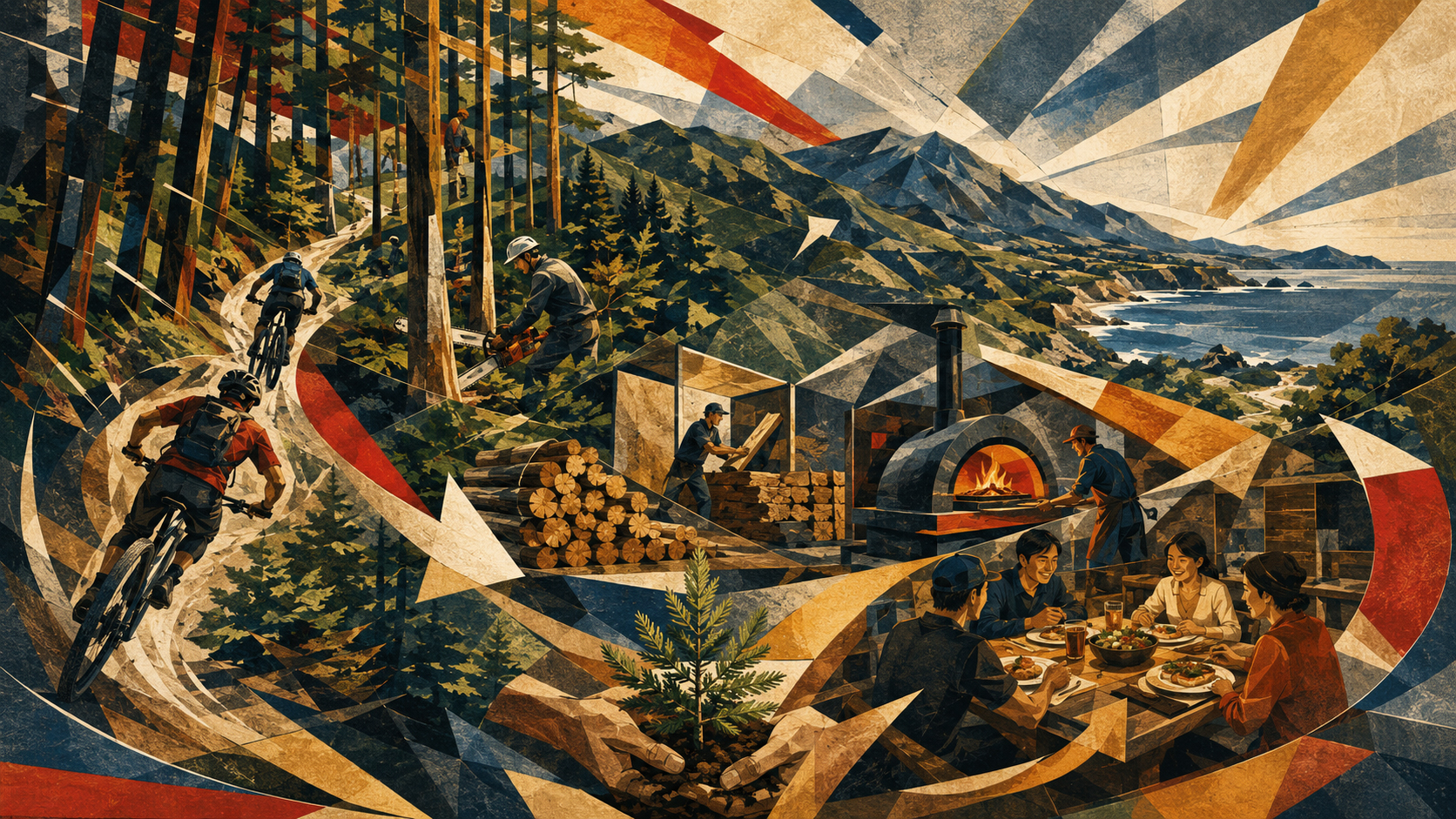
The trail is the operating system
BASE TRES began the West Izu Ancient Trail Restoration Project in 2012 after founder Junichiro Matsumoto heard older residents describe paths once used for charcoal making and daily movement. YAMABUSHI TRAIL TOUR followed in 2013. The company now advertises roughly 40 kilometers of guided routes, with instruction, rental bikes and electric-assist options.
The commercial product is a ride, but the work begins before a guest arrives: obtaining permission from districts and land managers, clearing fallen trees and brush, cutting drainage, checking surfaces, guiding safely and repairing damage. Tourism gives a neglected path an economic user. The path gives tourism a place-specific story.
The system expanded outward. Wood from forest work was used in BASE TRES and Lodge MONDO renovations, sold as stove fuel, and supplied for smoking Izu Tago-bushi bonito. Tours added hiking, kayaking, fishing and gathering. In July 2025, the group opened the 30-seat QUEBICO wood-fired restaurant in Matsuzaki. In January 2026, it announced a runner-up grand prize in the Japan Tourism Agency’s Sustainable Travel Award, following earlier environment and rural-business honors.
Follow the material, money and knowledge
| Forest output or activity | Next use | Value returned |
|---|---|---|
| Restored charcoal and life paths | Guided mountain biking and hiking. | Tour fees, employment and continuous inspection. |
| Usable trunks and branches | Interior timber, firewood, smoking fuel. | A market for material that might otherwise be stranded. |
| Wood heat | Cooking, hot water and space heating at QUEBICO. | Food revenue and reduced purchase of fossil heat. |
| Wood ash | Supplied to local farms as a soil amendment. | Nutrients may return to soil when chemistry and application are suitable. |
| Local fish, game, vegetables and herbs | Meals and harvest-linked tours. | Visitor spending reaches several producers. |
| Guides’ forest knowledge | Interpretation, safety and training. | Tacit knowledge becomes a paid regional skill. |
A genuine circular economy has at least three loops. The material loop keeps wood and nutrients in useful circulation. The financial loop returns visitor spending to local labor and upkeep. The knowledge loop carries landowner memory, forestry skill, trail craft and cooking technique into a new generation. If only the first is counted, the most important resource—people able to maintain the system—disappears.
Satoyama was never untouched wilderness
The wooded hills beside Japanese settlements are often called satoyama. Historically they supplied fuelwood, charcoal, leaf litter, fodder, mushrooms, poles and food. Coppiced broadleaf trees such as oak were cut near the base and allowed to resprout. Regular light, cutting and gathering created a shifting mosaic of young woodland, grass, field and water.
This was not nature without people. It was nature shaped by repeated work. Some species benefited from openings; other organisms depended on old trees and dead wood. Management was never automatically benign, but abandonment also changes habitat. The useful question is not “human or natural?” It is which intervention, at what intensity, for which ecological outcome.
West Izu’s old routes were infrastructure within this working landscape. Charcoal burners needed access to kilns and coppice. Residents moved between settlements, fields, forests and coast before roads and private cars reorganized space. A path recorded economic relationships in its gradient and destination.
The energy revolution that erased a road
Until the mid-twentieth century, wood and charcoal were ordinary household and industrial fuels. Then kerosene, LPG, electricity and city gas offered concentrated energy with less daily labor. Motorization shifted movement to paved roads. A charcoal path lost both its freight and its travelers.
At the same time, postwar Japan planted large areas of cedar and cypress to meet expected reconstruction demand. Cheap imported timber and high domestic labor costs later weakened forestry economics. Japan remained heavily forested, but many plantations needed thinning and many broadleaf fuel woods lost regular coppice markets. A green hillside could be economically abandoned.
This is an important distinction: forest cover is not forest condition. A dense stand may have little understory, poor access or low species diversity. An abandoned coppice may grow into a different habitat, accumulate large stems and lose the age mosaic created by cutting. Restoration must define the desired condition rather than assume any cutting is care.
| Era | Dominant relationship with the hills | Legacy |
|---|---|---|
| Pre-modern | Paths carry people, charcoal, fuelwood, food and materials. | Dense local knowledge and frequently worked coppice. |
| Meiji to early Shōwa | Markets, forestry and coastal trade expand. | Resource use becomes more commercial and connected. |
| Postwar reconstruction | Cedar and cypress planting accelerates. | Large mature plantation resource, often costly to manage. |
| High-growth era | Fossil fuels, imported timber and cars replace local systems. | Charcoal paths and broadleaf fuel markets decline. |
| Depopulating Japan | Fewer owners and workers maintain fragmented land. | Access, boundaries and management knowledge become bottlenecks. |
| West Izu experiment | Experience, food and heat create new demand for stewardship. | A service economy attempts to finance a working landscape. |
Why a bicycle can finance a forest
Low-value wood rarely pays for careful work on steep, fragmented land. A visitor experience can carry much more value per kilogram of extracted material. The same kilometer of maintained trail can be sold repeatedly as guided access without felling another kilometer of forest.
Guiding also bundles scarce goods: permission, route knowledge, transport, safety, instruction, rental equipment and interpretation. A novice buys confidence as much as terrain. An experienced rider buys access to a route that would be difficult to locate or negotiate alone.
This is why access should not be confused with free use. Trails cross ownership, community custom and liability. BASE TRES says it restores routes with permission from all relevant districts and managers. That social license is an asset. Unmanaged publicity can send riders onto private land, create conflict and destroy the cooperation on which the route depends.
Trail school: restoration is continuous
A reopened path is not finished. Rain concentrates in ruts, tires loosen soil, roots emerge, branches fall and vegetation returns. On Izu’s steep slopes and in its typhoon climate, drainage is the central engineering problem. Water must cross or leave the trail without accelerating erosion.
| Management task | Why it matters | Evidence to track |
|---|---|---|
| Landowner agreements | Establish permission, responsibility and closures. | Written scope, renewal and dispute process. |
| Drainage and tread | Limit erosion, sediment and unsafe ruts. | Post-rain inspections, repair hours, sediment points. |
| Rider management | Match speed and skill to a shared landscape. | Group size, incidents, complaints and near misses. |
| Seasonal closure | Protect saturated soil, wildlife or forestry work. | Clear triggers and compliance. |
| Ecological monitoring | Detect disturbance beyond the trail surface. | Vegetation plots, invasive species, wildlife observations. |
| Maintenance finance | Prevent a boom-and-neglect cycle. | Revenue earmarked per rider or tour. |
Mountain biking can support conservation when use is designed and maintained. It can also cause erosion, spread seeds, disturb wildlife and conflict with walkers when unmanaged. “Restored” should describe an adaptive maintenance regime, not a ribbon-cutting date.
QUEBICO: what 100 percent actually means
QUEBICO says no gas line enters the restaurant. Staff cut and process wood from forests they manage. Direct fire cooks food; a wood-biomass boiler supplies hot water and four panel heaters across two floors. The company describes this as 100 percent thermal-energy self-sufficiency.
The qualifier matters. Lighting, refrigeration, ventilation, air conditioning, pumps and other appliances use electricity. Vehicles, chainsaws, food deliveries and guest travel consume energy outside the restaurant’s thermal boundary. The operation is not “off-grid” and does not claim to be.
The restaurant reports avoiding 18.7 tonnes of CO₂ a year by eliminating fossil fuels from cooking, hot water and heating, roughly its comparison with nineteen passenger cars. The public website does not provide a full calculation method, baseline fuel, wood moisture, combustion efficiency or independent verification. The number should therefore be treated as the operator’s estimate, not an audited lifecycle result.
Biomass carbon: renewable does not mean smokeless
Burning wood releases carbon dioxide immediately. It can reduce fossil emissions when harvested wood regrows or would otherwise decay, when forest carbon stocks are maintained, transport and processing are modest, and the equipment burns efficiently. The timing matters: combustion occurs today; regrowth takes years or decades.
The correct comparison is the counterfactual. What would have happened to the tree without the restaurant? Would it remain storing carbon, be cut and left to decay, become a long-lived product or be burned elsewhere? What fossil fuel is displaced? A branch removed during necessary trail work has a different carbon story from a healthy old tree felled solely for heat.
Air quality matters too. Wood smoke can contain fine particles, nitrogen oxides and organic pollutants. Dry fuel, controlled combustion, suitable boiler design, chimney placement and maintenance reduce emissions. “Local” describes distance, not automatic cleanliness.
| Claim | Evidence needed | Common blind spot |
|---|---|---|
| Renewable wood | Harvest plan, regrowth and landscape carbon stock. | Assuming every tree regrows on the relevant timetable. |
| Fossil heat avoided | Measured heat output and credible baseline fuel. | Ignoring boiler efficiency and auxiliary electricity. |
| Local fuel | Origin, transport and processing records. | Chainsaws, trucks, drying and labor travel. |
| Clean combustion | Moisture control, equipment standards and maintenance. | Fine-particle exposure near staff and neighbors. |
| Net carbon benefit | Lifecycle boundary and time horizon. | Counting stack emissions as zero by convention. |
Ash closes a loop—carefully
QUEBICO says its wood ash goes to local farmers as a soil amendment. Ash can return calcium, potassium and other minerals removed from the forest. It is alkaline and can raise soil pH. That can be useful on an acidic field in an appropriate dose.
It is not universally beneficial. Ash chemistry varies by tree, soil contamination and combustion. Excess application can make soil too alkaline or overload salts; contaminants can concentrate in the residue. Food-crop use should follow testing and local agricultural guidance. A circle is only healthy when the receiving soil needs what the outgoing material contains.
Why the restaurant is more than an energy customer
Firewood is bulky and relatively low-value. A restaurant converts the same wood into heat, aroma, hospitality and narrative. Local fish, game, mushrooms, fruit, herbs and vegetables become part of a meal whose value includes the place. A guest can ride the forest, stay in a lodge lined with its wood, gather or fish, and eat food cooked over the heat it produced.
This vertical integration spreads spending across a visit. It also stabilizes demand: a wet day may cancel a ride but not dinner; a restaurant guest may book a tour tomorrow. Lodge, trail and dining can refer customers to one another.
Yet “local food” needs precision. Menus include imported coffee, wine, spices and other ingredients. That is not hypocrisy; no serious local economy is sealed. The useful question is which high-value relationships are localized, which imports are necessary, and whether the story distinguishes them honestly.
Regenerative, sustainable and circular are different
Sustainable usually means maintaining ecological and social conditions without depletion. Circular means designing out waste and keeping materials at useful value. Regenerative makes a stronger claim: the activity improves the ecological or social system beyond its starting condition.
West Izu’s model clearly links outputs and enterprises. Whether it is regenerative requires measurements: forest structure and species, soil and stream condition, carbon stock, erosion, employment quality, resident consent and the share of revenue returning to stewardship. An award recognizes an approach; it does not replace longitudinal evidence.
Scale is another boundary. A 30-seat restaurant can use carefully selected local wood. Replicating thousands of such restaurants without harvest plans could increase pressure on forests and air quality. The transferable lesson is not “burn more wood.” It is “build demand around locally appropriate stewardship, then stay inside the ecological yield.”
The rural-economy lesson: sell care, not just commodities
Rural Japan often exports low-value material and imports finished value. Logs leave; furniture returns. Fish leave; branded meals are sold elsewhere. Young workers leave because the local economy offers too few skilled combinations. BASE TRES reverses part of that chain by joining forestry, guiding, design, lodging, cooking and storytelling.
The jobs are hybrid. A guide understands braking technique, weather, emergency response, landowner relations and drainage. A cook understands fuel species, moisture, fire behavior and food. These combinations are hard to classify in old industrial boxes, but they are exactly how a small market creates full livelihoods.
Tourism can also extract. Outside investors may capture profit, housing may become scarce, residents may perform culture for visitors and popular sites may be degraded. A durable model publishes who owns assets, who is paid, how many visitors the trail can carry, and how residents can close or change a route.
How to audit the West Izu circle
| Dimension | Better indicator | Why it teaches more |
|---|---|---|
| Forest | Area under plan, age/species mix, carbon stock, habitat indicators. | Tonnes cut alone do not reveal ecological recovery. |
| Trail | Maintenance hours, erosion points, incidents, closure days. | Kilometers opened can hide condition and cost. |
| Energy | Useful heat, wood moisture, stack emissions, auxiliary electricity. | Firewood volume does not equal efficient or clean heat. |
| Economy | Local wages, procurement share, supplier count, maintenance allocation. | Visitor totals do not show where money stays. |
| Community | Landowner agreements, resident feedback and conflict resolution. | Social permission is infrastructure. |
| Learning | Staff training, apprenticeships and transferred practice. | A model survives only if knowledge outlives founders. |
The historical meaning: a road changes purpose, not memory
The old path first belonged to an economy of necessity. People walked it because wood, charcoal and movement required labor. Fossil energy and cars made that labor unnecessary, and the path vanished beneath vegetation. The new economy does not recreate the old life. Visitors ride for pleasure; cooks turn fuel into a premium experience; digital reservations bring distant customers.
Yet the physical logic survives. Forest, village, river and sea are close. Maintenance produces material. Material carries energy. Knowledge resides in people who repeatedly enter the land. The innovation is to attach modern revenue to those relationships without pretending history was picturesque or nature was untouched.
Japan’s postwar model rewarded scale, standardization and imported energy. West Izu tests another proposition: a small place can become competitive by making its constraints legible—steep land, forgotten paths, broadleaf woods, fishing coast, empty buildings—and joining them into one experience.
The circle will never be perfect. Visitors arrive in vehicles. Electricity and food cross regional boundaries. Wood smoke has emissions. Trail use has ecological costs. But completeness is not the standard; transparent improvement is. The useful circle is one whose boundaries are stated, flows measured, landowners heard and forests demonstrably better after the story has been sold.
West Izu’s most important product may not be a bike tour or a wood-fired plate. It may be a method for seeing abandoned infrastructure as memory with maintenance needs—and for turning the pleasure of a visitor into the patient work of keeping a landscape alive.
Sources and further reading
- YAMABUSHI TRAIL TOUR — route length, tour formats and the West Izu Ancient Trail Restoration Project.
- BASE TRES: Ancient Trail Restoration — project chronology, permissions, charcoal paths and wood uses.
- BASE TRES: About the West Izu model — staff, company history and links among forest, coast and tourism.
- QUEBICO official site — thermal-energy boundary, wood sourcing, menu, ash loop and the operator’s CO₂ estimate.
- Lodge MONDO: Opening of QUEBICO — boiler design, heating uses and electricity exclusion.
- BASE TRES: 2026 Sustainable Travel Award announcement — award history and replication plans.
- Forestry Agency of Japan: Annual Report on Forest and Forestry — national history, forest resources, labor and timber markets.
- Forestry Agency: State of Japan’s Forest Resources — official forest area and composition datasets.
- International Partnership for the Satoyama Initiative — socio-ecological production landscapes and stewardship.
- Ministry of the Environment: Satoyama conservation — Japanese policy and landscape context.
- Ellen MacArthur Foundation: Circular economy introduction — material-loop principles and design distinctions.
- IPCC AR6 Working Group III — bioenergy, carbon accounting and mitigation conditions.