The longest throw did not win gold. The reason tells us something important about elite para athletics.
Two brothers, one podium
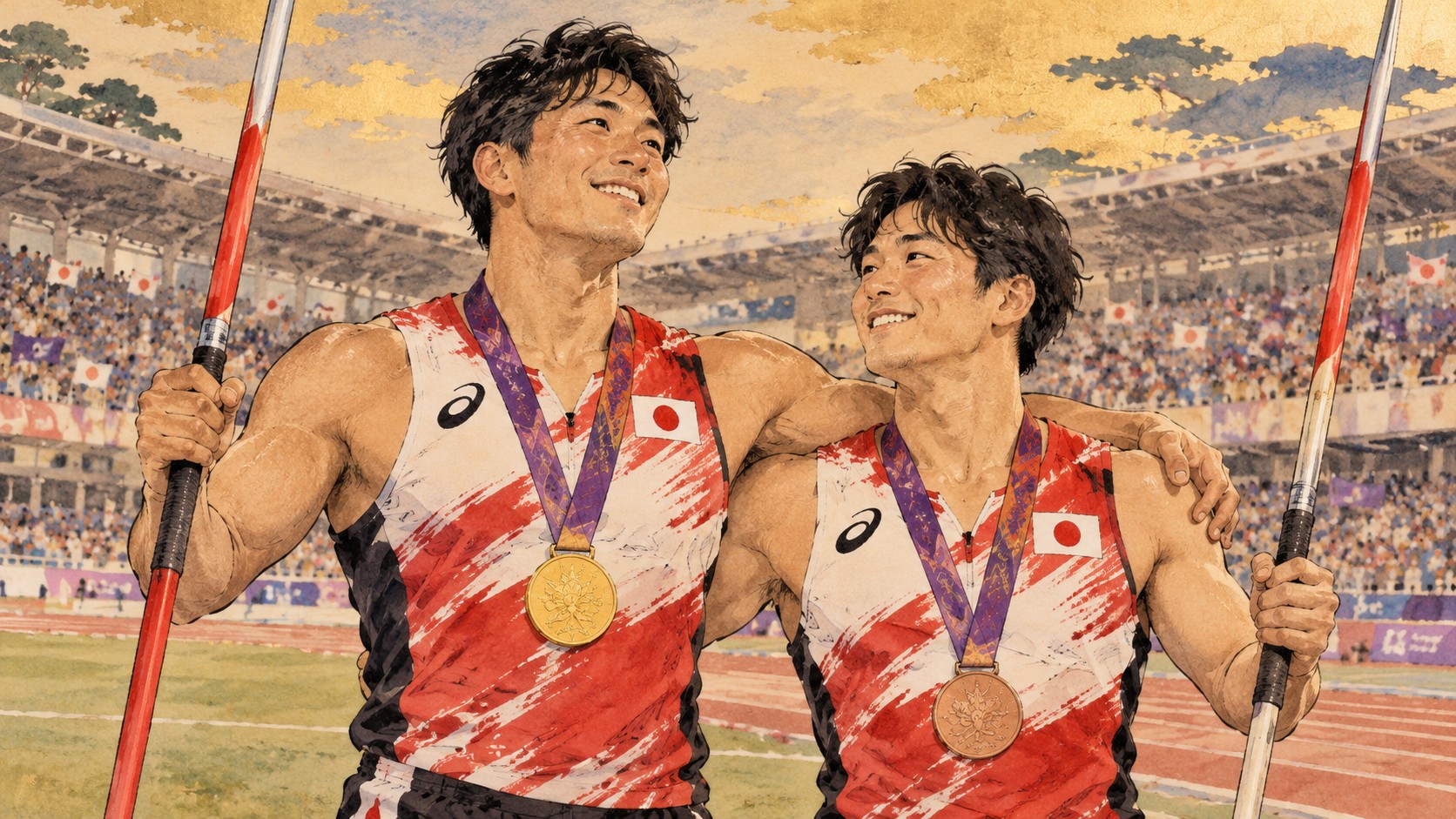
At Nagoya City Mizuho Park Athletic Stadium on October 21, brothers Yuta Wakoh and Kenta Wakoh delivered one of the host nation’s distinctive moments at the Aichi-Nagoya 2026 Asian Para Games. Yuta took gold in the men’s combined F12/F13 javelin competition and Kenta bronze. Between them stood Indian silver medalist Manjeet Vyas.
The Japanese news agency Jiji reported the medals and identified Yuta as 29 and Kenta as 26. The brothers’ Japanese names are 若生裕太 and 若生拳太; Wakoh is a romanization of the uncommon family name 若生, read わこう. Rather than assuming this was an ordinary longest-throw-wins final, the numbers force a better question.
The silver medalist threw farther than the gold medalist
Accounts of the competition place Yuta’s best at 59.66 meters, Kenta’s at 58.60 meters and Vyas’s at 61.41 meters. Vyas’s raw distance was the longest, yet gold went to Yuta. This is not a mistake or a disqualification: the athletes were competing in a combined event for two different visual-impairment sport classes.
The available results summaries list classification-adjusted scores of 914 points for Yuta, 838 for Vyas and 783 for Kenta. Those figures, rather than the raw distances alone, determined the medals. Any account that omits the scoring method risks misrepresenting the result and diminishing the achievements of all three athletes.
What F12 and F13 mean
Para athletics uses classifications so competitors with different eligible impairments can compete under defined conditions. F identifies a field-event category. F12 and F13 relate to visual impairment; they are not diagnoses and reveal neither an athlete’s complete medical history nor exactly how that person sees the world outside competition.
Where classes are combined in a field event, World Para Athletics rules allow a Raza points system, using class-specific coefficients to translate measured performance into a comparable score. This distinction is technical but essential. For a viewer accustomed to Olympic javelin, the scoreboard may initially be counterintuitive; understanding it makes the contest richer.
Before the javelin, baseball
Yuta’s route to this arena did not begin on a throwing runway. In an October 19 feature, Japanese broadcaster Nippon Cultural Broadcasting’s Low Vision Project reported that he captained a strong high-school baseball team and developed Leber optic neuropathy during his second year at university. He had wanted to become a physical-education teacher.
The broadcaster recounts that he tried goalball and blind football before discovering javelin, a sport to which the throwing skill he had developed in baseball could be applied. The continuity matters: the javelin did not erase his earlier sporting life. It gave skills accumulated in one sport a different competitive setting.
Kenta’s bronze deserves its own story
The same broadcaster introduced younger brother Kenta as an athlete with visual impairment representing Japan in the same event. His medal at age 26 is an independent accomplishment, not a footnote to Yuta’s victory.
The publicly available sources consulted here do not support invented conversations between the brothers, detailed descriptions of their private training, or claims about what either man felt on the podium. Those are questions for interviews. Respect for both athletes requires preserving that boundary.
A longer history of classification and fair competition
International disability sport expanded through the twentieth century, with the Rome 1960 Games later recognized as the first Paralympic Games. Athletics gradually developed categories and detailed technical rules to produce meaningful competition across eligible impairments. The system continues to evolve and sometimes draws debate, especially where different classes share a medal event.
Classification cannot eliminate every disagreement about fairness. It does, however, provide a transparent framework that can be examined and challenged. World Para Athletics publishes scoring tables for combined field events. Readers deserve to know that framework before being invited to judge an outcome purely by distance.
Nagoya and a wider Asian contest
The Aichi-Nagoya Games brought athletes from across Asia to compete in front of Japanese spectators. The brothers’ medals were part of a larger competition featuring international rivals whose performances matter in their own right. Vyas, for instance, produced a 61.41-meter throw and earned silver in the same event.
A strong host-nation story should not erase the rest of the podium. Nor should coverage of impairment treat athletes as symbols instead of technicians making competitive decisions. Running approach, release timing, balance and practice still determine what happens when the javelin leaves the hand.
What the photograph cannot tell us
An illustration of the brothers can capture celebration, but without a verified photo reference it cannot establish their faces, seating arrangements or specialized gear. The previously generated Japan.co.jp illustration incorrectly shows Kenta in a wheelchair even though this is a standing visual-impairment javelin event. It must be corrected or replaced before publication.
That may sound like an art-directing detail. It is a journalistic fact. A story about athletes whose classifications are frequently misunderstood should be especially careful not to create a new misunderstanding in its own visual presentation.
What remains after the medals
The results are established: gold for Yuta, bronze for Kenta. The brothers’ fuller story—the routines of training, the relationship between them, their ambitions and the meaning of competing at home—deserves firsthand reporting rather than imagined dialogue.
For now, the drama is already substantial. Two brothers made one podium, and a scoring system unfamiliar to most fans helps explain why the longest throw was not the winning performance. Understanding both facts makes this more than a sentimental moment: it becomes a story about the skill and structure of elite sport.
Sources and reporting notes
Cross-checked Jiji Press, the published schedule, Japanese radio profile, international result accounts and World Para Athletics scoring reference. No firsthand athlete interviews or independently acquired official full attempt-by-attempt result sheet.