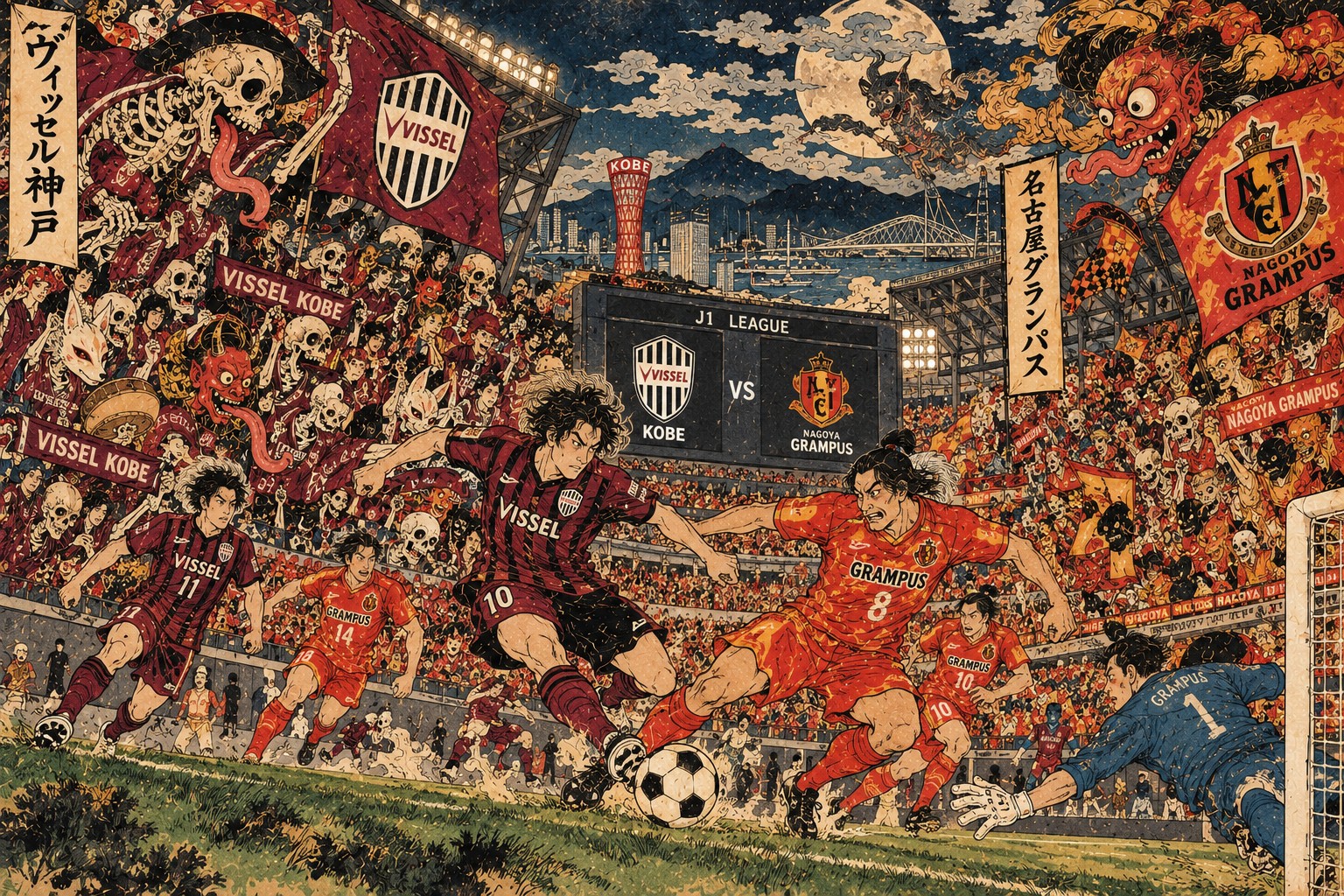
The match turns on two questions: can Kobe make pressure count, and can Nagoya defend without surrendering attacking intent?
Halloween afternoon, serious stakes
Halloween in Kobe has a football appointment. Vissel Kobe host Nagoya Grampus at Noevir Stadium Kobe on Saturday, October 31, with kickoff at 3 p.m. Japan time. The fixture is part of Matchweek 13 in the 2026–27 Meiji Yasuda J1 League, and it matters for reasons that have nothing to do with costumes. Kobe are pursuing the leading clubs; Nagoya are searching for greater consistency and a way to close a sizeable gap in points. An ordinary autumn afternoon has become a meaningful test of the two sides’ ambitions.
The verified state of play
J.League’s standings explicitly updated on October 25 place Kobe fifth with 23 points from 12 matches, and Nagoya 11th with 14. The teams are nine points apart. Kobe have seven wins, two draws and three losses; Nagoya four wins, two draws and six losses. The official fixture lists 3 p.m. kickoff at Noevir Stadium Kobe, with DAZN streaming and regional NHK broadcasts in the Nagoya area. Those are scheduled arrangements, not a guarantee that weather or last-minute circumstances cannot change.
Kobe’s frustrating zero
Kobe’s most recent league match offered an unusually clear picture of the tension facing an ambitious side. On October 24 the club drew 0–0 at home with FC Machida Zelvia, taking 17 shots and winning eight corners but finding no goal. They remain only four points behind the joint leaders, Machida and FC Tokyo, according to the October 25 standings. A single goalless game does not define an attack, but against a Nagoya side trying to regain ground, Kobe will be judged on how effectively pressure turns into a finish.
Nagoya’s late response
Nagoya were behind after 14 minutes against Yokohama F. Marinos on October 25, when Jordy Croux scored for the visitors. Yuya Yamagishi equalized in the 74th minute, converting a cross from Tomoki Takamine to secure a 1–1 draw. The moment reveals both opportunity and vulnerability: Nagoya found a way back after falling behind, but they still left with one point rather than three. Their recent league form includes draws and wins, yet their season record is negative in both goal difference and results.
A contest for the flanks
The last round suggests intriguing tactical questions. Nagoya found an equalizer from a cross, while Kobe generated pressure and corners without scoring against Machida. Can Kobe stretch Nagoya’s defensive line and create cleaner chances in central areas? Can Nagoya attack space left behind as Kobe push numbers forward? These are analytical questions prompted by actual recent matches, not claims about secret training instructions or a manager’s unpublished plan.
The week between two competitions
Kobe played in the AFC Champions League Elite on October 27 and recorded a 1–0 away victory over Daejeon Hana Citizen. That puts the Nagoya fixture within a compressed run of domestic and continental football. Rotation, recovery, and the timing of substitutions may therefore matter as much as an individual duel. It would be unsound, however, to name a guaranteed starting eleven three days before kickoff. Team sheets, fitness updates and suspensions require fresh match-day confirmation.
The numbers behind the match
After twelve league games Kobe had scored 18 and conceded 11, a goal difference of plus seven. Nagoya had scored 14 and conceded 18, a differential of minus four. The nine-point standings gap is significant but not insurmountable in a season scheduled to run into 2027. The team that wins the middle of the pitch may control the game’s rhythm, but no single number establishes who will win. Pressing intensity, chance quality, and personnel cannot be inferred from this simple table alone.
Why the calendar has changed
For international fans accustomed to the old Japanese season, the October fixture needs explanation. The J.League decided in December 2023 to shift to an August-to-May calendar starting in 2026–27. The league arranged a special transition competition during the first half of 2026. October once signaled the closing stages of a Japanese top-flight campaign; now it falls within the early autumn part of a season that stretches over a winter break and concludes in the following spring. This is a structural change for clubs, supporters, travel and recruitment.
A rivalry framed by different eras
Kobe’s modern ascent includes J1 championships in 2023 and 2024 and victory in the 2026 transitional competition. Nagoya won the league title in 2010 and has also captured major domestic cups, including the 2021 and 2024 Levain Cups. Those achievements cannot decide Saturday’s match, but they explain why each side carries a demanding constituency. Fans know what success can look like, and expectations are shaped by memory as well as recent results.
The business behind the matchday
Professional football also operates as a regional civic institution. A home fixture draws workers, visiting fans, television audiences, and spending around a stadium and transport routes. Yet no verified figure currently isolates the economic impact of this October 31 match. An honest account should distinguish the general commercial role of club football from measurable match-specific gains. The venue and broadcast information are confirmed; attendance and spending are not available before the event takes place.
What viewers should watch
Watch how quickly Nagoya advance after regaining possession; whether Kobe convert territorial pressure into clear chances; and whether the sides manage their substitutions differently as the second half progresses. These are testable questions, not predictions. The confirmed storyline is already compelling: one club trying to keep pace with the top four, the other trying to build momentum. When the match ends, the official result and lineup will supply the final chapter of this Halloween fixture.
Sources and verification
Official schedules and the standings explicitly updated October 25 are used. Tactical observations are analysis, not team disclosures. No October 31 outcome is assumed.