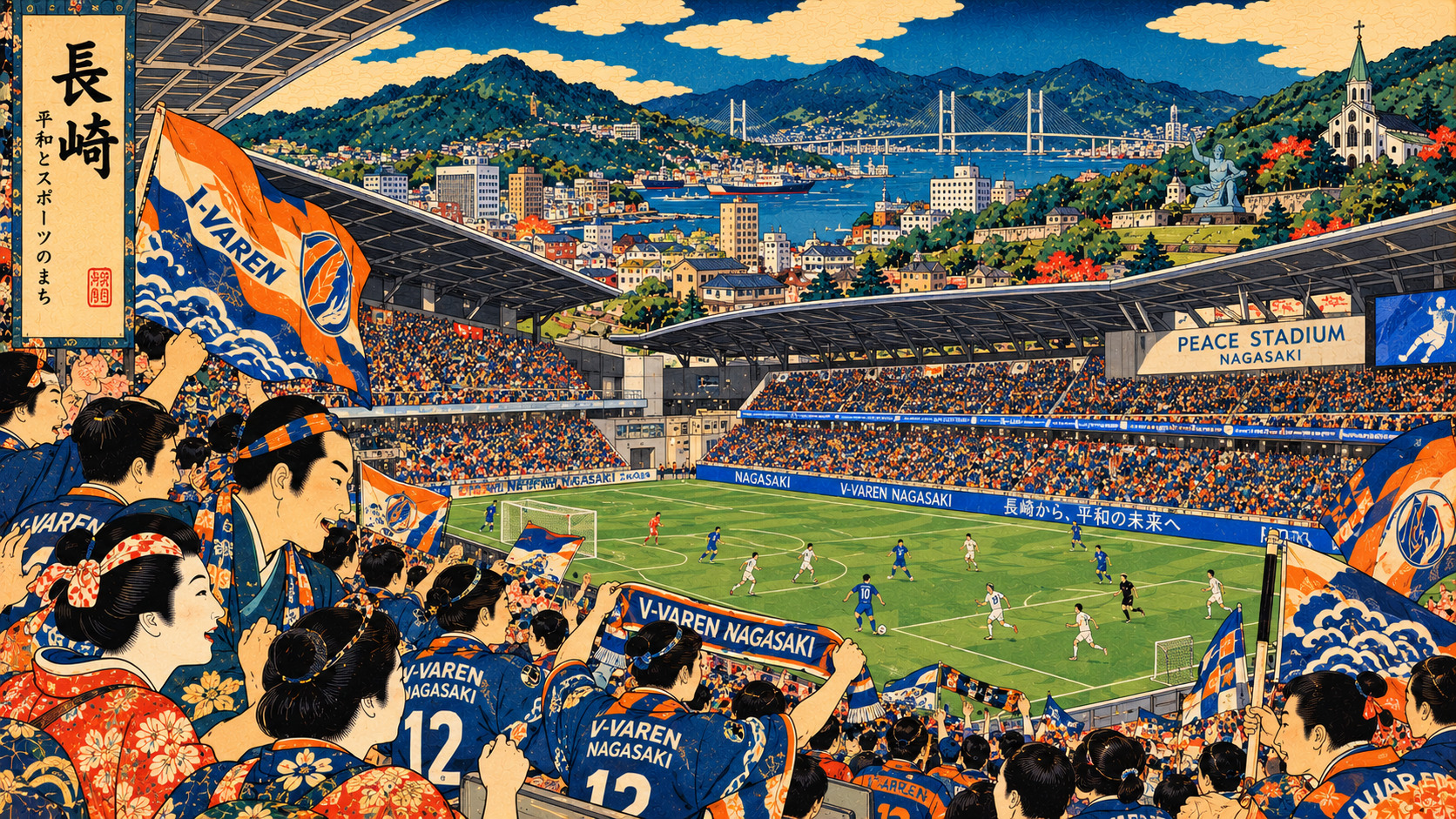
A full stadium, a late equalizer, and a defeat
The crowd at Nagasaki’s Peace Stadium had reason to believe. With 20,246 supporters in attendance on November 1, substitute Thiago Santana equalized against Tokyo Verdy in the 76th minute. Five minutes later, Kazunari Ichimi restored the visitors’ advantage. Nagasaki lost 2–1, and the score exposed a compelling contrast: a club playing before substantial home support inside a spectacular new urban development still has to solve the ordinary problems of defending, finishing and winning points. The stakes extend beyond a single football match, but the football must come first.
The first decisive moment came after 45 minutes
The official J.League kickoff was 2:03 p.m. Tokyo Verdy broke through in the twelfth minute of first-half stoppage time. Itsuki Someno took a pass from Kanya Fujimoto, moved into the penalty area and scored with his right foot. The extended added-time period is recorded officially; its precise causes should not be invented from the scoreline. For Nagasaki the important tactical fact is straightforward: a match in which it had built passages of possession reached the interval with Verdy ahead. Controlling portions of play had not produced the opening goal.
The substitute who changed the score
Nagasaki coach Takuya Takagi sought a route back after halftime. Thiago Santana entered from the bench and found the net in the 76th minute, turning a cross from Yuto Iwasaki on the left into a left-footed equalizer. The substitution showed that the home side could change the direction of a match with attacking personnel. Yet the best judgment of a substitution is not only whether the incoming player scores. The team must also manage the minutes that follow, when both sides are adjusting after a major momentum shift.
Five minutes later, Ichimi answered
The winning move was a sequence rather than an isolated shot. According to the league’s play-by-play account, Issei Kumatoriya threaded the ball to Shuhei Mizoguchi, whose cross reached Kazunari Ichimi in the penalty area. Ichimi scored in the 81st minute, restoring the lead and leaving Nagasaki without enough time or precision to recover again. It is tempting to call this a lapse in concentration; that would attribute a mental state that the available evidence does not establish. The verified sequence describes something more useful: Verdy constructed an opening through a pass, a cross and a finish.
What the numbers say—and what they do not
The J.League recorded 16 shots for Nagasaki against 13 for Verdy, possession at 50 percent apiece and shots on target of two and three respectively. Such statistics are directionally useful, but they cannot measure opportunity quality by themselves. Shooting more frequently is not the same as creating better chances, and the final score cannot identify every tactical advantage. The 16-to-13 shooting edge made little difference because Verdy converted two moments and Nagasaki one. Shot locations and expected-goals information would be needed for a more definitive chance-quality comparison.
Was this really a fortress?
Before kickoff, the league’s preview noted that Nagasaki had collected 11 points from its previous six home league fixtures, against only one point from six away games. Peace Stadium’s tightly arranged seating places spectators as close as about five meters from the pitch. It is easy to see how that physical relationship can create a distinctive matchday experience. It is harder to demonstrate that architecture causes results. Opponent strength, travel, injuries, schedule and team selection all matter. The loss to Verdy is a reminder to distinguish an appealing sporting hypothesis from a proven causal claim.
The long road from regional football
Nagasaki’s football identity predates the new stadium. The prefecture has a celebrated school-football tradition, notably associated with Kunimi High School. V-Varen itself emerged in 2005, entered J2 in 2013 and reached the top division for the 2018 season. Relegation and rebuilding followed. A second-place J2 finish in 2025 returned the club to J1 in 2026. Those milestones explain why a new stadium matters emotionally: the club did not suddenly appear as part of a real-estate development. It arrived with supporters, past disappointments and years of effort already invested.
A factory site becomes a new neighborhood
Nagasaki Stadium City opened on October 14, 2024, close to central Nagasaki and the railway station. Developed by Japanet’s Regional Creation Nagasaki, the integrated site contains Peace Stadium, an arena, hotel, retail and office space. It was conceived as somewhere people might spend time on ordinary days, not merely enter on match afternoons. The football stadium seats approximately 20,000 and the arena approximately 6,000. Restaurants and other amenities connect spectator activity to the wider daily economy, at least in principle. The business model is therefore larger than selling match tickets.
The difference between visits and visitors
The operator’s first-anniversary report, published in October 2025, said the complex recorded 4.85 million visits during its first operating year. That is an eye-catching activity measure. It is not evidence that 4.85 million different people traveled to Nagasaki, nor does it describe football attendance alone. Repeat local customers, hotel guests, retail shoppers and multiple event visits may all contribute. For a development meant to function all week, frequent local use is meaningful. But journalism should resist converting a cumulative footfall figure into an unsupported claim about inbound tourism.
A ¥37.83 billion estimate requires context
On October 1, 2026, the operator promoted an integrated impact assessment prepared by Funai Soken, estimating annual economic ripple effects for Nagasaki Prefecture at ¥37.83 billion. The distinction between an economic-impact model and verified net economic gains is central. Such estimates depend on assumptions about spending, supply chains, induced activity and the area of analysis. They do not automatically establish that household incomes, taxes or tourism spending increased by the full amount. Displacement from existing businesses and the costs of construction and operations also matter when evaluating public or regional value.
The case for a destination beyond football
Peace Stadium is deliberately embedded in a broader destination that combines a basketball arena, hotel, office buildings and commerce. That arrangement creates possibilities: a matchgoer might stay overnight, patronize restaurants or discover other parts of the city. It also creates economic questions. Does spending remain within one privately operated complex? How much reaches neighboring independent businesses? Are local workers gaining stable jobs? And do event crowds produce congestion or access problems? Answers require evidence from merchants, households and transport operators, not only developer projections.
A loss that leaves a larger question
Nagasaki did not earn a point against Verdy, despite the equalizer and the backing of 20,246 fans. But the existence of that crowd inside a distinctive central-city venue illustrates how football can become part of a city’s public life. A stadium may make attendance attractive and offer a platform for commercial activity; it cannot defend a cross in the 81st minute. The sporting and urban experiments should be evaluated on their own terms, with results tracked over time. Nagasaki’s next chapter will be written in both places: on the pitch and in the surrounding streets.
Sources and reporting method
Document-based reporting from official league results, the club, the facility operator and published match analysis. No original interviews with players, supporters or neighboring merchants were conducted.