- Why Yoshikazu fits this edition
- The historical shock behind Yokohama-e
- Who Utagawa Yoshikazu was
- How Yoshikazu pictured the unfamiliar
- Curated work I: “America”: A Steamship in Transit
- Curated work II: Portrait of a Russian Couple
- Curated work III: American Family with a Dancing Daughter
- Public domain, museum access and editorial caution
- Why Yoshikazu is the right Art Choice now
Why Yoshikazu fits this edition
Art Choice should do more than supply a beautiful image. It should provide a way of seeing the entire edition. For JAPAN.co.jp’s November 14, 2026 package, Utagawa Yoshikazu is compelling because he worked at an earlier turning point, when Japan was suddenly confronted with unfamiliar technologies, new people and a rapidly widening horizon. His pictures turned bewilderment into form.
That is precisely what this edition’s fifteen commissioned illustrations are trying to do. The stories range from physical AI robotics and digital medicine to industrial restructuring, regional food culture, sports and textile craft. Yoshikazu’s late-Edo Yokohama-e vocabulary—strong outlines, animated figures, daring perspective, blocks of Prussian blue and vermilion, and an appetite for novelty—can bind those varied subjects into a single editorial world.
This feature therefore serves two purposes. It introduces Yoshikazu as a historical artist worthy of dedicated attention, and it explains why his visual logic is unusually well suited to present-day journalism about Japan encountering new machines, new ideas and new forms of cultural exchange.
The historical shock behind Yokohama-e
Yokohama-e emerged from a moment of upheaval. After the treaties of the late 1850s and the opening of Yokohama in 1859, the port became one of the most visible contact zones between Japan and the wider world. Foreign residents, consular buildings, steamships, imported devices and unfamiliar clothes all became objects of popular curiosity.
The Yokohama Museum of Art describes how pictures of these exotic scenes were produced in great numbers from 1860 onward and came to be known as Yokohama-e or Hama-e. They were not neutral documents. They were commercial prints made quickly for an audience hungry to see what the new world looked like. That appetite gave artists room to teach, entertain, simplify and exaggerate all at once.
Seen today, Yokohama-e occupies an intriguing middle ground. It belongs to the world of ukiyo-e publishing and mass spectatorship, yet it also behaves like early illustrated journalism. It shows how urban Japanese artists processed the shock of globalization before photography and newspapers fully took over the work of visual reporting.
Who Utagawa Yoshikazu was
Yoshikazu remains a somewhat elusive figure. Municipal and museum sources identify him as 歌川芳員, read Utagawa Yoshikazu, a pupil of Utagawa Kuniyoshi. He used art names including Issen, Issen-sai and Ichikawa. His exact birth and death dates are uncertain, a reminder that even artists who helped define a major visual genre can remain biographically shadowy.
What is clearer is his activity. Official Japanese sources describe him as producing warrior prints, battle scenes, bird-and-flower subjects and illustrations, but they also emphasize his strong interest in foreign customs from the Kaei era onward. Kitakyushu Municipal Museum of Art states that he left roughly 110 Yokohama-e works—second only to Yoshitora—and became one of the genre’s leading specialists.
That combination matters. Yoshikazu was not a Europeanized outsider painting from inside the foreign settlement. He was an Edo-trained ukiyo-e artist applying established printmaking skills to unprecedented subject matter. His work reveals how quickly the popular print world could adapt to a transformed visual economy.
How Yoshikazu pictured the unfamiliar
The fascination of Yoshikazu’s prints lies not only in what they show but in how they show it. Foreign dress is rendered with care, but also with the flat patterning and theatrical clarity familiar from ukiyo-e. Machines are treated as spectacular protagonists. Interiors become stages on which chandeliers, chairs, pianos, sewing devices or cameras announce a new order of things.
Many such works were probably based partly on imported images, hearsay or indirect observation. That does not reduce their value. It tells us that Yokohama-e was an imaginative synthesis rather than a camera-like record. Japanese viewers were not simply consuming facts. They were consuming interpretation—an emotionally legible version of modernity.
This is one reason Yoshikazu works so well as an editorial inspiration today. His prints balance specificity and stylization. They acknowledge novelty without surrendering compositional discipline. In a newsroom setting, that helps turn difficult contemporary stories into a coherent visual language.
Curated works
Three works anchor this feature: the steamship triptych, the Russian couple, and the American family. Each offers a different way of seeing foreign encounter in late-Edo Japan.
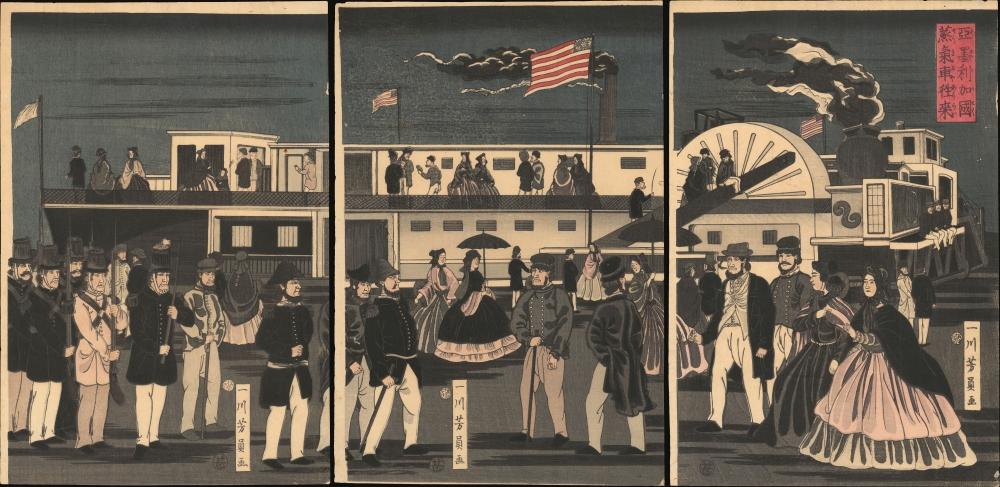
Triptych by Utagawa Yoshikazu. The Met marks the work public domain. We use it here as the lead visual metaphor for an edition about Japan meeting the future.
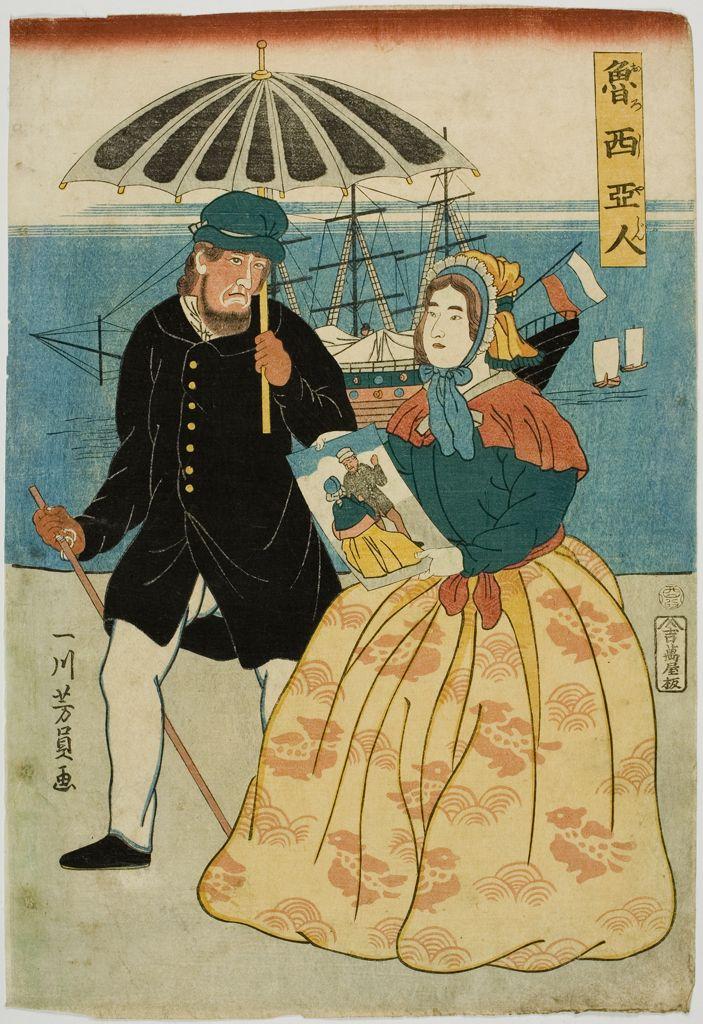
Documented by LACMA. The sheet shows Yoshikazu’s interest in dress, nationality labels and harbor symbolism as tools for making the foreign world readable.
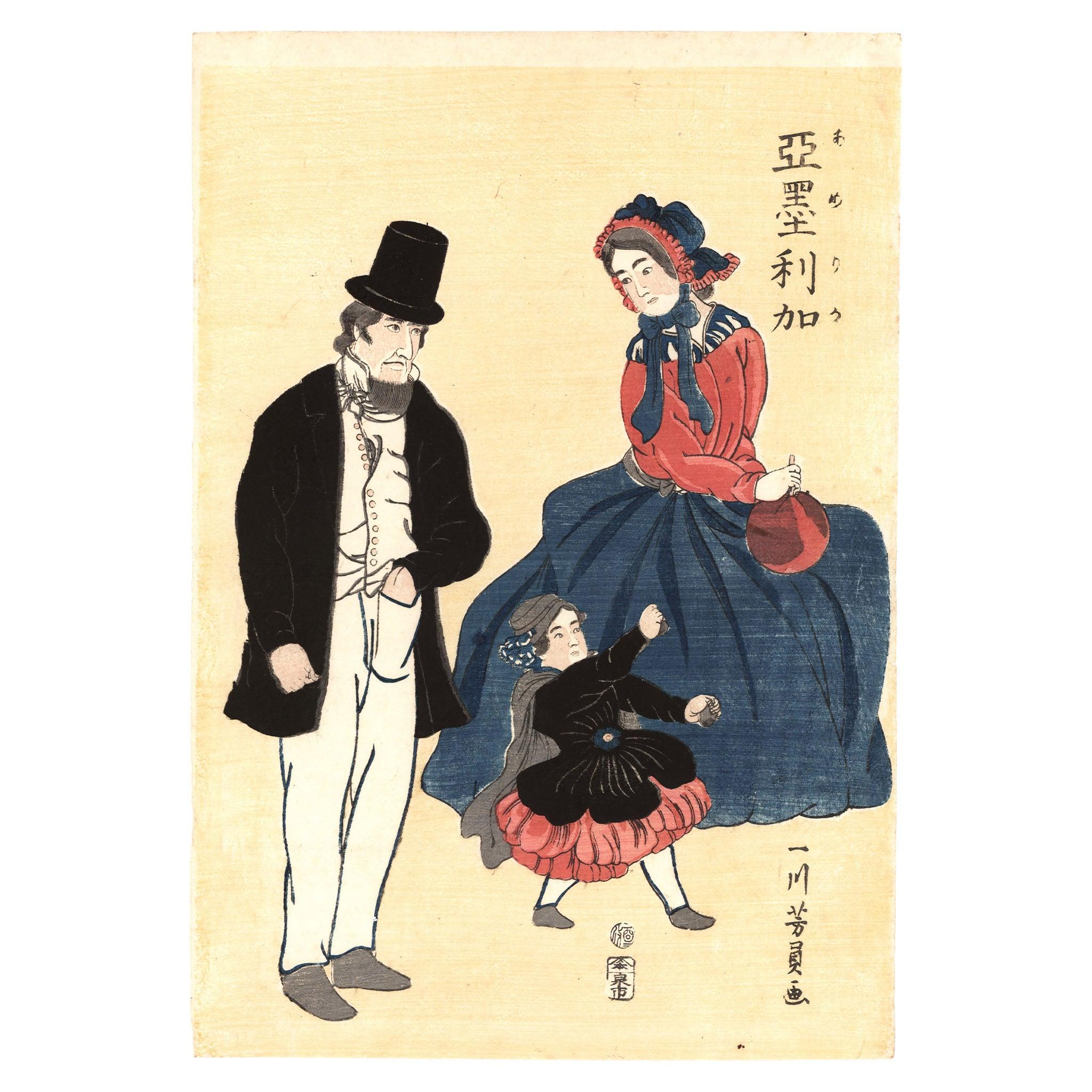
A more intimate Yokohama-e scene, published by the Met as a public-domain work. It humanizes international encounter by framing it through family life.
Curated work I: “America”: A Steamship in Transit
For the hero image of this Art Choice feature, the most dramatic selection is the triptych known in English as “America”: A Steamship in Transit,” dated 1861. The Metropolitan Museum of Art identifies it as a public-domain work by Utagawa Yoshikazu. Its Japanese title is conventionally written 「亞墨利加國蒸氣車往来」 or variants close to that wording.
The print compresses multiple fascinations into one panoramic sheet: military power, marine technology, foreign costume, flags, speed and the spectacle of massed figures moving with purpose. It is less a technical diagram than an announcement that the world has become larger and faster than it used to be. Even the crowdedness of the scene becomes part of the point.
As a curatorial choice for JAPAN.co.jp, the work offers an ideal metaphor. Our November 14 edition likewise assembles many domains—science, commerce, transportation, culture—under the sign of motion. One reason to use the steamship triptych as the lead image is that it captures the sensation of a society watching the future arrive all at once.
Curated work II: Portrait of a Russian Couple
The third curated work is Portrait of a Russian Couple, dated to the eighth month of 1861 and catalogued by the Los Angeles County Museum of Art. LACMA’s note places the image squarely within the short Yokohama-e boom of 1859–64 and explains how such prints relied on nationality labels, clothing details and harbor iconography to make the foreign world legible to Japanese consumers.
The sheet is especially revealing because it shows Yoshikazu’s interest in social display. Rather than focusing on a ship or machine, he turns the foreign couple into a study in posture, dress and cultural self-presentation. The woman holding a souvenir print inside the image adds a witty self-referential touch, reminding viewers that Yokohama-e was itself part of the commodity culture of the treaty-port era.
Curatorially, this matters because it broadens the story beyond technology. Yoshikazu was not only an illustrator of machines. He was an interpreter of social contact—how people looked at one another, how they dressed for public view, and how novelty became consumable through print.
Curated work III: American Family with a Dancing Daughter
The Metropolitan Museum’s public-domain print American Family with a Dancing Daughter, dated the second month of 1861, is perhaps the most humane of the group. Instead of monumental power or maritime spectacle, it presents a family scene: parents watching their daughter dance. The unfamiliar world becomes domestic, almost intimate.
That tonal shift is important. Yokohama-e was not only about astonishment. It was also about translation. By showing foreign people in recognizable social arrangements—family, leisure, conversation, work—artists made the unknown less abstract. The encounter with “the West” was filtered through scenes that could be read as ordinary life, even when the clothing and gestures remained exotic.
For JAPAN.co.jp, this print is a reminder that international encounter is not only geopolitical. It is also personal. Stories about science, sports or regional culture are ultimately stories about human beings adjusting to change inside everyday life.
Public domain, museum access and editorial caution
One of the practical advantages of choosing Yoshikazu is that several major institutions explicitly identify relevant works as public domain. The Met’s records for American Family with a Dancing Daughter and “America”: A Steamship in Transit all state Public Domain and provide download access. The Tokyo Metropolitan Library digital archive likewise marks certain Yoshikazu works as public domain.
At the same time, editorial caution remains necessary. The nineteenth-century prints themselves are in the public domain, but not every modern reproduction is released under identical terms. The Russian Couple work, for example, is easy to document at LACMA, yet the reproduction-rights environment differs from institution to institution. Any live publication workflow should therefore obtain images from museums or archives that explicitly permit reuse or provide open-access downloads.
A second caution concerns biography. Yoshikazu’s exact life dates remain unsettled across museum and municipal records. That uncertainty should be acknowledged rather than papered over. Good cultural journalism distinguishes between what is clearly documented, what is institutionally inferred and what remains unresolved.
Why Yoshikazu is the right Art Choice now
As an Art Choice feature, Yoshikazu offers more than period charm. He represents a specifically Japanese mode of looking at acceleration, contact and surprise. His works do not imitate Western realism, yet they confront Western presence head-on. They retain ukiyo-e’s graphic confidence while making room for ships, foreign families, cameras, sewing devices and other signs of a changing world.
That is why his perspective can organize the entire November 14 edition. The news package explores Japan meeting the future in many forms: artificial intelligence, conservation biology, autonomous mobility, changing sports culture, regional food knowledge and craft survival. Yoshikazu’s example tells us that novelty can be pictured with curiosity rather than surrender, with strong design rather than visual chaos.
My recommendation, therefore, is clear. Utagawa Yoshikazu deserves a dedicated JAPAN.co.jp Art Choice feature, and his late-Edo Yokohama-e sensibility provides the strongest unifying theme for the edition’s fifteen commissioned illustrations. He pictured Japan’s encounter with the world; that makes him an unusually apt guide to Japan’s encounter with the future.
Works at a glance
| Lead work | 《亜墨利加国蒸気車往来》 / “America”: A Steamship in Transit | The Met · Public Domain |
|---|---|---|
| Curated work | 《ロシア人男女図》 / Portrait of a Russian Couple | LACMA collection |
| Curated work | 《踊る娘を見守るアメリカの家族》 | The Met · Public Domain |
Note: the proposed website filename uses “steam-train,” but the historical work itself is a steamship triptych. You may want to standardize the asset name before live publication.
Sources and editorial method
This feature was built from museum and public-archive records. It separates verified object data from broader interpretive commentary and flags unresolved issues in the editorial notes outside the publishable HTML.
- The Metropolitan Museum of Art, American Family with a Dancing Daughter (Public Domain)
- The Metropolitan Museum of Art, “America”: A Steamship in Transit (Public Domain)
- Los Angeles County Museum of Art, Portrait of a Russian Couple
- Yokohama Museum of Art collection search, 横浜異人屋敷之図
- Odawara City Digital Archive, 歌川芳員
- Kitakyushu Municipal Museum of Art, 作家データ 歌川芳員
- Tokyo Metropolitan Library Digital Archive, 外国人衣服仕立之図
- Art Platform Japan / Agency for Cultural Affairs data, 亜墨利加国蒸気車往来
- Library of Congress, Amerika / Americans