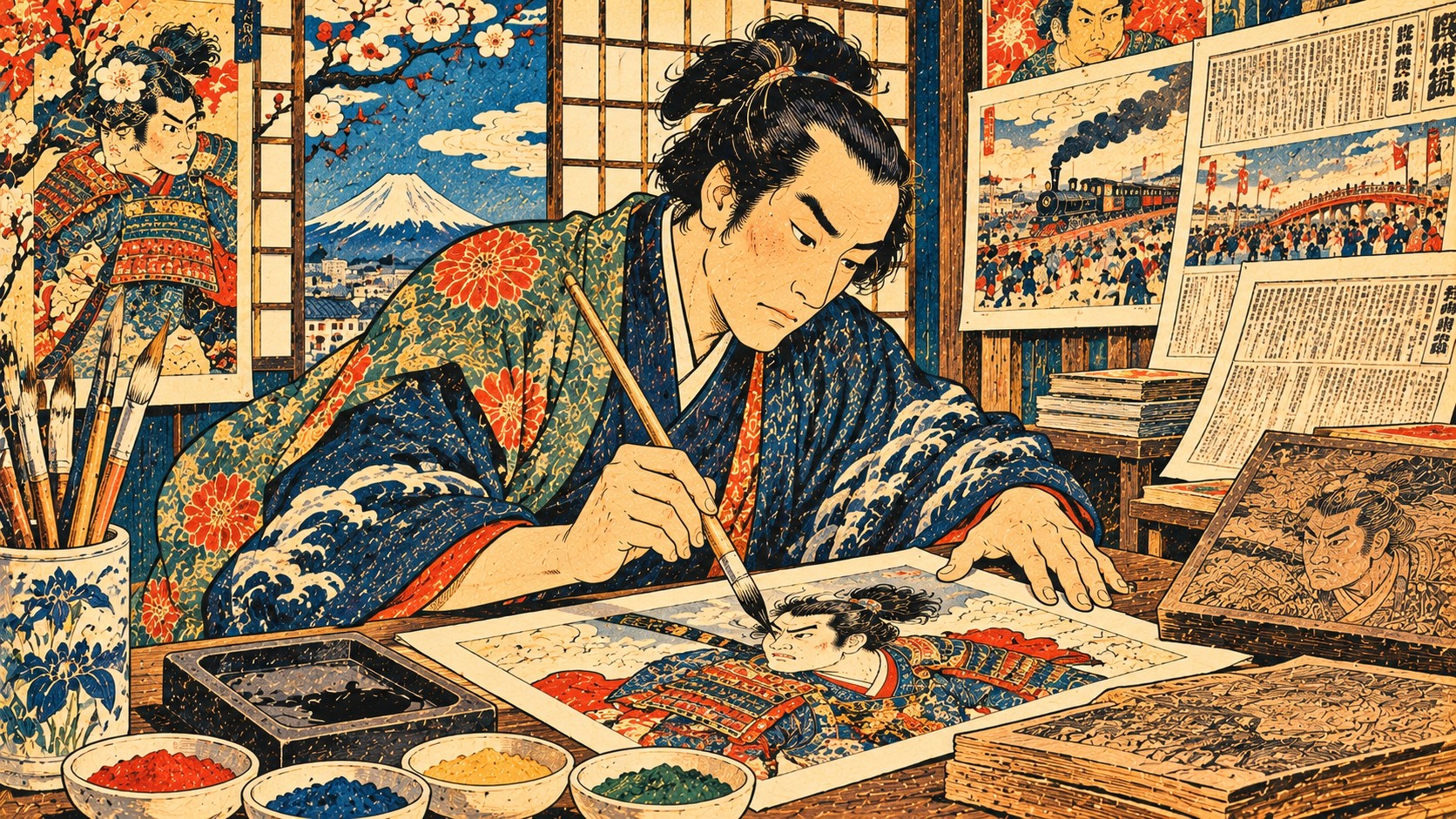
- The artist behind a newspaper revolution
- Learning to make history move
- 1861: Looking at foreigners in a changing port society
- 1865: Hodogaya, where two worlds meet
- Two women, one umbrella—and a useful lesson about attribution
- 1867: A warrior balanced between violence and flowers
- The daily newspaper and the newspaper-shaped print were different things
- Who gets remembered—and who makes a print?
- What Yoshiiku can teach an illustrated newsroom today
The artist behind a newspaper revolution
An astonishingly colorful form of news circulated in Tokyo in 1874: a single sheet combining an arresting woodblock picture with a compact account of a public incident. The artist might place a figure in a theatrical pose, surround the scene with vibrant imported pigments and turn a printed news item into an object people wanted to look at. The artist was Utagawa Yoshiiku, also known as Ochiai Yoshiiku.
It would be easy to call him a forgotten ukiyo-e master and stop there. But that misses the most intriguing feature of his career. He straddled two commercial worlds: the print shops of late-Edo Japan and the newspaper business of the Meiji era. Unlike many painters who merely witnessed the transition, he was directly involved in founding an influential daily newspaper.
This exhibition of four images allows us to follow an artist of unusual range. Three works have identifiable institutional catalog records; one visually striking scene of women under an umbrella still lacks a secure match. That uncertainty matters. The story of a visual journalist should itself distinguish between what an image shows and what its maker, date or subject can actually be proved to be.
Learning to make history move
Yoshiiku was born in 1833 in the Nihonzutsumi neighborhood of Edo, according to the Kanagawa Prefectural Museum of Cultural History. His given name was Ochiai Ikujirō. Around 1849 he entered the workshop of Utagawa Kuniyoshi, whose dramatic warrior prints and crowded, imaginative compositions had helped redefine the commercial appeal of ukiyo-e.
The young artist learned to make a pose carry a narrative. A raised arm, an angled sword, a fiercely patterned robe, a face turned toward an unseen opponent: each could signal a story before the viewer read a line. He also drew actors, fashionable women and foreigners. A museum account credits the prints he made around the catastrophic 1855 Ansei Edo earthquake with bringing him recognition.
Among his peers was Tsukioka Yoshitoshi. The two collaborated on the sensational Eimei Nijūhasshūku series, which included violent historical episodes. Its notoriety has sometimes obscured the broader range of Yoshiiku’s work. The four surviving subjects examined here show how readily he moved from battle to fashion, from outsiders to the commercial road.
1861: Looking at foreigners in a changing port society
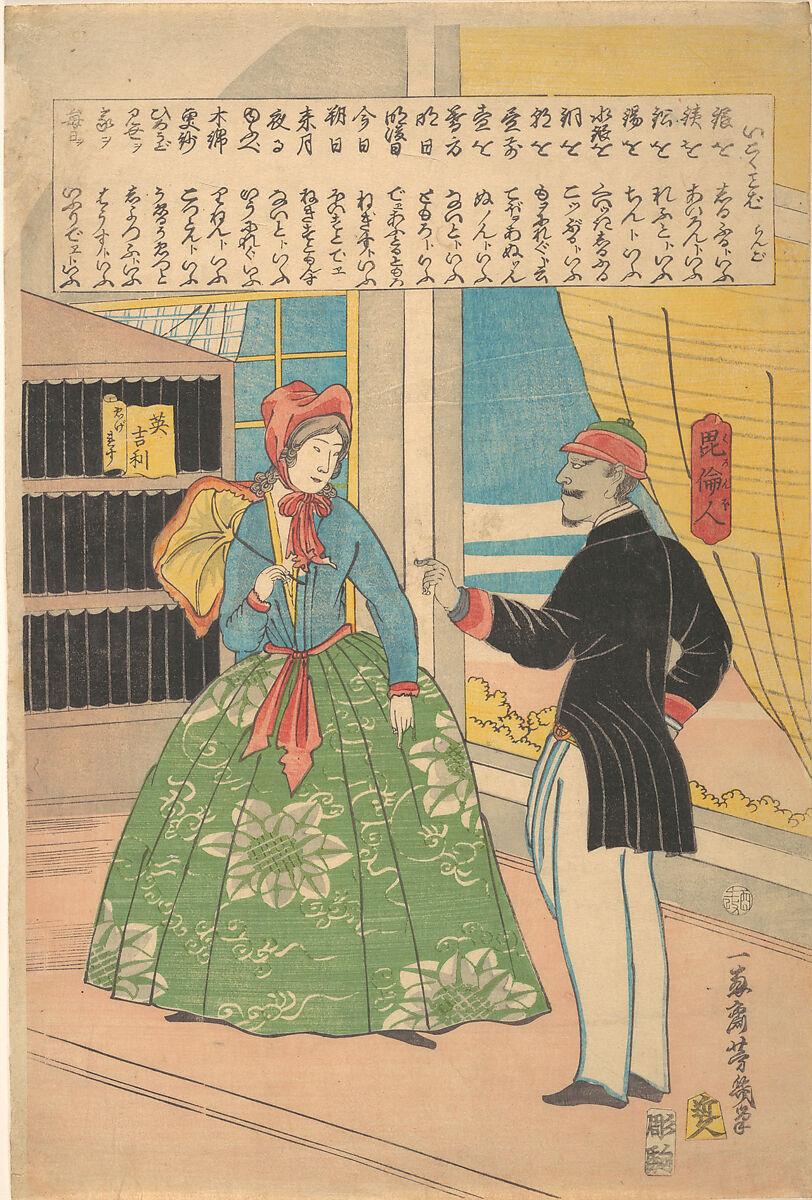
The Metropolitan Museum of Art catalogs one of the prints as English Woman with Black Man, dated to the eleventh month of 1861. The museum records the Japanese romanized title as Igirisu to korombojin, attributes it to Yoshiiku and places it in its open-access, public-domain collection under accession number 2007.49.232.
A woman in Western dress faces a man whose clothing and bearing are rendered through the conventions of an Edo-era printmaker. By then treaties and the opening of Yokohama in 1859 had brought foreign people, fashions and commodities into much wider Japanese public awareness. Foreigners were a marketable visual subject. The image reveals the way a printmaker rendered unfamiliar garments and bodies for audiences who might never encounter these individuals in person.
The collection record does not identify the people portrayed or document their personal relationship. The historical catalog title also uses racial terminology that belongs to its period and should be examined rather than casually adopted as a modern description. Neither the image nor its title can be treated as a candid social photograph. Its value lies in what it shows about a society learning to picture outsiders.
1865: Hodogaya, where two worlds meet
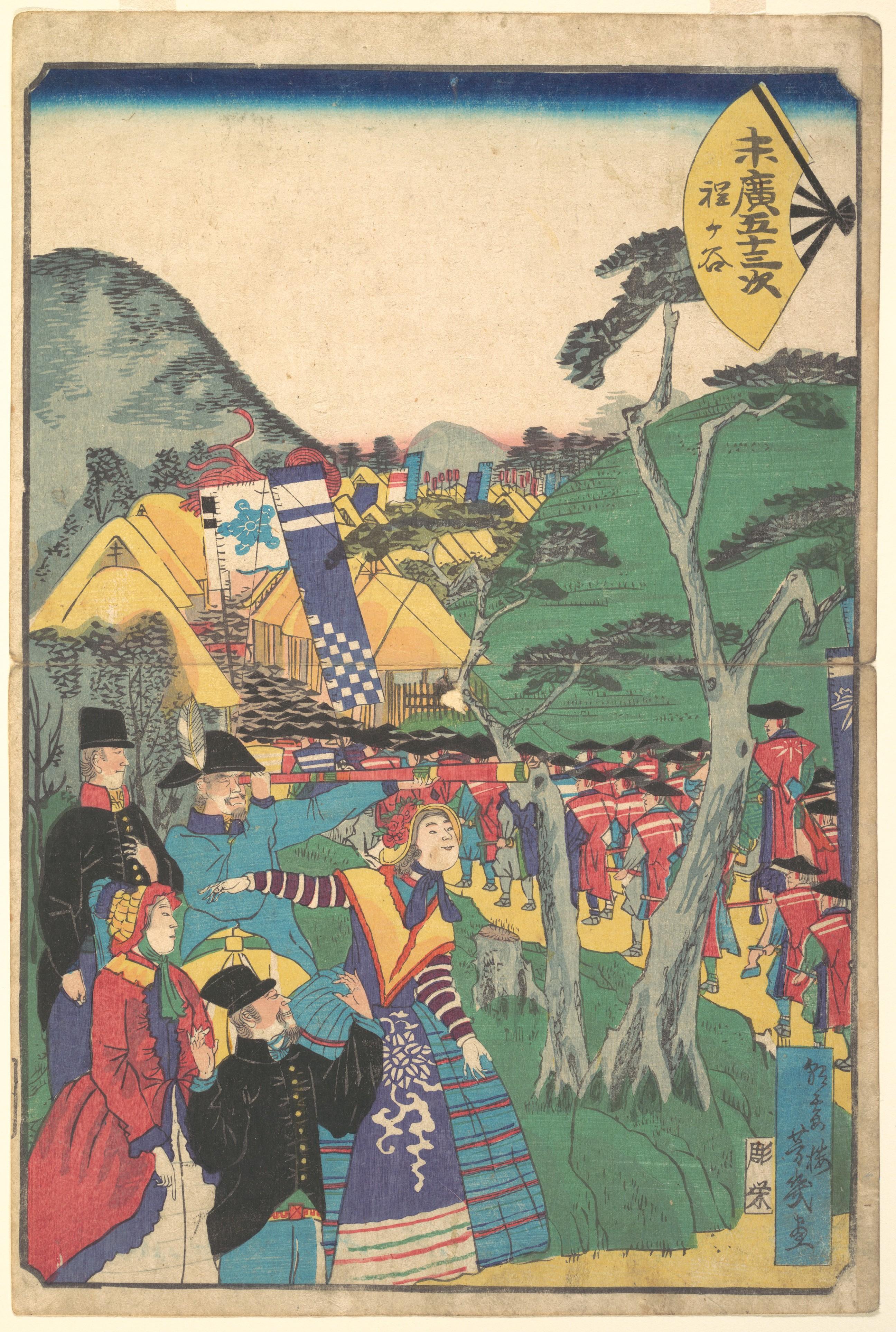
Yoshiiku’s Hodogaya, dated 1865 and preserved at the Metropolitan Museum of Art as object JP3197, presents a striking reversal. The procession of a Japanese lord travels along the Tōkaidō road, a deeply familiar subject in Edo travel imagery. Yet the large figures in the foreground are foreigners looking toward that procession. We watch spectators watching a spectacle.
The location was near Yokohama, where the expansion of foreign trade had rapidly changed the surrounding region. The print catches the coexistence of established feudal customs and unfamiliar Western dress during the final years of Tokugawa rule. Its theatrical sequencing is no less important than its subject: hills and banners lead the eye inward, while the foreign spectators anchor the foreground.
The museum’s description supports the identification of the procession and its observers, not the assumption that Yoshiiku stood there recording a particular parade. In 1865, before the Meiji Restoration, prints were commercial interpretations of the world around them. Their historical precision must be assessed as images, not inferred from their apparent realism.
Two women, one umbrella—and a useful lesson about attribution
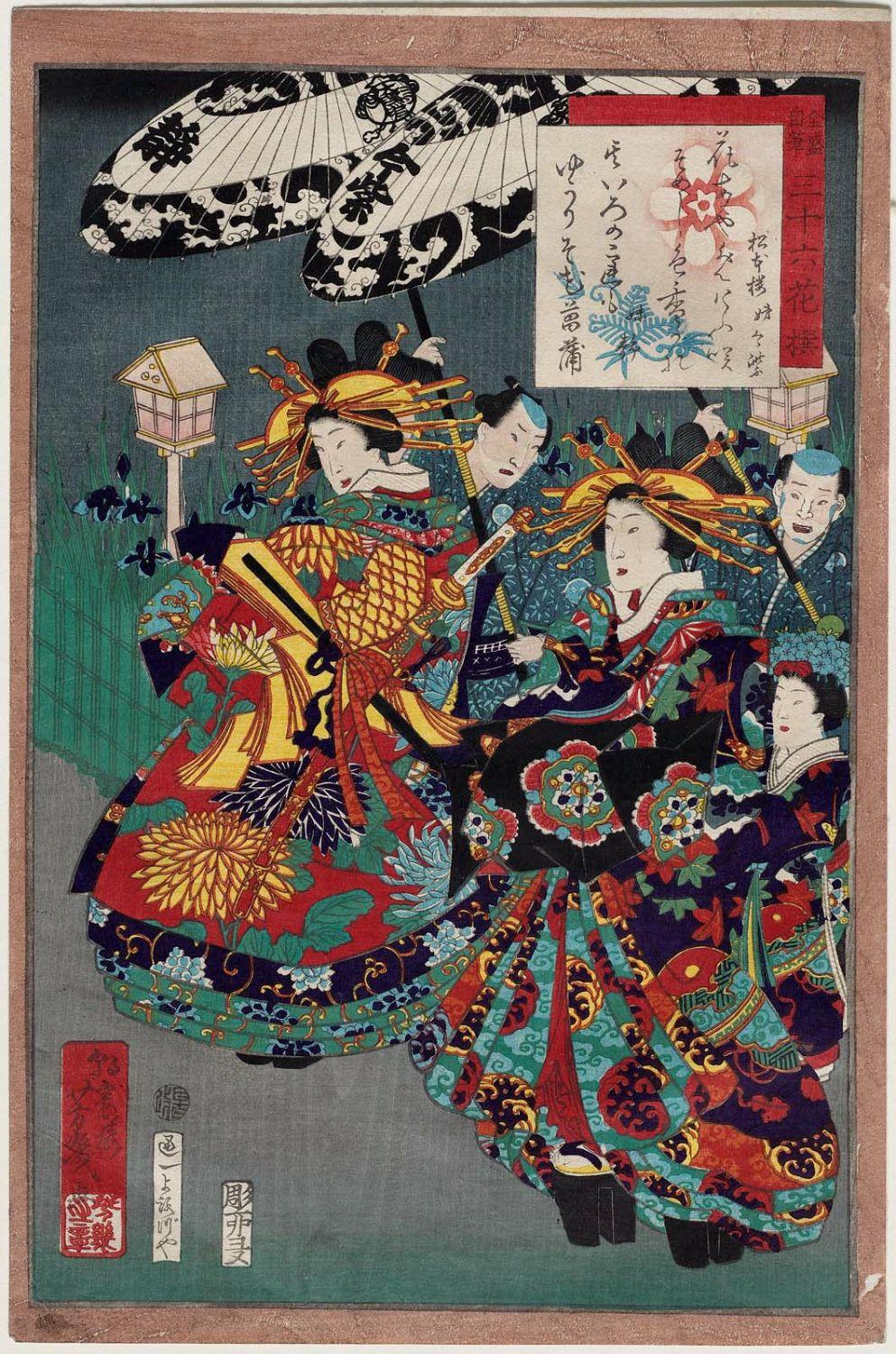
Two richly adorned figures stand beneath a patterned umbrella. Their elaborate hair ornaments, layered textiles and boldly contrasting floral patterns give the print a dense visual richness. A powerful umbrella shape organizes the top of the frame while surrounding attendants create a sense of activity and public display. The composition invites comparison with Yoshiiku’s documented work in beauty and theatrical subjects.
Yet the exact catalog title, production date, publisher and repository for this particular image have not been independently established. The descriptive filename calls the figures “courtesans,” but costume alone does not securely identify their profession or the precise narrative. We therefore treat both the title and the attribution to Yoshiiku as provisional while retaining the image in this curated discussion.
This is more than a disclaimer. Print histories routinely depend on small inscriptions, publishers’ marks, censor seals and surviving collection records. When one of those links is missing, a beautiful reproduction can circulate online under a confident but inaccurate name. A responsible gallery does not make the uncertainty disappear.
1867: A warrior balanced between violence and flowers
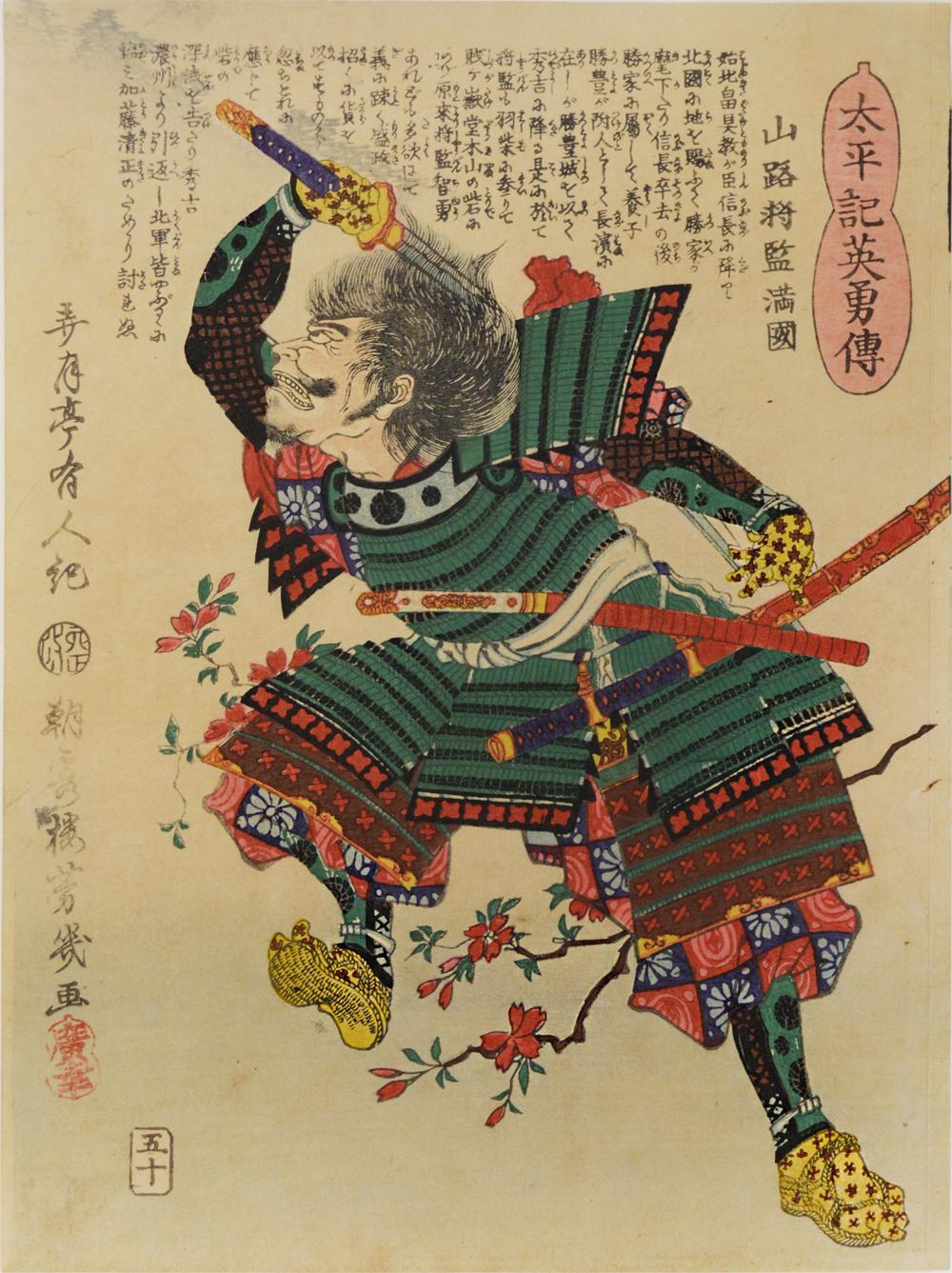
The Tokyo Metropolitan Library identifies a print from Heroes of the Taiheiki as number fifty, Yamaji Shōgen Mitsukuni, dating it to January 1867. The work is signed Chōkarō Yoshiiku ga and was issued by publisher Hirookaya Kōsuke. It is among the most dynamic poses in this selection: a warrior raises a weapon, one foot lifted, armor spread in carefully patterned bands.
The aggressive movement is offset by flowering branches. Scholarship in a university collection interprets this contrast as part of the tension between the cruelty of war and the beauty of the world that war endangers. The action is drawn like a climactic stage scene rather than a neutral military diagram. The title also belongs to a storytelling tradition that reworks history in commercially appealing episodes.
The name Mitsukuni as rendered on the print should not be silently equated with a modern historian’s preferred spelling for a historical individual. A print’s inscription, narrative tradition and the identity of its historical model can be three different things. What can be established here is the work’s cataloged title, artist, publisher and date.
The daily newspaper and the newspaper-shaped print were different things
The National Diet Library records Yoshiiku alongside the writer Jōno Saigiku and bookseller Nishida Densuke as a founder of Tokyo Nichi Nichi Shimbun in 1872. It was among Tokyo’s earliest daily newspapers and became part of the lineage of today’s Mainichi Shimbun. This was a serious move beyond supplying pictures to the existing print market.
Two years later, publishers issued the spectacular illustrated series known as Tokyo Nichi Nichi Shimbun, using a slightly different written form of the title. These were large color prints based on selected stories that had already appeared in the newspaper. The original reporting and the newly written, image-led retelling were not the same publication or the same kind of product.
The Kitakyushu Municipal Museum of Art describes the 1874–75 series as popular but too slow to satisfy an increasingly competitive news market. The hybrid succeeded at attention, storytelling and visual appeal; it struggled with timeliness. In a modern media vocabulary, it was closer to a collectible illustrated narrative of yesterday’s events than to a live news feed.
Who gets remembered—and who makes a print?
Yoshitoshi’s later fame as a master of dramatic historical imagery has often overshadowed Yoshiiku in popular surveys. But “forgotten” is at best a relative judgment. Museums in Japan and abroad have preserved and cataloged Yoshiiku’s work; the Chiba City Museum of Art owns the 1861 beauty print Shashin Kagami, while Tokyo’s library collections hold many of his warrior and news sheets.
The sheets also remind us that the making of a woodblock print was collaborative. The artist composed the image, while specialists carved blocks, printers applied colors and publishers financed and sold the edition. Written news pieces might involve separate authors. Yoshiiku belonged to an industrial culture of visual storytelling before that term existed.
The rise of illustrated newspapers was not merely a change in drawing style. It was a change in distribution, audience expectation and the commercial clock. Images could make a person stop on the street and look; the next challenge was persuading them that the story was worth believing.
What Yoshiiku can teach an illustrated newsroom today
Yoshiiku’s pages still feel startlingly current. A headline image is carefully designed to seize attention. A face or gesture condenses a complicated event into a dramatic scene. The audience is given an emotional route into the story before encountering the text. These are strengths of visual journalism, but they also create responsibilities.
For this JAPAN.co.jp Art Choice, the opening illustration is an original, AI-generated editorial interpretation inspired by nineteenth-century woodblock methods, not a surviving portrait of Yoshiiku. The four historic reproductions are presented separately with provenance information and explicit uncertainty where it remains. The boundary is essential: art may interpret an event, but it should not impersonate direct evidence of an event.
From a warrior’s raised sword to a foreign traveler’s gaze, Yoshiiku drew attention toward what his contemporaries considered strange, dangerous, exciting or new. What remains is not just a set of vibrant prints. It is a question that every illustrated news publisher still faces: how do we make the world vividly visible without confusing a powerful image with the complete truth?
Sources, provenance and reporting notes
Collection records from museums and public libraries are prioritized for dates, titles and attribution. The umbrella-and-women print lacks an independently verified catalog match and is labeled provisional. JAPAN.co.jp has not examined original impressions or interviewed curators for this feature.