The bestselling artist history almost forgot
Ask an international audience to name an ukiyo-e artist and Hokusai or Hiroshige will almost certainly come first. In nineteenth-century Edo, however, Utagawa Kunisada occupied a formidable position in the business of printed pictures. His designs ranged from kabuki stars to fashionable women, from book illustrations to images connected with a bestselling reinvention of The Tale of Genji. Japan’s Ota Memorial Museum of Art has described him as a central, immensely popular figure in the print world of his day. That disparity between contemporary renown and later fame is the beginning of a more interesting story than a list of beautiful prints: how Japan’s cultural marketplace once worked.
A childhood near the waterways of Edo
Kunisada was born in 1786 in Edo, around the Honjo area east of the Sumida River. Biographical accounts differ on details of his family’s business, describing connections to ferry operations and timber trading. His early artistic name Gototei recalls a ferry landing, but not every colorful detail of his childhood can be independently reconstructed. As a young man he studied under Utagawa Toyokuni I, a celebrated specialist in actor portraits. Surviving publishing evidence places Kunisada in commercial illustration by 1807, and his reputation grew quickly. He entered an environment where theaters, bookstores, print publishers and fashionable urban customers fed demand for constantly changing visual material.
The unseen workshop behind a famous signature
A woodblock print was never simply a painting copied by a machine. A publisher commissioned and marketed the project; the artist drew the design; specialist carvers cut blocks; printers carefully registered and applied successive colors. The wood, paper, pigments and labor all shaped the finished object. Kunisada led a sizable studio and furnished designs for a huge range of publications, a scale that depended on collaborative production. Describing his output as tens of thousands of individual artworks without qualification risks confusing designs, impressions, editions and workshop production. The more valuable insight is that his studio created pictures within an industrialized cultural system responsive to changing demand.
Kabuki celebrities on paper
In Edo, a theatergoer could watch an actor command the stage and later purchase a print that made the fleeting performance durable. Kunisada excelled at actor portraits, or yakusha-e, using tense hands, forceful eyes, lavish costumes and emphatic gestures to evoke particular theatrical roles. These are not neutral photographic records. They transform a performance into a dramatic emblem, sometimes presenting the actor’s public persona as much as a specific scene. For art historians, identifying exactly which role, cast and performance a print represents requires checking signatures, publication marks, theater records and museum catalogues. For the contemporary viewer, their immediacy explains why the images once circulated so widely.
Fashion as a form of social journalism
Kunisada’s women and interiors offer more than decorative charm. Patterned kimono, hair ornaments, seasonal plants, household objects and urban settings reveal what print consumers were invited to admire. The Ota Memorial Museum’s 2016 exhibition on Kunisada and Japanese dress treated such works as valuable evidence of everyday visual culture. Still, a print promoting a glamorous look cannot simply be read as a census of what every Edo woman wore. Clothing in art could signify a role, season, ambition or fictional identity. In this sense Kunisada was an interpreter and amplifier of fashion rather than a disinterested documentarian.
A thousand-year-old novel becomes a hit series
The great turning point was The Rustic Genji, properly Nise Murasaki Inaka Genji, written by Ryūtei Tanehiko and illustrated by Kunisada. Published from 1829 to 1842, this long illustrated fiction drew its inspiration from Murasaki Shikibu’s classical Tale of Genji but moved the action into a different historical setting, the medieval world of the Ashikaga shoguns. Its hero, Ashikaga Mitsuuji, does not simply repeat Hikaru Genji’s journey. He encounters political plots, quests for precious objects, romantic complications and the dramatic mechanics of Edo popular theater. Japanese literary institutions identify the work as a creative adaptation, not an illustrated copy of the Heian original.
How Genji became a new visual genre
The book’s enormous success made its characters recognizable beyond the bound pages in which they first appeared. Kunisada reworked its imagery into standalone multicolor prints. The richly dressed hero, striking women and opulent interiors borrowed the immediacy of celebrity portraits and beauty prints. In earlier centuries, Genji pictures often referred to scenes from the classical tale; Edo-period Genji-e could equally refer to Tanehiko’s popular transformation. Confusing these traditions erases Kunisada’s achievement. His images did not merely preserve a classic: they created a marketable new visual world that later artists continued to revisit.
When government reform interrupted a bestseller
The series ended after 38 installments, with draft material surviving for two more. Under the Tenpō reforms of the early 1840s, authorities tightened controls on luxury consumption and popular publishing. The Rustic Genji was suppressed. One enduring anecdote says it offended officials by seeming to parody the shogun and the women of the inner palace. Japanese library sources, however, present that as a story or possibility, not an established sole cause. Controls on lavish book production and entertainment publishing offer the firmer context. The censorship is a reminder that apparent escapism could carry political risk in a culture where images circulated well beyond the court.
Kunisada, Toyokuni III, and the puzzle of names
Around 1844 Kunisada adopted the prestigious Toyokuni name associated with his teacher. Modern catalogues usually identify him as Toyokuni III, although the historical succession and the ordinal number he sometimes used are not straightforward. He also signed designs with studio names including Gototei and Kōchōrō. Meanwhile, later artists inherited the Kunisada name. A museum listing headed “Kunisada” therefore needs closer attention to dates, signatures and generation. This is more than pedantry: precise attribution determines which artistic development a print can actually document and prevents confusion between the master and his successors.
Why some museums say 1864 and others 1865
Even Kunisada’s date of death illustrates the challenge of aligning Japanese historical records with Western cataloguing. Several Japanese museums give his final year as 1864, or the Japanese era year Genji 1; international scholarship commonly records January 1865. The shift between the Japanese lunisolar calendar and Gregorian dating contributes to the discrepancy in how the final year is presented. Instead of quietly treating one museum as mistaken, this article acknowledges the difference. The artist was born in 1786 and worked almost to the end of his life, leaving an unusually broad record of Edo tastes and publishing.
An artist who does not fit the tourist canon
Western enthusiasm for Japanese prints has often centered on Hokusai’s waves and Hiroshige’s roads. Kunisada asks viewers to pay equal attention to actors, books, fashion and the daily life of images. His work was mass-consumed, commercially alert and sometimes repetitive, yet capable of extraordinary precision and invention. Scholars debate the scale of his oeuvre partly because counting designs is not identical to counting surviving sheets or later impressions. That uncertainty should sharpen rather than diminish the story: his legacy is inseparable from a large creative network and from audiences who wanted fresh pictures at a rapid pace.
How to look at a Kunisada print today
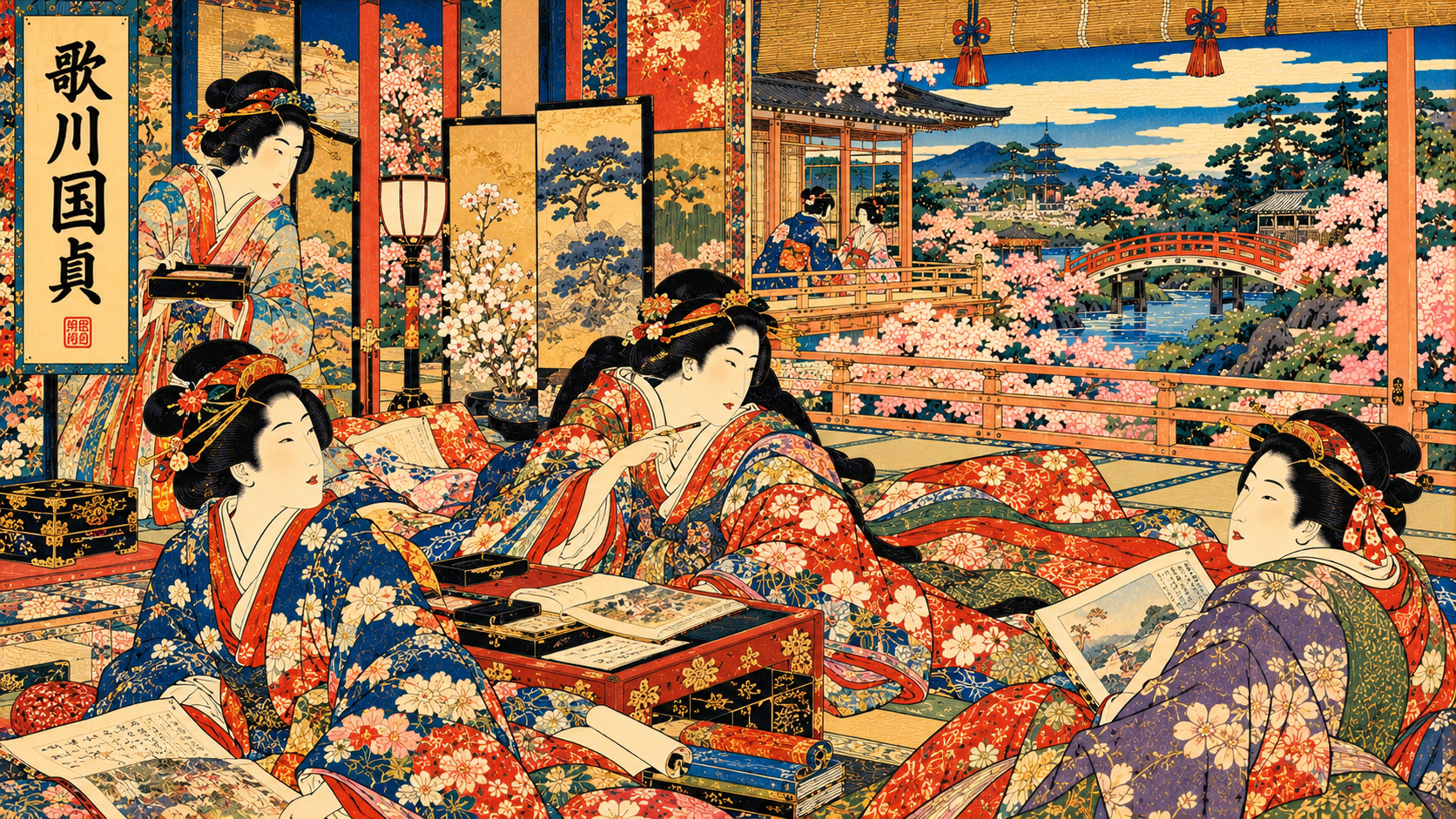
Begin with the picture, then read its circumstances. Who published it? Was it tied to a theatrical performance, a new volume of illustrated fiction or an ideal of fashion? What do the garments and interior objects tell us, and what might they conceal about the actual lives of women and performers? The answers make Kunisada relevant beyond specialists in Japanese art. They open a discussion of celebrity culture, merchandising, adaptation, commercial publishing and the politics of visibility. The illustration accompanying this Japan.co.jp feature is a newly generated editorial homage to his visual language, not an original Kunisada print or a reproduction licensed from a museum.
Sources and editorial notes
Compiled from Japanese museum and library collection records and institutional research sources. No original museum interview or onsite examination was conducted. The illustration is a modern homage; its use does not convey reproduction permissions for any museum-held Kunisada print.
- Ota Memorial Museum of Art: Kunisada retrospective
- Ota Memorial Museum: Kunisada, fashion and daily life
- National Institute of Japanese Literature: Rustic Genji
- Tokyo Metropolitan Library: Rustic Genji and its suppression
- Waseda University Library: Kunisada and Genji pictures
- Nakagawa-machi Bato Hiroshige Museum: Kunisada collection biography
- National Diet Library: Tanehiko and the culture of illustrated fiction
- University of Oregon: Kunisada biography and references
- Kanagawa Prefectural Library: Rustic Genji research notes