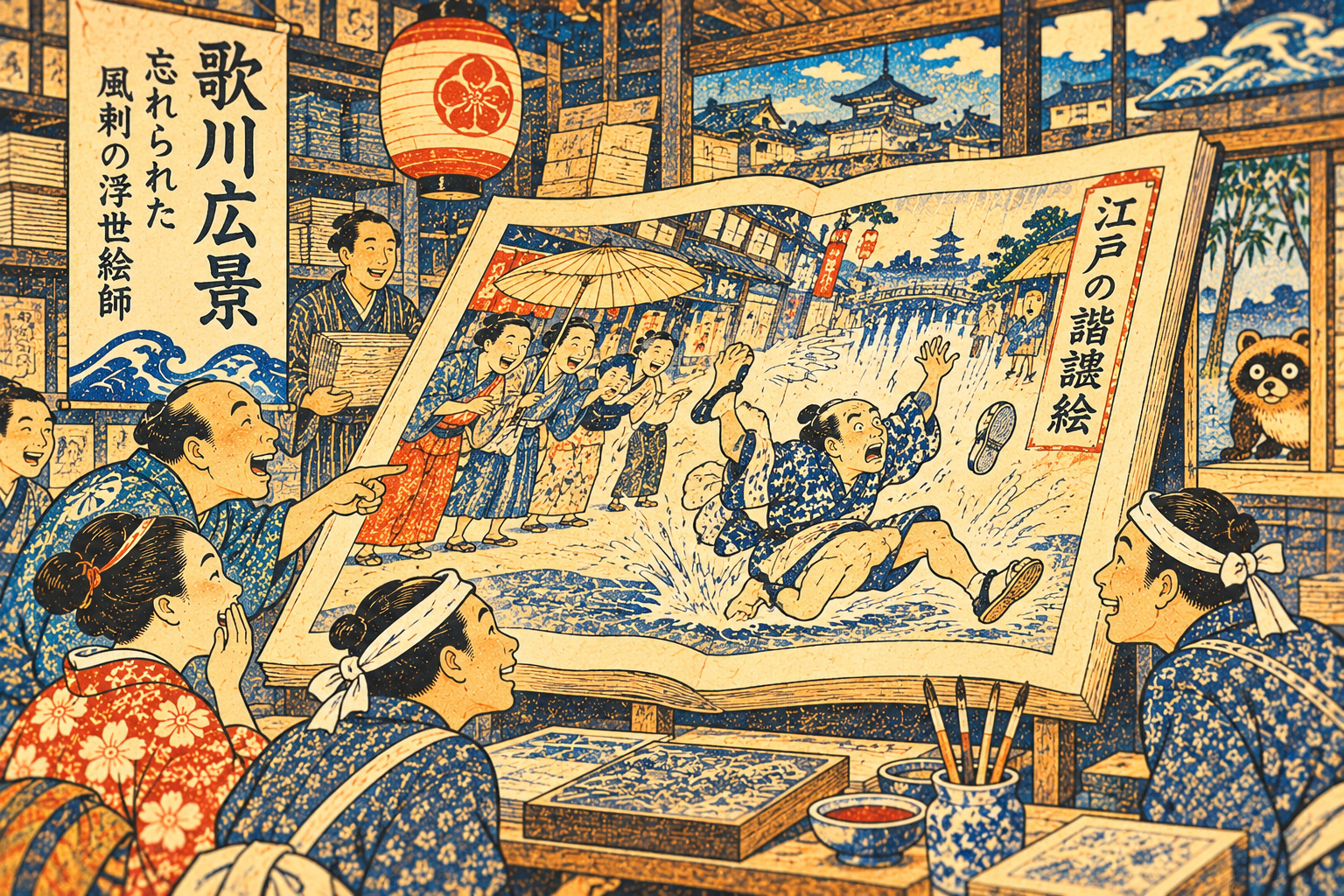
The city slips, and a sandal takes flight
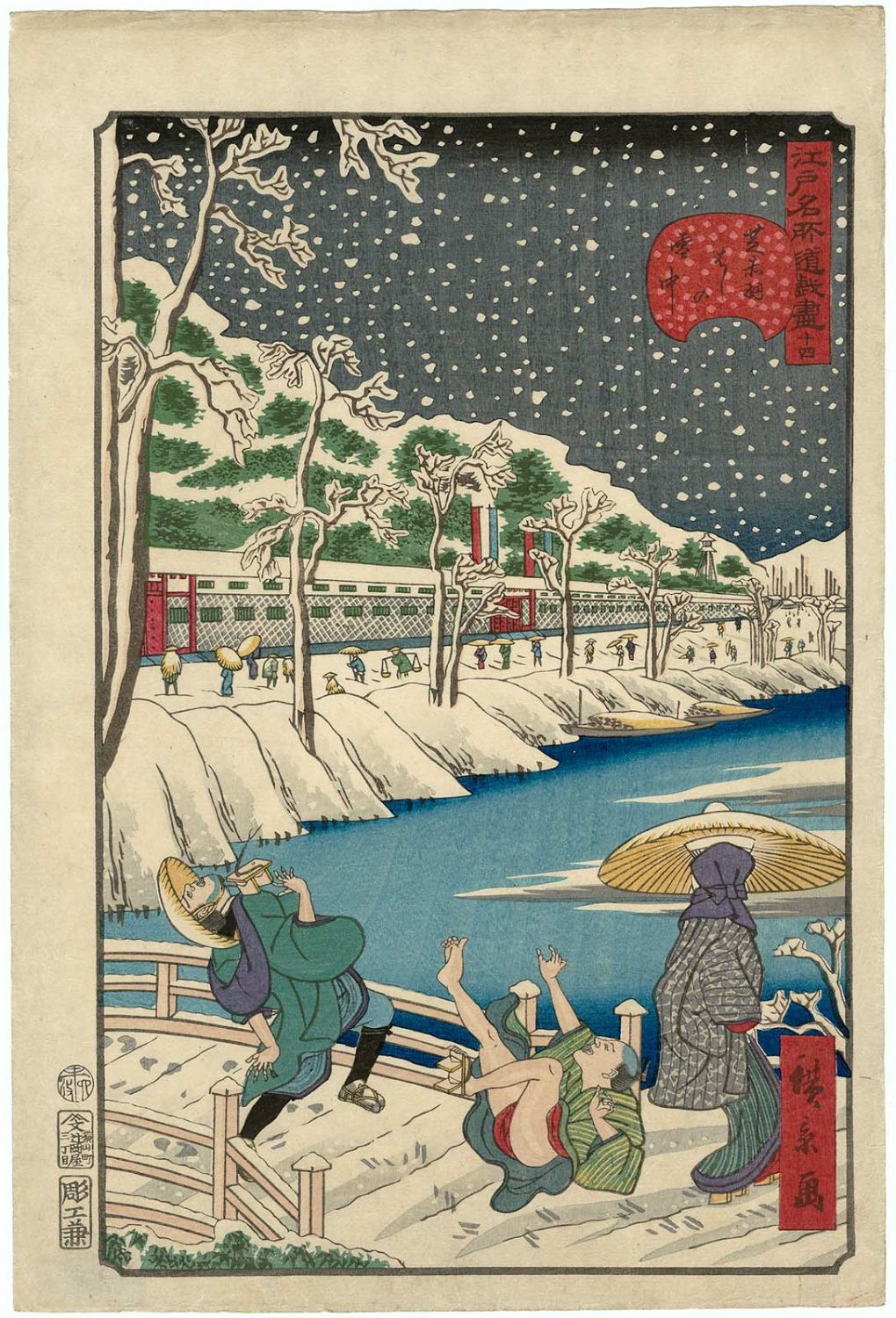
Snow is falling on Akabane Bridge in Edo. Pedestrians shelter beneath umbrellas, moving with the caution of anyone crossing slippery stone. One man loses his footing. He lands spectacularly, his clothing disarranged, his sandal springing away. That sandal does not simply disappear into empty space: it strikes another passerby on the chin. It is the kind of visual chain reaction that would work in a silent comedy, except the print dates to 1859. Its maker, Utagawa Hirokage, turned an established subject of Japanese art—the scenic view of a famous place—into a stage for human embarrassment. If we know relatively little about his life, we know exactly how his pictures seize a viewer's attention: first they establish the city, then they spring the joke.
A mysterious name on surviving sheets
Hirokage's birth and death dates have not been established. The Ota Memorial Museum of Art identifies him as a pupil of the celebrated landscape artist Utagawa Hiroshige but stresses how little is known of his identity. Surviving evidence places the principal run of his comic prints around 1859–1861. That is a much more reliable statement than presenting the loosely repeated 1850s–1860s as a securely documented long career. There is no sound basis for an invented childhood, studio anecdote or death scene. Hirokage is one of those artists for whom the work survives more clearly than the biography. His signatures, publishers' marks and the dated prints are therefore more than scholarly technicalities: they are the foundations of what can be said at all.
What Hiroshige taught—and what Hirokage changed
In the decades before the Meiji Restoration of 1868, prints of roads, bridges and celebrated sites were a flourishing form of popular urban culture. Hiroshige's Fifty-three Stations of the Tōkaidō and One Hundred Famous Views of Edo made weather, routes and perspective into dramatic pictorial experiences. Hirokage inherited the grammar: identifiable bridges, distant streets, city landmarks, the curve of a riverbank. But he reassigned the leading role. Instead of a landscape merely containing a few figures for scale, his setting waits for an accident. A dog steals lunch; a delivery goes wrong; a traveler is fooled by an animal spirit. The city is carefully drawn enough to feel real, precisely so that the ridiculous event feels as if it could happen there.
Fifty places, fifty opportunities for trouble
Hirokage's signature achievement is the 50-print series usually called Comical Views of Famous Places in Edo, or Edo meisho dōke-zukushi (江戸名所道戯尽). Museum catalogues date it broadly from 1859 through 1861. These were commercially produced nishiki-e, multicolour woodblock prints, not a private sketchbook and not a single painting. The publishing imprint Tsujiokaya Bunsuke appears in municipal and metropolitan catalogue records. The itinerary takes viewers through Nihonbashi, Yushima, Asakusa, Ōji, bridges and neighborhoods familiar from more solemn city views. Spelling on historical title labels and catalogues sometimes varies among characters associated with comic play; the standardized series title used here follows the Ota museum. Fifty prints are a documented set, not evidence that Hirokage made only fifty images during his life.
Akabane Bridge: a slapstick accident inside a real city
The Ota museum's curator Kenji Hinohara offers a wonderfully close reading of No. 14, Akabane Bridge at Shiba in Snow. The bridge crossed the Shibuya River south of Zōjō-ji, while the building in the background belonged to the Arima family, lords of Kurume. The merchantlike pedestrian slips; the strap of his geta breaks; the airborne sandal smacks another figure. Look beyond the mishap and the local details accumulate: leg wrappings on one walker, bundles carried in cloth, individual footprints impressed in the snow. The joke depends on an exact choreography of bodies, but it also preserves clues about the appearance and use of an actual place. A landscape viewer and a reader of visual comedy can occupy the same print without one cancelling out the other.
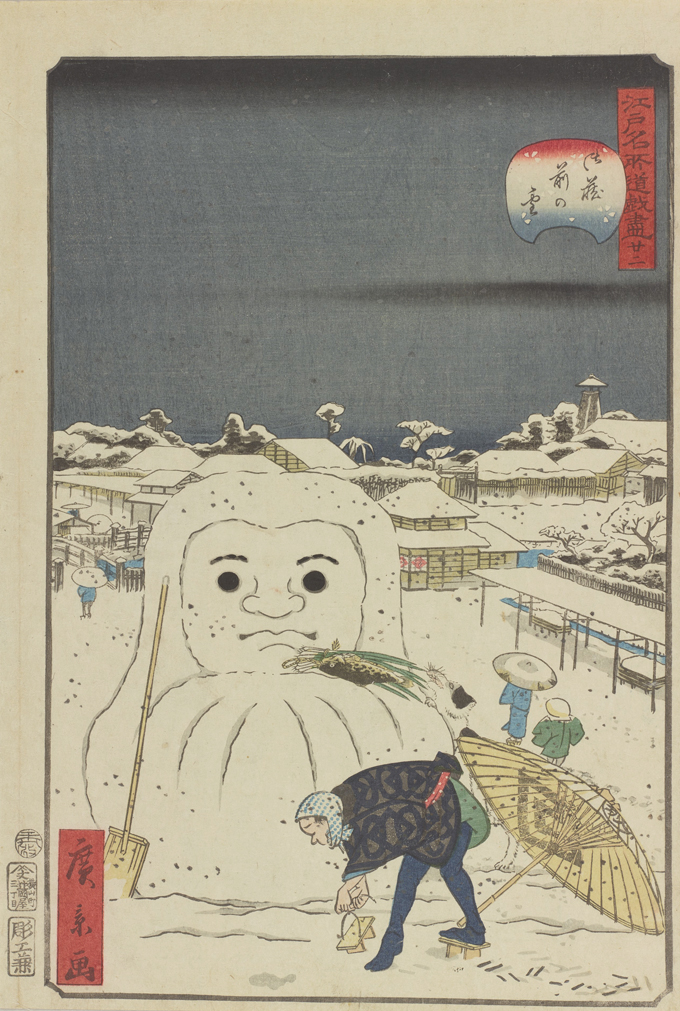
Kuramae in Snow: the giant Daruma in the street
No. 22, Snow at Kuramae, was published in the ninth month of 1859, according to the Tokyo Metropolitan Library. Its centrepiece is a giant seated figure made of snow, resembling the round Daruma doll associated with the Buddhist monk Bodhidharma. Modern readers may think first of the familiar two-ball snowman, but curator Hinohara explains that an Edo-period yuki-daruma could take the shape of Daruma himself. Here a seasonal amusement becomes a monument large enough to transform the whole street. The work is funny partly because of its scale and partly because it is grounded in a real custom. The large snow figure is not a fantasy invention concocted by an illustrator looking back from the present: Hirokage's 1859 print is visual evidence of how people might play with winter and ritual imagery.
Strange Events in Asakusa: when the night plays tricks
Another work, No. 3, Strange Events in Asakusa's Rice Fields, has a particularly useful documentary trail. The Edo-Tokyo Museum dates its print to the first month of 1859, while the Taito City Library names the publisher and explains the scene: men carry hoes through the fields at night, seemingly fooled by a tanuki, the shape-shifting animal of Japanese folklore. The catalogue links the composition to an area of farmland once lying north of built-up Asakusa. The image is therefore more than an amusing supernatural story. It reminds readers that nineteenth-century Edo included rural margins, and that tales of animal trickery coexisted with the everyday labor of those who cultivated them. Hirokage finds laughter at the boundary of uncertainty and ordinary work.
Dogs, noodles, fox fires and a thunder god
The series keeps changing the terms of its jokes. At the Nihonbashi morning market, a stray dog runs off with a fish and the seller gives chase. At Yushima Tenjin, a dog disrupts a soba delivery and the noodles land on a samurai's head. The fox fires of Ōji turn folklore into a theatrical procession. Suntory Museum of Art describes a thunder god tumbling into the Sumida River in No. 2, Ryōgoku in a Sudden Shower, only to find himself caught by a kappa. Nobody in Hirokage's universe is exempt from a mishap, not even a god. The humor is often physical, but it also depends on recognition: the viewer knows the setting, the custom or the supernatural figure being sent up. The joke grows out of the shared knowledge of the city.
Borrowing from masters was part of the method
There is no need to exaggerate Hirokage's originality by denying his sources. The Suntory Museum notes earlier visual models by Hiroshige and Katsushika Hokusai in connection with the Ryōgoku print. Commentary on the 2017 retrospective likewise identifies deliberate borrowings. That matters because Edo printmaking was a collaborative publishing industry in which artists, publishers, block cutters and printers worked together, and existing visual conventions could be reworked for new audiences. Hirokage's inventive act was not necessarily to draw a wholly unprecedented bridge or weather effect. It was to repurpose a recognizable scenic composition so that the human joke rearranged the viewer's attention. His pictures reward comparison as much as simple laughter.
The comedy has edges modern viewers should examine
An accident on an icy bridge can invite sympathetic laughter. Other forms of nineteenth-century popular humor may target people in ways that a contemporary audience finds demeaning. The Ota Memorial Museum explicitly warned that some images in its 2025 display contained expressions now regarded as discriminatory or inappropriate; it nonetheless showed the complete fifty-print series in historical context. That curatorial choice should shape how the works are discussed. Rediscovery is not the same as uncritical celebration. We can admire the sophistication of a composition and ask who is the object of its humor. Even in these lively prints, the distance between seeing ourselves in another person's bad luck and simply laughing at that person can be narrow.
The rediscovery already has a history
To call Hirokage utterly undiscovered would erase the work already done by museums. The Ota Memorial Museum exhibited all fifty prints in a 2017 retrospective and reunited the set again from November 14 to December 14, 2025. The latter exhibition also included twenty works by Hiroshige II, another pupil of Hiroshige, making the differences within the artistic lineage visible. The museum notes that its social-media posts featuring the snowbound bridge and giant Daruma drew unusually strong attention. These are episodes of renewed visibility, not evidence of a newly discovered print or a 2026 exhibition. This feature is a historical rediscovery based on documented holdings and curatorial research, rather than a report of a fresh archaeological or archival find.
A painter of the city’s imperfect inhabitants
A famous-view print can make a city appear monumental, almost untouchable. Hirokage brings it back to the scale of a person's unsteady feet. An arm flails; a meal spills; a fox deceives a traveler; everyone else turns to look. The bridges and buildings endure in the image, but the real protagonists are people without heroic biographies. We cannot yet tell a complete story of the man who signed these prints. We can say, with more confidence, what his finest surviving work achieved. It made late-Edo streets into places where the viewer recognizes not only the city as it was, but the ordinary human condition of being gloriously, embarrassingly fallible.
Sources and collection records
Based on collection catalogues and curatorial essays from the Ota Memorial Museum, Tokyo Metropolitan Library, Edo-Tokyo Museum, Taito City Library, Adachi City Folk Museum and Suntory Museum of Art. Historical variations in print titles are retained where relevant.
- Ota Memorial Museum of Art — 2025 exhibition and research overview
- Ota Memorial Museum of Art — English exhibition background
- Ota Memorial Museum curator Kenji Hinohara — Akabane Bridge snow scene
- Ota Memorial Museum curator — the giant Daruma snow figure
- Tokyo Metropolitan Library — original 1859 Kuramae print catalogue
- Adachi City Folk Museum — Kuramae collection entry
- Taito City Library — Asakusa rice field print, full catalogue
- Edo-Tokyo Museum — Strange Events in Asakusa-tanbo
- Suntory Museum of Art — Ryogoku thunderstorm and art-historical influences
- Ota Memorial Museum — 2017 Hirokage retrospective
- National Art Center Japan Art Commons — 2025 retrospective record
- Japan Search — index and sequence of the 50 Edo views