A free day with a much larger purpose
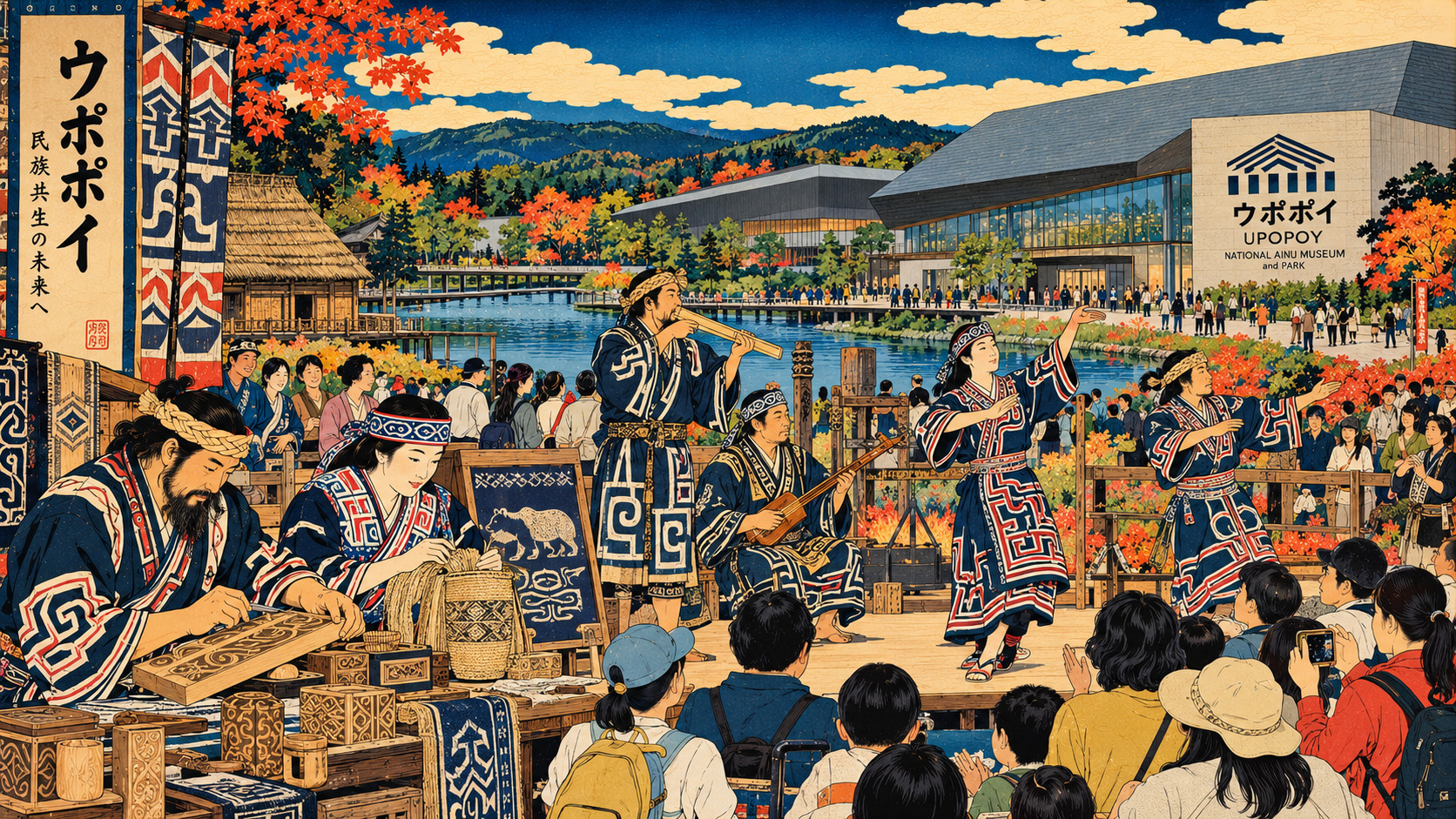
On November 3, Japan’s Culture Day, the National Ainu Museum and Park at Lake Poroto in Shiraoi, Hokkaido, will waive admission charges and expand its program of performances, exhibitions and hands-on activities. The holiday presents an unusually accessible invitation to learn about Ainu history and contemporary cultural practice. But the distinctive story is not just a free ticket: it is the difference between seeing a culture as a collection of historical objects and encountering the living people and organizations who continue to shape it.
What free admission actually covers
Upopoy’s announcement waives the park entrance fee and admission to the National Ainu Museum on Tuesday, November 3. Parking and certain experiences still have fees. Seasonal hours are 9 a.m. to 5 p.m., with final park entry one hour before closing and final museum entry 30 minutes before closing. A free-admission day may attract additional visitors, but the organizers have not released actual November 3 turnout in advance. Visitors should check the updated program and any timed or ticketed requirements rather than assume every activity is included.
The performers have names and communities
One of the most meaningful November 3 events is the performance by the Akan Ainu Cultural Preservation Association and the Shiranuka Ainu Cultural Preservation Association. The groups are scheduled at the Uekari Chise performance hall from 11 to 11:30 a.m. and again from 2 to 2:30 p.m. Entry requires a numbered ticket distributed outside the hall. It matters that these are identified regional organizations, not an anonymous collection of performers. Music and dance traditions are taught, practiced and renewed within communities, and each group brings its own inherited repertoire and history.
Learning through tools, textiles and action
The November 3 program includes woodcarving sessions at 9:30 and 11 a.m., 12:30, 2 and 3:30 p.m. Embroidery sessions are listed for 9:30 a.m.–noon, with last morning registration at 11, and 1–4:30 p.m., with last afternoon registration at 3:30. The Aksinot archery-play experience is scheduled for 10 a.m.–4:30 p.m., last registration at 4. Not every activity necessarily has the same fee, capacity or reservation rule. The educational value lies in learning how materials, skills and design choices work rather than treating crafts merely as souvenirs.
Six ways to see the world from within
The museum’s permanent exhibition is organized from a first-person Ainu perspective around six themes: language, world, life, history, work and exchange. That curatorial choice is consequential. Museums have too often arranged Indigenous peoples as objects of an outsider’s study. Here the intended approach places Ainu voices and categories at the center. Visitors can examine objects and historical evidence while asking who made them, how they were used, and how meanings shift across generations. The language gallery is particularly important because speech carries place-based knowledge, relationships and ways of thinking.
A special exhibition about exchange, not imitation
The 12th special exhibition, Kosonte and Ruunpe, runs from September 19 through November 23. It examines the connections between Japanese kosode garments and Ainu approaches to clothing, cloth and design. On November 3 a curator talk is listed for 10:30 a.m., capacity 20; a child-oriented conversational gallery talk begins at 2 p.m., capacity 15. Textile exchange is not a simple story of one culture copying another. What makers choose, adapt and transform is central to the history. A separate Japan.co.jp feature will explore the garments in greater depth; this report focuses on the holiday program and its public value.
Why Shiraoi matters beyond the museum
Upopoy stands beside Lake Poroto in Shiraoi, a location with a longer institutional and community history than the new campus. The former Ainu Museum maintained collections and cultural education here before closing in March 2018 as the transition began. The National Ainu Museum and Park opened July 12, 2020, after a pandemic-related delay. That date marked a major national commitment, not the beginning of Ainu culture in the region. The landscape and the surrounding communities should be understood as more than an attractive backdrop to modern museum architecture.
The history of national recognition—and its limits
Japan’s government approved the symbolic space project in 2014, and the 2019 Ainu policy law recognized the role of the new complex. These milestones matter, but an institution alone cannot resolve discrimination, questions surrounding collections, challenges of language transmission or debates over cultural representation. What people do with a museum is as important as the fact that one exists. Visitors can support serious cultural work by learning who made the displays, identifying contemporary artists and avoiding the assumption that there is one uniform or unchanging Ainu tradition.
The arrival of Matapa, the winter season
The holiday also coincides with Upopoy’s winter-season program, called Matapa, an Ainu expression meaning “winter year.” The 2026–27 season runs November 1 through April 24. Programs introduce winter practices such as preparing dried fish, called satchep, and processing frozen potatoes, pene-emo. These are examples of knowledge shaped by a demanding northern environment. The museum’s winter approach offers another way to understand culture: as practical skills and seasonal decisions rather than objects separated from the circumstances that gave them meaning.
A workable family itinerary
A visitor might enter at 9 a.m. for the museum’s permanent gallery, then choose either the 10:30 special exhibition talk or an 11 a.m. dance performance. The afternoon offers additional performances, textile and woodcraft sessions and a 2 p.m. children’s gallery talk. Upopoy’s collaboration with the educational group QuizKnock also supplies a self-guided quiz trail covering eight sites. Starting November 3, those who complete it and answer a survey may receive a limited-edition tote while supplies last; this is a conditional promotional offer, not a guaranteed free gift.
Food, regional neighbors and last-minute changes
The East Iburi Festival in Chikisani Square is scheduled from 9 a.m. to 5 p.m., featuring specialties associated with Shiraoi and nearby Tomakomai, Abira, Atsuma and Mukawa. This connects the museum day with the surrounding region rather than treating Upopoy as an island. Travelers should also watch a specific announced cancellation: the multi-purpose hall’s Itak Tomari language program is cancelled for the entire day. Organizers have listed additional performances and venue changes in the traditional kotan area, another reason to consult the latest official notices.
A beginning, not a complete encounter
Upopoy is approximately 500 meters, or a ten-minute walk, from JR Shiraoi Station’s north exit. Drivers should anticipate possible parking queues and a separate fee. For a first-time visitor, the most valuable takeaway may be the knowledge that one day cannot exhaust Ainu cultural experience. The performers, artisans, language specialists and community organizations represented at the museum have lives and work beyond a holiday timetable. Culture Day can be the starting point for following their continuing contributions—not a substitute for doing so.
Sources and reporting method
Document-based reporting from official Upopoy and National Ainu Museum material. The event had not yet taken place at the time of writing; no visitor turnout or eyewitness claims are reported. We did not conduct direct interviews with Ainu cultural practitioners.
- Upopoy: 2026 free-admission day
- Upopoy: November 3 program amendments
- Upopoy: Regional preservation groups’ dance performances
- Upopoy: Matapa winter-season opening
- National Ainu Museum: Permanent exhibitions
- National Ainu Museum: Mission and history
- Upopoy: Institutional history
- Upopoy: Access
- Upopoy: QuizKnock winter quiz program
- Upopoy: Official timetable
- National Ainu Museum: Kosonte and Ruunpe