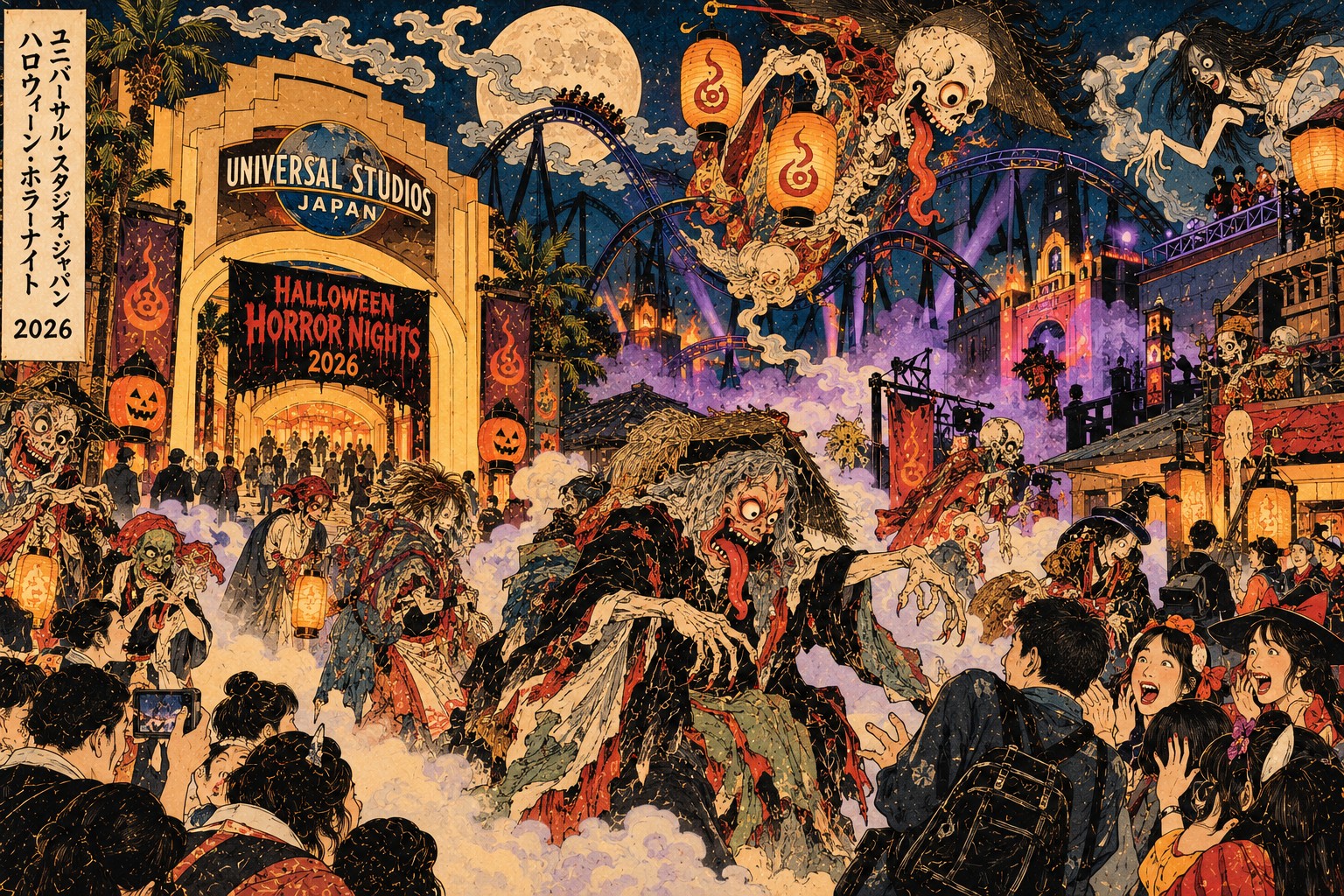
The art of selling fear rests on a boundary: between theatrical danger and actual safety.
A city street becomes a stage for fear
At Universal Studios Japan in Osaka, Halloween is not limited to pumpkins and costumes. The ordinary architecture of a theme park becomes the backdrop for roving zombies, darkened attractions and carefully orchestrated moments of suspense. On October 31, the spectacle reaches its calendar namesake—but the event does not end that night. USJ’s official schedule runs Halloween Horror Nights from September 11 through November 8, 2026; the broader Universal Extreme Autumn program began September 10. The distinction matters for visitors and for understanding the commercial strategy: this is a season, not a single party.
The fifteenth anniversary is also a lesson in Japan’s theme-park history
USJ opened in 2001 as a park built around experiences associated with film and entertainment. The company traces Halloween Horror Nights to 2011 and marks 2026 as the program’s fifteenth anniversary. Over those years, an autumn occasion became an extended live-entertainment offering featuring moving performers, themed rides, large-scale sound and lighting, and collaborations with recognizable media properties. The format sits at an intersection of theatre and park operations: audience members are both spectators and participants, but they remain within an environment managed for safety and throughput.
The street-zombie spectacle is choreography at scale
The company says 2026 has its largest contingent of street zombies to date. It has not provided a readily comparable public year-by-year count, so that superlative should be understood as a company claim rather than an independently audited statistic. The creative mechanism is easier to observe: actors in elaborate makeup appear across familiar park spaces, synchronized with narrative scenery, sound effects and crowd circulation. This is why a theme-park horror scene differs from an isolated haunted house. The visitor does not need to enter a single door to encounter the performance; the performance enters the landscape.
The adult-only attraction draws a new boundary
The new attraction Zanzō (残像), marketed in English as Lights Out: Nightmare Isolation, is described by USJ as its first R-18 horror experience requiring an explicit waiver. It is at Stage 18 and requires a separately purchased ticket. The Japanese official rules exclude everyone aged 17 or younger, require guests to leave bags in a locker and specify an arrival window before the booked time. The rules also prohibit revealing the attraction’s internal content. That restriction is a reason for responsible reporting, not an invitation to invent what occurs inside. The important verified development is a distinct, consent-based tier of intensity within the park’s larger Halloween offering.
Resident Evil becomes something you can walk into
The new Biohazard Requiem: The Dive experience connects the park to Capcom’s survival-horror franchise, known internationally as Resident Evil. Inspired by locations including the fictional Renwood Hotel and a sanatorium setting, the attraction translates a video-game environment into physical architecture, live action and ambient design. The franchise marks its thirtieth anniversary in 2026, giving the partnership a second commemorative dimension. USJ lists this attraction through December 27, later than the November 8 end of Horror Nights. The arrangement also illustrates intellectual-property licensing as an entertainment business: fans of a game are given a reason to experience the property outside the screen.
Sadako and the power of dread
Sadako’s Curse: Dark Horror Ride brings another form of fear into the mix. Japanese screen horror is often associated with a buildup of expectation—the unsettling pause, the suggestion that something may be nearby, the sudden recognition of a presence. A ride adds motion, darkness and physical disorientation to that grammar of suspense. It would be simplistic, however, to claim that today’s park attraction directly reenacts a centuries-old ghost story. The franchise has its own modern cinematic history, and USJ’s adaptation is a commercial entertainment experience rather than a folklore demonstration.
The surprising release valve is a dance floor
Among the striking components is Zombie de Dance, a street show in which performers and visitors trade the defensive posture of fear for the shared movement of music and choreography. The anniversary program also includes Halloween Horror Nights Academy: 15 Years of Screams. These experiences reveal a deliberate rhythm. The park alternates shock and release, placing communal celebration beside individual suspense. For a global audience, it is an example of how Japanese theme-park entertainment can recast horror as participatory pop culture, not simply a competition to produce stronger jump scares.
What technology does—and what the public record does not say
Lighting, fog, audio, special-effects makeup, timed theatrical cues and environmental design are visibly central to the genre. But USJ’s published 2026 announcements do not establish a complete technical inventory, specific control systems or verified spending on these effects. Claims about proprietary AI, motion tracking or new robotics would therefore be speculation unless supported by additional documentation. Equally significant is the unseen operational engineering: keeping audiences moving through dense environments, matching capacity to staffing, making information accessible and providing a way for those who do not wish to be frightened to avoid the experience.
Safety is a feature, not a footnote
The general Horror Nights page says the event is not recommended for children five and younger and that those twelve or younger need parental consent. Zanzō is stricter: no guests seventeen or younger. The park also states that from around 6 p.m. most areas, with exceptions, become horror zones, and identifies Universal Wonderland as a safety area for visitors avoiding scares. These rules are not interchangeable and are subject to the attraction being considered. Guests should check conditions for admission, separate tickets, timed entry, accessibility and costume restrictions directly with the operator before travel.
A season of fear has a commercial logic
A program stretching across September, October and early November can support visits beyond one Halloween weekend. The attractions also make space for separately ticketed premium experiences, collaborations, food and themed merchandise. Those are observable elements of the business model, but they do not reveal the event’s actual revenue or profit. USJ has not supplied a standalone, independently audited 2026 Horror Nights financial statement in the material reviewed. It would be misleading to attach an invented windfall to the park, to Osaka hotels or to local transit operators without evidence.
For Halloween visitors, the schedule is the story
An October 31 itinerary should be based on the official USJ app and date-specific show schedule, not a generic list of activities circulating online. Showtimes, ticket or numbered-entry availability, park hours and temporary closures can change. The 18-plus ticketed attraction requires particular attention, while the broader park is not uniformly an adult-only event. Visitors should also obey filming restrictions, especially where the organizer limits disclosure of an experience. This feature describes the announced programming; it does not guarantee admission or provide observed October 31 attendance.
Why people pay to be frightened together
A horror park sells a particular paradox: visitors enter voluntarily in order to feel briefly out of control. The production works only because there is an understood border between fiction and ordinary life. On one side are performers, effects and invented creatures; on the other are safety staff, rules, queues and the eventual exit. Fifteen years after the program’s debut, USJ’s Halloween spectacle illustrates how shared fear can become social entertainment—something to discuss, photograph where permitted, and remember after the lights return. That interplay of imagination and trust is more revealing than the organizer’s strongest promotional adjective.
Sources and verification
Based on official USJ program pages and company announcements. Company superlatives, undisclosed technical specifications and financial results are not presented as independently established.
- USJ: 2026 Halloween Horror Nights official Japanese program
- USJ: 2026 English Halloween Horror Nights
- USJ Co.: July 9 season announcement and attraction list
- USJ Co.: September 9 press preview
- USJ: Zanzō official rules and admissions
- USJ: 2026 autumn season overview
- USJ: English autumn season and other attractions
- USJ Co.: Biohazard Requiem collaboration announcement
- USJ: show and attraction schedule (times vary by day)