Turner painted nature’s overwhelming force. Today’s artists show us a world that human activity is changing.
The exhibition is about more than beautiful light
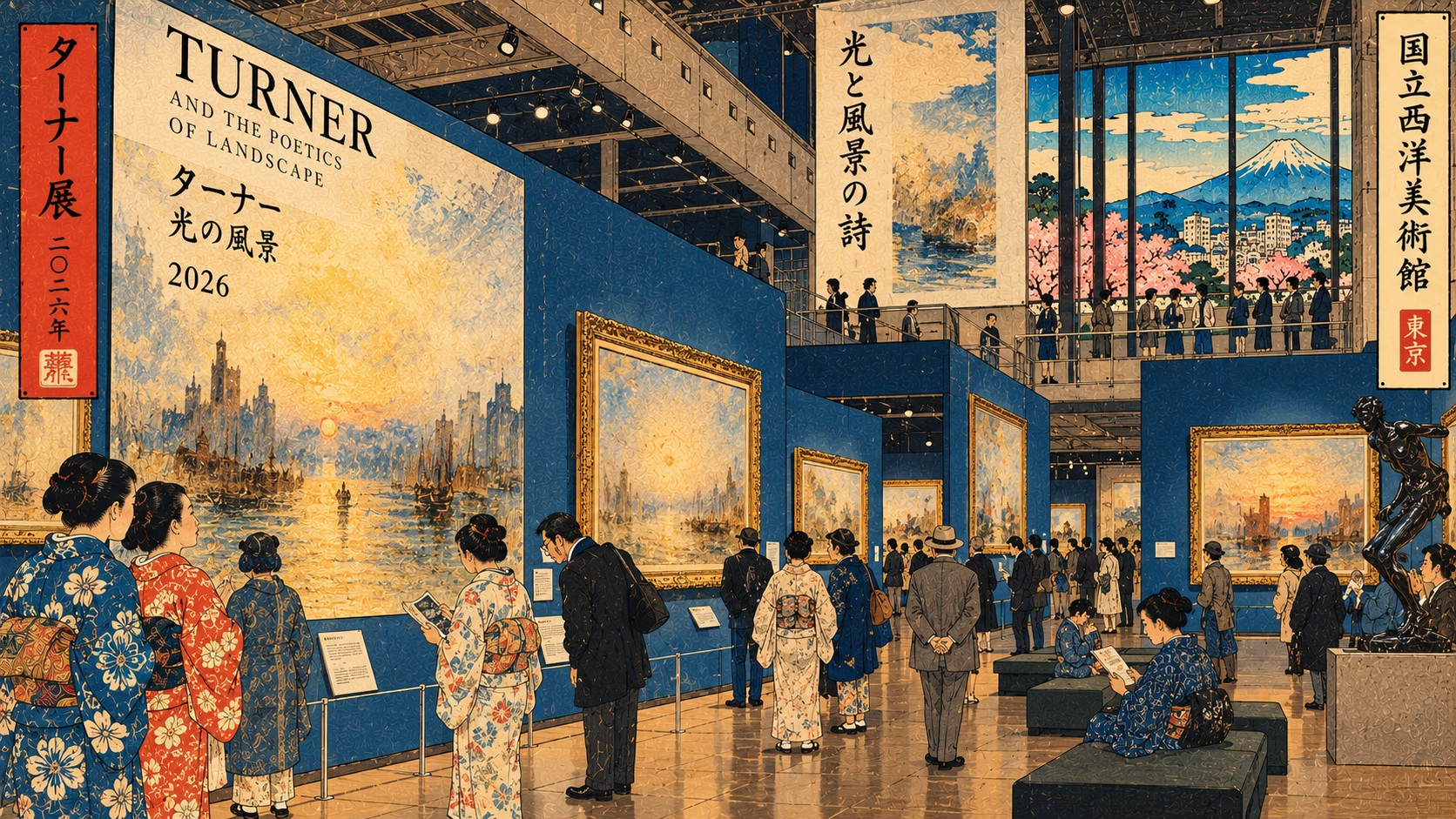
A new exhibition opened at the National Museum of Western Art in Tokyo on October 24, 2026, with an audacious proposition: J. M. W. Turner can be viewed not only as the great British painter of storms and luminous seas, but as an artist whose questions remain urgent in an age of melting glaciers and contested histories. Turner: Painting the Sublime, in Dialogue with Contemporary Art brings more than 80 oils and watercolours from Tate into conversation with postwar and contemporary artists. It runs until February 21, 2027.
An artist at the edge of an industrial century
Joseph Mallord William Turner was born in 1775 and died in 1851. His lifetime encompassed vast changes in Britain’s economy and physical environment: industrial smoke, steam power, expanding transport and the circulation of goods by sea. He was also a restless experimenter, trying to paint experiences that resisted stable outlines—mist, glare, rain, surf, snow and the air itself. The show follows the 250th anniversary of his birth in 2025, but its argument is not limited to commemoration.
What the sublime really asks of us
The exhibition’s word “sublime” is not simply another way of saying pretty. In eighteenth-century discussions associated with Edmund Burke and later Immanuel Kant, it concerned encounters with scale, danger, power and experiences that stretch human understanding. Turner’s seas and mountains draw their force partly from the knowledge that nature cannot be reduced to decoration. Yet the philosophical category is a framework for interpreting pictures, not scientific evidence that Turner anticipated present-day climate change.
An avalanche in 1810; a glacier in 2019
One of the most revealing curatorial decisions brings Turner’s Alpine subjects into contact with Olafur Eliasson. Turner’s Avalanche in the Grisons, exhibited in 1810, represents nature as a potentially overwhelming force. Eliasson’s The Glacier Melt Series 1999/2019 records the same Icelandic glaciers at two points twenty years apart. The exhibition also places his work alongside Turner’s views of the Mer de Glace. This is a dialogue constructed by the curators: the Romantic encounter with majestic ice sits beside contemporary evidence of environmental change.
The sea was a workplace, not merely a view
Turner’s marine painting was never just a catalog of attractive coastlines. Ships moved people, merchandise and power; they were exposed to forces they could not command. The exhibition identifies Rough Sea with Dolphins, dated approximately 1835–40, among its examples of Turner’s increasingly bold late handling of paint. Such works invite a double reading: the beauty of movement and light, and the vulnerability of human activity within a larger physical world.
The whaling ship and the economic history behind it
The exhibition prominently identifies Hurrah! for the Whaler Erebus! Another Fish!, shown in 1846. Its subject is a reminder that nineteenth-century maritime pictures also belong to the history of commercial resource extraction. A dramatic canvas can be admired as painting without treating the industry it depicts as beyond scrutiny. The show’s wider historical frame creates room to ask what forms of labor, trade and extraction sit behind the scene.
From the last Turners to Rothko and Newman
In a culminating chapter, the exhibition places Turner’s late investigations of atmospheric light near works by Mark Rothko and Barnett Newman, figures associated with the twentieth-century debate over an abstract sublime. This is an illuminating comparison, not a claim that Turner single-handedly invented abstraction. The language, institutions and philosophical ambitions of painting had changed profoundly by the time those artists worked. What survives across the centuries is the challenge of making color and space themselves into an experience.
The difficult history beyond the frame
The Otolith Group’s 2010 film Hydra Decapita introduces another set of questions, including slavery, colonial histories, and the politics of art institutions. The museum expressly identifies decolonization and criticism of capitalism among the issues raised through the work. That juxtaposition prevents a purely celebratory narrative about British cultural genius: the age of empire, global shipping and artistic production was also marked by profound unequal power. The questions belong to the curatorial argument; we have not independently interviewed the filmmakers.
Why the Tate collaboration matters
The London Tate collections include the largest holding of Turner works, and the Tokyo exhibition draws more than 80 examples from them. The organizers are the National Museum of Western Art, Tate, the Asahi Shimbun and TV Asahi. An international loan show allows audiences in Japan to examine original works in a sustained thematic sequence, while the presence of contemporary artists complicates the familiar format of a chronological blockbuster retrospective.
An unexpected Japanese counterpart
After Turner’s death in 1851, the Japanese printmaker Utagawa Sadahide became known for panoramic views of newly opened Yokohama, its ships, streets, merchants and foreign visitors. Turner and Sadahide did not document the same city or work within the same artistic conventions. There is no demonstrated direct influence between the two. But there is a useful editorial comparison: each visual tradition could turn a landscape into a record of a changing world, rather than a static postcard.
A practical guide to visiting
The venue is the National Museum of Western Art in Ueno Park, Tokyo, and the show runs October 24, 2026 through February 21, 2027. Hours are 9:30 a.m. to 5:30 p.m., extended until 8 p.m. on Fridays and Saturdays, with last admission thirty minutes before closing. Regular adult admission is ¥2,400, university admission ¥1,500 and high-school admission ¥1,100; junior-high pupils and younger enter free. High-school and university students have a free-admission period November 4–19. The museum has Monday and holiday-related closures, so dates should be checked on its official site.
What remains after the spectacle
The most compelling achievement of this exhibition may lie in the gap between two ways of looking. A viewer in Turner’s era might have stood before an avalanche and felt dwarfed by nature; a viewer today can also consider how industrial society has transformed the climate surrounding such scenes. Neither response cancels the other. Rather than simply asking whether Turner painted beautiful light, Tokyo invites a more durable question: what do landscapes reveal about the societies that look at them?
Sources and verification
Based on official museum and exhibition-organizer materials checked October 26, 2026. Japan.co.jp has not independently visited the galleries or interviewed the curators; commentary about artistic comparisons is editorial analysis.