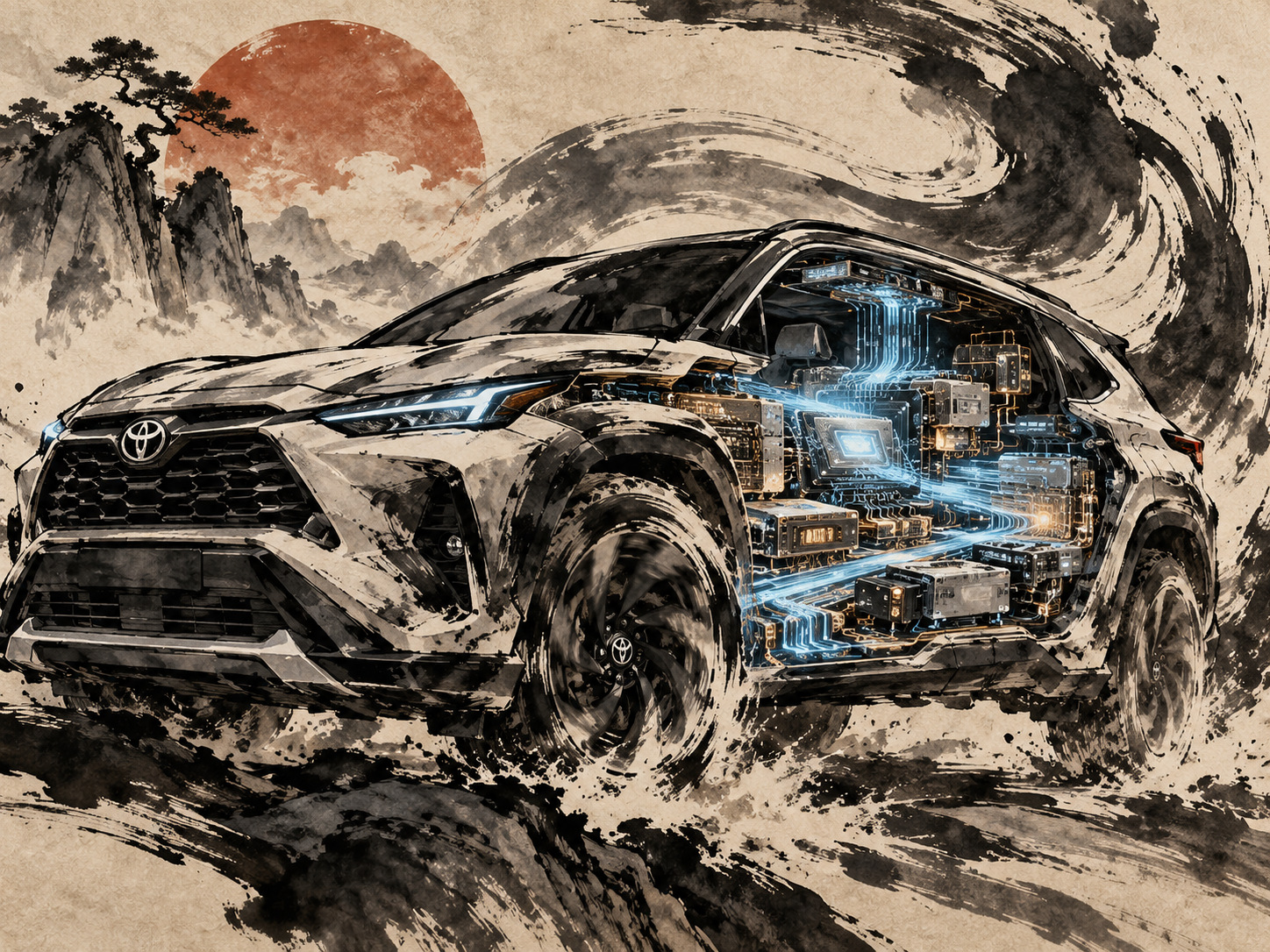
Deploying a software platform is not the same as promising every future feature to every driver.
The scale of the wager
Toyota wants its Arene software-development platform deployed across roughly 50 vehicle models and about 10 million newly produced vehicles a year by 2030. The scale, confirmed by a Toyota spokesperson on October 16 after a Nikkei report, would bring a once-specialized software architecture into the company's mass-market manufacturing system. The spokesperson said technology chief Hiroki Nakajima had outlined the direction at an investor event in Brussels, with a longer-term possibility of reaching alliance partners by 2035.
These are ambitions for deployment, not audited results. Ten million is an annual new-vehicle figure, not the number of cars already on the road receiving retrofits. Nor does running Arene necessarily mean every car has the same electronics, software features, or entitlement to future remote upgrades. The important story is what Toyota must change to make this ambition work.
A business built around manufacturing is rethinking the product
Modern vehicles already contain extensive code. What is changing is the organizing principle. Instead of treating software as a collection of modules largely coupled to specific hardware and suppliers, automakers increasingly want shared interfaces, repeatable testing, reusable functionality and processes that continue after a car leaves the factory.
The consequences reach beyond dashboards. Systems that influence braking, sensing, driver assistance, infotainment and connected services all require careful coordination. The promise is faster development and more consistent quality. The risk is that a defect in a shared layer could spread across multiple models unless isolation and validation are exceptionally strong.
Why the RAV4 matters
Toyota presented the sixth-generation RAV4 in May 2025 and launched the new vehicle in Japan that December. Toyota and Woven by Toyota identify it as the first Toyota model developed using Arene. Its significance lies in the production setting: a global, high-volume SUV is a far sterner test than an experimental prototype.
Toyota says Arene helped shorten software development for an upgraded Toyota Safety Sense package and key cockpit interfaces. The improvement in driver-assistance functions depends on more than code, however. Cameras, radar, computing hardware, vehicle dynamics and braking systems remain integral. The RAV4 demonstrates an initial deployment of development capabilities, not evidence that unrestricted feature updates are available to every buyer.
The deeper history: the production system becomes a software question
Toyota's reputation rests heavily on a method of manufacturing shaped by the principles of jidoka and Just-in-Time. Jidoka grew from Sakichi Toyoda’s loom innovations and emphasizes identifying abnormalities rather than passing defects onward. Just-in-Time, championed by Kiichiro Toyoda and refined through postwar production practice, aims to deliver the right materials at the right moment without unnecessary inventory.
Software introduces a different type of inventory: duplicated code, incompatible interfaces, accumulating technical debt and tests that must be repeated whenever one component changes. The analogy is imperfect—bugs are not identical to defective metal parts—but it helps explain why Toyota sees common development tools as strategic infrastructure. Software engineering is becoming another industrial production problem.
Inside Arene: the tools, the kit and the data
Woven by Toyota describes three important elements. Arene SDK offers common interfaces and frameworks so software can be developed and reused across vehicles and systems. Arene Tools supports simulation, automated validation and traceability linking requirements to testing. Arene Data is intended to create a controlled, privacy-aware pipeline for learning from vehicle behavior and informing improvements.
For an engineer, the real benefit is not a flashy screen. It is the possibility of avoiding a separate implementation of the same function for every hardware configuration, supplier combination and model. For executives, the crucial question is whether shared development can reduce cost and lead times without diluting accountability for safety and quality.
The limits of over-the-air expectations
A software-defined vehicle can be improved after sale, potentially through over-the-air downloads. But that should not be confused with unlimited upgradability. A function requiring a sensor, actuator or processor that a vehicle does not possess cannot simply be downloaded. The availability of updates may also vary with local regulations, model year, hardware versions, subscription arrangements and manufacturer support policies.
This creates questions that buyers should ask before treating the car as a continuously evolving device: Who owns the data? How long will security updates be supplied? What happens if connectivity fails? Will added features be free or charged? Can an update be reversed after a safety problem? Toyota has not publicly supplied model-by-model answers for the entire proposed 2030 rollout.
Competing against speed—and against complexity
Manufacturers in the United States, China, Europe and elsewhere are investing in software-defined architectures. Connected-vehicle companies compete on update cadence, software integration and digital experience, while established automakers still must manage vast combinations of regulations, markets, powertrains and service networks. Toyota is trying to leverage its production scale without sacrificing the quality discipline that made its name.
Speed alone is not the scorecard. Safety-critical software must survive edge cases, degraded sensors, cybersecurity threats and mistakes in real-world maintenance. An update cycle that works for a phone cannot be transferred mechanically to equipment that weighs more than a ton and travels at highway speeds.
The supplier question nobody should overlook
Toyota's architecture also matters to the dense industrial ecosystem of component suppliers, embedded-software specialists and electronics manufacturers that supports Japan's car industry. Common APIs could make it easier for capable smaller firms to build functions for multiple programs. They could also change who controls specifications and the profitable parts of development.
These are structural possibilities rather than documented forecasts of layoffs or contracts. The details will depend on governance, licensing arrangements and which functions Toyota chooses to bring in-house. The workforce implications extend into software security, simulation, semiconductor design, testing and the retraining of engineers whose expertise developed around specific control units.
What investors and drivers should measure by 2030
A deployment target is easy to count. Meaningful outcomes are harder: How long does it take to introduce a feature? How often do updates fail? Does software reuse actually reduce engineering effort? Do recalls become less common or simply change character? Does the owner receive tangible improvements years after purchase? And will the total cost of ownership improve rather than become a bundle of recurring digital charges?
The ambition places Toyota at an intriguing junction between two industrial eras. The company helped perfect repeatable physical production. Now it must show that software can be developed, verified, distributed and maintained with equally dependable discipline. The ultimate test is not the quantity of code installed. It is whether millions of people can trust what that code makes their cars do.
Questions that remain
- The model-by-model 2030 implementation timetable
- Which functions will be updatable, and in which regions
- Security support and service life for software
- How Toyota will share development and responsibility with suppliers
Sources and documentation
Primary Toyota and Woven by Toyota materials underpin the technical and historical reporting. The October 16, 2026 target is attributed to Toyota’s spokesperson as reported by Reuters.
- トヨタ:2025年5月 新型RAV4発表 / Toyota: RAV4 world premiere
- トヨタ:2025年12月 RAV4発売 / Toyota: RAV4 launch
- ウーブン・バイ・トヨタ:Arene技術 / Woven by Toyota: Arene architecture
- ウーブン・バイ・トヨタ:RAV4初採用 / Woven by Toyota: RAV4 integration
- トヨタ:2023年 新体制方針説明会 / Toyota: transformation strategy
- トヨタ:知能化技術 / Toyota: intelligent vehicle technology
- Toyota: 75 Years of Toyota, production-system history
- Reuters via Channel NewsAsia: October 16, 2026 confirmation