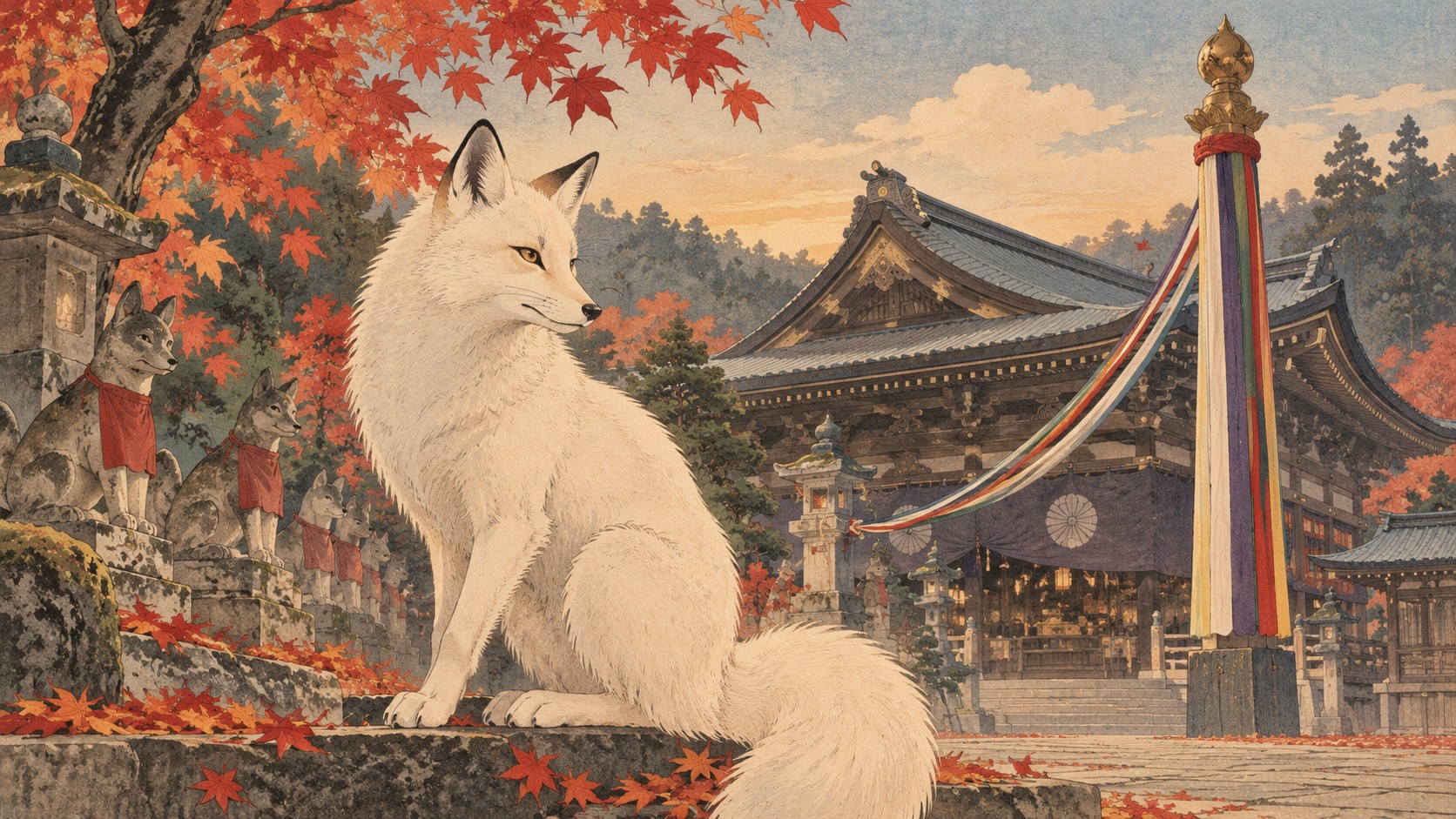
TOYOKAWA, Aichi Prefecture — A temple crowded with stone foxes will renew a ceremony unseen here for 72 years. From November 1 through 23, Toyokawa Inari, formally the Sōtō Zen temple Myōgon-ji, will hold a gokaichō: the ceremonial opening associated with the normally concealed image of its guardian, Toyokawa Dakini Shinten. The previous opening was held in 1954, when Japan was rebuilding after the Second World War.
The place invites a productive misunderstanding. Visitors pass torii gates and encounter foxes and the name Inari, yet this is a Buddhist institution. Its religious identity is not a curiosity to be explained away. It is a living record of the long interaction between Buddhism and Japan’s kami traditions. The coming festival, and an unusual visit from a Shinto priest, bring that history into view.
Seventy-two years, two eras of reconstruction
The organizers describe this year’s theme as connecting people across time. Their account places the last ceremony in the postwar year of 1954 and recalls the present main hall’s completion in 1930. The 2026 observance also looks toward that building’s centenary in 2030. The figure 72 describes the interval since the last opening; it is not evidence that the temple has always followed an unbroken 72-year cycle. The official history refers to Horse-year openings, a practice distinct from the long modern gap.
Preparations begin on October 24 with the erection of a wooden connection pillar at 10 a.m. On October 31, the cabinet-opening ceremony is scheduled for 2 p.m., followed at 3:30 p.m. by a rite connecting the sacred figures to the pillar. The public festival runs November 1–23 and ends with the formal closing of the cabinet at 2 p.m. on November 23.
How a five-colored cord becomes a link
The ceremony centers on an image of Dakini Shinten ordinarily enclosed in a sacred cabinet. According to the temple, a thread connects the concealed image to an o-maedachi, a representation set before it. Another five-colored cord, the zen no tsuna, leads to the goen-bashira pillar outside the main hall. The temple teaches that touching the pillar allows worshippers to form a religious bond with the deity. That is its account of the ritual’s significance, not an independently testable effect.
Visitors should understand the rules before traveling. The outdoor precinct is free to enter; selected halls require paid admission. But purchasing a hall-viewing ticket does not grant close worship before the o-maedachi. That observance belongs to those taking part in the separately arranged gokaichō prayer. General hall visitors may instead encounter a distinct bronze representation connected by the cord. A ceremonial opening should not be mistaken for unrestricted public display of the hidden image.
Why foxes watch over a Zen temple
Myōgon-ji traces its foundation to 1441 and the Zen master Tōkai Gieki. The temple identifies Senju Kannon, the thousand-armed bodhisattva, as its principal Buddhist figure; Dakini Shinten is revered as its guardian. In the Toyokawa iconography the guardian rides a white fox and carries rice and a precious jewel. The association helped give the temple its familiar Inari name and its reputation as a destination for prayers about prosperity and protection.
The temple’s founding tradition also tells of the thirteenth-century monk Kangan Giin, who returned from China and encountered the deity in a visionary episode. The narrative links his spiritual lineage with Tōkai Gieki. It matters as a statement of the temple’s religious memory, but a sacred encounter described in a foundation legend must not be treated as the same kind of evidence as a dated institutional foundation.
A Shinto priest brings kagura to the Buddhist precinct
On November 6 at 11 a.m., the chief priest of Toga Shrine is scheduled to visit and dedicate kagura to the guardian deity. The official program describes prayers for regional peace and prosperity. This is one of the festival’s most revealing moments: a Shinto priest making an offering within a Zen Buddhist temple, long after the state-sponsored separation of Buddhist and kami institutions began in the Meiji era.
On November 21 and 22, both at 2 p.m., a grand procession will carry the deity in a portable shrine alongside children, musicians and monks. An early Buddhist service at 5 a.m. on November 1, by contrast, is specifically designated an internal observance, not open to general participation. The calendar is both an invitation and a reminder that sacred space has boundaries.
A rare encounter with art, old and new
The temple’s displays extend the story beyond the opening ceremony. Two wooden standing Jizō Bodhisattva figures in the inner precinct are nationally designated Important Cultural Properties. The temple dates them to the middle-to-late Kamakura period and gives their heights as just over 77 centimeters each. Other viewing opportunities highlight Senju Kannon and richly carved architectural details. An ink-painting program involving contemporary artist Nishimoto Yūki adds another layer; its scheduled museum presentation runs from October 31 to November 23.
These are not merely decorative additions. They show how a religious institution preserves art, makes new art, and negotiates who may see which objects and under what conditions. Visitors should consult the specific hall-viewing guidance rather than assume every object is included in one admission.
A much older sacred landscape — but not proof of a much older temple
An independent researcher, Katsuyoshi Yamamoto of Far East Alexandria, has offered Japan.co.jp a different question: might the sacred geography of eastern Mikawa and western Tōtōmi contain religious layers predating Myōgon-ji? Yamamoto stresses that he is not a representative of the temple, and presents his comparisons as hypotheses.
The wider San-en region is genuinely rich in Yayoi-period bronze bells called dōtaku. Hamamatsu City says that after municipal consolidation it led Japan in the number of recorded dōtaku find-spots. Such discoveries demonstrate ancient ritual activity in the region; they do not establish that people worshipped at the future Myōgon-ji site or that any one cult persisted unchanged into medieval Buddhism.
One extraordinary textual detail deserves closer scrutiny. An entry for August 14, 860, in the Nihon Sandai Jitsuroku records a bronze bell discovered in the mountains of Muramatsu in Atsumi District, Mikawa Province. The record adds that some called it a treasured bell of King Ashoka, the Indian emperor associated with Buddhist patronage. The significance lies in a ninth-century interpreter invoking Ashoka to explain an unfamiliar find—not in proof that the object came from India. Muramatsu in historical Atsumi District must not be confused with the precinct of Toyokawa Inari.
Yamamoto is also investigating possible comparisons between Japanese torii and ancient Indian torana gateways. Visual analogy, even a striking one, does not document transmission. Establishing a relationship would require dates, intermediate examples and a plausible route of cultural exchange. No evidence reviewed for this article demonstrates that Toyokawa Inari was founded before 1441 or that it is Japan’s oldest Inari site.
What visitors need to know
General precinct admission is free. Individual or combined hall tickets are sold on site; gokaichō prayers begin at ¥5,000 per person. Prayer reception runs from 6 a.m. to 2:30 p.m. on November 1, 8 a.m. to 2:30 p.m. from November 2 through 20, and 8 a.m. to 1:30 p.m. on November 21–23, with interruptions for ceremonies. The temple specifies cash payment for prayers and hall admissions. Meal hospitality is reserved for eligible advance online applicants, and same-day prayer requests depend on capacity. The four special Daihannya prayer sessions were marked fully booked in the official notice consulted for this report.
JR Toyokawa and Meitetsu Toyokawa-Inari stations are approximately a five-minute walk from the temple. Organizers encourage public transport, especially around the final festival weekend. Travelers should recheck instructions and schedules directly with the temple.
The power of the 2026 opening is not that it solves every question about the past. It makes a living tradition momentarily visible: a fox-riding Buddhist guardian, monks, a visiting Shinto priest, centuries-old figures and contemporary art occupying the same sacred landscape. The historical mysteries may remain unresolved. That does not make the ceremony any less remarkable.
The schedule begins before November
The first publicized step comes on October 24 at 10 a.m., when the connection pillar is erected. The sacred cabinet is ceremonially opened on October 31 at 2 p.m.; the cord-linking rite follows at 3:30 p.m. On November 1, a 5 a.m. Daihannya ceremony is an internal observance and is not open to general participation. The November 6 visit by Toga Shrine’s chief priest, and the November 21–22 processions, show the breadth of the programme.
The temple has scheduled a White Fox Festival on November 21, from 4 to 9 p.m., alongside selected evenings of precinct illumination. These cultural activities are distinct from the ritual opportunity to worship before the o-maedachi. The cabinet is scheduled to close on November 23 at 2 p.m.
What a visitor's ticket does—and does not—include
Ordinary precinct entry is free. The adult main-hall viewing ticket is ¥500, and a combined ticket for the principal viewing locations costs ¥1,500. Both are sold on the day and require cash. The special gokaichō prayer begins at ¥5,000 per person and is the way to participate in close inner-hall observance before the o-maedachi. Advance online registration is recommended; the temple says its meal hospitality is limited to advance online registrants. Neither a viewing ticket nor the evening light show should be marketed as guaranteeing an unobstructed view of the normally hidden sacred image.
Documentation and reporting method
The temple's Japanese announcement provides dates, prices, named rites and the distinction between prayers and viewing tickets. Its historical page gives the founding account. Hamamatsu's archaeological materials and the ninth-century chronicle excerpt concern the wider region, not a proven prehistoric origin for this temple. Yamamoto’s comparisons are proposals for further research, not institutional findings. Japan.co.jp has not represented the correspondence as an interview with a temple official.