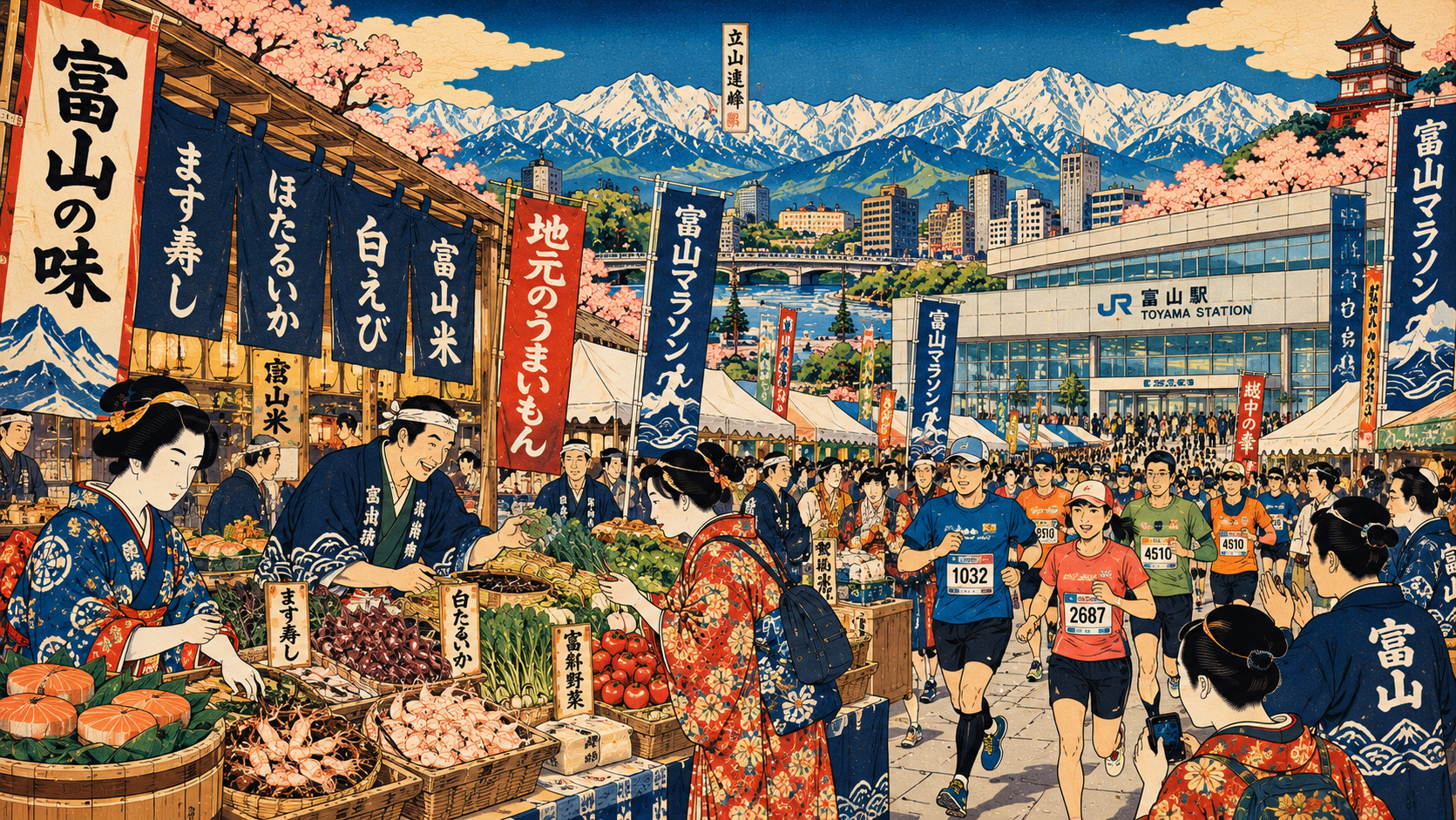
A finish line for runners, a shop window for farmers
As runners made their way across Toyama Prefecture on November 1, another event was designed around the people who grow, process and sell its food. Toyama City scheduled a one-day POP-UP MARKET at the north entrance plaza and north–south passage of Toyama Station, from 10 a.m. to 4 p.m. The city advertised approximately 40 vendors and a lottery restricted to marathon participants. The pairing offered a simple proposition: athletes and visitors arriving for a large sporting event could meet local producers before leaving the city. Whether they actually bought more local food remains a question worth investigating, not an outcome that can be assumed.
A carefully planned market, not a measured economic windfall
The approximately 40 sellers were the expected number published in the city’s October 28 event notice; the source does not provide a final count of vendors operating on the day. Nor did the official material reviewed supply market attendance, aggregate sales, customer origins or business generated after the event. It would therefore be misleading to turn the marathon’s runner count into a market visitor count or to calculate an economic multiplier without data. What is documented is a deliberate attempt by the municipality to introduce locally produced goods to people already gathering for a major event.
The marathon’s route is a tour of Toyama itself
The full marathon began at 9 a.m. outside Takaoka City Hall, covering 42.195 kilometers on a route that takes in Takaoka’s history, the Shinminato Bridge in Imizu and the waterside finish at Fugan Canal Kansui Park in Toyama City. Organizers had prepared a contingency route for adverse weather but confirmed on November 1 that the normal route crossing the landmark bridge would be used. The race is as much a display of the prefecture’s varied built and natural landscapes as a test of endurance. The station market added an agricultural and culinary chapter to that geographical story.
The race results, and what they do not tell us
Toyama Television reported 13,581 starters across the marathon and wheelchair events. Tomohide Nishikawa of Aichi won the men’s race for the first time, while Miyu Moriuchi, from Tonami, defended her women’s title with a reported 2:39:16. Another broadcaster gave a larger overall participation figure that may reflect other race categories; those counts should not be conflated. None is a measurement of traffic through the food stalls. Any assessment of the market’s influence requires its own records, including purchasers, spending and repeat customer behavior.
A geography that can be tasted
Toyama’s identity is shaped by mountains, river plains and Toyama Bay. Rice has sustained local cooking and celebrations; fresh and preserved seafood links households to the coast; seasonal produce reflects the agricultural landscape between mountains and sea. The significance of the pop-up was its emphasis on products grown or made within Toyama City. That sourcing boundary matters: a famous Toyama Prefecture specialty is not automatically evidence that a particular stall sold it. A useful regional food story needs to distinguish prefectural branding, municipal origin and the actual goods that sellers offered.
The small seed with a big place in the program
A Toyama Egoma Marche was among the announced attractions. Egoma, or perilla, is cultivated for seeds and oil and appears in seasonings and prepared foods. Bringing an unfamiliar product into a transport hub gives producers an opportunity to explain flavor, cooking techniques and storage to customers who might otherwise pass it by. For marathon visitors, food is a practical point of interest after hours on the road. But nutrition marketing should not become unsupported medical claims: the legitimate story is local agriculture, food knowledge and commercial discovery.
Organic agriculture steps out of the field
Toyama City’s Organic Agriculture Promotion Council announced that it would sell a limited Organic Village Deli menu at the event. Planned offerings included prepared dishes centered on city-grown vegetables raised without synthetic agricultural pesticides and chemical fertilizers, rice balls made with organically grown rice, brown rice, mochi, perilla oil and perilla dressing. The municipal release named Café Gocco, Shoku no Consultant Bouquet and Kitchen Hanamizuki as cooperating businesses. That list is documentary evidence of a coordinated project, not proof of what quantities were sold or how consumers responded.
A bowl of autumn soup is also a story about production
A limited autumn soup-and-rice meal was promoted as a collaboration between Toyama City and chef Tanaka of Kitchen Hanamizuki. The program also called for public mochi-pounding demonstrations and servings at 10 a.m. and 1 p.m., alongside a children’s vegetable-themed puzzle rally. These activities are not merely decoration around retail sales: they create opportunities for children and families to connect names, tastes and preparation methods to agricultural production. A reporter interviewing attendees could test that premise. Without interviews or an event survey, however, it remains the organizers’ intention rather than a demonstrated educational outcome.
Why the railway station matters
Toyama Station is a key stop on the Hokuriku Shinkansen. The 2015 extension to Kanazawa changed the way many visitors arrive and move through the region, while the city continues to use the station area as a gateway to its economy and attractions. A market placed there can reach people who would not normally visit a farm gate or a specialist store. Turning that first encounter into repeat business depends on more than a crowded day: clear identification of producers, portable packaging, reliable supply and ways to reorder can make the difference.
The economics of a one-day opportunity
For a small farm or food processor, direct encounters may deliver information unavailable through wholesale channels: which products spark curiosity, what a customer is willing to pay and whether a recipe needs explaining. But participating also requires staffing, transport, temperature control, setup and time away from regular operations. A market can be a success in publicity terms while yielding little net income to an individual seller. Future reporting should ask participating businesses about costs, margins, contacts and follow-up orders. None of those figures was provided by the official event pages checked for this article.
A race that began in 2015, and a longer test for its hosts
The Toyama Marathon began in 2015. More than a decade later, the strategic question is what residents beyond the racecourse gain from the international visibility and local enthusiasm it creates. On November 1, the municipality tried to extend the day’s value from sport to agriculture and food culture. The compelling part of the story is not a hypothetical windfall but a testable idea: can a temporary crowd develop a lasting relationship with people and businesses producing the things that make Toyama distinctive? The answer will be found in repeat customers and future orders, not simply the number of runners crossing a finish line.
Sources and reporting method
Document-based reporting using municipal and tourism notices, marathon organizers and local race coverage. No onsite reporting or vendor interviews were conducted.