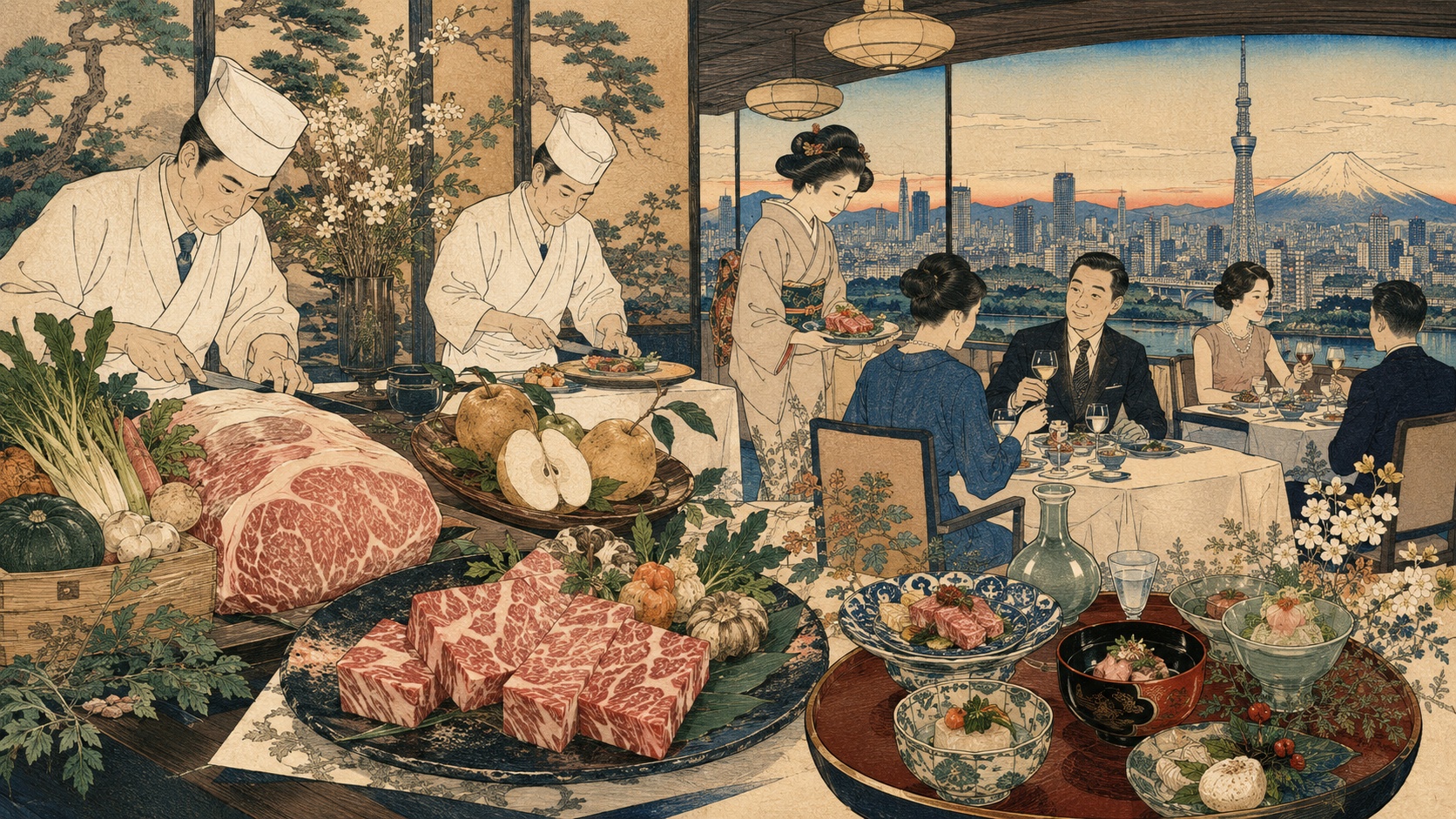
Hotel New Otani Tokyo says the 2026 Tottori Wagyu Fair runs from August 1 to September 20 across eight outlets. The noodle and cocktail items featuring the Shinkansen pear are scheduled to begin around mid-August in step with the harvest. Prices, dates and availability may change. This article draws on materials published by the hotel, Tottori Prefecture and producer organizations through August 2, 2026, Japan time, and distinguishes Tottori Wagyu generally from the separately certified premium subset called Tottori Wagyu Olein 55.
A map of Tottori appears on a Tokyo plate
Order the Tottori Wagyu burger in the lobby-level SATSUKI and the plate initially speaks the language of cosmopolitan luxury: foie gras, truffle, beef stew and a glossy sauce in the Rossini tradition. Follow the beef back to its source, however, and the gaze moves roughly 500 kilometers west from Kioicho to the foothills of Mount Daisen—toward clean water, rice straw, Sea of Japan weather and generations of cattle breeding. The burger is a translation written jointly by a rural prefecture and an international Tokyo hotel.
The fair becomes compelling because it refuses to leave its protagonist in one form. Tottori Wagyu appears as a burger, mild beef-cutlet curry, steak pilaf, filet-and-sirloin tasting course, seared shabu-style beef, a stamina bowl, chilled Inaniwa udon, black-miso fried noodles and a long braise. Around it, sand-dune rakkyo cuts through fat, Daisen foothill milk becomes gelato beside mizu-yokan, and pear enters both chilled noodles and a sake cocktail.
Regional food promotions can collapse into catalogues of famous products. Cooking does something more demanding: it creates relationships. Pickled rakkyo resets the palate after beef; pear juice meets dashi, lime or sake; milk's round sweetness deepens the darker flavor of azuki bean jelly. The most persuasive way to explain Tottori may not be to display a map, but to connect mountain, field, dune and sea inside a single meal.
Eight outlets tell eight versions of Tottori
| Outlet | Featured offering | What it communicates |
|---|---|---|
| SATSUKI | Tottori Wagyu and Foie Gras Burger, Rossini Style ¥6,800 / Mild Beef-Cutlet Curry ¥4,800 | An accessible hotel-food gateway combining familiarity with premium ingredients. |
| RIB ROOM | Steak Pilaf Set ¥10,000 / Filet and Sirloin Course ¥27,000 | A direct comparison of cuts and the flavor of the beef itself. |
| SEKISHIN-TEI | Tasting Lunch ¥26,000 / Dinner ¥36,000 | Live teppanyaki inside a Japanese garden with more than four centuries of history. |
| VIEW & DINING THE SKY | Seared Tottori Wagyu in Sukiyaki Sauce, weekday dinner buffet ¥15,000 | Live cooking and the panoramic viewpoint inherited from the hotel's 1964 opening. |
| KATO'S DINING & BAR | Stamina Gozen ¥7,150 / Chilled Inaniwa Udon ¥6,800 / Daisen Milk Gelato ¥2,200 | Beef, rakkyo, koji and milk placed inside a Japanese meal sequence. |
| mendokoro NAKAJIMA | Ultimate Chilled Udon with Shinkansen Pear ¥2,800 | Pear, dashi, lemon granita and dried fruit in an experimental noodle dish; planned from mid-August. |
| TAIKAN EN | Black-Miso Fried Noodles ¥6,000 / Tender Braised Wagyu ¥4,000 | Shanghai technique and fermented seasoning reveal another contour of the beef. |
| Bar Capri | SHIZUKU-HANA, Shinkansen Pear and Hiokizakura ¥3,900 | Pear, sake and lime condensed into one drink; planned from mid-August. |
The price ladder is broad, from a ¥4,800 curry to a ¥36,000 teppanyaki dinner, although none of it is everyday canteen food. That distance reflects what a luxury hotel does: it removes an ingredient from anonymous mass distribution, then adds technique, service, setting and narrative. Diners pay for that added value. The larger question is whether the value travels back—through sustained purchasing, interest in the prefecture, tourism, gifts or later retail demand—rather than ending at the hotel table.
Kedaka stands near the source of Tottori Wagyu
Tottori's cattle history predates modern branding by centuries. Prefectural records describe the cattle and horse market around Daisen's Bakurōza during the Edo period as one of Japan's three great livestock markets. Cattle were not primarily luxury meat. They plowed fields, carried goods and represented household wealth. The knowledge required to judge animals, remember lineages and improve the next generation grew out of agricultural life.
During the Taisho era, Tottori began what the prefecture describes as Japan's first Wagyu registration system, placing pedigree and performance on a recorded foundation. From that culture emerged Kedaka. At the first National Competitive Exhibition of Wagyu in 1966, the Tottori sire took first prize in a beef-production category. He is said to have produced about 9,000 descendants and became one of the important ancestral lines behind branded Wagyu across Japan.
At the 11th national competition in 2017, progeny of the Tottori-owned sire Hakuho 85-3 won the top meat-quality honor. Hakuho 85-3 also carries Kedaka blood. A small breeding region had sent genetics outward across the country, then used that same lineage to return national attention to Tottori.
One distinction matters: “Tottori Wagyu” is not the name of a separate cattle species. It is a commercial designation for high-quality Japanese Black cattle fattened in Tottori and meeting standards involving marbling, color and texture. Place, pedigree, husbandry and grading work together to create the brand.
Olein 55 does not mean every piece of Tottori Wagyu
Descriptions of Tottori Wagyu often emphasize oleic acid, a component of fat associated with melting characteristics and perceived quality. Yet not every animal sold as Tottori Wagyu is certified as “Tottori Wagyu Olein 55.”
Olein 55 is a selected premium tier. Its standards include at least 55 percent oleic acid in the fat and lineage from Kedaka, among other requirements. In other words, Olein 55 sits inside the larger category of Tottori Wagyu. Hotel New Otani's official fair page identifies the featured meat as Tottori Wagyu; it does not state that every dish uses Olein 55.
The distinction is more than technical housekeeping. Regional brands preserve trust when they explain precisely what has—and has not—been certified. Wagyu evaluation is also expanding beyond a simple race for more marbling. The quality of fat, depth of lean flavor, finish, animal care and environmental conditions increasingly shape the story told to diners.
Mount Daisen produces both beef and milk
The foothills of Daisen enter the fair in two forms. One is Wagyu. The other is milk. Hotel New Otani uses Daisen Sanroku Milk—limited by origin to the Daisen foothill area—in a gelato served with mizu-yokan. After the density of beef, the sequence offers the richness of milk with a cleaner finish, allowing two branches of the same mountain agriculture to appear in separate courses.
Daisen Dairy Agricultural Cooperative was established on July 21, 1946, and reached its 80th anniversary in 2026. It is unusual in Japan because all dairy farmers in Tottori Prefecture belong to the specialized cooperative, which integrates production, processing and sales. To an urban consumer, milk appears as a carton. Behind it stands a chain of pasture, feed, veterinary care, milking, collection, pasteurization and cold distribution. Daisen Dairy keeps much of that chain inside a regional cooperative structure.
Daisen Sanroku Milk was launched in 2024 with defined production-area and quality criteria. Its role in the fair is modest—a ¥2,200 dessert—but its history runs from postwar food rebuilding through school lunches, household refrigerators, tourism, sweets and cheese. The gelato is therefore not a decorative afterthought. It is another chapter of Tottori agriculture.
Pear culture moves from Nijisseiki to Shinkansen
Tottori's defining relationship with pears accelerated in 1904, when Eiji Kitawaki brought ten Nijisseiki pear saplings into the prefecture. The variety had been discovered in Matsudo, Chiba, but Tottori's climate, patient cultivation, cooperative sorting and labor-intensive pruning and bagging transformed the prefecture into its best-known home. The pear blossom became the prefectural flower in 1954, while historic cultivation tools have been recognized for documenting the development of Japanese fruit-growing technique.
The pear used in this fair is not Nijisseiki itself. It is Shinkansen, a red-skinned pear developed by Tottori's horticultural experiment station and registered in 2008. The hotel describes it as low in acidity and intensely sweet, typically 13 to 15 degrees Brix, while retaining the crisp texture associated with Nijisseiki. Its name evokes juice bursting “like a spring” from the fruit.
At mendokoro NAKAJIMA, coarsely grated pear meets chilled udon, dashi, lemon granita and a dried pear chip. The combination is not novelty for novelty's sake. It moves pear from the dessert plate into the realm of seasoning, using sweetness, aroma, acidity and water content as culinary tools. At Bar Capri, Hiokizakura sake and lime turn the fruit into a liquid landscape. For a fruit-growing region, such uses help extend a brief harvest into a longer chain of value and memory.
Sand-dune rakkyo turns difficult land into identity
In tourism photographs, the Tottori Sand Dunes appear to be a landscape of wind patterns and sky. For farmers, sand is also demanding soil: fast-draining and poor at holding nutrients. Those same properties suit rakkyo. Producers around Fukube in Tottori City spent decades turning austere sandy ground into a recognized growing region.
Tottori Prefecture says shipments toward Kansai began roughly 95 years ago. Today, Tottori Sand Dune Rakkyo is protected as a geographical indication and known for its consistent shape and crisp bite. Traditional hon-zuke pickling first holds the bulbs in brine for lactic fermentation, then removes excess salt before the final seasoned bath. Beneath the sweet-vinegar flavor is a preservation technology.
In KATO'S stamina set, hotel-pickled rakkyo accompanies a garlic-seasoned Wagyu bowl. It is formally a side dish, but conceptually essential. It cuts through fat, renews appetite and places sand-dune farming inside a meal dominated by expensive beef. A small bulb reveals a more ordinary, workmanlike Tottori that marbling alone could never show.
Pear and Hiokizakura put Tottori's rice and water into a glass
Bar Capri's SHIZUKU-HANA combines Shinkansen pear with Hiokizakura Shizuku Junmai Daiginjo and lime. Yamane Shuzōjō, the brewery behind Hiokizakura, was founded in 1887 in the valley landscape of Aoya, Tottori City. It prioritizes drawing out rice flavor through complete fermentation and is also known for working with Goriki, a sake rice native to Tottori.
The Shizuku Junmai Daiginjo used in the cocktail is made from Yamada Nishiki polished to 45 percent. The sake is collected by hanging bags and allowing it to drip under natural pressure, favoring clarity over efficiency. Against the pear's concentrated sweetness, dry sake and lime keep the drink from becoming a simple fruit cordial and bring it back toward the dining table.
Tottori is one of Japan's notable junmai regions, with pure-rice sake accounting for roughly four-fifths of production, according to the prefecture. In October 2025, “GI Tottori” was designated for qualifying junmai sake made in the prefecture using Tottori-grown rice and local water, among other standards. Wagyu protects pedigree, rakkyo protects place, and sake now protects geographical production rules. Tottori food is increasingly preserving not only flavor, but an auditable account of where and how that flavor was made.
A hotel born in 1964 carries regional Japan into Tokyo
The setting has a history equal to that of the ingredients. In 1962, with Tokyo facing a severe shortage of international accommodation before the Olympics, Yonetaro Otani accepted a government request to build a world-class hotel on his Kioicho property. Hotel New Otani opened on September 1, 1964. With 1,058 rooms at the time, Japan's first high-rise building, a pioneering unit-bath system and a revolving observation lounge designed to show visitors Mount Fuji, it was an instrument of postwar Japan presenting modernity to the world.
Yet under the modern tower, a landscape more than 400 years old was preserved. The land had belonged in succession to Kato Kiyomasa, the Ii family and the Fushiminomiya branch of the imperial household before Otani acquired it and restored the garden. A hotel built for the future of 1964 absorbed the terrain and stonework of an Edo-period daimyo estate.
In 2026, the complex has 1,389 rooms, 36 restaurants and bars, and 33 banquet rooms. Its scale resembles a small city. That is why a single regional fair can move through Western, Japanese and Chinese kitchens, a steak house, a garden teppanyaki pavilion, a noodle shop and a bar. The same beef receives a different editorial treatment in each kitchen. The hotel is both showcase and translation desk.
This is a continuing relationship, not a first meeting
Hotel New Otani's Wagyu archive lists a Tottori Wagyu Fair in 2019 and another in 2025. The 2026 edition is therefore not a one-off discovery but part of an ongoing relationship. The hotel's “STAY TOKYO EAT JAPAN” project frames Tokyo dining as a way to encounter food from across the country without leaving the capital.
Continuity changes the economics. A single fair can reduce a region to seasonal decoration. Recurring purchases, improved recipes, feedback to producers and the introduction of new cultivars or processed foods can turn a city hotel into a market-development platform. For a prefecture with limited production, selling smaller quantities in places able to explain value can sometimes be more useful than chasing anonymous national volume.
Luxury presentation, however, does not automatically equal regional revitalization. The real questions concern producer prices, long-term contracts, use of off-grade produce, logistics, and the ability of younger farmers to continue. The more beautiful the plate becomes, the more important it is to ask whether the agriculture behind it is sustainable.
Why Japan's least populous prefecture can claim to contain a whole pantry
Tottori is Japan's least populous prefecture, but its geography is not slight. The Sea of Japan and dunes line the north; Mount Daisen and the Chugoku Mountains rise to the south; plains form along three river systems. Rice, vegetables, fruit, livestock and fisheries exist within short distances. Because the prefecture is compact, the path from mountain water to field and sea can be unusually visible.
The “Food Paradise Tottori” strategy becomes stronger when it does more than list isolated champions. A guest who arrives for Wagyu learns about pear, milk, sake and sand-dune agriculture. When those discoveries reinforce one another, the prefecture itself becomes the brand.
The Rossini burger speaks in the global language of luxury. Rakkyo speaks in the language of farm preservation. Nijisseiki history speaks of agricultural modernization; Shinkansen speaks of contemporary breeding. Shirobara milk speaks of cooperative organization; Hiokizakura speaks of rice and fermentation. A meal that appeared to be about beef gradually reveals the structure of a regional society.
What remains when the meal is over
The success of a regional fair cannot be measured only in covers and revenue. Does the diner leave with “that was delicious,” or with questions: Where was it raised? Can I buy the pear or milk later? Should my next trip be to Tottori? The difference is the difference between temporary promotion and durable place branding.
Walk through Hotel New Otani's garden and you find Edo stonework sharing a property with a 1964 high-rise. Into that layered setting come Wagyu descended from a cattle-market culture, pear farming rooted in Meiji-era transfer and experimentation, a postwar dairy cooperative and a Meiji-era sake brewery. Different eras of Japan sit at one table.
Bringing Tottori to Tokyo is not the same as creating a substitute for Tottori. At its best, the meal makes the distance to the source visible. The final crisp bite of rakkyo, the returning perfume of pear and the fading sake finish leave more than appetite satisfied. The plate disappears. The map remains—and on it, Tottori has become a possible next destination.
Sources and verification
Japan.co.jp reviewed materials published by Hotel New Otani Tokyo, Tottori Prefecture, Daisen Dairy Agricultural Cooperative and Yamane Shuzōjō through August 2, 2026, Japan time. Menu names, prices and service periods are taken from the hotel's official fair page and may change with availability. The displayed exchange rate is 1 U.S. dollar = 157.57 Japanese yen. The supplied timestamp of July 31, 2026 at 9:00 p.m. UTC converts to August 1 at 6:00 a.m. Japan time.
- Hotel New Otani Tokyo: Tottori Wagyu Fair 2026
- Hotel New Otani Tokyo: Japanese fair page and full menu details
- Hotel New Otani Tokyo: Wagyu program and past fairs
- Tottori Prefecture Statistics Division: 2026 estimated population
- Tottori Prefecture: Tottori Wagyu history, Kedaka and national competition
- Tottori Prefecture: Tottori Wagyu Olein 55 standards
- Tottori Prefecture: History of Nijisseiki pear cultivation
- Tottori Prefecture: Sand-dune rakkyo and pickling culture
- Daisen Dairy Agricultural Cooperative: organization and history
- Daisen Dairy: prefecture-wide integrated dairy system
- Tottori Prefecture: Yamane Shuzōjō and Hiokizakura
- Hiokizakura: Shizuku Junmai Daiginjo and brewing methods
- Tottori Prefecture: junmai culture and GI Tottori
- Hotel New Otani Tokyo: history and hotel overview
- Hotel New Otani Tokyo: history of the Japanese garden
