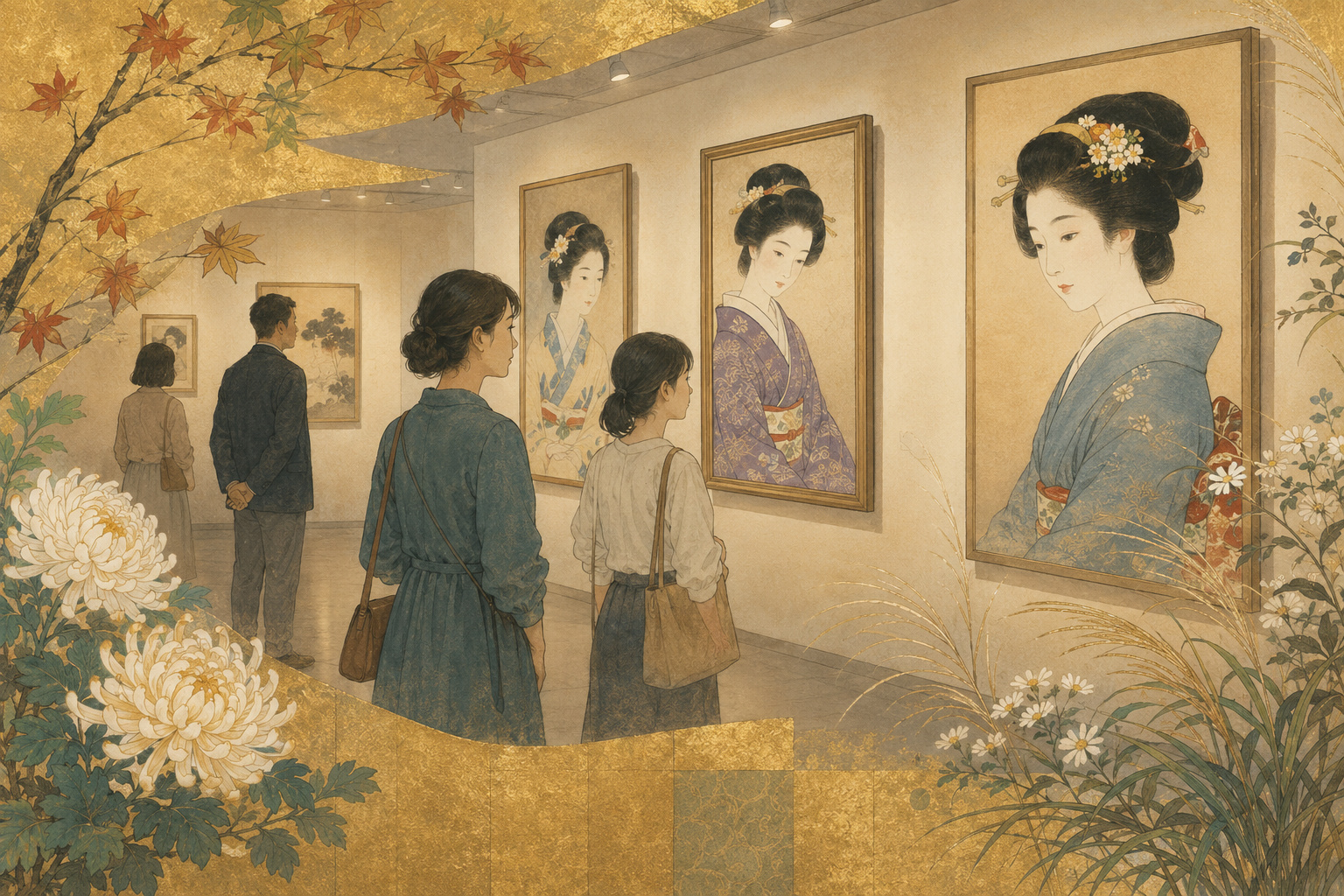
Torii Kotondo was born into a three-century visual business and, according to the Ota Memorial Museum, spent part of his youth resisting it. His father was the seventh head of the Torii school, the lineage long responsible for Kabuki signboards and theater imagery. Kotondo learned that work at home, then left its orbit to study classical painting and the refined bijin-ga of Kaburaki Kiyokata. He eventually inherited the Torii school, produced a small but celebrated body of modern beauty prints, and later returned to theater signboards and stage design on an enormous scale. The retrospective that opened September 1 in Harajuku makes those apparent contradictions the subject rather than a footnote.
The exhibition puts two Kotondos back into one career
“Torii Kotondo: Kabuki Paintings and Shin-Hanga (New Prints)” runs from September 1 through September 27 at the Ota Memorial Museum of Art. It is the museum’s first major Kotondo retrospective since 2000 and presents approximately 70 works.
The exhibition has three principal faces. The first is Kabuki: large hand-painted works such as Shibaraku, Narukami, Yanone and Yasha-ō, together with rare signboards that actually served theaters.
The second is the complete set of 22 shin-hanga beauty prints, shown alongside color variants and rare proof impressions. The third is hand-painted bijin-ga, including the 1928 folding-screen work Verdant Rain and the triptych Shubi-no-matsu Pine / Cooling Off by the Sumida River / Ryōgoku Bridge.
Placed together, the works make it impossible to reduce Kotondo either to a modern beauty-print specialist or to a hereditary Kabuki illustrator.
The Torii school was a theater brand before it was an art-history category
The Torii school reaches back to the Genroku period. Tokyo National Museum identifies Torii Kiyonobu I (1664–1729) as a foundational figure in a lineage active from the formative years of ukiyo-e. The school became deeply tied to Kabuki through actor imagery, theater programs and, above all, large painted signboards.
Kabuki-bito describes the classic Torii vocabulary in physical terms: hyōtan-ashi, or “gourd-shaped limbs,” exaggerating muscular bodies, and mimizu-gaki, “earthworm-like” lines that swell and contract with unusual force.
A theater signboard had a different job from a collectible actor print. It had to explain a production at architectural scale. Principal characters and narrative cues had to be legible to someone approaching a playhouse. Faces were stylized; bodies and costumes carried much of the drama.
Other schools eventually transformed the commercial market for actor portraits, but the Torii family retained the theater-signboard business across generations. To inherit the Torii school was therefore to inherit a relationship with the theater industry, not merely a brush style.
Born in 1900, trained first in the family workshop and then in classical painting
The Tokyo National Research Institute for Cultural Properties records Kotondo’s birth on November 21, 1900. His personal name was Shin Saitō. From childhood he was exposed to the seventh Torii head’s theater work.
In 1914, after leaving Rikkyo Middle School, he studied under Kobori Tomoto, a painter known for yamato-e and historical subjects. The training included the classical knowledge of costume and court custom that mattered to historical painting and stage representation.
He began using the name Kotondo the following year and worked on magazine illustrations and theater-program imagery while continuing his training. A report from the 2026 exhibition identifies an Engei Gahō illustration connected to a February 1914 Ichimura-za production among his earliest known published works. His father supplied the cover for the same issue.
Even before the young artist tried to move beyond the family trade, he was already working inside its media ecosystem.
Kaburaki Kiyokata offered another model of what an ukiyo-e descendant could become
In 1918 Kotondo entered the circle of Kaburaki Kiyokata and studied bijin-ga. Ota Memorial Museum says Kotondo is believed to have felt rebellious toward the inherited Torii profession in his youth; by around age twenty or twenty-one he was studying the depiction of women under Kiyokata.
Kiyokata’s lineage traced back through the Genjidana school toward Utagawa Kuniyoshi. Ota Memorial Museum therefore proposes a striking interpretation: Kotondo can be viewed as a rare, perhaps unique, heir to both major ukiyo-e lineages—the Torii school by family succession and an Utagawa-derived tradition through his teacher.
That is a curatorial interpretation, not a literal claim that he led two schools. But it captures the visual tension in his work. Torii Kabuki imagery is bold, public and theatrical. His Kiyokata-derived women often occupy private moments—combing hair, dressing, sitting indoors, standing in rain.
Shin-hanga revived an old production system for a modern market
Ota Memorial Museum defines shin-hanga as modern woodblock prints produced through collaboration among a publisher, artist, professional carver and printer. Publisher Watanabe Shōzaburō became the movement’s central advocate, bringing the old ukiyo-e division of labor into Taishō- and Shōwa-period print culture.
That structure distinguished shin-hanga from the ideal of the sōsaku-hanga movement, in which the artist was expected to carve and print personally. Shin-hanga could therefore be modern in subject and visual sensibility while remaining deliberately traditional in production.
For Kotondo, the model carried an additional irony. He had grown up in a hereditary workshop culture where art was already inseparable from theater professionals and practical production. His route toward modernity did not require abandoning collaboration; it required applying collaboration to a different kind of image and market.
Twenty-two prints built a reputation far larger than the series itself
Kotondo’s shin-hanga bijin-ga form a surprisingly compact body of work. Ota Memorial Museum is showing all 22 together in 2026.
An on-site exhibition report says his early-Showa prints were issued through Sakai and Kawaguchi-related publishing arrangements around 1929–30 and through Ikeda editions during the following years. Works such as Makeup, Combing Hair, Rain, Obi, Snow, Morning Hair and Iris-Patterned Yukata turn ordinary domestic gestures into highly finished woodblock compositions.
The women are heirs to the bijin-ga tradition, but their clothes, interiors, hairstyles and bodily distance belong to urban modernity. The drama is not a famous story. It can be the few seconds before a woman finishes dressing.
Some designs moved between painting and print. The 2026 exhibition report discusses Snow as a work likely translated from an earlier screen painting, with scenery and textile detail reorganized for the requirements of woodblock printing. A shin-hanga impression was not simply a reproductive copy; the carver, printer and publisher transformed the original design into a second medium.
Morning Hair collided with the boundaries of prewar censorship
Morning Hair became Kotondo’s best-known beauty print. The Ota museum’s English exhibition text says the work is said to have been confiscated by the Metropolitan Police under contemporary censorship rules. A 2026 on-site report relays the exhibition’s account that a planned edition of one hundred was stopped after seventy impressions.
The catalogue history, however, is not perfectly uniform. Earlier museum lists have dated Morning Hair to 1930, while the 2026 exhibition reporting uses November 1931. Japan.co.jp therefore does not present one of those dates as uncontested here; the censorship history is treated as the exhibition’s documented account rather than a newly independently resolved catalogue problem.
The work’s later reception is almost a reversal of that episode. Ota Memorial Museum notes that Steve Jobs was an admirer of Kotondo, along with Kawase Hasui, and is known to have kept Morning Hair in his private room. An image once caught inside Japanese censorship history became part of the international rediscovery of shin-hanga.
In 1929, Kotondo inherited the trade he had tried to move beyond
Ota Memorial Museum says that when his father retired in 1929, Kotondo is believed to have succeeded as the eighth head of the Torii school. That is also the period in which his beauty-print work accelerated.
The two careers therefore did not occur one after another. He did not stop being a modern bijin-ga artist on the day he inherited the school. The hereditary obligation and the independent print career overlapped.
Tokyo’s National Research Institute records another sequence of names. In 1935 he began using Kiyokoto; in 1962 he formally succeeded to the Kiyotada name. The National Diet Library records him as the fifth Kiyotada while simultaneously describing him as the eighth head of the Torii lineage.
His names preserve the same tension as his pictures: an individual artist moving within a hereditary institution.
Kabuki tradition did not mean repeating an eighteenth-century formula
The 2026 exhibition emphasizes that Kotondo eventually created Kabuki paintings combining the Torii school’s force with his own modern sensibility. Shibaraku, Narukami, Yanone and Yasha-ō retain the theatrical clarity required of the family tradition, but they are works by a painter who had also absorbed modern Nihonga and bijin-ga.
Signboards were especially practical objects. They were built to advertise performances, exposed at theaters and replaced as programs changed. That is one reason surviving historical examples are rare: they were working media before they became museum material.
The 2026 on-site report includes a Meijiza signboard for Meiji Ichidai Onna from 1951 and stage-design material for a 1968 National Theatre production. Kotondo’s theater practice extended beyond an image on paper into the organization of a performance space.
After the war, the Torii inheritance expanded into stage design and television
The Tokyo National Research Institute classifies Kotondo not only as a painter but as a stage designer who also worked in television. It records him as teaching stage design in Nihon University’s College of Art from 1966 to 1972.
His work included signboards for major theaters, stage design for Kabuki, historical drama and dance, and art-historical or costume consultation for new media.
This is one way a premodern workshop survived modernization. The Torii school did not remain alive because theaters continued to operate exactly as they had in 1700. It remained relevant because the knowledge of how to visualize performance migrated into modern stage design, film, television and formal education.
The hand-painted beauties show a freer side of the same artist
Kotondo’s twenty-two shin-hanga prints are unusually easy to count and catalogue. His hand-painted bijin-ga reveal a less standardized body of work.
Verdant Rain, shown in the retrospective, is documented as having appeared at the Kiyokata-circle Kyōdokai exhibition in May 1928. Ota Memorial Museum praises its restrained color and moist, atmospheric figure treatment. The three hanging scrolls Shubi-no-matsu Pine / Cooling Off by the Sumida River / Ryōgoku Bridge place female figures and urban scenery into a quieter narrative rhythm.
The contrast with the Kabuki works is extreme but productive. The signboard has to declare itself at a distance. The hand-painted beauty can reward prolonged looking. Kotondo mastered both demands.
Why one label cannot contain Torii Kotondo
| Field | Inherited structure | Kotondo’s modern contribution |
|---|---|---|
| Kabuki imagery | Torii-school signboards, stylized bodies and theatrical communication | Modern Nihonga composition, color and large-scale hand-painted works |
| Shin-hanga | Ukiyo-e-style division of labor among artist, carver, printer and publisher | Twenty-two refined images of early-Shōwa women and everyday life |
| Hand-painted bijin-ga | Kaburaki Kiyokata and an Utagawa-derived beauty-painting lineage | Muted color, urban intimacy and private moments |
| Stage design | The Torii school’s long institutional relationship with Kabuki theaters | National Theatre, Meijiza, modern stage production and media consultation |
| Teaching | Hereditary workshop transmission | Stage design taught within a modern university system |
The museum’s “two great ukiyo-e lineages” thesis
Ota Memorial Museum describes Kotondo as an artist who can be seen as inheriting the “genes” of both the Torii and Utagawa traditions: Torii through the family, Utagawa through Kiyokata’s artistic genealogy.
The phrase is interpretive. Kotondo did not become institutional head of two schools. But it offers a useful alternative to the idea that ukiyo-e simply ended and modern Japanese art began.
In Kotondo’s career, Edo-period workshop structures, Meiji/Taishō Nihonga education, early-Shōwa print publishing and postwar theater production overlap. Modernization looks less like replacement than recombination.
After Kotondo, the Torii school passed to his daughter
Kotondo died on July 13, 1976 at age seventy-five. The Tokyo National Research Institute records lung cancer as the cause of death.
In 1982, his daughter Torii Kiyomitsu became the ninth head of the school and its first woman head. Kabuki-bito describes her as continuing the signboard tradition while also working in stage design and costume.
Kotondo was therefore not the final keeper of an exhausted lineage. His work formed a bridge to another generation.
Nov. 21, 1900: Born into the household of the seventh Torii-school head.
1914: Studies under Kobori Tomoto; begins early illustration and theater-related work.
1918: Studies bijin-ga under Kaburaki Kiyokata.
1928: Verdant Rain appears at the Kyōdokai exhibition.
1929: Believed to succeed his father as eighth head of the Torii school; shin-hanga beauty-print period intensifies.
1930s: Kotondo beauty prints issued through Sakai/Kawaguchi- and Ikeda-related publishers.
1935: Tokyo National Research Institute records his adoption of the Kiyokoto name.
1962: Formally takes the Kiyotada name.
1966–72: Teaches stage design at Nihon University College of Art.
July 13, 1976: Dies at age 75.
1982: Daughter Torii Kiyomitsu succeeds as ninth head.
2026: Ota Memorial Museum holds its first major Kotondo retrospective in a quarter-century.
Tradition survives by changing what the tradition is for
Kotondo’s career loses much of its interest if it is reduced to a story about a rebellious son eventually accepting his family duty.
He did not preserve the Torii school by painting exactly what an eighteenth-century ancestor painted. He depicted early-Shōwa women in shin-hanga, designed modern theater spaces, advised film and television, and taught stage design at a university—while still keeping Torii imagery on the face of the Kabuki theater.
Shin-hanga followed the same pattern. Its artists did not keep ukiyo-e alive by copying old prints. They reused the collaborative structure of artist, carver, printer and publisher to create images for a modern market.
That is why Kotondo is especially revealing fifty years after his death. Tradition and modernity never resolved themselves into a clean winner in his career. He resisted, departed, absorbed another lineage, succeeded in another market and then returned to the inherited work with new visual experience.
Stand in front of the fine hair and quiet posture of Morning Hair, then move to the oversized theatrical force of Shibaraku, and it can feel as though two artists are being exhibited.
The retrospective’s argument is that the history becomes more interesting once we understand they were the same man.
Sources & Reporting Notes
- Ota Memorial Museum of Art, “Torii Kotondo: Kabuki Paintings and Shin-Hanga (New Prints)” — Primary exhibition source: Sept. 1–27, approximately 70 works, eighth Torii head, Kabuki paintings, all 22 shin-hanga bijin-ga and rare proofs.
- Ota Memorial Museum of Art, Japanese exhibition page — Primary Japanese source for official names, work titles and curatorial framing.
- Ota Memorial Museum exhibition flyer, front — Official title, dates and exhibition imagery.
- Ota Memorial Museum exhibition flyer, reverse — Official overview and selected works.
- Tokyo National Research Institute for Cultural Properties, Torii Kiyotada VIII obituary archive — Birth/death dates, study under Kobori Tomoto and Kaburaki Kiyokata, 1929 succession, later names, stage design and teaching.
- National Diet Library Authorities, Torii Kotondo — Authority record for Torii Kotondo, variant names and his status as eighth head of the Torii school.
- Tokyo National Museum, early Torii-school exhibition — Public-museum history of the Torii school from the Genroku period and the forceful style of Torii Kiyonobu I.
- Kabuki-bito, Torii-school theater signboards — Kabuki-industry account of the Torii school’s signboard tradition and its continued transmission.
- Kabuki-bito, “Ekanban” — Explanation of Kabuki signboards as large hand-painted images and their three-century Torii-school lineage.
- Ota Memorial Museum, Shin-hanga overview in the Shiro Kasamatsu exhibition — Primary museum explanation of shin-hanga as collaborative woodblock production involving artist, carver, printer and publisher.
- Internet Museum, 2026 exhibition report — Secondary on-site report used for early illustrations, publishers and the exhibition’s account of Morning Hair censorship.
- Shimane Art Museum, Torii Kotondo artist record — Institutional artist biography and collection record.
This article was checked against public material available by 2:24 AM JST on September 3, 2026. The official reading Torii Kotondo and variant names were verified against the National Diet Library authority record. The Ota Memorial Museum’s “eighth head of the Torii school” and NDL’s “fifth Kiyotada” are treated as different numbering systems for school succession and the Kiyotada art-name lineage. The Ota exhibition describes Morning Hair as said to have been confiscated under contemporary Metropolitan Police censorship; earlier institutional catalogues date the print to 1930, while 2026 exhibition reporting gives November 1931. The article therefore does not present one production date as newly resolved. Ota’s Steve Jobs anecdote and its description of Kotondo as a possible heir to both Torii and Utagawa traditions are attributed as museum curatorial claims. The “22 prints” figure refers specifically to the full body of shin-hanga bijin-ga identified by Ota Memorial Museum.
Image rights: © 2026 Japan.co.jp. AI-assisted historical editorial illustration. Reproduction or reuse without permission is prohibited. For licensing, see the contact page.