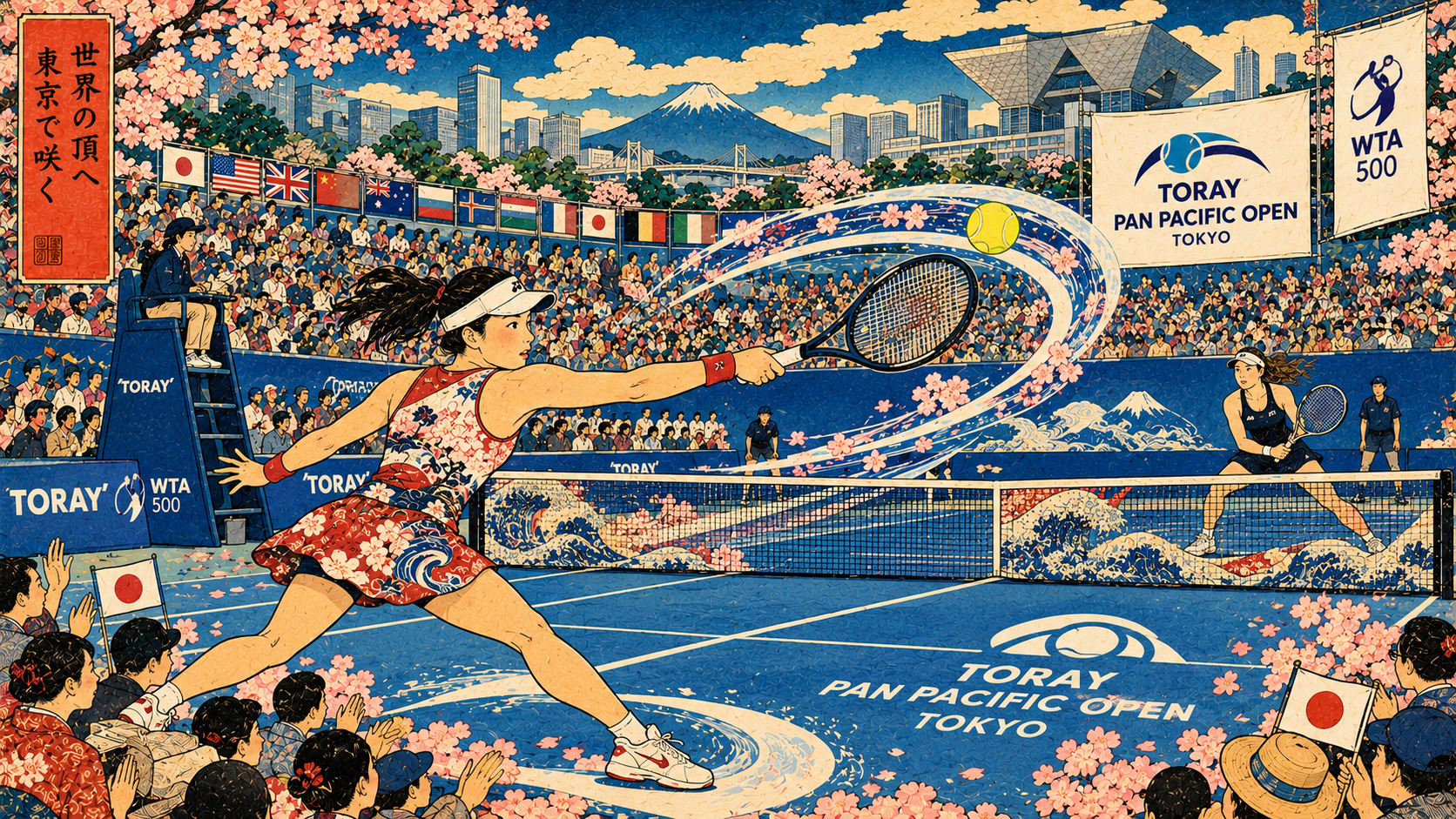
The results belong to the players on court. The stage they compete on was built across more than four decades.
Tokyo is a global meeting place for women’s tennis
A tennis ball crosses the net in Ariake, but so do years of history and sporting ambition. The 2026 Toray Pan Pacific Open began its main draw on October 26, bringing players from Japan, East and Southeast Asia, Europe, Australia and North America onto Tokyo’s outdoor hard courts. For an international reader, the tournament is more than a stop on a schedule: it is a long-running meeting point between the women’s game and the enormous Asian audience that has helped shape it.
What the 2026 competition actually is
The WTA classifies Tokyo as a WTA 500 tournament. Its official overview lists a 28-player singles draw, 16 doubles teams and a total financial commitment of $1,206,446. Matches are scheduled from October 26 to November 1 at Ariake Coliseum and Ariake Tennis Forest Park. The final is scheduled for November 1; the quarterfinals and semifinals have not yet been played at the time of this report’s verification. An event’s financial commitment should not be confused with an individual winner’s prize or an estimate of its economic impact.
An opening day that already told several stories
Four completed first-round singles matches on October 26 show the range of the field. American Alicia Parks beat China’s Wang Xinyu 6–1, 7–6. Australian Talia Gibson defeated fellow Australian Daria Kasatkina 6–0, 7–5. Belgium’s Elise Mertens beat Japan’s Moyuka Uchijima 6–4, 6–2. Alexandra Eala of the Philippines beat Britain’s Mika Stojsavljevic 6–1, 6–2. Each result is drawn from the tournament’s official score page and describes one completed match, not subsequent progress.
Weather is part of the draw
The organizers postponed all October 26 show-court matches because of rain. The disruption matters because a tennis draw is not merely a static grid; rest time and scheduling can change with weather, withdrawals and court availability. The official October 27 schedule lists matches including Naomi Osaka against Jasmine Paolini, but the results page consulted for this article did not provide completed scores. The article therefore avoids claiming a winner. Readers should consult the continuously updated tournament site for the most recent outcomes.
Naomi Osaka’s Tokyo return is no simple nostalgia play
Osaka’s presence brings one of Japan’s most globally recognized sports figures back to the tournament for the first time since 2022, according to the organizers’ August announcement. Her local history includes runner-up finishes in 2016 and 2018 and a 2019 title. A return, however, does not make her the inevitable favorite. It places a four-time Grand Slam singles champion within another demanding field of established opponents and ambitious younger players. The real story will unfold in played matches, not in advance predictions.
Alexandra Eala helps widen the audience beyond Japan
Eala’s opening victory supplies a second point of connection for Asian audiences. The Philippine player is listed by the tournament as a first-time entrant, and her victory gives supporters at home a clear reason to follow a Japanese tournament. In the modern women’s game, attention does not simply travel outward from the traditional tennis capitals. It moves through Filipino fan communities, Chinese audiences, Japanese spectators and global digital coverage. Our separate Eala feature focuses on the athlete; this report puts her performance within the wider tournament.
Before the WTA 500 label, there was a Japanese experiment
The event’s lineage extends back to a 1973 women’s circuit known as the Toray Silook Tournament. The first Toray Pan Pacific international edition took place in December 1984 at Tokyo Metropolitan Gymnasium, with Manuela Maleeva winning singles. The organizers describe that launch as a milestone for international women’s tennis in Asia. Rules, surfaces, tournament categories and commercial arrangements have evolved since then; today’s WTA 500 classification should not be projected backward onto a 1984 event.
Kimiko Date changed the meaning of a home tournament
In 1995, Kimiko Date beat Lindsay Davenport in the final, becoming the tournament’s first Japanese singles champion. The year also saw Date reach world No. 4. Her victory mattered not only to the local audience but to the idea that Japanese players could compete with the best in an internationally significant event at home. It created a touchstone for subsequent generations, without requiring them to follow the same career path.
Naomi Osaka’s 2019 title took the show to another city
In 2019, the tournament was staged in Osaka for the first time. Osaka defeated Anastasia Pavlyuchenkova 6–2, 6–3, becoming the first Japanese singles winner in the event since Date 24 years earlier. The relocation gives the tournament’s history a geographic dimension: the name Pan Pacific does not mean it has always lived in exactly one arena. The return to Ariake in 2026 adds another chapter, but no outcome is guaranteed by the location or the name on the draw.
A tour category is not a measure of sporting value
The WTA 500 designation tells spectators where the event sits in the professional tour’s points and ranking structure. It does not capture all the value of a week in which athletes compete, children watch elite players in person and supporters see athletes who rarely travel to their country. Nor does a prize commitment represent total revenues or a public subsidy. A credible business or sports account needs to keep those financial concepts distinct.
Why this event matters to international audiences
For Japanese readers, the tournament offers a rare opportunity to compare familiar national players directly with rivals from different systems. For Chinese audiences, the opening match involving Wang Xinyu is an immediate connection. For Filipino fans, Eala’s first-round win provides another. For Australian and European supporters, the field supplies established names and changing matchups. The story’s international appeal emerges from those authentic ties—not from describing every participant as a future superstar.
What to watch as the week moves forward
The official schedule places second-round singles play on October 28 and 29, quarterfinals on October 30 and semifinals on October 31. Doubles matches run alongside them. Check the order of play and verified completed scores before interpreting any advancement, especially after the opening-day rain disruptions. The central question at this stage is not who will win but how the draw changes when proven champions, returning stars and emerging players finally meet on court.
More than a winner, a platform with a memory
The Pan Pacific Open has outlasted generations of players and different eras of women’s sport. It connects Maleeva’s first international edition in 1984, Date’s breakthrough in 1995, Osaka’s Osaka-city triumph in 2019 and the multinational 2026 field in Tokyo. Its enduring achievement is creating a recurring stage on which audiences in Japan can watch the global women’s game close up. That is an argument for paying attention throughout the week, not just on finals day.
Sources and verification
Checked against the organizer’s results and historical records and the WTA tournament listing. Completed October 26 scores are distinguished from scheduled or unverified later matches. No onsite reporting or original interviews were conducted.