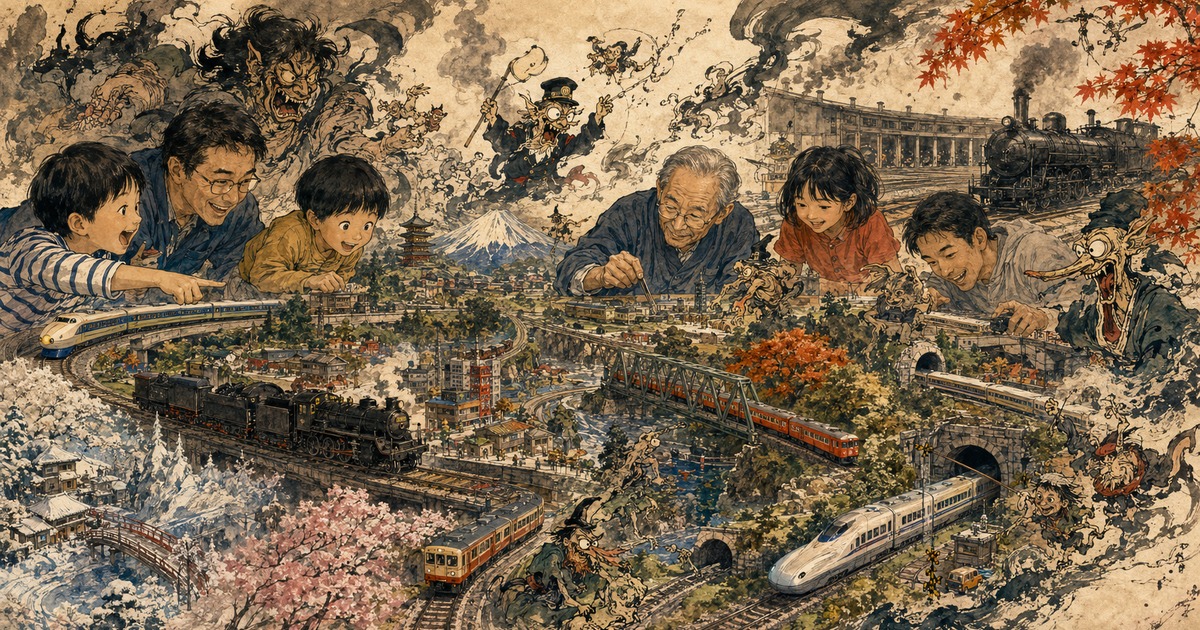
A commuter train enters a platform smaller than a hand. Its headlamps are points of white light. The steel wheels make a dry, regular click; above them, catenary poles divide the scene into intervals. Beside the station stands a convenience store, behind it an apartment block, and beyond that a blue-painted bridge turns toward mountains that are much nearer than geography would permit. The distances are false. The recognition is exact.
This is the paradox at the center of TOMIX, the Japanese model-railway brand that turns 50 in September. An N-gauge layout compresses, edits and rearranges reality. Curves tighten. Stations shorten. A morning express can circle back as an evening local in less than a minute. Yet the model can recover a place with an intimacy that an aerial photograph cannot: the angle of a platform roof, the bus waiting outside a provincial station, the color stripe that identifies an era, the level crossing beside a row of houses.
Kyoto Railway Museum will examine that power in “Railway Model TOMIX 50th Anniversary Exhibition in Kyoto Railway Museum,” announced Monday and scheduled for August 29 through September 23. The exhibition will show a large modular N-scale layout, representative products from five decades, forthcoming models, selections from 46 catalogs and period magazine advertising. It will compare versions of the same train produced in different years, making visible the growth of molding, printing, lighting and mechanical detail.
Most revealingly, TOMIX track will be used to reconstruct, as closely as the system allows, the layout of Umekoji depot and Kyoto Freight Station around the museum. The miniature will sit in a place where full-size locomotives, a working roundhouse and Kyoto’s active railway geography remain close at hand. It is difficult to imagine a better demonstration of the relationship between prototype, memory and play.
The First Product Was Not a Locomotive. It Was a Promise.
TOMIX was born under the toy maker Tomy in September 1976 with a phrase that still explains the brand: dare demo tetsudō mokei no sekai o—roughly, “the world of model railways for everyone.” The claim was not that every household would become a master builder. It was that the intimidating boundaries around the hobby could be lowered.
Its first range made the promise concrete. There were locomotives—the ED75, ED61 and a small C-type tank engine—but also brown-roadbed track, a wooden station, an opposite platform, a power unit and catenary poles. In other words, TOMIX did not present the train as an isolated jewel. It offered the beginning of a system: something to run, something to run on, a place to stop, electricity to control motion and infrastructure to explain the world around the vehicle.
That distinction matters. A locomotive in a display case is sculpture, engineering and collectible property. Add points, platforms, power and scenery, and the owner becomes a dispatcher, civil engineer, timetable planner, electrician, town designer and storyteller. The model railway is not a small train. It is a set of relationships.
Tomy entered a field others had already created. Sekisui Kinzoku, now known through the KATO brand, had decided in 1963 that plastic N gauge offered a practical future for Japanese homes and released the country’s first domestically mass-produced N-gauge models—the C50 steam locomotive and Oha 31 coach—in 1965. KATO’s work established the scale and helped prove that precision and reliable running could survive miniaturization. TOMIX’s importance lies not in replacing that history but in widening the system-building idea and sustaining a productive rivalry that pushed both companies.
Why Nine Millimeters Fit the Japanese Home
The letter N is commonly associated with “nine,” the millimeter distance between the rails. For Japanese conventional trains, 1:150 became the mainstream body scale; Shinkansen and many standard-gauge subjects are commonly modeled closer to 1:160. The compromise is revealing. Most Japanese main-line track uses a real gauge of 1,067 millimeters, which does not reduce neatly to nine millimeters at 1:150. Japanese N gauge accepts a mismatch so that many railways can share a practical track standard.
This is not a flaw that realism failed to eliminate. It is the condition that makes the hobby social and workable. A standard allows a freight locomotive, private-railway commuter car and Shinkansen to move through the same ecosystem of rails, controllers, cases, shops and club layouts. Model railways have always balanced optical truth, mechanical reliability, cost and space. The best compromise is not the one with no distortion; it is the one that remains convincing in motion.
Space was decisive. Postwar Japanese cities expanded through apartments and compact detached houses, while the fixed basement empires common in some Western model-railway traditions were unavailable to many families. N scale made long trains possible on a table or floor. Sectional track could be assembled in a living room or tatami room and returned to boxes at night. KATO’s own history identifies this build-run-pack-away pattern as central to the Japanese development of roadbed track.
TOMIX was built for the same domestic rhythm. The layout did not need to be a permanent monument. It could be an event: pieces clicked together on a holiday, a new siding tested, two generations kneeling beside the rails, the town disappearing before dinner. Modularity was not only engineering. It was an accommodation between desire and the architecture of everyday life.
The Catalog Became an Atlas of Ordinary Japan
The 46 catalog covers promised for Kyoto may look at first like commercial archaeology. They are more than that. Taken together, TOMIX catalogs form a selective atlas of how Japan imagined itself through railways. The glamorous vehicles are present, but so are the objects that make their world legible.
By 1977 the range included the 113 series suburban train, KiHa 02 railcar, passenger coaches, viaduct track, an over-track station and a wooden footbridge. In 1978 came the EF81 and DD51 locomotives, the 415 and 113 series, 24-series sleepers, an electric turntable, a thatched farmhouse, shops and a two-track engine shed. By 1979, alongside the 583 series and KiHa 58, one could buy a roundhouse, suburban houses, a Mitsubishi Fuso bus, an Isuzu Elf truck and a Nissan Cedric.
That list reads like inventory. It is also social history. The elevated station belongs to commuter expansion. The farmhouse and local railcar recall routes away from the metropolis. The bus recognizes that the railway does not end at the station door. The truck and freight car place logistics beside passenger romance. The family restaurant added in 1989, the condominium in 1990, and later convenience store, gas station and pachinko parlor record the changing commercial roadside.
No catalog is neutral. Manufacturers choose what is recognizable, saleable and technically feasible. Industry, poverty, demolition and pollution are easier to omit than a nostalgic station garden. The result can become an ideal Japan of clean platforms and punctual movement. But the bias itself is historically valuable. These pages show which fragments of the built environment consumers wanted to possess—and which kinds of disappearance they were beginning to feel.
1976 Arrived Between the Bullet Train and the Blue Train
TOMIX entered the market 12 years after the Tokaido Shinkansen opened on October 1, 1964. The bullet train had reduced Tokyo–Osaka travel to a little over three hours at inauguration and condensed the national image of speed, engineering and high-growth confidence into a white body with a blue stripe. To model a Shinkansen was to own the future in sectional form.
Yet late-1970s railway desire also looked backward and into the night. The “Blue Train” boom made sleeper expresses objects of popular fascination for adults and children. Their headmarks, dining cars, berths and overnight routes transformed a network map into narrative. A train left Tokyo after dark and arrived in another region after breakfast. The model could not reproduce the hours, but it could reproduce the formation—the exact order of locomotive, power car, sleeping cars and tail sign on which the train’s identity depended.
This double attraction—future speed and vanishing journey—has shaped Japanese model railways ever since. In 1982 TOMIX released the 200-series Shinkansen. Through the 1980s and 1990s its range also multiplied versions of sleeper trains such as the Hokutosei, Twilight Express and Cassiopeia. As real night trains retreated under competition from the Shinkansen, aviation, buses and changing travel habits, the models accumulated a new role. They became runnable memory.
The difference between a museum artifact and a model matters here. A preserved sleeping car remains one real object. A model allows the remembered train to depart again, repeatedly and in formation. That repetition is not historical proof. It is ritual.
Privatization Made the National Railway More Regional on the Shelf
Japanese National Railways, created as a public corporation in 1949, had been the central postwar transport institution. Motorization, aviation, industrial restructuring, debt and management failures weakened it; long deficits culminated in the 1987 breakup and privatization that produced six regional passenger companies and a nationwide freight operator, alongside other successor organizations.
For the model shelf, the change was immediate and visual. A comparatively unified JNR identity divided into JR companies with new logos, colors, refurbished fleets and region-specific services. TOMIX’s year-by-year history records the proliferation: JR Freight treatments, Hokkaido sleeper versions, regional diesel colors, named limited expresses and “farewell” sets tied to retirements or route changes.
This was more than a marketer discovering variants. The railway itself had become a more fragmented cultural map. Liveries could say Hokkaido, Kyushu or West Japan before a station name was visible. Enthusiasts learned to care not only about a class number but about production batches, window arrangements, equipment changes, depots and a particular formation on a particular date.
Precision deepened accordingly. Fine printing made smaller logos possible. Separate handrails and underfloor equipment increased specificity. Lighting, couplers and mechanisms improved. The Kyoto exhibition’s comparison of the same train type across release periods will make technological progress visible—but also a changing contract with the buyer. What counted as “accurate enough” in 1976 no longer satisfied a public armed with digital cameras, enthusiast books and online archives.
To Drive a Model Was to Learn the Railway as a System
TOMIX’s history is also a history of control. The first power unit used a center-off control designed to be durable and approachable. An electric turntable followed in 1978. The 1984 automatic crossing detected trains with light sensors, lowered barriers and sounded an alarm. In 1986, the DU-1 one-handle controller introduced acceleration, coasting and braking as a physical performance rather than a single speed dial.
Constant-light capability in the 1990s allowed lamps to glow while a train stood still. TCS pulse control, automatic signals, sensors and automated-operation units made blocks and stopping patterns part of play. The 2003 Fine Track system refreshed the physical grammar; mini and super-mini curves later made operation possible in still tighter spaces. Wireless control, camera systems, sound and experiments shown during the 50th-anniversary year continue to move the point of view between spectator and driver.
These devices teach through the hand. A child who cannot define adhesion discovers why a gradient matters. A careless operator learns that a long train needs stopping distance. Reverse loops create electrical questions. Points determine routes; platforms determine train length; curves determine what can pass. Even a playful oval contains an argument about standards and coordination.
It also contains authority. The controller puts a network under one person’s command, removing labor disputes, weather, passengers and budgets. Miniature order can be emotionally satisfying precisely because real transport is collective and difficult. The model is both a lesson in interdependence and a fantasy of total control.
Scenery Turned Rolling Stock Into Memory
TOMIX’s current beginner material explicitly invites owners to recreate “that time, that place”: a rural railway from childhood, a melancholy landscape never personally visited, or the familiar commuter line near home. The language acknowledges that railway modeling is often autobiographical even when the layout is imaginary.
Tomytec’s wider Diorama Collection intensified that possibility. Its 1:150 and 1:80 families encompass display trains, buses, trucks, cars, buildings, streetscape elements and working vehicles. The Railway Collection brought modest local private-railway equipment into an accessible display format that could often be motorized. A small electric car inherited from a larger company, a rural bus or a wooden freight wagon could now command the center of a scene.
This shifted attention away from prestige alone. Japan’s railway story is not only Shinkansen speed or famous expresses. It is also municipal trams, lightly used local lines, second-hand rolling stock, station-front bus connections and freight movements that rarely become tourism icons. Miniatures can preserve the ordinary precisely because the ordinary is small enough to overlook at full scale.
But preservation by product has limits. What remains available depends on demand, licensing and production runs. A model may freeze one photogenic moment and make a complex community seem timeless. Rural nostalgia can hide depopulation, school closures and the economic reasons a line disappeared. The miniature should not be mistaken for the whole history. It is an invitation to investigate what the scene leaves outside its baseboard.
TOMIX and KATO: Rival Systems, Shared Culture
Japanese N gauge cannot be told as a single-brand triumph. KATO preceded TOMIX in domestic mass production and developed its own influential track, vehicles and control products. Other manufacturers—including Micro Ace, Greenmax, Modemo and specialized makers—expanded the range of subjects and building methods. Competition improved mechanisms, printing, track geometry and expectations.
Brand systems sometimes encourage loyalty strong enough to resemble railway allegiance. Track connections, point motors and control accessories are not always interchangeable without planning. Yet the larger culture is shared. A TOMIX train can appear on a club layout built to another standard; scenery techniques circulate through magazines, shops, videos and exhibitions; secondhand markets let different eras coexist.
The rivalry also prevented “Japan in miniature” from becoming one company’s authorized edition. Manufacturers made different choices about proportions, color, motor placement, coupling distance and which obscure prototype deserved release. Modelers compared and argued. That friction is healthy. Accuracy is not a finish line delivered by a brand; it is a public conversation about evidence, compromise and taste.
The Camera Changed What “Real” Meant
Model-railway photography has long hidden scale through low angles, careful lighting and shallow depth of field. Smartphones and social media made that practice immediate. TOMIX now promotes the idea of TOMIX toritetsu—photographing model trains with the vocabulary of real-world rail photography. At its May anniversary event on Ueno Station’s Platform 13, the brand included a miniature Ueno scene designed for shooting.
The location collapsed several layers of representation. Platform 13 once dispatched celebrated sleepers such as Hokutosei and Cassiopeia and now serves Train Suite Shiki-shima. For the anniversary, an E501-series ten-car train returned to Ueno after about 19 years with a special headmark. Nearby, TOMIX staged what it described as its first N-gauge operation on an active station platform. The full-size train, remembered train and miniature train occupied one place.
A photograph can make a 1:150 model look full-size, but it can also reveal errors the eye forgives: oversize rail, dust like boulders, a plastic sheen, a curve too sharp. The camera therefore produces a new cycle of demand. Better photographs require finer detail; finer detail invites closer photographs. The model becomes not only an object and a performance but media.
Kyoto Will Put the Map Beside the Territory
The Kyoto venue is unusually intelligent. The museum’s permanent 1:80 diorama measures roughly 30 meters by 10 meters and demonstrates railway operations at a much larger model scale. Outside the special gallery are full-size vehicles, including steam locomotives associated with the historic Umekoji site. Active JR lines remain visible around the museum. Visitors can move among three levels of abstraction: operating network, preserved machine and model system.
The anniversary layout will present Shinkansen, urban and mountain scenes, while the Umekoji depot/Kyoto Freight Station reconstruction asks a different question: how close can standardized sectional track come to a particular place? “As closely as possible,” the organizers say. That phrase is honest. Track geometry will require selection and compression. The result will be an interpretation, not a survey.
That is exactly why it is valuable. Visitors can look for what the builder considered essential: the branching routes, the relationship between depot and main line, the freight station’s spatial logic, the museum’s position in a living rail district. A model reveals priorities through every omission.
The history display will place older and newer versions of the same train together. Do not look only for finer windows or better printing. Ask what each generation believed needed to be visible. Early models often achieved recognition through silhouette and color. Later ones promise subtype, era and formation. The distance between them records five decades of manufacturing—but also five decades of increasingly specialized looking.
A Workshop About Making, Not Merely Buying
The exhibition includes an operating corner and museum-staff guidance for beginners. On selected weekends and holidays, Tomytec staff will lead a 45-minute workshop to assemble a rail set based on the museum’s first-floor vehicle-factory area. It costs ¥9,800, requires a separate museum ticket and has limited capacity; tickets are scheduled to go on sale through Asoview from 4:30 p.m. on August 21.
A second workshop lets participants draw on a white TOMIX freight wagon, run it on the exhibition layout and photograph it. It costs ¥1,000 in cash and includes a museum 10th-anniversary clear file. The object is modest, but the sequence is important: design, place on track, operate, observe, record. It changes the visitor from consumer into maker and operator, however briefly.
Accessibility should still be judged critically. A slogan about “everyone” does not erase the cost of trains, space, time or technical confidence. The hobby has often been marketed through a heavily male enthusiast culture, even though its combinations of craft, history, electronics, photography and urban design are far broader. Beginner instruction at a public museum is useful because it makes tacit knowledge visible. A truly open next 50 years will require more of that hospitality.
- Compare an early and recent model of the same train: which details became technically possible, and which became culturally necessary?
- Read catalog backgrounds as carefully as the trains. Shops, roads, homes and signs date a scene.
- Study where the Umekoji reconstruction compresses or bends real geography.
- Watch a train stop. Lighting, low-speed control, coupling distance and platform length reveal the system more clearly than top speed.
- After the miniature, look outside at the active railway district and identify what the model included—and what it left out.
Japan Was Recreated in the Space Between Things
Fifty years of TOMIX can be counted in products, catalogs and mechanisms. The more compelling history lies between them. A 113-series train becomes an era when it meets the right platform. A sleeper becomes a journey when its formation carries a headmark into darkness. A rural railcar becomes a community when a bus, shop and field establish the life around its station.
Miniature Japan is therefore not a perfect duplicate. It is assembled memory. Modelers choose which year can coexist with which building, which express will survive a cancellation, which local line will keep running, which childhood view deserves another square meter of existence. They compress distance to preserve relation.
The practice can sentimentalize. It can reduce public infrastructure to private possession and difficult history to an attractive backdrop. Yet it can also sharpen attention. To reproduce a platform is to notice its roof supports. To wire a crossing is to understand that safety is a system. To research a freight formation is to restore labor and logistics to a railway story too often dominated by passenger glamour.
At Kyoto Railway Museum, the smallest trains will run beside some of Japan’s largest railway memories. Their achievement is not that they fool us into believing they are full-size. It is that, despite the tight curves and impossible distances, they remind us how a nation was connected: track to station, station to street, street to home, and one remembered journey to another.
Reporting Notes and Sources
This report reflects information available by 10:29 a.m. Japan time on July 28, 2026. The Kyoto program was announced July 27. TOMIX’s 50th anniversary falls in September 2026. Interpretive passages distinguish the documentary value of models and catalogs from the claim that a commercial range can represent the whole of Japanese railway or social history.
- Kyoto Railway Museum / JR West: exhibition announcement, displays and workshops
- Kyoto Railway Museum: official exhibition release
- Tomytec / Takara Tomy: TOMIX 50th-anniversary release and Ueno event
- TOMIX: official introduction, scale, production and layout philosophy
- TOMIX: official year-by-year product history
- TOMIX: official catalog archive
- TOMIX: control-system, crossing, signal and automation history
- KATO: brand history and the development of Japanese N gauge
- Tomytec Diorama Collection: current collection families
- Ministry of Land, Infrastructure, Transport and Tourism: history and structure of JNR reform
- JR Central: Tokaido Shinkansen historical overview
- Kyoto Railway Museum: permanent displays and 1:80 railway diorama
- Kyoto Railway Museum: official English visitor access