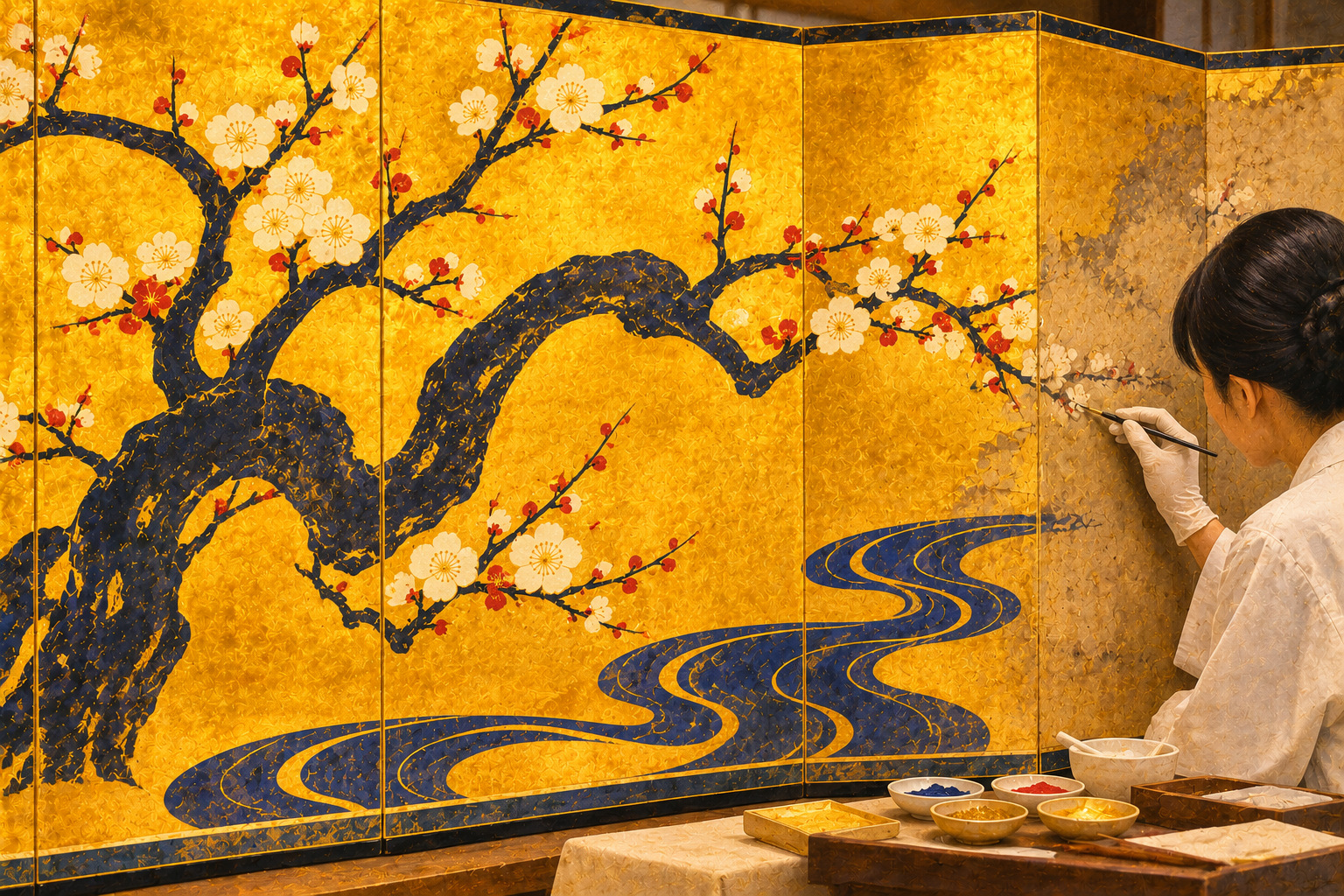
- When the conservator becomes the artist
- What makes an artwork worth conserving?
- A school of copying that is not copying
- A history extending beyond the modern university
- What does restoration actually mean?
- The science behind an almost invisible repair
- Why the mount matters as much as the painting
- The uncomfortable trade-off between showing and saving
- Training people who know when to stop
- Five days in Ueno, and a bigger question
When the conservator becomes the artist
What happens when the people trained to preserve ancient paintings make new paintings of their own? It is an unusually revealing question. A conservator must understand how a brushstroke was made, but must also know when not to recreate it. To preserve a work is to preserve evidence: the paper or silk, the pigments, later repairs, and sometimes damage that is itself part of the object’s history. The promise of a gleaming “before and after” picture can obscure the quieter decisions that make cultural heritage survive.
At the University Art Museum of Tokyo University of the Arts, an exhibition called *Bun-Po-Nichi・Ten 2026* brings that distinction into view. Scheduled for November 11–15 in the Chinretsukan Gallery, it presents **new creative work by students and faculty** of the Japanese Painting Conservation Studio, informed by their research into the techniques, materials, and preservation of Japanese and East Asian classical painting. The organizers do not describe it as an exhibition of original masterpieces actively undergoing restoration. Its appeal lies in a more unusual proposition: the knowledge used to save old art can also generate new art.
What makes an artwork worth conserving?
A classical Japanese painting is more than the image visible at arm’s length. It is an assemblage of materials and decisions: a silk or paper support, mineral pigments and dyes, animal glue that holds colors together, backing sheets, mounting fabric, wooden rollers or folding-screen frames. Each component ages differently. A bright mineral blue, a fragile organic red, and the paper beneath them may react differently to light, moisture, and handling. The question “How do we restore the picture?” therefore begins with “What, exactly, is the picture made of?”
Japan’s Agency for Cultural Affairs documents how painted silk can fray, pigments detach, and repeated rolling can break supports. The National Museum in Tokyo likewise describes conservation as a spectrum, from carefully securing loose pigment to complex treatments involving old mounts. An intervention that stabilizes one material can place stress on another. Evidence-based conservation rarely has the simplicity of applying fresh paint over a faded area.
A school of copying that is not copying
The studio’s university description emphasizes hands-on training in copying classical paintings, restoration, and **hyōgu** or **sōkō** traditions—the preparation, mounting and structural support of painted works and calligraphy. Copying, in this setting, is a form of investigation. How absorbent was the support? What did the binder allow the original artist to do? How did layers of color build opacity or luminosity? The answers cannot always be read from a photograph or a catalogue.
At doctoral level, Tokyo University of the Arts links reconstruction studies and materials research with art history and the natural sciences. The point is neither a romantic rejection of machines nor a belief that instruments can replace the trained hand. It is the combination: making, observing, comparing and recording. Those habits give this exhibition its intellectual background, although its public listing does not identify every artwork, technique or participant individually.
A history extending beyond the modern university
For centuries, Japanese temples, shrines, patrons and specialized craftspeople kept paintings and documents usable. Screen makers, paper makers, silk workers and mounting specialists maintained an interdependent system of skills. That older work was not identical to modern conservation ethics. Treatments reflected the tastes and technical assumptions of their own times; later additions can now become historical evidence in their own right.
The institution behind the current exhibition has a more recent chronology. The Tokyo Fine Arts School opened in 1887; Tokyo University of the Arts was established in 1949. A graduate course in conservation and restoration technology followed in 1964, and the independent Conservation program was established in 1995. The University Art Museum emerged from an earlier art-materials collection in 1998. This history matters because traditional craft did not disappear when science arrived. It acquired new ways to test its assumptions and teach its techniques systematically.
What does restoration actually mean?
Many visitors imagine restoration as the return of missing color or an apparently perfect original appearance. A conservator’s first obligation is less theatrical: to understand condition, record evidence, evaluate whether treatment is necessary and avoid additional harm. If a pigment layer is lifting, it may need careful consolidation before anything else can be attempted. If the support has torn, a compatible patch or reinforcement may preserve its integrity without inventing a lost image.
The Tokyo National Museum distinguishes minor stabilization from full-scale treatment, and illustrates the very different work of securing flaking surfaces, supporting damaged paper and addressing old restoration materials. There is no universal recipe that suits every scroll or screen. The fact that a treatment can be done is not sufficient reason to do it. The conservation decision is also a judgment about authenticity—what the institution knows, what it does not know and how visible the intervention should be.
The science behind an almost invisible repair
Infrared examination, ultraviolet fluorescence, X-radiography, microscopy and pigment analysis can help specialists distinguish materials, hidden structures or subsequent interventions. Tokyo University of the Arts includes instrumental and materials-based study within its wider conservation disciplines. Such tools are selective, not magical: interpreting an image or a measurement depends on questions framed beforehand and on knowledge of what the object has experienced.
A painted surface can be chemically stable but structurally weak; the opposite can also be true. A darkened area might be original, an old varnish, later overpainting or a change in the underlying support. The responsible researcher treats such possibilities as hypotheses to test, not as prompts to manufacture a more attractive “original.” None of the instruments listed here should be assumed to appear as exhibits in *Bun-Po-Nichi・Ten*; they explain the professional research world from which its participants come.
Why the mount matters as much as the painting
Japanese painting frequently reaches viewers as a hanging scroll, handscroll, sliding door or folding screen. Those forms are themselves engineered systems. A hanging scroll must be capable of rolling for storage without damaging its painted support; a folding screen needs a structure that can repeatedly fold while keeping panels aligned. Repairing the image while ignoring the mount is akin to repairing a manuscript but destroying the binding that made it readable.
In an illustrated conservation project concerning a historical painting, Tokyo National Museum explains the use of animal-glue solution to secure vulnerable pigment and narrow strips of Japanese paper on the reverse to reinforce folds. These repairs are easily missed by the visitor—and that is often their strength. Rather than add a signature flourish, the conservator creates the conditions in which somebody decades from now can still encounter the original object.
The uncomfortable trade-off between showing and saving
Museums are asked both to share cultural treasures and to protect them. Exposure to light can fade vulnerable colors; changes in humidity may stress supports; repeated transport or mounting creates mechanical risk. Tokyo National Museum describes the control of temperature, humidity, light and the length of exhibition periods according to an object’s needs. Some delicate materials are exhibited under particularly low illumination for precisely that reason.
The display of original works made by conservation researchers provides a different kind of access. Visitors may come closer to the intellectual process without requiring a fragile ancient painting to remain continuously on view. That is an interpretation of the exhibition’s significance, not a claim that organizers have announced a substitute for displaying heritage originals. Specific interpretations of the participants’ pieces should await the catalogue or a visit.
Training people who know when to stop
The conservation profession requires manual control, chemistry, historical literacy, documentation, and the confidence to recognize when a treatment is too uncertain to proceed. One expert may understand brushwork deeply; another may know paper fibers or mounting structures. Complex projects need collaboration and the humility to revise assumptions as evidence arrives. The celebrated virtuoso restoration is not always the safest restoration.
Tokyo University of the Arts says its graduate studio trains specialists who can take leadership roles in conservation through the study of classical painting techniques, restoration and research. Making new work is part of that education’s broader intellectual landscape. A student who has tried to reproduce the layered behavior of pigments knows why the original artist’s choices are difficult to infer; a student who has handled fragile paper knows why “just fill the gap” is no simple instruction.
Five days in Ueno, and a bigger question
The official exhibition runs **November 11–15, 2026**, 10 a.m.–5 p.m., with admission until 4:30 p.m., at the Chinretsukan Gallery second floor of Tokyo University of the Arts’ University Art Museum in Ueno. It is free and has no scheduled closing day during its five-day run. The studio organizes the event, with support from the Housen Cultural Foundation. Visitors should check the official museum website for changes to opening arrangements.
Go first for the artwork: its lines, texture, color, and the very human effort to make something beautiful. Then consider the less visible question behind every mark: how can a material record of a different century remain legible without being remade in ours? This exhibition offers an entrance to the people learning to answer that question. It does not offer a finished answer, and responsible conservation rarely does.
Exhibition information
Visitor information: November 11–15, 2026 / University Art Museum, Tokyo University of the Arts, Chinretsukan Gallery 2F / 10:00–17:00 (last entry 16:30) / free admission.
Sources and reporting notes
This feature uses the university’s exhibition announcement and primary institutional references for conservation methods and history. It does not invent participants’ remarks, artwork details, or exhibition observations.