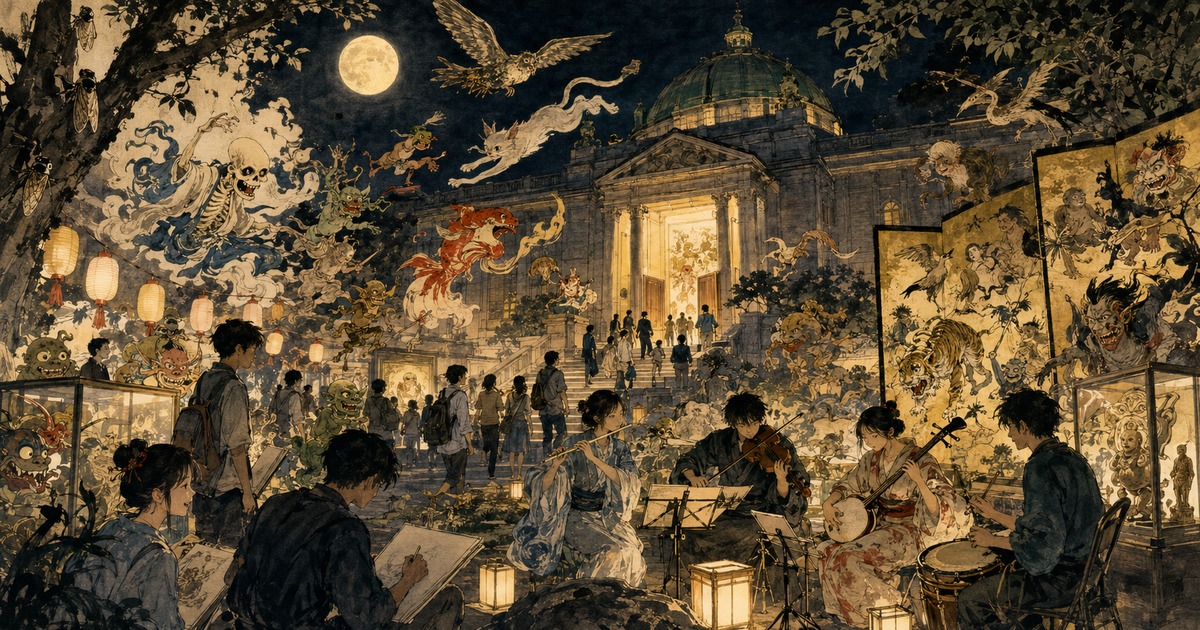
At five in the afternoon, Tokyo does not become less crowded. It changes currents. Office workers pour toward railway gates. Students loosen ties, shoulder instrument cases and compare messages under station signs. Heat lingers between buildings even as the shadows lengthen. Most public institutions are preparing to close at precisely the moment when many of the people who pay for them are finally free to enter.
“Summer Night Museum 2026” makes a temporary correction. From August 6 through 28, six cultural facilities run by the Tokyo Metropolitan Government will extend selected evening hours. Most stay open until 9 p.m. on Fridays; Tokyo Metropolitan Art Museum closes at 8 p.m.; Tokyo Photographic Art Museum adds Thursday nights. After 5 p.m., university, graduate, vocational and high-school students can enter eligible exhibitions free with identification. General visitors and people aged 65 and over receive roughly the group rate, depending on the show.
The geography is unusually broad. The program joins the newly renovated Edo-Tokyo Museum in Ryogoku, Tokyo Metropolitan Art Museum in Ueno, Tokyo Metropolitan Teien Art Museum in Shirokanedai, Tokyo Photographic Art Museum in Ebisu, Museum of Contemporary Art Tokyo in Kiyosumi-Shirakawa and Tokyo Shibuya Koen-dori Gallery. It is not one festival site but a constellation stretched across a working city.
The offer sounds simple: open later, charge students less, add music. Its implications are not. A public museum’s accessibility is usually measured in ramps, captions, language, admission price and distance. Time is also an entrance. A locked door at 5:30 p.m. can exclude as effectively as a high ticket price.
The Door That Time Keeps Shut
Museums tend to describe opening hours as logistical facts, like street addresses. They are closer to policy. A 10 a.m.–5 p.m. schedule quietly imagines an ideal visitor: someone free in the middle of a weekday, able to travel, browse and leave before the evening commute. Retired people, tourists and those with flexible work may fit that model. Full-time workers and many students do not.
Price and time reinforce each other. A student choosing between a paid exhibition and dinner may postpone the exhibition. A free museum that closes before class ends remains inaccessible. The Tokyo campaign addresses both barriers at once: after school, the price falls to zero and the available window expands. That combination matters more than either measure on its own.
It is also why “night museum” is not merely nightlife branding. The galleries are not becoming clubs. The most important change is ordinary: a student can leave a seminar in Hongo and reach Ueno before the last admission; a retail worker finishing in Ebisu can spend an hour with photographs rather than save a museum visit for a rare day off; a parent and teenager can meet after work and school.
Summer adds another dimension. Tokyo’s August heat makes afternoon walking punishing, especially between a station and Kiba Park or through Ueno. An evening visit does not remove the danger of high temperatures, but it shifts part of the journey away from peak sun. It also changes the emotional register: the garden at the former Prince Asaka residence darkens; the glass volume of the photographic museum faces Yebisu Garden Place at night; Ryogoku’s immense Edo-Tokyo building glows like civic infrastructure rather than a daytime attraction.
A Hundred-Year Promise in Ueno
This year gives the experiment historical weight. Tokyo Metropolitan Art Museum is marking its centenary. It opened on May 1, 1926, as Tokyo Prefectural Art Museum, financed by a donation of one million yen from Kyushu coal businessman Keitaro Sato. Official museum history identifies it as Japan’s first public art museum.
“Public” then meant something different from a modern collection museum. The institution did not begin by assembling a canonical permanent collection. It supplied desperately needed exhibition space to artist associations and large public-entry shows. Ueno already hosted the government-sponsored Bunten and the independent Inten and Nika exhibitions; the new building gave the expanding art world a civic stage. Its crowded autumn calendar helped bind exhibitions to the popular idea of “the arts in autumn.”
That model democratized visibility while producing its own hierarchies. Open-call exhibitions allowed artists outside courtly and private patronage to seek public recognition, but juries, associations and cultural authority still determined whose work appeared. The museum was public not because every barrier vanished, but because access to exhibition and audience became a matter of civic infrastructure.
A century later, the question has moved from whether Tokyo possesses a public exhibition hall to whether citizens can fit it into their lives. On August Fridays, visitors can see “Views of This Place—Ueno, Omuta, and Buenos Aires,” a centenary exhibition that examines how art meets particular places, until 8 p.m. Students and visitors under 18 are free throughout the exhibition, while general and senior tickets are discounted by ¥200 after 5. “Edo in Focus: Japanese Treasures from the British Museum” also remains open late, with visitors under 18 and high-school students admitted free throughout its run.
The benefit is therefore not identical at every gallery. At the centenary show, student freedom is already built into the exhibition. The night campaign contributes time rather than an additional price reduction. That distinction is worth preserving. “Free students” is a good headline; the more durable policy is to design exhibitions whose ordinary admission and operating hours both acknowledge young audiences.
Tokyo’s Museum Map Expanded With the City
The six venues tell a compressed history of metropolitan museum policy. Tokyo Metropolitan Art Museum belongs to the civic expansion of the 1920s. Tokyo Metropolitan Teien Art Museum opened in 1983 inside the 1933 Art Deco residence built for Prince Asaka, turning an elite domestic environment into a public site for art and architecture.
Then came a remarkable 1990s sequence. Edo-Tokyo Museum opened in 1993 to interpret the city’s history. Tokyo Photographic Art Museum began partial operations in 1990 and opened comprehensively in 1995, among the relatively few institutions in the world devoted to photography and moving images. Museum of Contemporary Art Tokyo also opened in 1995, inheriting more than 3,000 works from Tokyo Metropolitan Art Museum and giving the city’s modern and contemporary holdings a large home beside Kiba Park.
The locations matter. Ueno remains Tokyo’s most concentrated museum district, but public culture no longer belongs only to that hill. It reaches a former imperial residence in Shirokanedai, a commercial complex in Ebisu, a residential and warehouse district around Kiyosumi-Shirakawa, the sumo and history landscape of Ryogoku, and a compact inclusive-art gallery amid Shibuya’s retail and music streets.
Edo-Tokyo Museum’s return is particularly symbolic. The institution closed in April 2022 for major renovation and reopened on March 31, 2026. Its first summer-night season after four years away reconnects a colossal civic building to evening life. On August 14, a woodwind quintet performs “Moon River” and “Oborozukiyo” in front of the reconstructed Nakamuraza theater inside the permanent galleries. The museum’s time machine—Edo streets held inside late-20th-century architecture—gains another layer when contemporary commuters enter after sunset.
From Three Museums to a Citywide Ritual
The campaign began in 2017 under the name “Yoi no Bi,” or evening beauty. That first edition linked three metropolitan museums with three national institutions: the National Museum of Modern Art, Tokyo; the National Museum of Western Art; and the National Art Center, Tokyo. It tested late summer openings not as an isolated exception but as a coordinated cultural route.
In 2018, four metropolitan museums offered Friday openings generally until 9 p.m., student admission after 5 and a seven-museum mystery rally tied to Tokyo Metro. In 2019, five venues participated, with talks, mini-concerts and extended shop and café hours. The foundation’s public archive then jumps from 2019 to 2023 before listing annual editions through 2026—a visible interruption around the pandemic years, even if the archive alone does not explain every operational decision.
The underlying ambition has been larger than one August promotion. Tokyo cultural planning documents have described late openings as a way to reach younger people and international visitors, connect museums with neighboring businesses and improve the city’s evening cultural life. That can sound like the familiar language of tourism and “nighttime economy.” Yet museums change the equation. They offer a form of evening life that is neither consumption-centered nor alcohol-dependent: a third place for slow attention after work and school.
Coordination makes the gesture legible. One museum staying open late can be missed. Six institutions using the same August rhythm teach residents to expect something different from Friday. Repetition can turn an exception into a habit—and eventually into a demand.
Six Venues, Six Different Nights
The program is strongest when it does not flatten the museums into identical containers. Each building produces a different after-dark experience, and each eligible exhibition sets its own rules.
| Venue | Late dates and closing | What changes after 5 p.m. |
|---|---|---|
| Edo-Tokyo Museum Ryogoku | Aug. 7, 14, 21, 28 9 p.m. | Students free for eligible permanent and special displays; group-rate pricing for general and 65+. Woodwind concert Aug. 14. |
| Tokyo Metropolitan Art Museum Ueno | Aug. 7, 14, 21, 28 8 p.m. | Exhibition-specific terms; centenary show already free for students and under-18s. Wind-trio concert Aug. 21. |
| Teien Art Museum Shirokanedai | Aug. 7, 14, 21, 28 9 p.m. | Students free for the Lucie Rie exhibition and garden; group rates for general and 65+. Market and saxophone quartet Aug. 28. |
| Tokyo Photographic Art Museum Ebisu | Aug. 6–7, 13–14, 20–21, 27–28 9 p.m. | Thursday and Friday nights; student-free entry to three eligible shows, dates varying. String quartet Aug. 13; screenings Aug. 27–28. |
| Museum of Contemporary Art Tokyo Kiyosumi-Shirakawa | Aug. 7, 14 9 p.m. | Students free for “MOT Collection: Art for Starters”; group rates for general and 65+. Flute and cello Aug. 7. |
| Shibuya Koen-dori Gallery Shibuya | Aug. 7, 14, 21, 28 9 p.m. | The gallery is always free. Solo viola Aug. 14; curator talk with sign-language interpretation Aug. 21. |
A possible month begins with “Art for Starters” at MOT, then moves to Mako Idemitsu’s video practice and “Tomorrow’s Dining Table” at the photographic museum. In Shirokanedai, Lucie Rie’s ceramics occupy a 1930s residence in which Lalique glass and Art Deco interiors are inseparable from the building. In Ryogoku, “Western-style Architecture in Japan” asks how modernity looked in the Meiji period before an ukiyo-e collaboration with the Idemitsu collection takes over on the last Friday.
Shibuya Koen-dori Gallery adds a different definition of access. “Listening to the Inner Voice: The Art of Living True” is free during ordinary hours as well as at night. Its August 21 gallery talk begins at 7 p.m., requires no reservation and includes sign-language interpretation. Late time, no admission charge and communication access work together. Any one of them alone would leave someone outside.
When Music Enters the Museum
Six “Museum × Music!” concerts, planned with Tokyo Bunka Kaikan and Tokyo Metropolitan Theatre, make sound part of the campaign. The performances last about 20 minutes and require no advance application. Their placement is deliberate: entrance hall, lobby, gallery, garden and the Nakamuraza space at Edo-Tokyo Museum.
At MOT on August 7, flute and cello perform Franz Danzi and Yuko Uebayashi. A string quartet brings Borodin and Debussy to the photographic museum on August 13. The following night, a woodwind quintet in Ryogoku plays Henry Mancini’s “Moon River” and the Japanese song “Oborozukiyo,” while a solo violist performs Bach and Reger in Shibuya. On August 21, oboe, clarinet and bassoon carry Piazzolla’s “Libertango” and Yosui Inoue’s “Shonen Jidai” into Tokyo Metropolitan Art Museum. The series closes August 28 with a saxophone quartet in the Teien museum’s western garden, alongside a summer market.
Music can make a museum sociable without demanding specialist knowledge. A person who feels unsure how long to stand before a photograph knows how to listen through a short piece. Applause briefly converts strangers into an audience. The building becomes audible: strings reveal the photographic museum lobby’s resonance; winds in the Nakamuraza create a conversation between live breath and a reconstructed performance space.
But sound is not neutral. Some visitors seek museums precisely for quiet; music can compete with close looking, sensory access or the acoustic requirements of media installations. The organizers’ short sets and mostly transitional locations limit that conflict. The best result is not background decoration. It is a temporary change of attention that allows the gallery and the performance to remain distinct.
“Free” Comes With Fine Print
The campaign’s generosity is real, but visitors should read the conditions. “Student” includes university, graduate, vocational, high-school and similar enrollment categories; identification is required. Junior-high students and younger enter eligible exhibitions free during the campaign, with proof of age. General visitors and people 65 and older receive discounts, not free admission, and the amount varies.
Benefits are exhibition-specific. At most venues, the after-5 rate applies to tickets bought at the same-day counter, not to advance online purchases; the Teien museum is an exception with online handling. Last admission is generally 30 minutes before closing. Shibuya Koen-dori Gallery is free at all times, so its night benefit is additional time and programming rather than a cheaper ticket.
Not every museum function remains open as late as the galleries. Reading rooms and libraries close earlier: the Edo-Tokyo library at 5:30 p.m.; information and art libraries at several other museums at 5 or 6. Some garden paths at the Teien museum close by 6 for safety. Restaurant kitchens take final orders before building closing times. “Open until nine” does not mean the entire institution operates unchanged until nine.
- Check the specific exhibition, date and last-admission time; schedules differ by venue.
- Bring a student card or proof of age. Free entry and senior discounts require verification.
- Buy at the same-day counter after 5 p.m. unless the venue explicitly allows an online night ticket.
- Check concert capacity and weather notices. Outdoor programs may move or be canceled.
- Do not assume libraries, cafés, gardens and shops share the gallery’s closing time.
Access Has a Labor Cost
Every additional public hour is also an additional staffed hour. Guards remain at doors. Visitor-service workers answer questions. Registrars and conservators consider light exposure, climate and object safety. Cleaners, shop staff, technicians and managers extend a day that may have begun before the first visitor arrived.
That work is easy to erase when late opening is presented as atmosphere. Japan’s revised museum operating standards, discussed in 2026, encourage institutions to respond to user needs through holiday, early-morning and nighttime opening and periodic free access. The same language also emphasizes sustainable and healthy operations. That qualification matters. Public access gained through chronic overtime, understaffing or outsourced precarity is not a durable public good.
The campaign’s limited run can therefore be read two ways. Four Fridays—eight evening dates at the photographic museum—are too few to transform access across a year. They are also a manageable test of demand, staffing, transport, conservation and revenue. A Cultural Affairs Agency survey of distinctive museum practices documented one case in which a two-hour night opening drew about twice a normal holiday’s full-day attendance. That example shows potential, not a universal result. Tokyo should publish venue-level attendance, visitor profiles, worker impact and costs if it wants the experiment to guide permanent policy.
Who Is Still Missing After Dark?
Late Fridays privilege conventional weekday schedules. They help office workers and many students, but not everyone. Nurses, restaurant staff, retail workers and caregivers may be busiest then. Families with young children can find 9 p.m. impractical. People who live far from central Tokyo must subtract the return journey from the added hours. Disabled visitors may face reduced evening transport or support, even when the building itself is accessible.
Free student entry draws a clean policy category, yet age and educational enrollment are imperfect measures of need. A 23-year-old vocational student enters free; an unemployed person of the same age does not. A senior receives a discount even if wealthy; a low-paid mid-career worker pays the general rate. Simple rules make administration possible, but they should not be confused with a complete account of economic access.
There is also the risk of treating youth as audience development rather than citizenship—as future donors or consumers to be acquired. The more generous interpretation is that students already own a stake in metropolitan culture. Free entry is not a marketing sample. It is a return on public investment and a chance to use art without having to prove an educational outcome.
What the City Looks Like at 8:47
A night museum changes the visit’s ending. In the daytime, the exit returns a person to heat, errands and appointments. At 8:47 p.m., the city outside has caught up with the mood inside. Ueno Park is dark between pools of light. The Teien museum’s trees become silhouettes against the residence. In Ebisu, photographs about domestic life release visitors into restaurants and apartment trains. In Kiyosumi, the walk beside Kiba Park creates a decompression chamber between contemporary art and the subway.
This is why extended time can become curatorial even when no object moves. Evening light alters the architecture around an exhibition. Smaller crowds may permit slower looking; concerts may generate bursts of density. The visitor arrives carrying the day rather than beginning fresh, and that fatigue can narrow attention or make a single work unexpectedly powerful.
Museums have long claimed to preserve time: the Edo period, a photographic instant, the history of modern art. Summer Night Museum asks them to reorganize time in the present. It turns opening hours from a line of visitor information into part of the cultural offer.
Four Fridays Are an Invitation, Not a Solution
The campaign should be enjoyed in its immediate form. See Lucie Rie after the garden shadows lengthen. Hear a viola in Shibuya without buying a concert ticket. Take a student card to Ryogoku and move from Edo bridges to Meiji architecture. Use the photographic museum’s Thursday option when Friday is impossible.
Then ask what should remain in September. A regular weekly late night at selected metropolitan museums would be easier to remember than a short annual festival. A rotating schedule could spread staff pressure while ensuring at least one major institution is open late each weekday. Free youth admission could be standardized across metropolitan collection shows. Better multilingual information, sign-language interpretation, quiet hours and coordination with local transit would make “access” more than a price promotion.
Tokyo Metropolitan Art Museum’s first century began with a donor giving the city a building where artists could meet a public. Its second begins with a subtler construction problem: aligning cultural time with lived time. The required materials are not concrete and stone but staffing, budgets, calendars and political will.
At five o’clock on an August Friday, the museum doors will remain open while the city changes shifts. Students will enter without paying. A phrase of Debussy or “Shonen Jidai” will travel through a lobby. None of this abolishes the inequalities around culture. It does something modest and revealing: it proves that the closing time was never inevitable.
Reporting Notes and Sources
This report reflects official information available by 10:29 a.m. Japan time on July 28, 2026. Benefits, eligible exhibitions, last-admission times and event arrangements vary by venue and may change; visitors should confirm details before traveling. Historical interpretation distinguishes the documented campaign record from broader analysis of public access, labor and museum policy.
- Tokyo Metropolitan Foundation for History and Culture: Summer Night Museum 2026 overview, venue schedules, benefits and concerts
- Tokyo Metropolitan Government: July 3 program announcement
- Tokyo Metropolitan Foundation: official 2026 press release
- Tokyo Metropolitan Foundation: 2017 “Yoi no Bi” program archive
- Tokyo Metropolitan Foundation: Summer Night Museum 2018 archive
- Tokyo Metropolitan Foundation: Summer Night Museum 2019 archive
- Tokyo Metropolitan Art Museum: museum history
- Tokyo Metropolitan Art Museum: 100th-anniversary project
- Edo-Tokyo Museum: institutional history and mission
- Edo-Tokyo Museum: March 2026 renewal information
- Tokyo Photographic Art Museum: institutional overview
- Museum of Contemporary Art Tokyo: history and mission
- Museum of Contemporary Art Tokyo: collection history
- Agency for Cultural Affairs: 2026 museum operation standards and access considerations
- Agency for Cultural Affairs: survey of distinctive museum practices