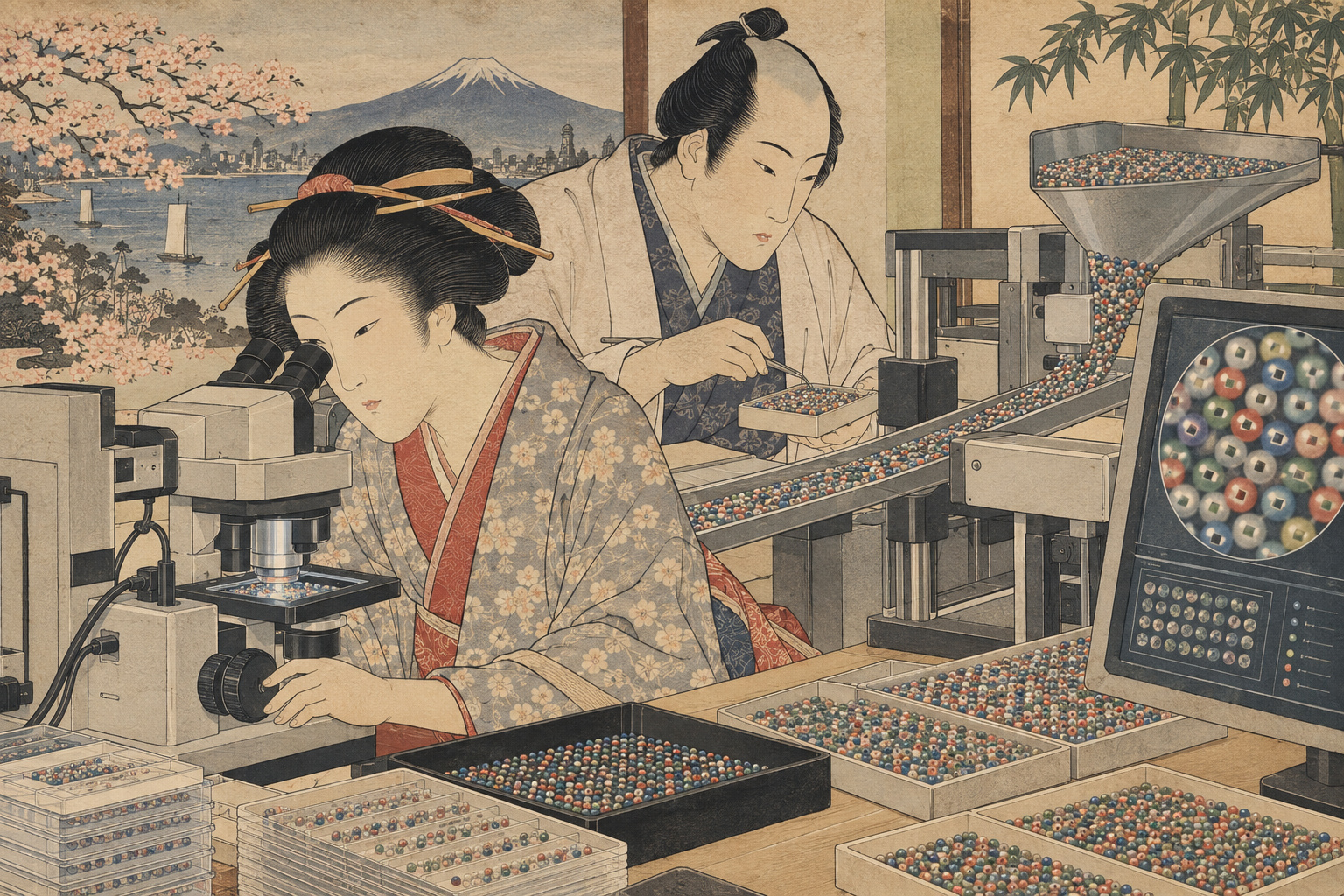
The hard part of a microscopic barcode is not dreaming up a large number of possible identities. It is manufacturing enough physical tags, assigning the identities you actually want, and reading them back without turning the experiment into a barcode factory. A University of Tokyo team now reports a way to separate those jobs.
In a May 2026 bioRxiv preprint, Akihiro Eguchi, Yuichiro Iwamoto, Hinata Tokuda, Haruka Narita, Adrian M. Martin and Sadao Ota of the University of Tokyo’s Research Center for Advanced Science and Technology describe a universal five-domain hydrogel microparticle that can be fabricated continuously at more than one million particles per hour. The particle is made first. Its optical identity is written later, by hybridizing fluorescent DNA strands to five spatially distinct DNA-addressable regions. [1][5][6]
That distinction is the engineering idea behind the headline. The system does not need to redesign particle fabrication for every barcode. It creates a common stock of templates and moves diversity into a post-fabrication chemistry step. The researchers argue that this can bridge a longstanding tradeoff: deterministic barcodes are controllable but can be cumbersome to manufacture code by code, while random combinatorial tags can be easy to diversify but difficult to produce as a requested, predefined library. [1][2]
The “more than one million per hour” figure refers to fabrication of the common five-domain DNA-addressable hydrogel templates. Encoding those templates, imaging them and decoding them are additional operations. The paper does not report an end-to-end commercial production rate for finished, application-ready barcode libraries. [1][2]
The manufacturing problem comes before the barcode problem
The particles are hydrogels with five stripes, or domains. Each domain carries a different immobilized oligonucleotide sequence. Once a batch of identical templates has been fabricated, complementary DNA strands carrying fluorophores can bind selectively to those domains. Different fluorescence intensities in different positions form the optical code.
The fabrication step uses what the authors call contact-free multilaminar flow lithography with all-around three-dimensional sheathing. Five reactive streams are laminated together to form the future domains. Additional sheath flows surround the reactive core from the top, bottom and sides, keeping it away from the microfluidic channel walls. A shaped ultraviolet pulse then polymerizes slices of the flowing precursor into particles. [2]
Keeping polymerization away from the walls matters because flow-lithography systems can suffer from material sticking or polymerizing near the channel surface, raising the risk of fouling and clogging. The team’s device maintained continuous operation for more than three hours and produced more than three million five-domain particles in one run. The reported major and minor axes were 63 ± 2 micrometers and 32 ± 2 micrometers. [2]
Fabricate one universal five-domain particle → stock the common template → hybridize selected fluorescent DNA strands to each domain → create a chosen codebook without changing the particle-making device for every identity.
Five domains have to stay five domains
High speed is useless if the five reactive layers blur into one another before the hydrogel is fixed. The paper estimates a residence time of roughly 42 milliseconds in the lamination region. Using a deliberately conservative diffusion coefficient for short single-stranded DNA, the authors estimate about 3.5 micrometers of diffusion during that interval, below the separation used later in the decoding workflow. Fluorescent complementary strands subsequently bound to the intended regions, supporting the claim that the oligonucleotide domains remained spatially resolved and chemically accessible. [2]
This is an easy detail to overlook, but it is central to the architecture. The five regions are not merely decorative stripes. They are five separately addressable chemical locations. That lets one physical particle carry several independent optical “digits.”
The billion-code number is a ceiling, not the demonstrated library
In single-domain measurements, the team resolved 64 candidate optical states. If all 64 states could be used independently and reliably in each of five domains, the combinatorial space would be 64 to the fifth power—about 1.1 billion possible barcodes. [1]
The large experiment was deliberately more conservative. The researchers used nine predefined spectral states per domain, giving 95, or 59,049 possible codes. That is the library size they actually implemented with a split-pool labeling workflow. [2]
The distinction matters. “A billion optical barcodes” would imply a completed library of that size. The preprint instead reports an experimentally informed theoretical capacity based on the number of distinguishable states observed in an individual domain.
How 16,174 beads became 14,198 confident calls
For the 59,049-code test, the authors implemented nine spectral states using different AF488 and AF647 labeling mixtures. A third fluorophore, AF405, acted as a spatial fiducial rather than a coding channel, helping the software orient and segment the five domains. [2]
The image pipeline extracted domain-level fluorescence values from 16,174 beads. A Gaussian mixture model assigned one of nine states to each domain. The team then imposed a stringent rule: all five domain assignments had to exceed a posterior probability of 0.95. Under that criterion, 14,198 beads were retained as decoded—an 88% recovery. [2]
That should not be simplified into a 12% “wrong barcode” rate. Some particles were rejected because they did not meet the confidence threshold. In a pooled screen, refusing to make a low-confidence call can be preferable to assigning the wrong identity with false precision.
The frequency with which individual codes appeared was also broadly consistent with the Poisson expectation for uniform random sampling from the predefined codebook, the authors report, without an obvious strong representation bias in the sampled population. [2]
Eleven days later, could the same bead still be recognized?
A useful barcode must survive more than a single snapshot if it is intended for longitudinal biology. In matched fields of view, the team reports correctly re-identifying more than 7,800 beads after 11 days with greater than 0.95 accuracy. [1][2]
That is evidence for optical identity stability in the study’s experimental setting. It is not evidence that the particles have been tracked for 11 days inside a human body, nor does the paper establish clinical biocompatibility for such use. The demonstrated claim is narrower: a particle imaged later can still be associated with its earlier optical identity under the tested conditions.
This is the next chapter of a Tokyo barcode program
Ota’s group has been working on the broader problem of preserving identity across measurements for years. In 2023, a University of Tokyo and RIKEN team reported “Computational Design of Synthetic Optical Barcodes in Microdroplets” in Advanced Optical Materials. That work deliberately embraced randomness: combinations of differently colored microbeads generated many optical identifiers, while simulated training data and machine learning decoded the patterns. The researchers also demonstrated Image-DNA dual barcoding, or ID-coding, so the same identifier could connect microscopy with DNA sequencing. [3][4]
The 2026 preprint attacks a different limitation. Instead of asking, “Can we decode a randomly generated identity?” it asks, “Can we manufacture a universal tag and then write the identity we choose?” That shift from stochastic identity to programmable identity is what makes the new architecture potentially useful for predefined screening libraries.
The surrounding research program points toward applications rather than a single product. Eguchi’s JST ACT-X project is explicitly titled “Large-Scale Evaluation of Protein Functions Enabled by Optical DNA Sequencer Beads.” [8] Iwamoto, meanwhile, has worked on high-throughput optical analysis of rare nanoparticles using deep-learning-enhanced sensitivity. [7] The common theme is scale: make many objects, measure many objects, and preserve enough identity to connect one measurement with another.
Why optical IDs matter in pooled screening
Pooled experiments gain efficiency by mixing many conditions together. The problem is that mixing destroys provenance unless each object carries a recoverable identity. DNA barcodes are powerful, but reading them can require destructive sequencing or multiple chemistry cycles. Optical barcodes offer a different advantage: identity can potentially be read directly from an image while the object remains available for further observation.
A programmable bead could therefore act as a bridge between a condition and a phenotype. A particular code might correspond to a compound, protein variant, culture condition or perturbation. Researchers could mix the beads, run a common experiment, image the outcome and decode the bead in the same workflow. The preprint specifically frames the platform as a foundation for pooled high-throughput screening and future functional payloads. [1][2]
But the paper is still primarily a platform demonstration. It does not report discovery of a drug candidate, diagnosis of a disease or completion of a million-condition biological screen. Those applications require their own validation of assay chemistry, payload attachment, biological compatibility, image throughput and error control.
The most important scaling decision may be inventory, not optics
A billion theoretical combinations are visually impressive, but laboratories rarely need a billion equally represented codes. They need a specific codebook in specific quantities. A 96-condition experiment, a 10,000-variant protein library and a longitudinal single-cell study have very different inventory requirements.
Separating fabrication from encoding can change that logistics problem. A laboratory or supplier could, in principle, manufacture common template particles in bulk and postpone identity assignment until the experiment is known. The fabrication tool would not have to be reconfigured for every code. That is analogous to making blank media first and writing information later.
The key scaling move is not simply “more colors.” It is moving barcode identity out of the particle-fabrication step.
There is already an intellectual-property trail—but no announced product
The University of Tokyo is the applicant on a related international patent publication for optically readable particles, with Ota, Eguchi, Tokuda, Iwamoto, Narita and others listed among the inventors. [9] That shows the broader technology is being protected beyond an academic paper. It does not establish that this specific preprint system is commercially available.
No product price, commercial launch date or standardized kit for the reported five-domain barcode particles has been announced in the sources reviewed by Japan.co.jp. Cost per usable code, total labeling time, automation requirements and inter-laboratory reproducibility remain important unanswered engineering questions.
What to watch next
First comes peer review. The manufacturing rate, code-state separability, statistical decoding and longitudinal matching will have to withstand external scrutiny. Beyond that, the decisive test is an integrated biological workflow: fabricate at scale, program a codebook, attach functional cargo, run a pooled assay, image it quickly enough, and recover the right identities at a useful cost.
If that chain works, optical barcodes could become less like handcrafted tags and more like infrastructure for experimental identity. The million-particle-per-hour result matters because biological experiments are already moving toward millions of cells, molecules and perturbations. At that scale, a barcode is no longer an annotation at the edge of the experiment. It becomes part of the measurement system itself.
Sources and references
- bioRxiv: Decoupling Fabrication from Encoding: DNA-Addressable Template Microparticles for Large, User-Defined Optical Barcode Libraries (May 2026 preprint)
- Endo Lab: full-text extraction and structured summary of the same preprint (methods/results cross-check)
- University of Tokyo RCAST: computational design of microscopic identifier materials (Dec. 22, 2023)
- Advanced Optical Materials: Computational Design of Synthetic Optical Barcodes in Microdroplets (2023)
- University of Tokyo: Akihiro Eguchi profile, Assistant Professor
- University of Tokyo RCAST: Sadao Ota profile, Professor
- University of Tokyo RCAST: Yuichiro Iwamoto and colleagues, Deep Nanometry research (Feb. 21, 2025)
- JST ACT-X: Akihiro Eguchi, Large-Scale Evaluation of Protein Functions Enabled by Optical DNA Sequencer Beads
- WIPO PATENTSCOPE: WO2026075252 (University of Tokyo applicant; inventors include Sadao Ota, Akihiro Eguchi, Hinata Tokuda, Yuichiro Iwamoto and Haruka Narita)
- J-GLOBAL: Yuichiro Iwamoto researcher profile
- J-GLOBAL: Haruka Narita researcher profile
Evidence reviewed September 16, 2026, Japan time. Core results come from the bioRxiv preprint and a full-text extraction used to verify methods and numeric details; institutional history, names and positions were checked against University of Tokyo, JST, J-GLOBAL and WIPO sources. The work is not yet peer reviewed. The 645 figure is an experiment-informed theoretical capacity, while the demonstrated large predefined library contains 59,049 codes. No commercial product, price or clinical use was identified in the reviewed sources. Analysis is Japan.co.jp’s unless otherwise attributed.