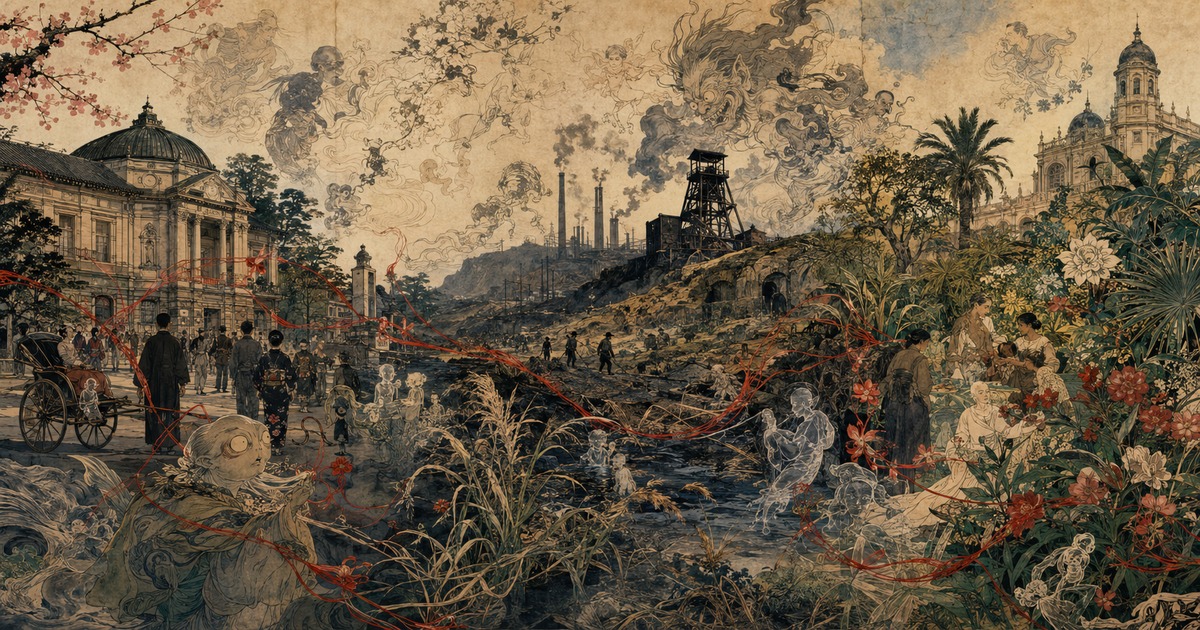
Three clocks begin around the same moment. In Ueno, a classical building with columns and a monumental staircase opens in May 1926 as Japan’s first public art museum. In Omuta, a boy named Shigeo Egami is filling ordinary paper with the rooms, gardens and roads around him before beginning a working life at the Mitsui Miike coal operation. In 1926, an obscure painter named Kanetaro Fujioka completes an oil painting crowded with zinnias; the following year, a man whose name is written with the same characters but read Tetsutaro Fujioka leaves Japan for Argentina and works with gardens and flowers.
“Views of This Place—Ueno, Omuta, and Buenos Aires,” which opened July 23 at Tokyo Metropolitan Art Museum, brings those clocks into the same galleries. Its English headline can be understood as three centuries, but not as 300 successive years. These are three overlapping century-long narratives: an institution, a human life and an archival mystery. Each asks who is visible, who is authorized and what survives.
Centennial exhibitions often behave like monuments erected by institutions to themselves. They display founding documents, famous loans and milestones in a smooth line toward the present. This one makes the line unstable. The museum tells its story through wartime propaganda, postwar poverty, independent exhibitions and a collection it no longer houses. Then it gives its largest space to roughly 400 works by a self-taught employee who drew for decades far from Tokyo and mostly outside the expectation of national recognition. Finally, it lets an uncertain name lead beyond the artwork into migration, family photographs, flower cultivation and unanswered questions.
The exhibition does celebrate survival. But its deeper accomplishment is self-criticism. Tokyo Metropolitan Art Museum is asking whether a museum exists to certify excellence, preserve objects, provide a public stage, nourish private life, recover ordinary records—or somehow hold all of those purposes without pretending they are the same.
“Three Centuries” Means Three Lives of One Century
The exhibition’s structure is an argument about historical scale. One hundred years is the age of a durable institution, but it is also the possible length of a person’s life. Egami lived 101 years. A painting can survive the same period while its maker’s biography becomes fragmentary. By setting those durations side by side, the museum declines the assumption that institutional time is the master clock against which all other lives should be measured.
Ueno supplies the canonical timeline: founding, exhibitions, war, reconstruction, a new building, a transferred collection and reinvention. Omuta supplies repetition rather than milestones. Egami went out, looked, drew and returned, one landscape after another. Buenos Aires supplies discontinuity. Names are pronounced differently, records cross an ocean, photographs remain in family hands and the research does not collapse into a perfectly solved identity.
The three parts are not sealed rooms. The installation reportedly moves from the museum’s early history into Egami, back to the 1975 building and the first collected paintings, again through Egami’s late work and finally toward Argentina. Time folds instead of marching. That choice matters. It prevents “the center” from presenting Ueno first and treating the other places as regional footnotes.
A Public Museum Built With Coal Money
The origin begins with a civic need and a private fortune. In 1921, Tokyo prefectural assemblyman Motoyasu Koike proposed a permanent art exhibition hall in connection with the coming Peace Commemorative Tokyo Exposition. Keitaro Sato, a businessman from northern Kyushu known for his success in coal, offered the prefecture ¥1 million for construction. The museum says he was inspired by Andrew Carnegie and devoted roughly half his wealth to public purposes including scholarships, hospitals, rural improvement and women’s education.
Architect Shinichiro Okada designed the Tokyo Prefectural Art Museum, which opened May 1, 1926. Its columns and high stairs performed authority before a visitor reached a picture. To have a work shown there could mean public recognition as an artist. Government exhibitions, academies and independent associations gained a common stage. More than 1,000 works appeared in the opening exhibition honoring Prince Shotoku, bringing rival sectors of the art world into the same building.
Yet a disagreement existed at birth. Sato wanted what would now be called a museum: a place to protect older art, collect systematically and maintain permanent displays. Tokyo’s administrators emphasized a gallery—a venue for temporary exhibitions and new work. The distinction remains central to the anniversary show. Is the institution a treasury, a gate, a rental hall, a classroom or a civic commons?
Coal complicates the answer. Wealth extracted through an industrial network in Kyushu built a cultural center in Tokyo. The centenary does not conceal that geography; it sends the exhibition back toward it. Omuta is not included as picturesque regional contrast. It is part of the material history that made Ueno possible.
Ueno’s “Hall of Art” Also Served War
A public stage reflects the public that controls it. In the 1920s and 1930s, the museum introduced European modernism, Japanese calligraphy and bonsai while hosting government and independent exhibitions. By 1938, annual attendance had passed one million. Its prestige helped enlarge the field of art. Prestige also made it useful to state power.
During the war, the institution showed paintings designed to intensify fighting spirit. The current exhibition includes the Women Artists Service Corps’ monumental Pictures of All Women in Japan at Work in the Greater East Asia War from 1944, shown in spring-summer and autumn-winter sections. Women artists gained an enormous commission, yet under a system that mobilized their labor and imagery for imperial war. Visibility and freedom were not the same thing.
In October 1944, authorities ordered public exhibitions suspended and art organizations dissolved, then staged a special wartime exhibition. After defeat, the museum’s space held another burden: GHQ requisitioned five rooms in 1946 and ordered 153 war-record paintings stored there. The building that had conferred artistic legitimacy became evidence storage for a discredited state project.
Outside, Ueno also changed. Photographs in “Views of This Place” show repatriates at the station, shoeshine boys, people sleeping in underpasses and a war orphan living in the park. A history told only through exhibition posters would miss the bodies gathered around the institution. The “place” in the title therefore means more than an address. It includes who could enter, who slept nearby and whose suffering entered the archive.
After Defeat, the Unjuried Exhibition Opened the Gate
Postwar democratization produced a different use of the museum. The Yomiuri Independent exhibitions accepted work without a jury, loosening the academy’s authority over what deserved a wall. Painters, sculptors and emerging anti-art practices could encounter one another without first winning approval from a salon hierarchy. The old “hall of art” became valuable precisely because artists could violate its standards inside it.
The exhibition’s work list moves from postwar rural and labor subjects to Akutagawa Saori, Toneyama Kojin, the Fukuoka-based Kyushu-ha and other makers who challenged polished metropolitan taste. Kyushu-ha declared its opposition to Tokyo and to established public exhibitions, yet its members also brought work to Ueno’s independent show. Resistance to the center still needed routes into the center if it was to become nationally legible.
Behind the group’s material aggression stood the social pressure of industrial Kyushu, including the Miike labor struggle. The 1959–60 dispute over restructuring at the mine continued for roughly ten months and became one of modern Japan’s largest labor confrontations. That history makes “independence” more than a stylistic label. The substances and conflicts of working life entered arguments over what art could look like and whom it should address.
There is no clean moral progression from wartime control to postwar freedom. Institutions accumulate contradictory uses. The same rooms can authorize propaganda and dissidence, exclusion and first attempts. A serious centenary does not choose one as the museum’s true identity. It asks what structures made each possible.
Shigeo Egami Made Art Before and After Anyone Was Watching
Egami was born in 1912 in what is now Miyama, Fukuoka Prefecture, and moved to Omuta soon afterward. After higher elementary school, he entered the construction section of the Mitsui Miike operation. He did not follow the metropolitan route through art school, juried exhibition and critical recognition. He worked, raised a family and kept making images with materials close at hand: pencil, watercolor, crayon, oil pastel, woodblock and dyed paper.
The early subjects are intimate enough to appear almost anti-historical: a cousin’s garden, his mother’s sewing box, a red dresser, an interior, a bowl in a garden. Yet repetition turns intimacy into an archive. Furniture records aspiration and domestic labor. A garden records what a family planted and how it occupied space. A road or harbor records industry before official heritage programs decide what deserves preservation.
During wartime, according to the opening report, Egami drew roadside plants while carrying the discomfort of having been exempted from military service. Later he made dense crayon landscapes, experimental abstractions, woodblock views of Omuta and floral studies of mourning. His practice cannot be reduced to documentary realism. The approximately 400 works in Tokyo include tests, departures and returns—the evidence of someone using art to think, not merely to illustrate a city.
At 60, after retirement, Egami held his first solo exhibition at the Omuta Izutsuya department store. He eventually mounted ten exhibitions in Omuta and elsewhere. For roughly three further decades, he traveled out to a landscape, completed a watercolor and returned home, often at the rate of one picture a day. Recognition arrived, but it did not create the practice. It encountered a practice already old.
Omuta’s Landscape Was Not Merely Scenery
Omuta grew with the Miike coalfield, whose mines, railways, port and industrial works helped power modern Japan. The same system formed neighborhoods, schools, company housing and identities. It also produced hierarchy, danger and conflict. The city’s official chronology records the massive 1960 labor dispute, the 1963 Mikawa mine explosion that killed 458 people and the mine’s final closure on March 30, 1997.
Egami lived across that complete industrial arc. He worked for the mining company, saw the city at its population peak and continued painting through restructuring, disaster and decline. Works such as the woodblock Sunset at the Coal Yard make industrial infrastructure part of a lived horizon. Other sheets remain with clouds, coastal weather, paths and plants. The ordinary view does not sit outside political history. It is where political history is endured.
It would be wrong to recruit every Egami landscape as a coded statement about the strike or mine disaster. The exhibition’s force comes partly from refusing to make him a convenient “coal artist.” He painted what was near, and nearness included industry without exhausting the meaning of a garden or sky. That independence protects the life from being used as an explanatory caption for Tokyo’s history.
Still, the connection to Ueno is inescapable. Coal profits traveled from Kyushu into the stone of a public museum. Egami’s drawings stayed in family hands and regional collections for decades. A century later, the institution uses its central galleries to receive what the center did not originally produce or validate. That is not charity toward the periphery. It is a correction to the museum’s account of itself.
A Zinnia Painting Becomes a Door Into Buenos Aires
Garden Full of Zinnias is an oil painting measuring 97 by 130.3 centimeters. It was painted in 1926 by an artist recorded as Kanetaro Fujioka and entered the Tokyo Prefectural Art Museum’s holdings in 1927, where it is regarded as the first collected painting. Today it belongs to the Museum of Contemporary Art Tokyo, after the older museum transferred nearly 3,000 works and its art-library materials in 1994.
For such a foundational object, remarkably little was known about its maker. That absence became a research brief. AHA!—Archive for Human Activities, an initiative that has worked with private photographs and ordinary records since 2005—followed the name. The search encountered another man whose name uses the same Japanese characters but is read Tetsutaro Fujioka. Born in 1901, he left for Argentina in 1927 and became involved in landscaping and floriculture around Buenos Aires.
The coincidence is cinematic: a garden painting enters a collection as a man with the same written name crosses the world and works with flowers. But responsible archival work does not convert elegance into proof. The exhibition presents family photographs, possessions, interviews and the stages of investigation around the question of whether the painter and migrant were the same person. The uncertainty is part of the work, not an embarrassment to remove.
That restraint changes what a museum label can do. Instead of compressing a life into birth date, school and awards, the exhibition shows knowledge being built from partial evidence. Visitors see not only an object but the labor of asking descendants, comparing records, traveling and admitting what remains unresolved.
Migration Changed the Meaning of the Flower
Japan and Argentina are marking 140 years of Japanese immigration in 2026, counting from an 1886 arrival; official Argentine accounts identify 1908 as the beginning of the first larger phase. Many early migrants reached Argentina indirectly through Brazil, Peru or neighboring countries. They found work in urban services, agriculture, landscaping and flower cultivation, building communities whose histories rarely entered Japanese national art narratives.
Fujioka’s 1927 journey therefore belongs to a broader movement but cannot be reduced to it. Family photographs from the 1930s place Tetsutaro and his sister Fusae inside a lily-growing facility and show the household they built in Argentina. Flowers here are not only aesthetic motifs. They are work, adaptation, technical knowledge, trade and a means of making place in a new country.
AHA!’s project extends that history into 2027 by gathering publicly submitted flower photographs for a tear-off calendar. The gesture could look modest beside an oil painting in a museum. That modesty is the point. One image is protected as a collection object; hundreds of contemporary flower photographs pass day by day through homes. The calendar asks whether an archive can be prospective—made for use now, before historical importance is assigned.
The zinnia thus changes function repeatedly. It is a painted subject, a collection milestone, a research clue and an invitation to contribute. Art does not merely preserve the past. It can activate a social relation in the present.
The Building Descended From a Temple Into a Public Square
The museum’s architecture embodies a change in civic posture. Okada’s 1926 building asked visitors to climb a great staircase toward classical columns. It staged art as elevation. By the late 1960s, however, more than 100 organizations were using an overcrowded, aging structure criticized as dark, noisy, hot in summer and cold in winter.
Kunio Maekawa designed the replacement, completed in 1975. Because Ueno Park limited building height, nearly 60 percent of the floor area went below ground. Visitors descended toward an esplanade surrounded by separate blocks for curated exhibitions, public association shows and cultural activities. Rather than dominate the park, the red-brick-toned volumes broke down their scale and sat among trees.
The new program also widened the museum’s job. Professional curators organized exhibitions and collected modern art; studios, lectures and open production supported learning; and in 1976 the museum opened Japan’s first publicly accessible specialist art library. The building became an early model for the mixed functions now familiar in Japanese public museums.
Then its identity shifted again. In 1994, almost the entire collection and library moved to the new Museum of Contemporary Art Tokyo, which opened the following year. Large co-sponsored international exhibitions and group shows became main pillars in Ueno. After a two-year renovation, the museum reopened in 2012 with a mission to be a “doorway to art” and increased emphasis on art communication. The centenary exhibition is credible because the institution has never been one stable thing.
The Museum’s First Collection Is No Longer in the Museum
Garden Full of Zinnias now returning to the centenary story from another Tokyo institution exposes a productive paradox. A museum is often imagined as a building plus a permanent collection. Tokyo Metropolitan Art Museum has retained its public name, architecture, exhibition culture and social memory after most of its objects departed. What, then, is the institution?
One answer is a set of relationships: artists bringing new work, associations organizing shows, newspapers assembling international loans, schoolchildren encountering their first gallery, researchers reopening a file and citizens discussing what they see. Objects matter enormously, but they are not the only carriers of continuity. The transfer itself is part of the history rather than proof that the older museum lost its identity.
That argument also revises the meaning of preservation. Egami’s works survived through family care, private owners and regional museums before the capital assembled them. Fujioka’s possible migration story survived through photographs and memories outside a formal art archive. The museum is not the sole guardian rescuing everything else. It arrives late and depends on forms of custody that existed without it.
What Is Art For?
The exhibition offers no single answer, and that is its strength. In 1926 Ueno, art was for public display and professional recognition. Under wartime mobilization, it became propaganda and service to the state. In postwar independent exhibitions, it became a means of refusing judges. For Egami, it was an everyday discipline capable of holding weather, work, shame, experiment, memory and pleasure before a major institution knew his name.
For the two Fujiokas—or possibly one—the flower painting is both an object and a question. For descendants, photographs are family property before they are historical evidence. For AHA!, archiving means maintaining uncertainty and inviting participation rather than extracting a neat biography. For today’s museum, art is also conversation: the exhibition offers dialogue nights, curator-led viewing and a free Kids + U18 Day, while all students and visitors 18 or younger receive free regular admission.
There are risks in this generous framework. An institution can romanticize the “unknown” maker after ignoring the conditions that kept that person unknown. It can turn industrial hardship or migration into atmospheric content. It can congratulate itself for decentering Tokyo while every story still arrives for validation in a Tokyo gallery. The exhibition should be judged by whether the three places truly alter one another, not simply by whether all three are represented.
Yet the choice of material makes that judgment possible. Wartime complicity is visible. Egami is given abundance rather than one token landscape. The archival mystery remains open. Coal links philanthropy to extraction and center to periphery. A celebratory show has made room for reasons not to celebrate simply.
The Next Century Begins With Attention
Tokyo Metropolitan Art Museum’s centennial statement describes art as “nourishment for living.” The phrase risks becoming sentimental until it is placed beside Egami’s working life. For him, making images did not wait for institutional permission or leisure detached from labor. It accumulated in the margins and then extended through thirty years after retirement. Nourishment is not always spectacular. It can be the reason to go outside tomorrow and look again.
The Buenos Aires section adds another lesson. Archives need not end by closing a case. Sometimes the responsible result is a better question, a map of evidence and a relationship with people who hold the memory. The 2027 flower calendar carries that unfinishedness forward one disposable page at a time.
Ueno supplies the public room in which these scales can meet. That remains a profound function. A museum can gather objects that never expected one another and let their differences become legible. But the room is useful only if it recognizes how much of art happens before the door, beyond the capital and without an audience.
Three century-long stories have arrived in the same building. One has columns, budgets and an anniversary logo. One consists of thousands of days when a worker chose to draw. One survives as a painted garden, a shared name and flowers cultivated on the other side of the earth. The exhibition does not rank them. It lets each expose what the others cannot explain alone.
That is what art may be for: not to furnish a final answer, but to keep a place, a person and a question visible long enough for another life to meet them.
Reporting Notes and Sources
This report reflects information available by 10:29 a.m. Japan time on July 28, 2026. “Three centuries” is Japan.co.jp’s editorial description of three overlapping 100-year arcs; the exhibition does not cover 300 consecutive years. The project examines whether the painter Kanetaro Fujioka and migrant Tetsutaro Fujioka were the same person, but elegance of coincidence is not treated here as proof.
- Tokyo Metropolitan Art Museum: official English exhibition information
- Official exhibition site: three sections and research project
- Tokyo Metropolitan Art Museum: bilingual work list
- Tokyo Metropolitan Art Museum: centennial timeline
- Tokyo Metropolitan Art Museum: institutional and architectural history
- Tokyo Metropolitan Art Museum: centennial mission and “doorway to art”
- Tokyo Museum Collection: Garden Full of Zinnias object record
- Tokyo Metropolitan Foundation for History and Culture: exhibition overview, biographies and programs
- Bijutsu Techo: opening report and Ueno section
- Bijutsu Techo: Egami installation and exhibition structure
- City of Omuta: municipal chronology of the Miike dispute, disaster and mine closure
- Argentine Foreign Ministry: history of Japanese immigration and bilateral relations
- Embassy of Japan in Argentina: 2026 immigration anniversary