- A centenary that asks who a museum is for
- A coal entrepreneur’s million-yen intervention
- The public gallery and Japan’s modern artists
- A new building, then a major redefinition
- Opening the Beginnings: the institution becomes the exhibit
- Ways of Reading: five artists, five invitations
- An anniversary with both major loans and free entry
- How to visit—and what is not yet known
- The next century is a question of participation
A centenary that asks who a museum is for
A museum can be an archive, a stage, a school or simply a place where strangers discover something they had not expected to see. Tokyo Metropolitan Art Museum, founded in Ueno Park in 1926, has spent a century moving among those roles. On November 19, 2026, it is scheduled to open two free exhibitions that make that evolution the subject rather than the backdrop. One turns to a century of drawings, exhibition records and photographs. The other invites visitors to think of art as a way of reading the world.
Together they pose an unusually direct institutional question: does a public museum exist mainly to guard valuable objects, or to create encounters between artists and audiences? The answer in Ueno has changed repeatedly. That history is what makes the anniversary interesting beyond the calendar.
A coal entrepreneur’s million-yen intervention
The institution began with an act of private philanthropy. In March 1921, Keitaro Sato, a businessman from northern Kyushu associated with the coal industry, offered ¥1 million toward an art museum in Tokyo. Tokyo Prefectural Art Museum opened in May 1926, with May 1 observed as its founding day. Architect Shinichiro Okada designed the original building.
The gift did not resolve an important dispute about what to build. Sato imagined a museum that would preserve, collect and display art on a continuing basis. The metropolitan administration favored a gallery principally devoted to exhibitions. The distinction mattered: a collecting museum places resources in holdings and conservation; an exhibition venue gives artists and groups recurring access to audiences. Ueno began closer to the latter model, even as its activities grew more varied.
The public gallery and Japan’s modern artists
For decades the museum served as a major platform for art associations and public exhibitions. The 2026 archive show describes it as a place where modern artists presented work, sometimes where experiments at the edge of accepted taste attracted attention. Its public identity was made not only by masterpieces brought in from elsewhere, but by artists who needed a place to show their own work.
A centennial timeline records annual attendance exceeding one million in 1938. Yet the museum also reflects the pressures of its century: wartime authorities ordered an end to open-entry exhibitions and the dissolution of art groups in 1944; after Japan's defeat, parts of the building were requisitioned by the Allied occupation authorities. Those episodes complicate any easy celebration of an uninterrupted cultural public sphere. Access to galleries depends on institutions, politics and the freedom to exhibit.
A new building, then a major redefinition
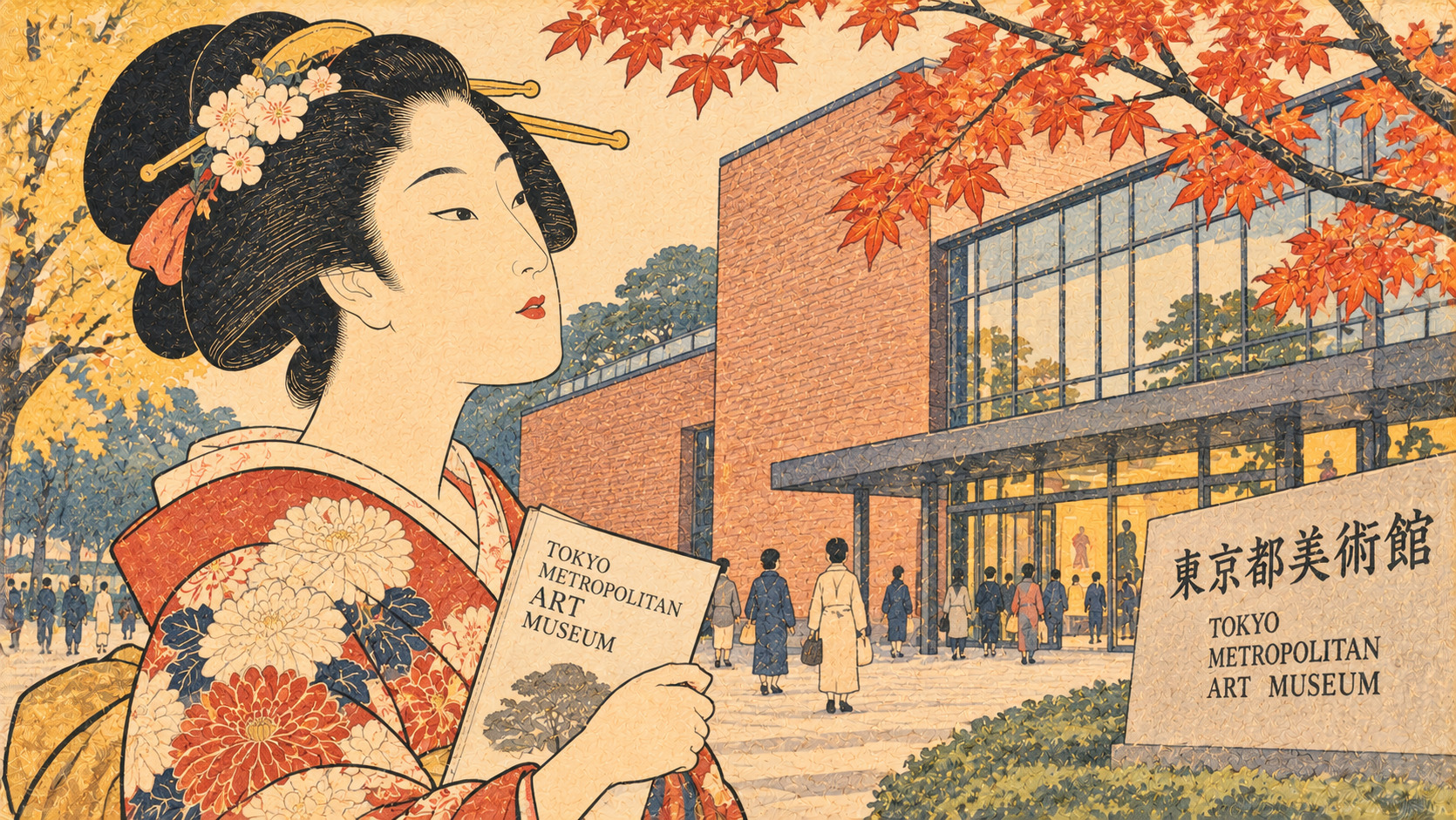
By the 1960s the original building had deteriorated. Construction of a replacement began in 1972 under the architectural practice of Kunio Maekawa. The new museum opened in September 1975, and the original building was subsequently demolished. Its carefully composed brick-toned forms became part of Ueno's architectural landscape.
The change was not merely visual. The institution expanded its own curated programs, art education, library services and collecting activities. Another turning point came in 1994, when most of its collection and art-library materials transferred to the new Museum of Contemporary Art Tokyo, with a small number of outdoor sculptures and related three-dimensional works excepted. The resulting emphasis on exhibitions and cooperation with art groups meant that the institution's function could not be inferred from the size of a permanent collection.
Opening the Beginnings: the institution becomes the exhibit
The archives exhibition, officially titled The History of the Tokyo Metropolitan Art Museum and presented in Japanese as “Hajimari o Hiraku: Tokyo-to Bijutsukan no 100-nen,” is scheduled for Gallery B. Five chapters, framed by a prologue and epilogue, trace the museum's shifting purposes. Records of past exhibitions, photographs, architectural plans and other archival materials will make the workings of the institution visible.
Notably, the show also includes photographs supplied by members of the public. A museum keeps official inventories and annual reports, but visitors remember different things: a first exhibition, a family visit, an entrance hall, a conversation outside a gallery. Putting those private memories beside institutional records challenges the assumption that an institution's history belongs exclusively to its administrators. It also offers material for understanding how people used the building, not just what was displayed there.
Ways of Reading: five artists, five invitations
The second show, Ways of Reading—How the World Speaks to Us, How We Speak to the World, occupies Galleries A and C. Its stated premise is that looking at art is an active way of interpreting experience. It assembles Alberto Giacometti, Momo Yamanishi, Shuntaro Tanikawa, Bikky Sunazawa and Elena Tutatchikova across sculpture, photography, language and other media.
The curatorial sequence approaches the world through light, time, words, nature and bodily imagination. Giacometti's sculptural attention to the human figure sits beside the work of poet Tanikawa, the carved forms of Sunazawa, and contemporary practices by Yamanishi and Tutatchikova. The museum has announced new ceramic works from Tutatchikova's “Islands” series and Yamanishi pinhole photographs made in Nepal in December 2025. These are planned display details, not claims based on our own preview of the installed exhibition.
An anniversary with both major loans and free entry
The November celebration also includes a separate blockbuster exhibition. What a Wonderful World: Masterworks from the Musée d’Orsay opened on November 14, with approximately 110 works spanning painting, sculpture, craft and photography. It addresses the changing rhythms of everyday life during the industrial and social transformations of nineteenth-century Europe. Its ticketing arrangements are distinct from the two free centennial shows.
The museum has also announced an autumn centennial week, November 14–23, with public activities, while a Taito fashion and accessories fair is scheduled for November 20–22. The combination is revealing: international art loans, local makers, institutional archives and experimental contemporary art are presented within the same civic setting. That is a wider statement about access than a single celebratory blockbuster could make.
How to visit—and what is not yet known
Both free exhibitions are scheduled for November 19, 2026, through January 11, 2027. Ordinary hours are 9:30 a.m.–5:30 p.m., with Friday opening until 8 p.m.; last entry is 30 minutes before closing. Published gallery closures are December 7 and December 21–January 3. The history exhibition is in Gallery B, and Ways of Reading occupies Galleries A and C.
This report is a preview prepared before the opening, not a review from inside the galleries. Layouts, final installation details, and visitors' responses have not been independently observed. Readers should consult the museum's official pages for changes, accessibility arrangements, timed activities, or gallery-specific conditions. Other exhibitions in the building can have different admissions and schedules.
The next century is a question of participation
It is tempting to reduce a hundred years to an attractive timeline of founding donors, architects and famous exhibitions. But Ueno's story includes contested institutional purposes, spaces for young artists, moments when expression was curtailed, a reconstruction, and the transfer of a collection. The museum has continually had to redefine the value it offers Tokyo.
The anniversary shows suggest one possible answer. A civic museum can preserve a history while recognizing that a visitor brings something essential to the encounter. If the next generation sees the museum not as a guarded vault but as a doorway through which it can make sense of the world, the 1926 experiment will have found a new purpose.
Exhibitions at a glance
| Exhibition | Venue | Dates | Entry |
|---|---|---|---|
| The History of the Tokyo Metropolitan Art Museum | Gallery B | Nov. 19, 2026–Jan. 11, 2027 | Free |
| Ways of Reading | Galleries A & C | Nov. 19, 2026–Jan. 11, 2027 | Free |
Primary sources and reporting scope
Based on museum history, exhibition pages and centennial announcements; no original on-site reporting or artist interviews.
- Tokyo Metropolitan Art Museum: autumn centennial week, Nov. 12, 2026
- Museum: The History of the Tokyo Metropolitan Art Museum
- Museum: Ways of Reading
- Museum: official history
- Museum: centennial historical timeline
- Museum: centennial program calendar
- Museum: What a Wonderful World, Musée d’Orsay exhibition
- Museum: exhibition calendar
- Tokyo Metropolitan Art Museum, official English history
- Museum: 2026 exhibition programme