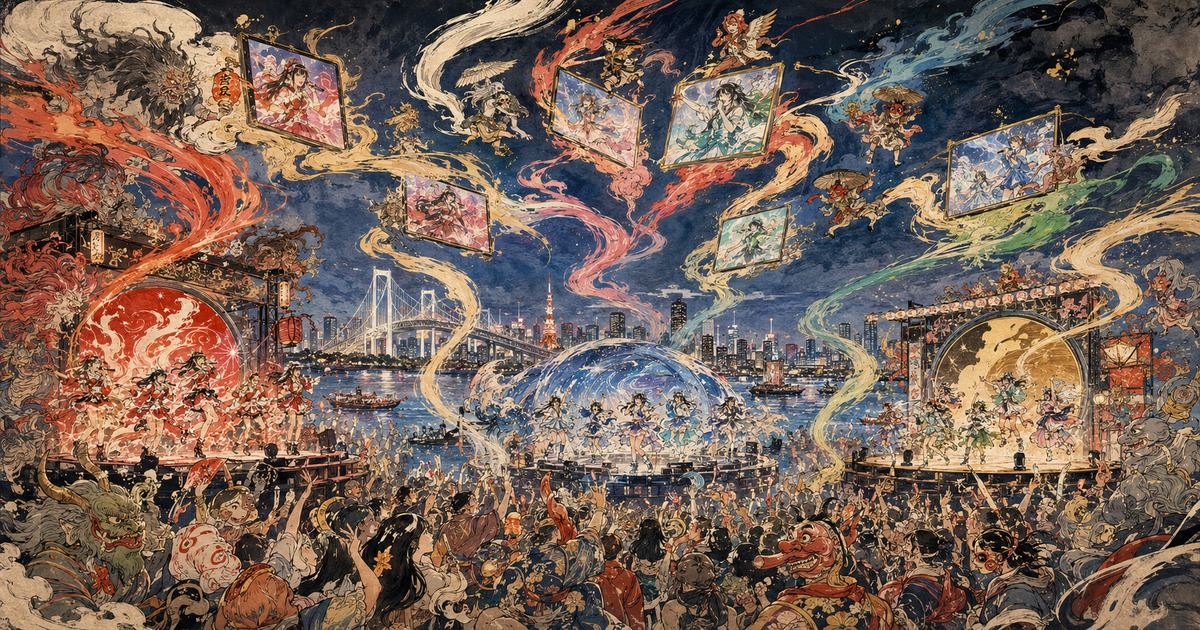
Shortly after 9 a.m. on Friday, July 31, Tokyo Idol Festival 2026 is due to stir into motion across Odaiba and Aomi. The outdoor HOT STAGE will face the summer sky. HEAT GARAGE will fill Zepp DiverCity with concert lighting. At SMILE GARDEN, beside Fuji Television’s Wangan Studio, the day’s first voices will carry across a patch of ground idol fans have come to call sacred. By the grand finale on Sunday night, more than 200 acts will have chased a colossal three-day timetable.
The expansion in this year’s headline is not geographical. TIF has not moved its physical stages beyond Tokyo’s waterfront. What has expanded is the audience perimeter. On July 27, organizers confirmed online coverage of all seven live stages as well as the talk-oriented INFO CENTRE. HOT, HEAT and SMILE will be joined on screens by DOLL FACTORY, SKY STAGE, TOROCCO PARK and the floating-island stage. The last two are being streamed as stages for the first time.
This is a pre-event report, accurate as of 10:29 a.m. Japan time on July 28. Performers, rights clearances, weather and connection conditions can still alter the broadcasts. One distinction matters from the start: there is no single service called “all of TIF.” The eight programmed spaces are divided among FOD, TIF Streaming, NicoNico, sheeta, SHOWROOM and other platforms. Home viewers can look across more of Odaiba than ever, but not with one universal ticket or one browser window.
Not One Stream, but Eight Windows
The clearest way to understand the online TIF is not as a television program but as eight windows opened along the waterfront. FOD’s pay-per-view package and the separate TIF Streaming service will carry the festival’s three principal stages: HOT STAGE, HEAT GARAGE and SMILE GARDEN. Holders of a July 31 TIF Streaming ticket can take part in online voting for the Main Stage Contest final at HEAT GARAGE. An FOD ticket does not include that voting right.
DOLL FACTORY will appear on NicoNico’s “TIF Ura Channel,” while SKY STAGE will have a NicoNico “TIF Channel.” TOROCCO PARK and the 360-degree floating-island stage will use sheeta Live Stream. INFO CENTRE programming will generally be available free on SHOWROOM, with selected projects also assigned to MixChannel or Machebara. “Every stage is streamed” is true. “Every stage is in one streaming bundle” is not.
| Stage | Place and character | Main stream |
|---|---|---|
| HOT STAGE | Outdoor main stage in the Aomi temporary parking area | TIF Streaming / FOD |
| HEAT GARAGE | Large indoor venue at Zepp DiverCity | TIF Streaming / FOD |
| SMILE GARDEN | Open-air “idol holy ground” beside Wangan Studio | TIF Streaming / FOD |
| DOLL FACTORY | Studio stage inside the Fuji Television complex | NicoNico “TIF Ura Channel” |
| SKY STAGE | Rooftop stage with the city and sky as its backdrop | NicoNico “TIF Channel” |
| TOROCCO PARK | Outdoor stage using mine-cart-style platforms to close the fan gap | sheeta Live Stream |
| Floating-Island Stage | Octagonal outdoor stage with a 360-degree audience | sheeta Live Stream |
| INFO CENTRE | Talks, announcements and the words behind the performances | SHOWROOM and others; some free |
The fragmentation adds friction. Viewers need to check accounts, prices, regional availability and archive windows. If a favorite moves from one stage to another, the viewer may have to move between services too. Yet the inconvenience resembles something essential about TIF itself. A person in Odaiba does not sit in one reserved seat all day. They grip a map and a timetable, sacrifice one set to reach another, and hurry across a sunlit plaza for the next 15 minutes. In 2026, that physical circulation has been translated into browser tabs.
A Three-Day FOD Pass at One-Third the On-Site Price
FOD is selling a one-day pass for the three major stages at ¥3,900 and a three-day pass at ¥9,800. After each live program is prepared for replay, ticket holders can watch the archive until 11:59 p.m. on August 5. Sales close at 5 p.m. that day. The T-shirt-wearers-only stage is excluded, as is the online voting right in the Main Stage Contest.
General-admission tickets to the physical festival cost ¥11,500 for one day or ¥30,000 for all three. At the displayed exchange rate of ¥163.74 to the U.S. dollar, the on-site tickets are about $70.23 and $183.22. FOD’s prices are about $23.82 and $59.85. Those conversions exclude ticket fees and any card or bank exchange spread.
| Way to watch | Yen price | At ¥163.74/$1 | What it buys |
|---|---|---|---|
| On site, one day | ¥11,500 | About $70.23 | Movement across the site, cheers, merchandise, meet-and-greets and accidental discovery |
| On site, three days | ¥30,000 | About $183.22 | The full physical weekend; travel, lodging and heat protection are extra |
| FOD, one day | ¥3,900 | About $23.82 | Live and limited replay access to the three major stages |
| FOD, three days | ¥9,800 | About $59.85 | All three days on the major stages; other stages use other services |
The price gap does not mean that streaming is simply a cheaper copy. The physical ticket includes proximity, reverberation, merchandise tables, cheki-style photo sessions, and the chance of being stopped by a song one never intended to hear. Streaming creates another entrance for people who cannot travel, cannot endure long hours in severe heat, are caring for children or relatives, live far from Tokyo, have mobility constraints, or are beginning to explore Japanese idols from overseas. These are not two identical products competing on price. They are two versions of TIF designed around different bodies and distances.
2010: An “Idol Trade Fair” Built by Hand
The TIF origin story is far more improvised than today’s enormous waterfront map suggests. On August 7 and 8, 2010, the first festival used Shinagawa Stellar Ball along with hotel banquet rooms, theaters and other nearby spaces. It was promoted as Japan’s first large, simultaneous, idol-specific music festival. Forty-five groups drew roughly 5,000 people. Alongside concerts were talks, handshake events, a dolphin show involving idols and even a bowling tournament.
Founding general producer Seita Kadosawa had worked on Fuji Television’s “Idoling!!!” and imagined a place where groups could meet outside the boundaries of a single agency or television program. The model owed something to Fuji Rock: multiple stages, audiences in motion, and the possibility that the performance one had not planned to see would become the day’s most important. He applied the idea to an idol world then separated among live houses, regional scenes, television, record labels and fan events.
The phrase “Idol Warring States Period” was fashionable at the time. In a later retrospective, Kadosawa recalled deliberately avoiding it at TIF. The purpose was not to stage a battle from which only one act emerged. It was to make a place where every kind of idol might shine—a principle he characterized as openness to those who wished to take part. Diversity was not a slogan added after success; it was an operating theory.
Commercial success did not arrive immediately. Merchandise remained unsold, and the first event was not an obvious profit engine for its organizer. What it created first was infrastructure: a temporary market linking performers, fans, broadcasters and music media. “Trade fair” is an imperfect term for something powered by affection, but it captures the festival’s industrial function. TIF allowed the scene to see itself gathered in one place.
From Shinagawa to Odaiba, Two Days to Three, 5,000 to 88,000
TIF moved to Odaiba in 2011. The bayside district suited an event that wanted a city block rather than a concert hall. Plazas, rooftops, television studios and live venues could be connected into a walking festival. Different scales, regions and musical identities appeared on the same map. For fans, TIF became both a place to see the people they already supported and a machine for finding the people they might support next.
The festival expanded from two days to three in 2016. At its 10th-anniversary edition in 2019, 212 groups and 1,393 idols performed for about 88,000 attendees—more than 17 times the first year’s audience. The coexistence of the 48-group family, the Sakamichi series, Hello! Project, Stardust acts, regional idols, live-house groups and voice-actor or character projects became a form of media in its own right. The lineup was a three-day argument about how broad the word “idol” could be.
| Year | Milestone | What TIF expanded |
|---|---|---|
| 2010 | 45 groups and about 5,000 people in Shinagawa | The large, multistage idol-festival form |
| 2011 | Move to Odaiba | A festival discovered by walking through a district |
| 2016 | Expansion from two days to three | Performance slots, encounters and time to discover |
| 2019 | 212 groups, 1,393 idols and about 88,000 attendees | The physical scale behind its “world’s largest” reputation |
| 2020 | Physical event canceled; TIF ONLINE created | A multistage festival without a shared physical site |
| 2022 | About 30,000 on site plus 25,000 online | A hybrid definition of the festival audience |
| 2026 | Seven live stages and INFO CENTRE streamed | The whole physical map as a digital circulation space |
The Pandemic Turned Streaming From an Add-On Into a Venue
Immediately after the 2019 high-water mark came TIF’s greatest disruption. In 2020, COVID-19 forced organizers to cancel the physical gathering for the first time in the festival’s first decade. Under the promise that they would not let the flame go out, they created TOKYO IDOL FESTIVAL ONLINE in October. It attempted not merely to relay concerts but to rebuild the multistage format online, including fan interactions, games and virtual idols treated as participants rather than novelties.
The festival moved into a hybrid phase in 2021. When the full midsummer Odaiba gathering returned in 2022, 230 groups and 1,319 idols appeared. Approximately 30,000 people attended physically and another 25,000 joined online. By that accounting, streaming was not an emergency exit on the edge of the event. It represented roughly 45 percent of the combined audience pathways.
On-site attendance climbed to about 70,500 in 2023 and 80,604 in 2024. Physical recovery did not require digital retreat. The pandemic demonstrated two truths at once: a screen cannot fully reproduce the embodied pressure of a live crowd, and a festival does not have to discard people whose bodies, jobs, locations or family obligations prevent them from entering that crowd.
The 2026 plan is therefore less a sudden technological leap than a consolidation of hard-earned practice. TOROCCO PARK and the floating-island stage are newly added to the broadcast map, but the conceptual breakthrough occurred when TIF had no Odaiba at all. The festival learned to think of a stream not only as documentation of a venue, but as a venue with its own entrances, sight lines and failures.
The 2026 Lineup Is a Cross-Section of Idol History
Read the 2026 bill from top to bottom and it becomes clear that it is not a simple ranking of current popularity. AKB48 appears alongside HKT48, SKE48, NMB48, NGT48 and STU48. Nogizaka46 represents the Sakamichi lineage. =LOVE, ≠ME and ≒JOY sit beside Juice=Juice, Tsubaki Factory and Rosie Chronicle. CANDY TUNE and CUTIE STREET meet iLiFE!, Appare!, LinQ and Niji no Conquistador. Veteran figures including Maki Goto, Yuki Kashiwagi and Ayaka Sasaki return as artists with histories that overlap several eras.
This is not merely succession. It is superimposition. The television-and-CD model of the 2000s, the 48 and Sakamichi expansion, regional movements, groups built in live houses, the social-video “kawaii” pop of the 2020s, and a game-derived project such as Uma Musume Pretty Derby all occupy the same weekend. The word idol has always joined music to personality, repetition, proximity and narrative. TIF makes the changes in that formula visible.
The largest names help sell tickets and stabilize attention. TIF’s deeper cultural work, however, is connecting a 15-minute small-stage slot to a larger future. A little-known group can be found by a fan who happens to walk past, a viewer who switches streams, a booker watching the archive, or an overseas listener who encounters a short clip days later. The event is a concert festival, but it is also the idol industry displaying its possible next chapters to itself.
That is why comprehensive stage streaming matters. Broadcasting only the headliners would distribute fame already accumulated. Broadcasting the smaller stages can distribute opportunity—provided viewers can find them. A camera on every stage is the beginning of access, not the end of discovery.
Nagi Inoue and the Meaning of Succession
In 2026, Nogizaka46 member Nagi Inoue becomes TIF’s third chairperson, following Rino Sashihara and Neru Nagahama. Inoue joined Nogizaka46 as a fifth-generation member in 2022 and took the center position on the 2023 single “Ohitorisama Tengoku.” She is scheduled to appear at the grand opening at SMILE GARDEN on July 31 and to perform with Nogizaka46 on August 2.
The chairperson is not an administrative presiding officer. She serves as the festival’s public face and as a symbolic bridge between large and small acts, television and live houses, memory and novelty. Sashihara moved from the center of the 48-group ecosystem toward producing idols herself. Nagahama took on a cultural-guide role after Keyakizaka46. Inoue accepts the position while actively representing the current generation of one of Japan’s largest groups.
The succession shows how thoroughly TIF has matured into an institution. In 2010, the festival tested whether the idol boom could become something durable enough to deserve its own large-scale gathering. By 2026, artists whose careers were formed during TIF’s lifetime can inherit its public story. A festival committed to newness has also become a ritual of continuity.
What the Camera Gains—and What It Cannot Carry
A stream can do things that an on-site spectator cannot. It can bring a SKY STAGE expression close, deliver the dark interior of HEAT GARAGE with controlled sound, and recover a simultaneous performance through replay. No one in Odaiba can be in two venues at once. A viewer combining live feeds and the archive can reduce the losses built into the schedule.
Yet many of the memories that make TIF TIF resist the camera: an unfamiliar song heard on the walk to SMILE GARDEN; reflected heat rising from the pavement; a queue that forces a change of plan; an argument between friends over the next stage; a photo handed over at a meet-and-greet; the sky changing color behind a rooftop performance. The screen brings the performer closer while erasing much of the crowd’s social texture and the distances of the city.
The camera also exercises power. A director’s choice to isolate one member, preserve a full formation or cut to the audience changes the meaning of a short performance. For a small act, excellent stream footage can become the material that attracts a future fan or booking. If rights restrictions remove the archive, the same appearance can disappear almost instantly.
To digitize “discovery,” TIF must therefore design more than coverage. Search, clips, readable timetables, artist context, subtitles, stable archives and overseas purchasing all determine whether a transmitted set becomes a cultural bridge. Without those layers, a stage can be technically available while remaining functionally invisible.
Can Serendipity Survive an Algorithm?
At the physical TIF, failed plans often create the best discoveries. A desired stage reaches capacity, so a fan enters the one next door. A voice heard while crossing the site makes someone stop. A friend says, “Just watch five minutes,” and a new attachment begins. This is not the same as a platform recommending more of what a person’s viewing history already resembles.
The 2026 challenge is consequently not just to put Odaiba online. It is to build a screen that makes an unknown name tempting, a timetable that crosses platforms and stages, and short introductions that locate a group by hometown, formation year, style or first TIF appearance. The free INFO CENTRE can be an important threshold: talk creates personality and context, which can then lead a viewer toward a paid performance.
- A cross-stage timetable: Viewers should compare every choice at the same time, rather than browse each service in isolation.
- Fast context: Hometown, history, musical character and first-time status should appear before a viewer clicks.
- Rewindable accidents: A person arriving from another stage should be able to recover the beginning.
- Subtitles and overseas routes: Talk, purchase regions and time zones should not become invisible walls.
- Small-stage visibility: The stages outside the major three cannot be allowed to sink into an “other” category.
If online viewers use the weekend only to follow stars they already know, TIF will still function as an impressive simultaneous broadcast. But it will surrender its trade-fair power. The festival’s historical value lies in rearranging attention: making the famous share a map with the not-yet-famous, and letting movement—physical or digital—redistribute curiosity.
Is a Festival a Place, or a Shared Time?
Parts of TIF depend completely on Odaiba. The rooftop, plazas, Zepp venue, temporary parking lots, television studios, sea air and metropolitan skyline form a route no studio can reproduce. Merchandise and fan-contact events remain emotional and economic centers of the idol model. Organizers are urging hats and hydration because the bodily fact of midsummer is both the festival’s atmosphere and one of its risks.
But the 2020 event taught TIF how not to define a festival by place alone. If multiple stages move at the same time, spectators choose among them, unknown performers are found, and people argue afterward about what they saw, then some portion of festival life can exist in front of a screen. The 2026 edition applies an emergency-era lesson to ordinary audience expansion.
Its success should not be judged only by pay-per-view sales. Did more names from small stages get searched the following week? Did a regional fan decide to travel to a later concert? Did an overseas viewer want to understand the lyrics? Did a person unable to make the trip feel not that they had merely watched, but that they had participated? Those are the measures that reveal whether eight transmitted stages have become more than eight feeds.
On July 31, the spectators in Odaiba will fasten wristbands and walk toward their first stages. Spectators elsewhere will open apps and choose their first windows. One group will have sea air, cheers and distance underfoot. The other will have close-up images and time that can be replayed. Neither can possess all of the weekend. Both must choose, miss and find the next name. That incompleteness—the need to surrender one performance in order to discover another—has been the true architecture of Tokyo Idol Festival since 2010.
Reporting Notes and Sources
This pre-event article reflects information available at 10:29 a.m. Japan time on July 28, 2026. Performers, stream contents and starting times may change. It distinguishes FOD’s three main stages from the separate services carrying the other stages; it does not state that FOD includes the entire festival.
- TIF 2026: detailed stage-stream announcement
- TIF 2026: official broadcast and platform guide
- FOD: three major stages, prices, start times and replay window
- TIF 2026: eight programmed spaces and venue map
- TIF 2026: performer lineup
- TIF 2026: on-site ticket prices and conditions
- TIF 2026: official history since 2010
- TIF 2026: Nagi Inoue appointed third chairperson
- Pia Music / Music Natalie: oral history and the founding philosophy of TIF
- TIF ONLINE 2020: cancellation and online-festival rationale
- SCREEN ONLINE: TIF 2022’s 30,000 on-site and 25,000 online participants
- TIF 2024: 195 groups, 80,604 attendees and the floating-island stage
- Fuji Television: TIF 2019 and the festival’s development