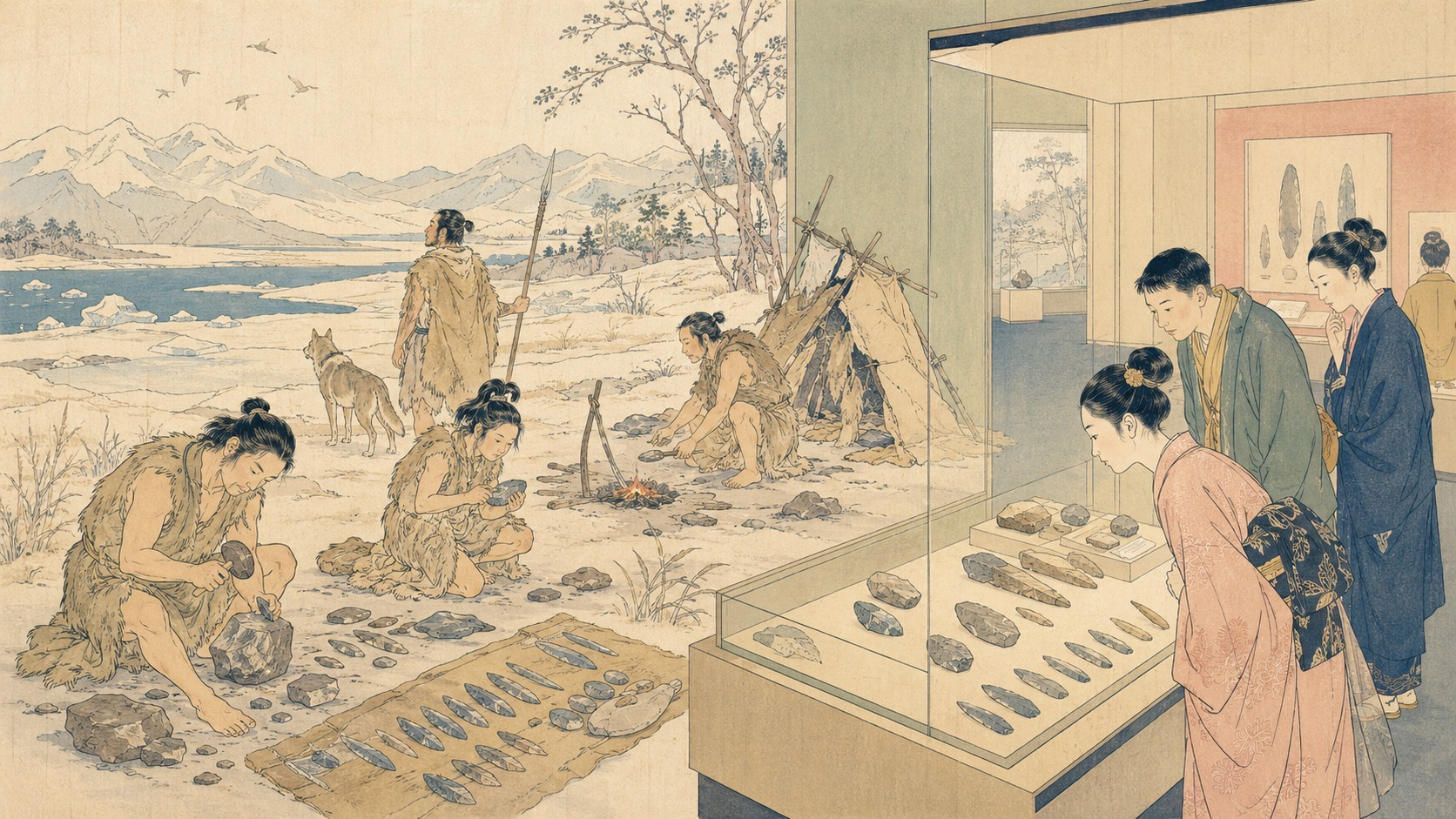
The object that opened a new depth of Japanese history was not gold, a royal grave or a monumental building. It was a piece of obsidian in red earth beside a road cut in Gunma. In 1946, 20-year-old Aizawa Tadahiro saw intentionally fractured stone inside a layer that many archaeologists treated as culturally sterile. Three years later, a controlled excavation turned his intuition into stratigraphic evidence. Human history in the archipelago suddenly extended tens of thousands of years beyond the Jomon period.
Tokyo National Museum’s special thematic exhibition Before the Jomon Era: Commemorating 80 Years Since the Discovery of Japan’s Paleolithic Period refuses to leave that transformation as a lone-hero story. Across five chapters it brings together Aizawa’s surface finds, Meiji University’s excavated Iwajuku assemblage, Japanese points and microblades, a French handaxe, an Indian cleaver, modern replicas of hunting weapons and a diorama. The larger questions are methodological: When does a stone become a tool? How can a layer carry time? What does international comparison illuminate, and what can it distort?
The exhibition runs from June 16 through August 23, 2026, in the Heiseikan Thematic Exhibition Room at the museum in Ueno. Monday, July 27—the publication date of this article—is a museum closing day; the next opening is Tuesday the 28th. Admission is ¥1,000 for adults and ¥500 for university students, with free admission for high-school students and younger visitors, people under 18 or 70 and older, and specified accessibility categories. The gallery is compact. Its intellectual reach is roughly forty millennia.
Nor is the anniversary only retrospective. A study published on July 17 has reconstructed a rigorous radiocarbon chronology for Japan’s early Upper Paleolithic. It infers a strong expansion in the number of occupations between about 36,000 and 34,000 years ago, when distinctive tools and large circular stone concentrations proliferated. Eighty years after Iwajuku, the evidence is still moving.
When “no one lived in the red soil” was common sense
Claims of a Japanese Paleolithic did not begin in 1946. Older-looking stone and bone had been reported, and some researchers suspected a human presence before the Jomon period. But age, context and even whether an object had been worked by people remained disputed. The accepted archaeological sequence still began with Jomon pottery.
On the Kanto Plain, reddish-brown loam derived from repeated volcanic falls lies beneath the darker soil that contains Jomon material. It belongs to the Pleistocene, but for many researchers it was not where human occupation should be sought. That expectation formed a loop: because people were assumed absent before pottery, a worked-looking stone in red loam was not recognized as a tool; because it was not recognized, the absence appeared confirmed. Aizawa broke the loop by continuing to look.
Aizawa Tadahiro: history found on a peddler’s route
Born in 1926, Aizawa walked the Kiryu region after the war selling goods including natto, pursuing archaeology between rounds. He did not have a university laboratory, an academic title or an excavation budget. Yet walking for work meant seeing exposed ground—fields, slopes and road cuts—every day. In 1946 he collected obsidian flakes from the Iwajuku exposure. In 1949 he found an obsidian spearhead-shaped point that strengthened his conviction that people had occupied the red-earth landscape.
The point at the center of the exhibition is now dated on the museum label to about 23,000 BCE. It was probably mounted as a weapon tip and could also cut like a knife. It is a Registered Tangible Cultural Property. Aizawa’s archive goes far beyond that object: 39,370 archaeological items, spanning the Paleolithic through historical periods and concentrated around Mount Akagi, were nationally registered in 2024. His family donated the complete collection to the Iwajuku Museum in 2022.
More than half the objects in the Tokyo exhibition come from the Iwajuku Museum. The city says this is the first time its holdings have been presented together outside the municipality. A film about Aizawa, Sleeping in Red Earth, is also being produced by Midori City for national release in March 2027. The 80th year has become a reconsideration not only of the discovery, but of the social position of the person who saw what institutions did not.
Collaboration turned intuition into proof
Iwajuku is not adequately told as an outsider genius defeating a closed establishment. Aizawa brought his evidence to scholars. Serizawa Chosuke and Sugihara Sosuke at Meiji University recognized its significance, and the university organized controlled fieldwork. Excavations in September 1949 and April 1950 recovered groups of stone tools from distinct positions in the Kanto loam. Recorded stratigraphy showed that they were not later objects that had slipped downward, but remains from communities that had not used pottery.
The assemblages were classified as Iwajuku I, II and III cultural phases, implying variation within the Paleolithic rather than one undifferentiated “before.” A photograph dated September 11, 1949, shows young excavators, four years after the end of the war, digging a new time scale for the country. Aizawa’s eye, Serizawa’s and Sugihara’s comparisons, the students’ excavation and the geology of the layer all mattered. Discovery required both individual attention and collective verification.
Forty Iwajuku tools held by Meiji University are designated Important Cultural Properties. Their appearance at Tokyo National Museum is the first there since 1988. Each small object carries two histories: its making in the Late Pleistocene and the modern process by which archaeology learned to accept it as evidence.
Stratigraphy is the grammar of time
Placed by itself on a table, a stone tool does not disclose whether it is 5,000 or 35,000 years old. Paleolithic archaeology depends first on context. Which layer held it? At what angle? With what other material? Was the sediment disturbed? Do separated flakes refit? Is charcoal securely connected to the human activity being dated? Iwajuku taught Japanese archaeology to read the relationship between artifact and layer as a historical sentence.
Volcanic Japan offers an unusually powerful clock. Tephra from a major eruption can be identified through mineral and chemical signatures and correlated across distant sites. Radiocarbon dating of charcoal or bone is calibrated to calendar time. Optically stimulated luminescence can estimate when sediment grains were last exposed to light. Tool typology remains useful, but the strongest chronology aligns stratigraphy, tephra, several measurements and reproducible samples.
Date labels need their own caution. “35,000 years ago,” “35,000 BCE” and “35,000 cal BP” do not share the same zero point. BP conventionally counts back from 1950; cal BP is a radiocarbon result calibrated into calendar years. This article rounds research chronologies into “about 38,000 years ago” and preserves the museum’s BCE labels when describing exhibited objects. Apparent precision should never outrun the method.
Forty thousand years ago, the map was different—but still watery
The strongest current evidence places Homo sapiens on Paleo-Honshu—the joined landmass of Honshu, Shikoku and Kyushu—by about 38,000 years ago. Sea level was lower and the coast lay farther out, but the archipelago was not simply attached to the continent. Water remained between the Korean Peninsula and Paleo-Honshu. The first successful movement into this territory probably required a crossing.
Hokkaido was periodically connected northward through Sakhalin, allowing northern animals and technologies to move. Yet the July 2026 chronology notes that no early Upper Paleolithic sites earlier than about 30,000 years have been securely identified in the Hokkaido–Paleo-Sakhalin region. A western route from the Korean Peninsula is a leading possibility for the first Paleo-Honshu groups; an East China Sea route has also been discussed. The origin is not settled.
The Ryukyu Islands preserve another migration story. More than 30,000 years ago people crossed channels wide enough that the destination could disappear below the horizon, while the Kuroshio pulled powerfully across the route. Late Pleistocene human remains survive at Shiraho-Saonetabaru Cave on Ishigaki. Sakitari Cave on Okinawa records repeated occupation beginning 35,000–30,000 years ago, shell artifacts and fishhooks from roughly 23,000 years ago. An experimental National Museum of Nature and Science project demonstrated that a dugout canoe could complete the Taiwan–Yonaguni crossing. It did not prove the exact prehistoric boat; it showed the voyage was within human capability.
Obsidian that had to cross the sea
Obsidian from Kozushima in the Izu Islands provides a maritime signature on the Paleo-Honshu side. Elemental sourcing, including X-ray fluorescence, identifies Kozushima material at sites reaching back to roughly 38,000 years ago. The island remained separated from the mainland even at low sea level. Someone traveled there and carried the stone back.
Obsidian fractures into an exceptionally sharp edge, but sources are geographically restricted. Provenance analysis converts a tool from an object into a trace of movement. Did specialists make the crossing? Did raw nodules, finished tools or social information travel? Was acquisition direct, seasonal or exchanged between groups? Those questions remain open. The minimum conclusion is still profound: the sea was a corridor as well as a boundary.
A stone tool is a chain of decisions, not a finished shape
The exhibition’s third chapter follows Japanese Paleolithic life through changing equipment. A point from the Motojuku site, labeled about 18,000 BCE, was made from obsidian or another stone such as shale that takes a sharp fracture. Microblades and a core from Masugata, labeled about 16,000 BCE, represent a different design economy. Standardized slivers could be set along a shaft of wood or bone. If one broke, it could be replaced like a razor blade without remaking the entire weapon. The system saved portable stone and allowed repair during movement.
The edge-ground axe from Iwajuku I posed an earlier and deeper surprise. Grinding had once been treated as a marker of Neolithic technology. In Japan, axes made by flaking a body and grinding the working edge occur from about 38,000 to 32,000 years ago. Experimental work published in 2024 has established criteria for separating microscopic and macroscopic traces produced by chopping wood from other tasks. Not every axe can be called a tree-felling tool, but the evidence supports serious investment in wood processing within forested landscapes.
| Tool or feature | Design logic | Evidence archaeologists test |
|---|---|---|
| Trapezoids and backed knife-shaped tools | Preserve a cutting edge while retouching the base or back for handling and mounting | Reduction sequence, refits, microwear and raw material |
| Edge-ground axe | Flake the body, then grind a durable working edge for impact | Edge damage, polish and comparison with experimental replicas |
| Spearhead-shaped point | Create a symmetrical tip for mounting, piercing and cutting | Basal modification, impact damage, residues and weapon trials |
| Microblades and core | Mass-produce inserts and replace only a broken segment of a composite tool | Scars left on the core, standardization and hafting experiments |
| Circular lithic concentrations | Possible gatherings of several groups or organized collaborative work | Layouts over 30 meters, raw-material sources and refits across clusters |
A July 2026 model: population growth and cultural complexity
A paper published in Nature Communications on July 17 analyzed 354 reliable radiocarbon dates from 61 sites through Bayesian chronological models. Its earliest secure occupations fall broadly around 38,400–36,500 years ago. The number of dated sites expands markedly from about 36,000 to 34,000 years ago, peaking around 35,000. At the same time, trapezoids diversified, blade technologies appeared, edge-ground axes spread and large circular lithic concentrations became more frequent.
The authors interpret this pattern as a demographic expansion that provided more opportunities to invent and share technologies among groups. Some circular arrangements exceed 30 meters, combine stone from different sources, and contain flakes that refit across separate clusters. They may have been aggregation camps for social networking, or places for cooperative hunting and butchery.
A site count is not a census. Research intensity, development-led excavation, preservation and the availability of datable material all affect the curve. The paper tests regional sampling concerns, but its population reconstruction remains an inference. Its value lies in making a richer proposition testable: early Paleolithic people were not necessarily isolated nuclear bands. They may have met periodically, pooled labor and refreshed social networks.
The Ice Age was not one endless white landscape
“Paleolithic” easily summons an eternal tundra populated by mammoths. In reality, climate oscillated repeatedly across the tens of thousands of years at issue, and conditions differed by region. Paleo-Honshu around the first settlement included deciduous forest. That matters when considering edge-ground axes and the demand for wood. Near the Last Glacial Maximum about 20,000 years ago, sea level fell further and colder, drier environments expanded.
Tokyo National Museum describes mobile hunters pursuing animals from Naumann’s elephants to hares. Yet acidic volcanic soils destroy bone, wood, leather and plant fiber. A 2026 Scientific Reports study notes how few Japanese Paleolithic sites preserve animal remains and that the relationship between human activity and the extinction of large mammals remains unresolved. A spear point beside a reconstruction of an elephant does not by itself prove elephant hunting.
Stone survives disproportionately. That does not mean life was made of stone. Shafts, cordage, clothing, carrying bags, tents, wooden spears and much plant food vanished. The exhibition’s reconstructed weapons are valuable because they return those missing organic technologies to the problem, not because they photograph the past.
Where bones speak: the limestone caves of Okinawa
While mainland loam dissolves bone, limestone caves in Okinawa have protected human and animal remains and shell. Directly dated Late Pleistocene human bones were recovered from Shiraho-Saonetabaru Cave. Later investigation identified use of the cave as a mortuary place, including a nearly articulated person from about 27,000 years ago. The Minatogawa remains, around 20,000 years old, represent several individuals and are exceptionally complete for Paleolithic Japan.
At Sakitari Cave, shell fishhooks, beads, tools, and seasonally collected crabs and freshwater snails transformed the stereotype of people following large terrestrial prey. Islanders combined aquatic resources, small animals and craft in shell. A place with few flaked-stone artifacts did not necessarily lack technology. Researchers must look for shell, bone, wood and fiber systems suited to another ecology.
Why place a global handaxe beside Iwajuku?
The exhibition’s fourth chapter moves far outside Japan. A handaxe collected at Saint-Acheul in France is labeled 450,000–350,000 BCE. An Indian cleaver spans the broad range 1.5 million–200,000 BCE. The handaxe served varied tasks such as butchery, hide work and wood cutting, and is described as one of humanity’s earliest strongly designed forms. The thick-edged cleaver delivered force through wood, bone or flesh.
They are not presented as direct ancestors of Iwajuku tools. Tokyo National Museum received such material from the Meiji era into the early Showa period, before a Japanese Paleolithic was accepted. Researchers involved in Iwajuku used international collections as a comparative vocabulary for distinguishing natural fracture from intentional manufacture and thinking about technique and use.
Comparison also carries danger. If a European stage sequence is treated as universal, Japan’s early edge grinding appears anomalous or impossible. Similar form does not prove one people, one function or direct transmission. Different societies can invent similar answers to similar mechanical problems. The international gallery is strongest when it compares both objects and the rulers used to classify them.
Breaking stone can break a hypothesis
The fifth chapter mounts modern replicas of knife-shaped tools, points and microblades in reconstructed hunting equipment. Stone, wood and antler hammers illustrate direct percussion, indirect percussion and pressure flaking. Reproducing the process exposes the sequence, force, errors and learned skill concealed by a finished tool.
Experimental archaeology is not historical theater in which a successful copy “proves” the past. It compares the conditions that produce traces. How do the edge scars and microscopic polish of a wood-chopping axe differ from hide processing? What fracture does a thrown spear leave? Which shaft and adhesive make a microblade maintainable? Replicas build a reference collection for reading original wear.
The Iwajuku diorama places a portable shelter near water in a sunny setting. It is a model derived from excavation and comparison, not a photograph. Tent material and group size remain uncertain. Responsible reconstruction should disclose which elements are evidence, which are analogy and which are a plausible choice among alternatives.
From one road cut to more than ten thousand sites
After Iwajuku, red-earth layers were excavated across the country. The Japanese Palaeolithic Research Association’s 2010 database counted 14,542 Paleolithic cultural layers, consolidated into 10,150 distinct sites, from Hokkaido to Okinawa. Development archaeology accelerated dramatically from the 1970s as roads, railways and housing projects exposed buried landscapes. Research moved beyond ordering tool forms to raw-material circulation, camp organization, hunting practice and environmental adaptation.
Paleolithic Tokyo lies beneath the modern metropolis. At the nationally designated Suzuki Site in Kodaira, a local museum displays stone tools from roughly 38,000 to 16,000 years ago. The Musashino upland contains repeated short occupations beneath streets and houses. After seeing Iwajuku at Tokyo National Museum, a visitor can recognize Tokyo’s ground itself as an Ice Age archive.
The forgery scandal and the discipline of verification
Iwajuku’s success also fed a race to push the human past deeper. In 2000, reporting exposed Fujimura Shinichi planting objects that would be announced as Early and Middle Paleolithic finds. The Japanese Archaeological Association established a special committee. Over three years, archaeologists, anthropologists and geologists reexamined sites, scratches, deposits, adherence, typology and field methods. Credibility collapsed, and textbooks were rewritten.
The lesson is not that independent researchers are unsafe and professionals are safe. The scandal persisted because experts and institutions failed to challenge spectacular results. The desire for an age record and the authority attached to the discoverer weakened independent replication and falsification.
Iwajuku is strong by contrast. Aizawa’s surface collection was not treated as the end of the matter. Controlled excavation established context; the material was preserved; other researchers could revisit it. Current Paleolithic archaeology combines three-dimensional provenience, complete field records, refitting, radiometric samples, microwear, geochemical sourcing and open databases. “Oldest” is less important than “independently testable.”
Use “the first Japanese” with care
Paleolithic inhabitants cannot simply be called modern Japanese people. Groups probably entered at different times and by multiple routes, moved, mixed and sometimes disappeared. Early human remains are almost absent from acidic Paleo-Honshu soils, and recoverable ancient DNA is rarer still. Similar tools do not equal close biological ancestry.
Research into the formation of present-day Japanese populations includes Jomon ancestry and later migration during and after the Yayoi and Kofun periods. It does not provide an unbroken documented family tree from the people who reached Paleo-Honshu about 38,000 years ago. “The first people of the archipelago” belong in the wider dispersal of Homo sapiens through Asia, not as prehistoric citizens of a modern nation-state.
How to walk the five chapters
- Chapter 1: What features of fracture and layer allowed Aizawa to distinguish a tool from natural stone?
- Chapter 2: How did the 1949 excavation transform a surface find into evidence another scholar could test?
- Chapter 3: What do material, form and repair economy reveal about movement and hunting decisions?
- Chapter 4: Where do tools from France, India and Japan resemble each other—and how do age and use differ?
- Chapter 5: Which details in the replicas and diorama come from excavation, and which remain hypotheses?
| Dates and venue | June 16–August 23, 2026 / Heiseikan Thematic Exhibition Room, Tokyo National Museum |
|---|---|
| Hours | 9:30 AM–5:00 PM; until 8:00 PM Fridays and Saturdays. Last admission 30 minutes before closing |
| Closures | Mondays. Closed July 27; open Monday, August 10 |
| Admission | Adults ¥1,000; university students ¥500. High-school age and younger, under 18, 70 and older, and specified accessibility categories free |
| Access | About 10 minutes from JR Ueno Park Exit or JR Uguisudani South Exit; about 15 minutes from subway and Keisei Ueno stations |
The future inside the red earth
Pottery offers shape and decoration. A dwelling can outline domestic space. Paleolithic evidence is more radically incomplete. A flake of stone must be opened into layer, material, manufacture, use, movement and comparison.
What Aizawa saw at Iwajuku was not a complete answer. It was a fragment that contradicted common sense. He kept it, recorded where it came from, showed it to scholars and saw the proposition tested by excavation. Eighty years later, obsidian source chemistry, Okinawan shell fishhooks, microscopic wear and hundreds of calibrated dates are making new social worlds visible.
The exhibition’s deepest message is not simply that Japanese history is older. It is that the beginning of history moves whenever evidence changes. Discovery is not the instant an ancient thing is picked up. It is the longer process through which the claim is doubted, measured, compared and made available for someone else to reach the same conclusion. The red earth opened forty thousand years of past—and a future method for deciding what to believe.
Sources and method
This article uses Tokyo National Museum’s official exhibition structure, object labels and visitor information; primary records from the Iwajuku Museum, Meiji University Museum, the Agency for Cultural Affairs, the Japanese Palaeolithic Research Association, the Japanese Archaeological Association and the National Museum of Nature and Science; and peer-reviewed work on chronology, tool function, demographic modeling, maritime adaptation and human remains. Because source conventions mix BCE, years ago and cal BP, dates are rounded unless an exhibition label is being reported. Routes, population, hunting and reconstructed scenes are identified as hypotheses where the evidence does not support certainty.
- Tokyo National Museum: Before the Jomon Era
- Iwajuku Museum: loans to Tokyo National Museum
- Meiji University Museum: forty Iwajuku objects in the exhibition
- Agency for Cultural Affairs: Iwajuku excavated assemblage
- Agency for Cultural Affairs: Aizawa Tadahiro collection
- Japanese Palaeolithic Research Association: sites in the archipelago
- Japanese Palaeolithic Research Association: open site database
- Nature Communications: early Upper Paleolithic chronology, demography and complexity (2026)
- Quaternary International: edge-ground axes and the first Homo sapiens
- Journal of Archaeological Science: replicated edge-ground axe experiments
- National Museum of Nature and Science: 30,000-year voyage project
- University Museum, University of Tokyo: Paleolithic Ryukyu crossing and the Kuroshio
- National Museum of Nature and Science: Kozushima obsidian transport
- PNAS: Sakitari Cave maritime adaptation and shell fishhooks
- Anthropological Science: Shiraho-Saonetabaru human remains and dating
- Scientific Reports: animal-bone preservation and Fukui Cave
- Japanese Archaeological Association: investigation of the Paleolithic forgery problem
- Kodaira City: Suzuki Site Museum