- The danger arrives before winter looks like winter
- What the Aomori and Iwate numbers actually measure
- Yamagata, Akita and the mountain-pass problem
- A forecast is not a record of what happened
- A car that moves is not necessarily one that stops
- Which tires and which chains?
- Why Japan changed its approach to extreme snow
- The people and services behind an ordinary winter trip
- A practical pre-departure check
- What a roadside survey can—and cannot—tell us
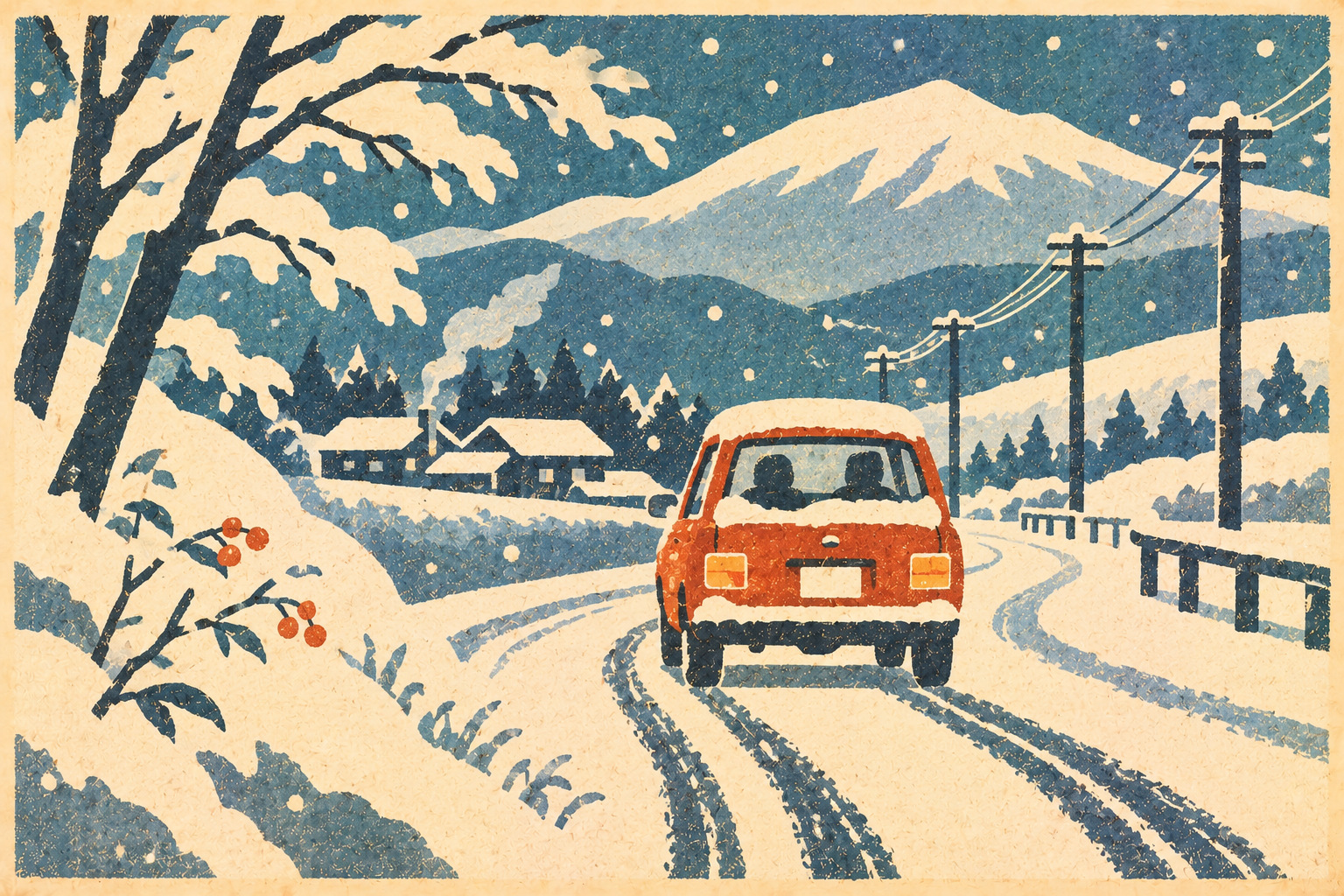
The danger arrives before winter looks like winter
The first great risk of northern Japan’s winter is not always a blizzard. Sometimes it is the stretch of ordinary-looking asphalt between a town that has not yet seen snow and a mountain pass that has. In early November 2026, roadside checks across Tohoku found many drivers had not switched to winter tires. The surveys landed just as expressway operator NEXCO East warned that cold weather could bring snow to Hokkaido, northern Tohoku and Shinetsu through November 10.
At two Aomori roadside stations, the winter-tire fitting rate was 44.9%. At two in Iwate, it was 32.6%. Separate Yamagata-area releases reported 24% on November 2; Akita-area offices warned that roughly seven in ten vehicles in their checks lacked winter tires. These are not measurements of every car in the region. They are local snapshots, and their value lies in what they reveal about the timing of preparation.
What the Aomori and Iwate numbers actually measure
Aomori’s national highway office inspected parked vehicles at the Namioka and Towada roadside stations on November 5. Reported fitting rates were 44.6% and 45.9%, producing a combined 44.9%. The total was 3.5 percentage points above the comparable figure a year earlier, according to local reporting. Better than last year, in other words, but still fewer than half the observed cars were fitted.
Iwate’s highway office examined 267 parked vehicles on November 4. At Ishigami-no-Oka in Iwate town, 34 of 86 vehicles had winter tires, or 39.5%. At Shizukuishi Anekko in Shizukuishi, the count was 53 of 181, or 29.3%. Together the figures produced 87 of 267, or 32.6%, compared with 31.0% in the corresponding check last year.
None of these roadside-station observations is a random, prefecture-wide vehicle survey. The composition of motorists, time of day and site elevation may all matter. Comparing the headline percentages as though they were competing prefectural safety grades would lend a precision the research does not have. The sounder conclusion is simpler: many of the vehicles encountered at these specific sites had not yet changed tires.
Yamagata, Akita and the mountain-pass problem
On November 5, the Yamagata and Sakata highway offices issued notices reporting a 24% winter-tire fitting rate as of November 2. On November 6, Akita-area road offices used the warning that about 70% were not yet fitted. Detailed sites and denominators must be checked in the individual releases before treating either figure as a population statistic.
The terrain makes these warnings important. A driver can leave a relatively mild town, ascend into a shaded valley and encounter snow or frozen pavement before seeing much winter at home. The National Route 112 Gassan corridor in Yamagata illustrates why planning for the harshest part of a route matters more than judging conditions at the starting point. A route is only as safe as its most demanding section.
The October appearance of snow on some higher passes also explains why waiting for the first snowfall in town is a poor scheduling strategy.
A forecast is not a record of what happened
NEXCO East published an advisory at 5:30 p.m. Japan time on November 6 warning of possible snow from November 6 to 10 in northern parts of the country. That is a dated forecast, not evidence that every named location experienced snow or that roads were subsequently closed. This report was researched using information available through November 7 and should be checked against updated weather and road reports at publication.
The forecast does, however, expose a practical mismatch. Many motorists arrange tire replacement after weather alerts begin circulating. Shops may have limited capacity when large numbers of customers seek appointments at once. A driver who waits for visible snowfall may discover that the available replacement date comes after the weather risk.
Frozen pavement can also appear on bridges, in shaded bends and during overnight cooling even when nearby streets look clear.
A car that moves is not necessarily one that stops
Japan Automobile Federation tests conducted in 2017 in Shibetsu, Hokkaido, compared tires on compacted snow and ice. Braking from 40 km/h on packed snow, the summer tire took 29.9 meters to stop against 17.3 meters for a studless winter tire: a 12.6-meter difference. On smooth ice, all stopping distances became much longer and the results depended on the equipment tested.
The findings are controlled comparisons with new tires, a particular vehicle and specified conditions—not universal braking distances to apply to every car or surface. But they illustrate the gap between traction sufficient to get moving and traction sufficient to stop before a pedestrian or junction.
Four-wheel drive may help a vehicle gain traction to move uphill; it does not cancel the physics of braking on ice. Nor should safety features such as anti-lock brakes be mistaken for a replacement for grip.
Which tires and which chains?
Studless winter tires use tread designs and compounds intended for cold weather. All-season products can offer more snow traction than conventional summer tires, but JAF’s published comparisons show considerable limitations on ice. The mere label “all-season” does not certify suitability for every mountain road or frozen surface.
Chains add another layer of protection on steep or difficult routes. Certain exceptional-weather restrictions can require chains even when winter tires are fitted. Drivers need equipment compatible with their vehicle and tire sizes and must understand installation and speed limits. Emergency textile devices and sprays have product-specific restrictions and are not automatically equivalent to winter tires or approved chains.
The quality of the installed tire also matters. NEXCO East advises checking the winter-tire wear indicator, called the platform, that signals the loss of its intended snow-use tread depth. Pressure, damage and correct fitting deserve attention, too.
Why Japan changed its approach to extreme snow
A stranded vehicle is not always an isolated inconvenience. On a narrow arterial route it can stop trucks behind it, interrupt deliveries, delay ambulances and block snow-removal equipment. Road management increasingly treats vehicle immobilization as a threat to an entire transportation network.
In December 2018, Japan’s transport ministry described plans to strengthen snow management and introduced a targeted framework for chains during extraordinary snowfall. Thirteen national highway and expressway sections were under coordination at that time, particularly steep routes with histories of major stoppages. The historical number does not describe every current restriction: drivers must check the active rules for the actual journey.
The broader lesson is that winter preparedness is both a personal responsibility and a small contribution to keeping a region connected.
The people and services behind an ordinary winter trip
When a main road is blocked, the consequences extend beyond recreational drivers. Mountain communities depend on routes carrying school buses, commuters, food, fuel, home-care staff and patients going to appointments. A delay on a pass with few alternatives can spread far beyond the disabled vehicle.
Heavy trucks present additional concerns. Japan’s transport ministry emphasizes appropriate winter tires on all wheels, monitoring tread wear and carrying chains when needed. It also warns that even well-equipped trucks can struggle with deep snow or steep gradients. In an extreme forecast, revising the itinerary or suspending travel can be safer than attempting the route.
This is why the familiar question “Can I get there?” should be joined by another: “What will happen to everyone behind me if I cannot?”
A practical pre-departure check
First, confirm tires are appropriate for the weather and road surface, correctly fitted and in usable condition. If chains may be necessary, verify their size and learn how to install them before reaching snow. Inspect the full route—not merely the destination—for passes, shaded roads and sections subject to restrictions.
Consult current forecasts and the traffic bulletins of NEXCO East and the Japan Road Traffic Information Center (JARTIC). Road information can change faster than a feature article. Allow extra time, reduce speed, leave greater following distance and avoid abrupt steering, acceleration or braking. Remove accumulated snow from the vehicle before setting off.
If required equipment is unavailable, roads are closing or the forecast is severe, postponing a journey is a valid safety measure. A winter tire is necessary in many conditions but is not a guarantee of safe passage.
What a roadside survey can—and cannot—tell us
The survey results offer no reliable basis for estimating the winter-tire fitting rate of all of Tohoku. Nor can they predict the number of crashes that will happen in November. Weather conditions, traffic patterns and reporting methods change from year to year, and even a year-on-year rise in fitting rates cannot on its own prove which public-information campaign caused the improvement.
Their significance is more modest and more immediate. As the season shifts, official observers can still find substantial numbers of vehicles that lack equipment recommended for snow and ice. Publishing those results gives motorists a chance to act before a steep road or freezing morning turns the warning into a crisis.
The safest winter trip may be the one that begins with a tire change days earlier—or the one that is postponed when the conditions demand it.
Sources and reporting method
Japanese official primary sources take priority. Local news was used as corroboration; the article does not infer later road conditions or a current region-wide tire fitting rate.
- Tohoku Regional Development Bureau: November 2026 releases
- Iwate River and National Highway Office: 2026 tire survey
- Aomori Asahi Broadcasting: November 5 roadside survey
- Yamagata River and National Highway Office: November release
- NEXCO East: November 6 advisory for snow
- JAF: winter stopping-distance tests
- JAF: all-season tire limitations
- MLIT: December 2018 chain restrictions initiative
- MLIT: tire and chain guidance for heavy vehicles
- Japan Road Traffic Information Center