Today’s Art Choice: Utagawa Yoshitora — When Japan Began Making the Future
In 1872, an Edo-trained printmaker pictured imported machinery, women at work and a silk industry being remade for global trade. Yoshitora captured the moment Japan began learning how to manufacture a new future.
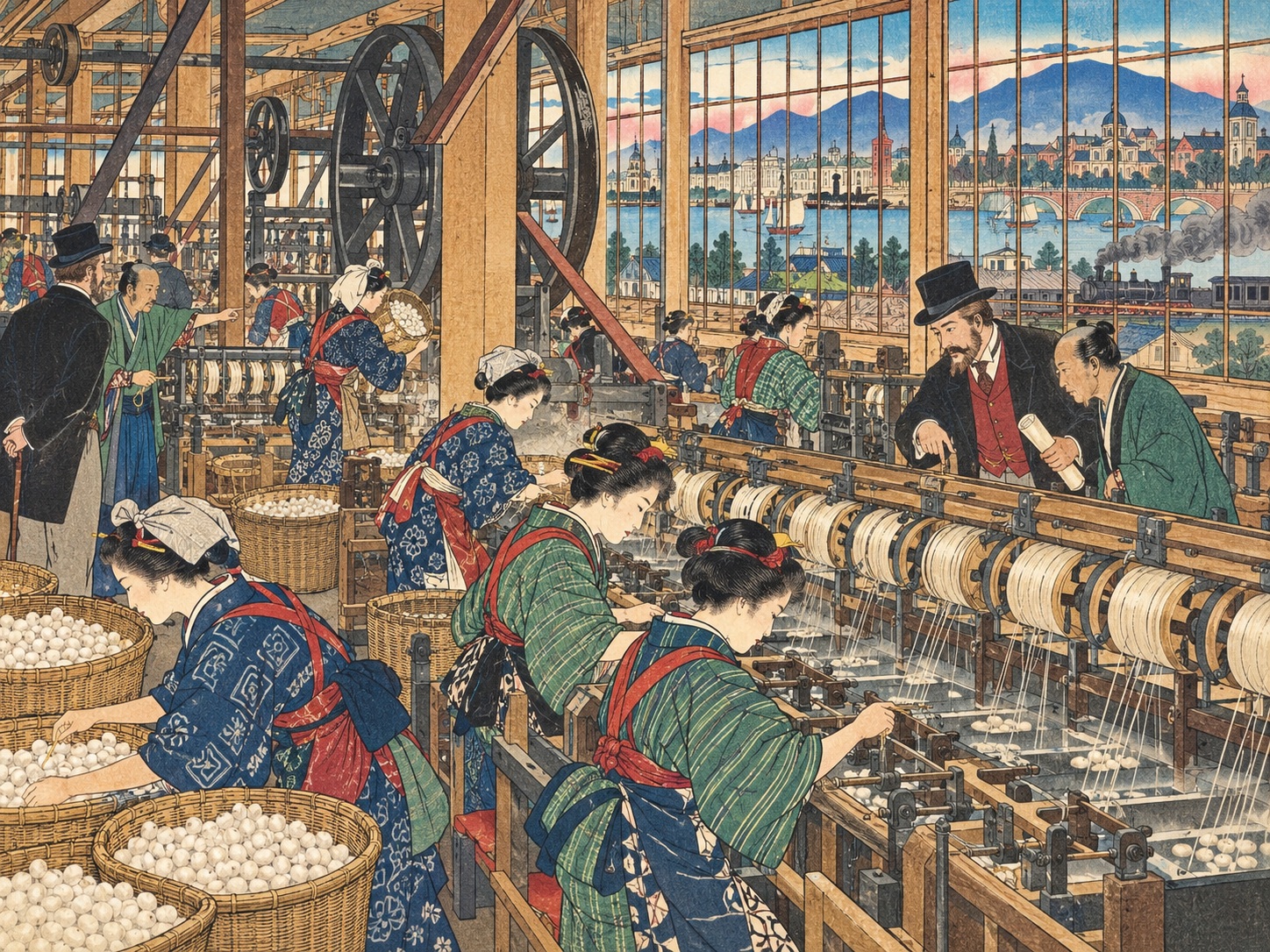
TOKYO. Steam rises from vats. Women empty baskets of cocoons into hot water, search for nearly invisible thread ends, combine several filaments and guide them toward turning frames. Beyond them stretches a room filled with repeated wooden machinery.
Utagawa Yoshitora’s 1872 triptych Imported Silk Reeling Machine at Tsukiji in Tokyo is more than a picture of a factory. It is an Edo-trained printmaker using one of Japan’s most mature traditional mass-media technologies—the color woodblock print—to record machines, industrial labor, foreign engineering and a new export economy.
Japan’s Agency for Cultural Affairs database records the Japanese title as 『東京築地舶来ぜんまい大仕かけきぬ糸を取る図』 (Tōkyō Tsukiji hakurai zenmai ōjikake kinuito o toru zu), attributes it to Mōsai Yoshitora, and dates the three-sheet woodblock print to 1872. The Metropolitan Museum of Art owns another impression, identifies the artist as Utagawa Yoshitora, active about 1850–80, and classifies the work as public domain.
Japanese title: 東京築地舶来ぜんまい大仕かけきぬ糸を取る図
Artist: Utagawa Yoshitora / Mōsai Yoshitora
Date: 4th month, 1872
Medium: color woodblock triptych
Subject: mechanized silk reeling in Tsukiji, Tokyo
The Metropolitan Museum of Art: Public Domain
The future was not only trains and brick buildings
Popular images of Japan’s early Meiji modernization often center on steam locomotives, gas lamps, Western dress, horse-drawn carriages and Ginza’s brick streets. Mechanized silk reeling was no less important to the transformation.
After Japan opened its ports, raw silk became one of the country’s principal exports. European sericulture had been damaged by silkworm disease, increasing demand for Japanese silk and silkworm eggs. Rapid growth, however, also produced inconsistent quality.
The Meiji government responded by importing Western reeling technology. In 1872, it opened the government-run Tomioka Silk Mill in Gunma as a model factory intended to raise silk quality and disseminate modern production methods. Japan’s Agency for Cultural Affairs describes Tomioka as a central expression of the government’s shokusan kōgyō industrial-promotion policy.
Yoshitora made his Tsukiji print in the same year. Tomioka represented state-led modernization. The Tsukiji mill represented another path: private Japanese capital employing foreign expertise in the middle of Tokyo.
The Ono mill: imported machinery inside the new capital
Japan’s Ministry of Agriculture, Forestry and Fisheries describes the Tsukiji silk mill associated with businessman Zensuke Ono as a 60-worker mechanized reeling operation using Italian-style equipment. Its wooden machines combined filaments from multiple cocoons and reeled silk directly onto large frames.
The Met adds another figure: Casper Müller, a Swiss specialist based in Yokohama, who was hired by the Ono Silk Filature Company to build a modern reeling factory in Tokyo.
Yoshitora’s print is unusually valuable because it shows process rather than simply displaying machinery as a symbol of progress. Women pour cocoons into steaming water, locate filament ends and feed several strands into the reeling apparatus. The Met calls the triptych a precious record of the factory’s activity.
The Japanese cultural heritage database identifies the machinery as Italian-style silk-reeling equipment. MAFF goes further, describing the print as an exceptionally important visual record for understanding the Italian reeling method then being introduced in Japan.
The workers at the center are women
The machines dominate the architecture of the image, but the people operating them are women.
That was not artistic decoration. Women formed the essential workforce of Japan’s mechanized silk industry. Tomioka famously recruited women from around the country as trainees, with the idea that they would learn Western machine-reeling techniques and later transmit them to their home regions.
Modernization is often narrated through governments, businessmen and foreign engineers. Yoshitora’s image preserves another reality: the export product was physically made by workers, many of them young women, whose skill connected cocoon, machine and market.
They are not merely spectators looking at modernity. They are the people making it function.
| What appears in the print | What it meant in 1872 |
|---|---|
| Imported reeling machinery | Japan’s rapid absorption of foreign industrial technology |
| Women workers | The labor force at the center of mechanized silk production |
| Cocoons and boiling vats | The physical link between sericulture and export silk |
| Three-sheet panoramic format | A way to show architecture, machinery and workers as one system |
| Woodblock printing | An Edo-period medium explaining Meiji-period modernity |
Yoshitora moved from warriors to foreigners and machines
Utagawa Yoshitora’s exact birth and death dates are uncertain. The Met gives his active period as approximately 1850–80. Japan’s National Diet Library reference database identifies him as a pupil of Utagawa Kuniyoshi, born in Edo, with the surname Nagashima and the common name Tatsugorō. He used art names including Ichimōsai, Kinchōrō and, later, Mōsai.
Early in his career he worked in subjects associated with Kuniyoshi, including warriors and actors. A 1859 print in the Met, The Warrior Slaying the Giant White Hihi, shows the dramatic storytelling and exaggerated action typical of that world.
After the opening of Yokohama, however, Yoshitora became particularly active in Yokohama-e and kaika-e—prints depicting foreigners, Western buildings, overseas places, ships, machines and the novelties of “civilization and enlightenment.”
His 1861 People of the Five Nations shows foreign merchants, officers, women and servants in a Yokohama waterfront setting. The Met notes that Yoshitora experimented with shading and linear perspective likely inspired by Western engravings, even when the resulting space was somewhat awkward.
That experimentation matters. Yoshitora was not only documenting unfamiliar subjects. He was changing how he represented space in order to depict them.
This is evidence, not an engineering blueprint
It is tempting to treat Yoshitora’s detailed machinery as if the print were an industrial photograph or technical drawing.
It was not. The artist had to make the factory legible and dramatic across three vertical sheets. Woodblock artists could alter scale, perspective and architectural proportions to clarify action and create visual rhythm.
The work should therefore be read both as an industrial-historical source and as a constructed image. It tells us a great deal about what machinery, labor and factory organization looked like to viewers in 1872; it does not guarantee millimeter-level accuracy.
Even with that caution, official Japanese sources regard it as an unusually important record of the Italian-style reeling system.
In the same year, Tomioka began operating
1872 is one of the defining dates in Japan’s silk-industrial history.
Tomioka Silk Mill began operations on October 4. Its main reeling hall was about 140 meters long and contained 300 reeling stations, making it one of the largest mechanized silk factories in the world at the time. French specialist Paul Brunat directed the technical program.
Japan’s Agency for Cultural Affairs describes Tomioka as a site where Western—especially French—technology was introduced and fused with Japanese techniques, helping drive Japan’s industrialization and the development of global silk culture.
Read beside Tomioka, Yoshitora’s Tsukiji factory becomes part of a larger national experiment. Japan was not simply buying foreign machines. It was learning how to embed them into Japanese capital, architecture, labor systems and commercial networks.
Silk helped pay for modernization
For decades after the ports opened, raw silk was a strategically important export. Foreign currency earned from silk helped Japan participate in the world economy at a time when the country was importing machinery, industrial knowledge, transport technology and other capital goods.
That gives the cocoons in Yoshitora’s print a larger meaning. Each thread passed from a worker’s hand into a reeling frame, then into a commercial chain leading toward Yokohama and overseas buyers.
The factory was not only a place where Japan used modern technology. It was part of the mechanism through which Japan financed modernity.
An Edo technology documented Meiji technology
There is a particularly elegant paradox in this print.
The modern imported machine is being explained through a mature Edo-period production system: multicolor woodblock printing. An artist designed the image, block cutters carved it, printers registered multiple colors and a publisher distributed it to buyers.
Woodblock printmaking was itself a highly specialized division of labor.
The silk factory worked through another division of labor: handling cocoons, finding thread ends, managing vats and operating frames. Old media represented new industry through a production logic that was, in its own way, already complex and collaborative.
Tradition and modernity therefore do not appear as clean opposites. Existing skills become the tools through which new systems are understood and spread.
Why the print belongs with Japan.co.jp’s October 5 edition
The same pattern runs through this edition’s contemporary stories.
Regional banks in Tohoku and Rakuten’s fintech businesses are reorganizing institutions in response to demographic, technological and financial change. Denso’s abandoned transfer of combustion-related businesses reflects a world in which old and new powertrains coexist longer than simple transition narratives predicted.
At Tohoku University, robots connect furnaces, X-ray instruments and mechanical testing so that artificial intelligence may eventually choose the next materials experiment. At the University of Osaka, graphene, high-power lasers and AI-assisted analysis are combined into a new proton-acceleration system.
Japan’s space-debris programs are building infrastructure to deal with the consequences of a growing space economy. Secondary-capital policy and beneficial-ownership reform are attempts to redesign institutional architecture. Maebashi is layering art and architecture over a declining commercial core to create new uses for an old downtown.
None of these stories is simply about erasing the old and replacing it with the new. They are about recombination.
A 154-year dialogue with Oshima tsumugi
The most striking pairing is with today’s story on Honba Amami Oshima Tsumugi.
Yoshitora’s 1872 factory represents mechanization intended to make silk more consistent, productive and competitive in global trade. In 2026, Oshima tsumugi faces almost the inverse problem: how to preserve labor-intensive, specialized hand skills in an economy built around speed and scale.
Yet the contrast is not absolute.
The Tsukiji machines still depended on human skill. Oshima tsumugi survives partly by accepting selective modernization—labor-saving equipment, new products, digital commerce, youth promotion and public policy—without abandoning the techniques that define the textile.
The question in 1872 was how to incorporate machines into Japanese industry. The question in 2026 is how to use technology without destroying the economic value of what only skilled hands can do.
Do not read it only as a celebration of progress
Meiji kaika-e can look like advertisements for modernization. Machines, brick architecture, foreign clothing and railways are presented as novel and spectacular.
History is more complicated. Industrialization brought intense labor demands, business failures, regional disruption and competition as well as productivity and wealth. The Ono commercial group expanded rapidly in the early Meiji era and later collapsed; the Tsukiji silk mill itself did not become a permanent industrial institution.
Yoshitora’s image therefore is not proof that every machine in the picture represented a successful future. It records a moment when the future was still uncertain.
That uncertainty is precisely what makes it useful now. In 1872, no viewer could know which technologies, firms and institutions would survive. The same is true of AI laboratories, new financial structures, orbital services and urban experiments in 2026.
Today’s Art Choice: the future arrives in mixed form
In Yoshitora’s Tokyo, an Edo printmaker depicted a Meiji factory; Japanese women operated imported machinery; an ancient material became a modern export commodity; and a domestic merchant house worked with foreign expertise.
The future did not arrive by deleting the past.
It arrived inside existing institutions, skills and visual languages, altering them as it went.
One hundred fifty-four years later, that is still a useful way to look at Japan’s transformation. Artificial intelligence, robotics, financial restructuring, new infrastructure and cultural regeneration are not replacing society all at once. They are being grafted onto systems that already exist.
Yoshitora does not give us a theory of progress. He gives us something more valuable: a picture of people trying to make an unfamiliar future work.
Sources
- The Metropolitan Museum of Art, Utagawa Yoshitora, Imported Silk Reeling Machine at Tsukiji in Tokyo
- Japan Cultural Heritage Online, 東京築地舶来ぜんまい大仕かけきぬ糸を取る図
- Silk Museum, Tokyo Tsukiji silk-reeling print
- Ministry of Agriculture, Forestry and Fisheries, Meiji 150 woodblock-print archive
- National Diet Library reference database, Utagawa Yoshitora
- National Diet Library, modern Japan and French industrial technology
- Tomioka Silk Mill, historical guide
- Japan Cultural Heritage Online, Tomioka Silk Mill reeling plant