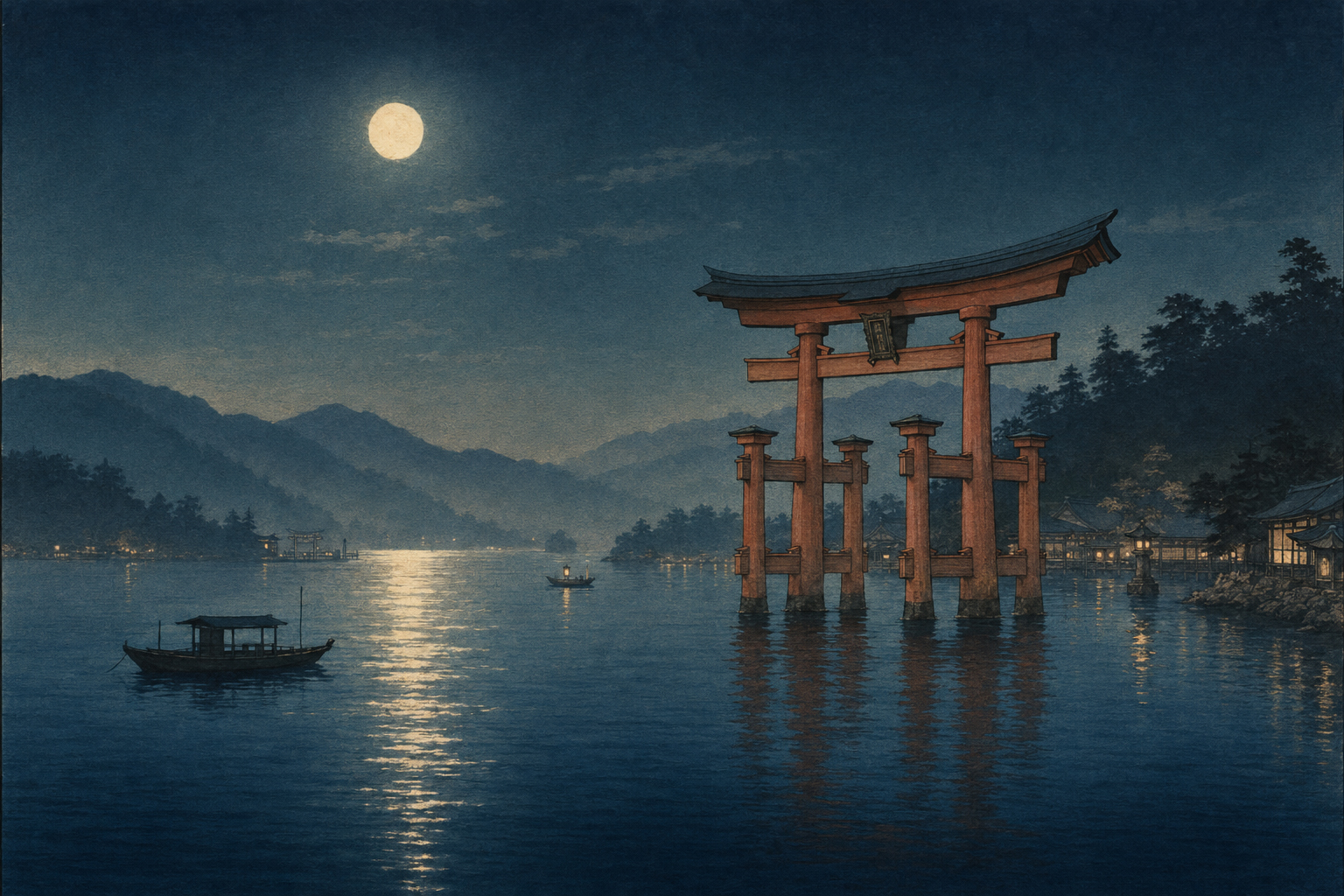
- Artist: Tsuchiya Koitsu (1870–1949)
- Title: Summer Moon at Miyajima (Natsu no tsuki, Miyajima / 《夏の月 宮島》)
- Date: 1936, Shōwa 11
- Series: Collection of Views of Japan (Nihon fūkeishū)
- Medium: Color woodblock print, large ōban format
- Original publisher: Doi Sadaichi; impressions were also printed in later editions
- Collection reference: The Art Institute of Chicago holds an impression as object 196937
Begin under the eaves
Koitsu does not give us the view that a tourist expects. He does not stand on the shore, center the great torii and let the famous gate perform alone. He places us within the architecture of Itsukushima Shrine, under an overhanging roof and beside a receding corridor. The foreground is dark, close and built. Beyond it, the sea opens.
A full moon appears through bands of cloud. The offshore torii stands in the middle distance, reduced from national icon to one element in a larger field. A small boat and its solitary figure establish human scale. Lanterns along the shrine’s veranda send warm points of light into the cool night, while their reflections break apart on the water. The eye moves outward along the architecture, then sideways toward the gate, upward to the moon and down again into its unstable reflection.
The composition contains two lighting systems. Moonlight is silver-blue, broad and seemingly without a source of heat. Lantern light is amber, local and attached to human shelter. One makes distance visible; the other makes proximity safe. Koitsu allows them to coexist without letting either conquer the night.
The moon is not the brightest object because it contains the most white. It shines because Koitsu and his printers built an entire darkness around it.
| What we see | What it does | What to notice |
|---|---|---|
| Shrine eaves and corridor | Frame the view and make the spectator feel physically present within the sacred complex. | The famous torii is seen through architecture, not presented as a detached emblem. |
| Moon and clouds | Create a slow pulse between revelation and concealment. | The pale disk depends on surrounding blue and gray gradations for its apparent light. |
| Lanterns | Introduce a second, human-made temperature of light. | Warm accents prevent the cool palette from becoming emotionally remote. |
| Boatman | Gives scale and time to an otherwise monumental scene. | His movement is imagined rather than shown; the still print makes us supply the next stroke. |
| Reflections | Turn solid forms into broken, wavering color. | Water does not duplicate the world. It translates it. |
How can paper produce night?
A color woodblock is an unlikely instrument for darkness. Oil paint can be mixed continuously on a palette and glazed on a canvas. A camera can gather light through an aperture. A woodblock print begins with separated decisions: one carved area will receive one passage of pigment; another block will place another color; every sheet must be registered against the previous impression.
That separation is precisely what gives Koitsu’s night its structure. Dark blue is not “night” by itself. It becomes night beside a lighter blue, a cloud gray, a warm orange, a nearly black roof and the pale reserve of the moon. The printer can soften a boundary through bokashi, a controlled gradation produced by applying and wiping pigment on the block, managing moisture and pressure, and rubbing the paper with a baren. Subtle changes of density let sky and water breathe rather than sit as flat color.
We should not imagine that Koitsu personally carved every contour and printed every layer. Shin-hanga retained the distributed workshop model of ukiyo-e: the artist designed; the publisher commissioned, edited, financed and marketed; specialist carvers translated lines and tonal areas into blocks; specialist printers transformed those blocks into atmosphere. The exact seals on surviving impressions may differ because successful designs were reprinted by later hands. “The original” therefore names a design and its first publication history, while every physical impression also records a particular production event.
This does not reduce Koitsu’s authorship. It makes the achievement more interesting. His design had to communicate enough for other skilled people to re-create not merely objects, but a temperature, a tide and an hour. The publisher Doi Sadaichi’s workshop was central: scholarship compiled by Ross F. Walker and Toshikazu Doi attributes far more Koitsu designs to Doi than to any of his other shin-hanga publishers.
A shin-hanga print is not a painting mechanically multiplied. It is a negotiated performance repeated on paper.
The master who taught him to see light
Koitsu’s nocturnes begin half a century before Summer Moon at Miyajima. Born Tsuchiya Sahei in the Hamamatsu area in 1870, he moved to Tokyo at fifteen. An apprenticeship with the engraver Matsuzaki Shūmei led him to Kobayashi Kiyochika, the great visual chronicler of early Meiji Tokyo. From about 1886 to 1900, the young artist lived in Kiyochika’s household. Kiyochika gave him the art name Kōitsu.
Kiyochika’s celebrated kōsenga—“light-ray pictures”—had made illumination itself a subject. Gas lamps, fires, moonlight, snow and reflections reorganized the rapidly modernizing city. The works absorbed Western perspective and chiaroscuro without ceasing to be Japanese color woodblocks. Photography still struggled with nocturnal exposure; printmaking could invent a night more optically persuasive than a camera could reliably record.
That lesson entered Koitsu’s visual grammar: do not draw the lamp alone; draw what its light does to everything around it. Yet the inheritance has an uncomfortable chapter. Both teacher and pupil made images of the First Sino-Japanese War of 1894–95. Koitsu’s early commercial triptychs depicted negotiations, ships and victory at a time when prints functioned as mass media as well as art. The same capacity to dramatize light could lend urgency to war.
Koitsu subsequently worked in lithography and produced paintings, woodblocks and machine-printed items for commercial publishers. Illness interrupted part of that career. For decades he remained useful and employed, but not famous as a landscape print designer. His mature identity arrived remarkably late.
A debut at sixty-one
In 1931, Koitsu helped with an exhibition commemorating the seventeenth anniversary of Kiyochika’s death. There he met Watanabe Shōzaburō, the publisher who had named and cultivated the shin-hanga movement. Watanabe encouraged him to design new landscapes. Cherry Blossom Viewing in the Evening at Gion followed and appeared in Watanabe’s 1932 modern woodblock exhibition. Koitsu was already over sixty.
There is a useful correction in this biography. Art history often prefers the prodigy, the young rebel, the career that moves cleanly from discovery to mastery. Koitsu’s great landscape period began after an entire adult life of training, commercial work, illness and technological change. The moon at Miyajima was not youthful inspiration preserved intact. It was concentrated experience.
He soon worked with at least six publishers. Doi Hangaten, beginning in 1933, became the most prolific partnership. Summer Moon at Miyajima arrived in 1936, within the brief, intense period in which Koitsu produced the atmospheric landscapes now most associated with his name. The Second World War damaged the export markets on which his woodblocks and other work depended. After the war he continued painting but designed no new shin-hanga before his death in 1949.
The modern business of looking traditional
Shin-hanga means “new prints,” and the newness matters. By the early twentieth century, photography, lithography and mechanical reproduction had made the old woodblock publishing system appear inefficient. Watanabe’s answer was not to deny modernity but to reorganize tradition for a modern art market. He brought painters, carvers and printers together to produce technically ambitious sheets and understood that foreign collectors could value Japanese craft as fine art.
These prints often combined Japanese subjects and inherited workshop methods with Western-inflected naturalism, perspective and atmospheric light. They were modern commodities whose success partly depended on looking like a beautiful Japan outside ordinary time. The contradiction is not a flaw to solve; it is the engine of the movement.
In 1936, Japan was not the silent, untroubled country suggested by Koitsu’s water. It was a year of political violence at home and imperial expansion abroad. Nothing in the print requires us to read it as commentary on those events, and it would be careless to force such a claim. But it is equally careless to call the image timeless. Its tranquility was made at a particular historical moment and offered to a market that found tranquility desirable.
The print’s nostalgia is therefore active rather than innocent. It removes crowds, commercial signs, schedules and politics from an already famous destination. It slows Miyajima until a boatman, a lamp and a cloud seem sufficient. The result may console; it may idealize. It does both with extraordinary discipline.
Before the print: the sacred island
Itsukushima was old before anyone called its image picturesque. The island in the Seto Inland Sea had long been understood as sacred. The first shrine buildings were probably erected in the sixth century. The complex associated with Taira no Kiyomori took its defining form in the twelfth century; the surviving buildings preserve later reconstructions faithful to that architectural language.
The shrine’s genius is not simply that buildings stand over water. It joins sea, architecture and the forested mass of Mount Misen into one religious and visual system. UNESCO, which inscribed the site in 1996—six decades after Koitsu’s print—describes this trinity as a central expression of Japanese scenic beauty, combining nature and human creation. At high tide, the corridors and gate appear to float; at low tide, the seabed becomes accessible. The place continually redraws its own ground.
Historically, worshippers approached by boat, crossing through the great torii from ordinary space toward the sacred island. A seventeenth- or eighteenth-century folding screen now at Princeton shows boats, pilgrims, shops and the extensive shrine complex in a bird’s-eye view. Koitsu reverses that older logic. His viewer seems already inside the corridor, looking back toward the threshold and the open sea. We do not arrive at the sacred view; we look out from within it.
Miyajima had also long been a branded landscape. Neo-Confucian scholar Hayashi Gahō listed it with Matsushima and Amanohashidate among the Three Views of Japan in 1643. By Koitsu’s time, the great torii was not an undiscovered motif but a nationally standardized image. His achievement was not finding it. It was changing our position in relation to it.
The gate is not the protagonist
Most contemporary photographs of Miyajima solve a practical problem: how to get an unobstructed image of the gate. Koitsu makes obstruction essential. Roof, columns, railings and lanterns occupy the near field. The torii is partly absorbed into distance and weather. This is a sophisticated refusal of the postcard.
A gate is normally a device of passage. In an image, however, it easily becomes a logo—instantly recognizable, detached from the bodily experience of crossing. Koitsu restores duration. The diagonal corridor asks the eye to travel. The boat implies a slow route. The tide prevents the ground from being fixed. Clouds veil the moon. Every stable emblem is placed inside a changing condition.
Even the title is exact. It is not simply “Miyajima” but “Summer Moon.” Season and time precede monument. Summer is not illustrated by a festival or flower; it is felt through open water, soft air and the calm extension of night. The work makes atmosphere the subject and architecture its measuring instrument.
Why the image survives reproduction
Summer Moon at Miyajima now circulates far beyond the physical impressions held by museums and collectors. It appears on screens, posters, cards and unlicensed merchandise. Digital display flattens paper texture, changes color temperature and makes a later printing look identical to an early one. The very success of the image can hide what it is: not a free-floating composition, but an object produced through blocks, pigments, pressure, paper and publishing history.
That does not mean a digital encounter is false. It means that looking should include material questions. Which impression is being shown? Which publisher and seals appear in the margin? Is it a lifetime printing, a postwar edition, a photographic reproduction or a newly made image inspired by the work? Color can vary because of ink, paper, fading, printing decisions, photography and screen settings. A definitive “Koitsu blue” cannot be extracted from one online file.
For the same reason, today’s Japan.co.jp hero is explicitly a contemporary illustration, not a claim to reproduce the 1936 sheet. It borrows a general grammar—moon, tide, layered blue, warm architectural light—to place the edition in conversation with Koitsu. Attribution is part of seeing. Inspiration becomes more meaningful when the boundary is visible.
- First 10 seconds: Resist naming the torii. Register only warm and cool light.
- Next 10: Follow the corridor’s recession and notice where it places your body.
- Next 10: Find the smallest human figure and use it to resize the architecture.
- Next 10: Compare every reflection with the object above it; none is an exact copy.
- Next 10: Imagine the color separations and the order in which the sheet met the blocks.
- Final 10: Ask what has been omitted—crowds, commerce, weather discomfort, modern politics—and what that silence gives the image.
The light after the lamp
Koitsu’s reputation has often stood in the shadow of more famous shin-hanga landscapists, particularly Kawase Hasui and Yoshida Hiroshi. That comparison can obscure the strangeness of his route. Koitsu carried Meiji print culture into the Shōwa period. He learned from an artist who pictured Tokyo’s first modern lights, worked on war imagery and lithography, then entered shin-hanga landscape production only in old age. His serenity was earned through media change.
Summer Moon at Miyajima gathers that history without narrating it. Kiyochika’s light-ray pictures survive in the opposition of lamp and darkness. The ukiyo-e workshop survives in the divided labor of publisher, carver and printer. The old meisho tradition survives in the famous place. Western naturalism survives in space, shadow and weather. Modern tourism survives as the thing the composition quietly refuses to resemble.
Koitsu did not preserve a timeless Japan. He manufactured a moment of stillness inside a country moving too quickly to stand still.
Look again at the moon. It is the least tangible object in the picture and the force that organizes everything: clouds brighten around it, water answers it, lanterns compete with it, tide obeys its gravity. Yet on the sheet it remains pigment and paper, neither hot nor luminous. The eye supplies the radiance.
That is the print’s deepest pleasure. Its world is clearly constructed, but the construction does not diminish the spell. It makes the spell available for inspection. A sacred island, an old gate, an elderly artist, a commercial publisher and invisible craftspeople meet in a field of blue. The summer night is not captured. It is rebuilt—one registered layer at a time.
Sources and reporting method
Object data were checked against the Art Institute of Chicago, Gallery Soumei-do and the Kanagawa Prefectural Museum of Cultural History exhibition list. Koitsu’s biography and publisher history were cross-checked against research summarized by the Lavenberg Collection at the University of Oregon, including the Walker–Doi studies in Andon. Shin-hanga production and market context draw on the Smithsonian National Museum of Asian Art, Worcester Art Museum and Bowers Museum. Kiyochika’s light-ray pictures were checked against the Metropolitan Museum of Art and Machida City Museum of Graphic Arts. Itsukushima’s history and landscape were checked against UNESCO, JNTO and Princeton University Art Museum. Visual analysis is Japan.co.jp’s interpretation; no undocumented number of blocks or printing sequence is asserted.
- Art Institute of Chicago — Summer Moon at Miyajima, 1936
- Gallery Soumei-do — 《夏の月 宮島》, Doi Sadaichi edition
- Kanagawa Prefectural Museum of Cultural History — modern print exhibition catalogue
- University of Oregon — Tsuchiya Koitsu biography and publisher research
- Smithsonian National Museum of Asian Art — shin-hanga and Japanese modernity
- Worcester Art Museum — shin-hanga collaboration, atmosphere and international audiences
- Bowers Museum — Doi, Koitsu and the modern nostalgia of shin-hanga
- Metropolitan Museum of Art — Kiyochika’s light-ray pictures
- Machida City Museum of Graphic Arts — Kiyochika and kōsenga
- UNESCO World Heritage Centre — Itsukushima Shinto Shrine
- Japan National Tourism Organization — shrine history and setting
- Princeton University Art Museum — Pleasures at Itsukushima Shrine
- Princeton University Art Museum — Miyajima and the Three Views of Japan
