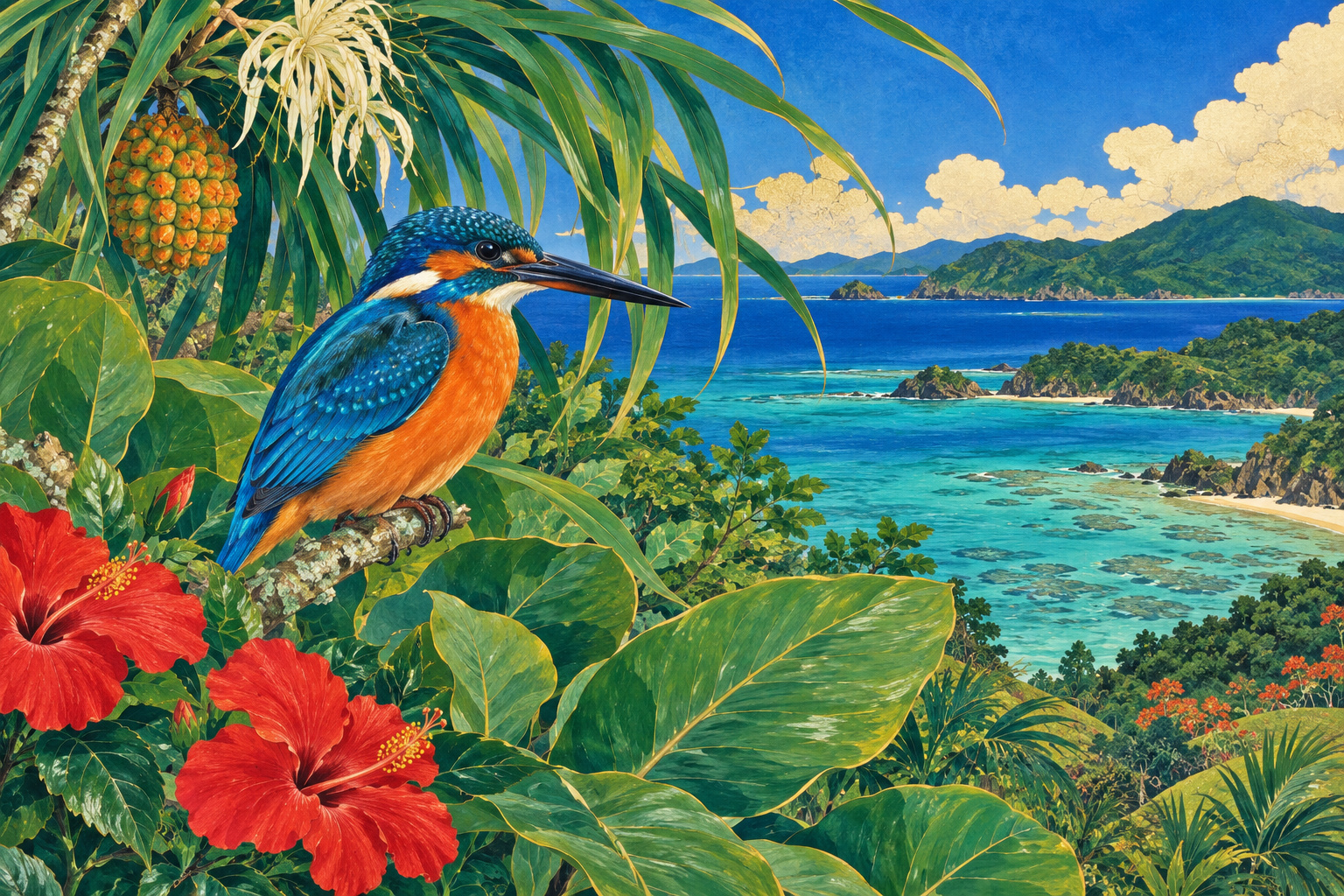
Tanaka Isson’s paintings offer a reason to look longer at the natural world. For this edition’s art choice, his plants and birds bring a sense of Amami Oshima as a particular place, shaped by forms and colors that reward sustained attention. Isson, whose name is written 田中一村, lived from 1908 to 1977.[1]
Making a life that allowed him to paint
Born in Tochigi, Isson moved to Amami in 1958 at the age of 50. Amami City’s account describes him supporting himself through textile-dyeing work, then returning to painting when he had saved enough.[3]
That practical rhythm matters. Creative independence involved earning the time and means to continue. His story can be understood through those choices without treating hardship as a requirement for artistic achievement.
Looking closely at a place
The Tokyo Metropolitan Art Museum’s 2024 checklist dates アダンの海辺 to 1969 and 不喰芋と蘇鐵 to before 1973. Both are listed as color on silk. The same checklist includes sketchbooks and studies of plants and fish, evidence of work extending beyond the finished compositions.[2]
For a viewer, the plant names offer a useful starting point. Instead of absorbing a painting as a general impression of tropical greenery, follow a leaf’s shape, the overlap of forms, or the relationship between a bird and its surroundings. Color can help separate and connect those elements as well as establish a mood.
This is one way to approach Isson’s island paintings: as a world constructed through attention to specific living things. Their appeal need not depend on imagining Amami as an untouched paradise.
A reputation that grew after his death
Isson died on Amami in 1977. The city records a posthumous exhibition in 1979 and nationwide exposure through NHK’s art program in 1984, followed by wider interest in his work.[3]
Tokyo Metropolitan Art Museum’s retrospective, “Tanaka Isson: Light and Soul,” ran from September 19 to December 1, 2024. Its account of his career and its artwork checklist are background sources for this feature, rather than an announcement of an exhibition currently running in Tokyo.[1]
Why he belongs in this edition
Scientific observation, local communities and creative independence recur across today’s stories. Isson provides an artistic connection through the act of attending to one’s surroundings. Painting and scientific inquiry have different purposes, but both can prompt us to notice distinctions that a quick glance misses.
This edition’s AI-generated illustrations take inspiration from his palette and attention to nature. They are original editorial images, not works by Isson or reproductions of his paintings. The Tokyo retrospective archive and the Tanaka Isson Memorial Museum provide starting points for exploring the originals.[1][4]
