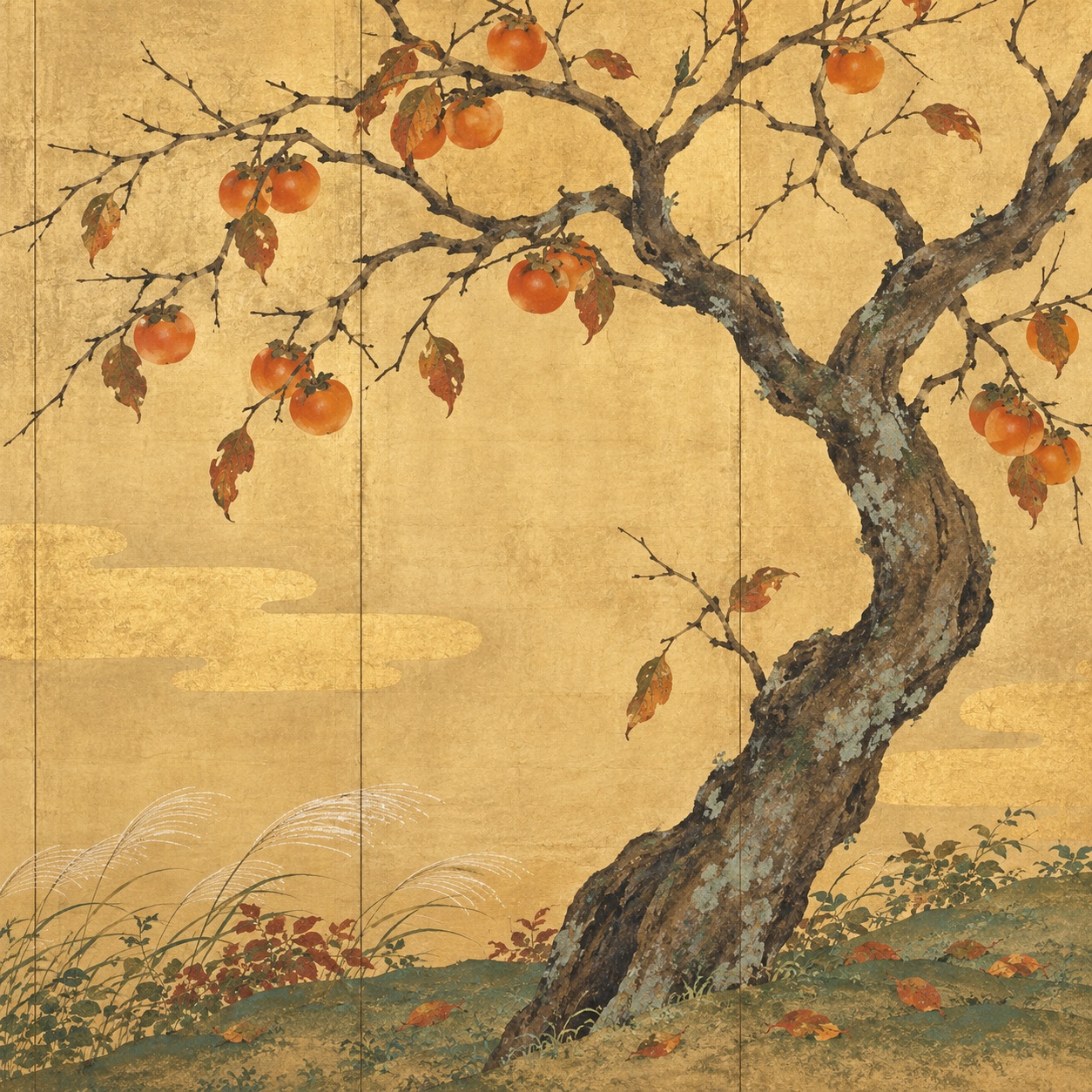
Sakai Hōitsu did not need a mountain, a blaze of maple leaves or a field of autumn flowers to paint the season. In Persimmon Tree, dated to late autumn 1816, he gives us one aging tree, sparse grasses and a few fruit hanging from increasingly exposed branches. Much of the two-panel screen is left as bare paper. The Metropolitan Museum of Art describes the work as a meeting of Rinpa’s characteristic tarashikomi—mottled ink produced by dropping wet pigment into wet pigment—and Hōitsu’s unusual interest in naturalistic observation.[1]
The Met lists the Japanese reference title as 酒井抱一筆 柿図屏風, identifies the work as a two-panel folding screen in ink and color on paper, and dates it to 1816. Acquired through the Rogers Fund in 1957, object 57.156.3 is now part of The Met’s Open Access program; the museum identifies its image as public domain and available for unrestricted use.[1]
One tree holds the end of a season
A 1979 Metropolitan Museum bulletin describes the persimmon as solitary, bent and brittle with age. Most of its leaves are gone. Near the center, a cluster of red fruit hangs heavily from a fragile branch. Below stand withered pampas grass and a few weeds. The unpainted paper behind the tree suggests the cold sky of a clear late-autumn day.[2]
The fruit is not presented as a lavish symbol of abundance. Its orange-red color feels strong precisely because so much else has disappeared. Leaves have fallen, the branches are exposed and the grasses are drying. The persimmons hold almost the last concentrated color in the composition.
Hōitsu paints autumn not through spectacle, but through what is leaving.
Tarashikomi: letting water and ink create texture
The screen uses tarashikomi, one of the techniques most closely associated with Rinpa. A second pigment or wash is introduced before the first layer has fully dried, allowing fluid blooms, pooled edges and irregular mottling to form. The Met explicitly identifies this screen as displaying Rinpa’s trademark mottled-ink technique.[1]
The result is not conventional realism. Bark and leaves are not described hair by hair or vein by vein. Instead, the physical behavior of water and pigment creates the surface of aging wood and curling foliage.
Yet the work is not merely decorative either. The Met also points to Hōitsu’s interest in Western-style realism. The twisting leaves, broken branch structures and fine grasses feel observed, not simply inherited from a pattern book. Hōitsu combines stylization with attention to how an actual plant ages in cold weather.[1]
Rinpa was a lineage of reinvention, not a hereditary school
Rinpa is often called a “school,” but it did not function like a continuous hereditary atelier such as the Kano tradition. The Met describes it as a major Edo-period revival of indigenous Japanese aesthetic interests, carried across generations through painting, textile, ceramics and lacquer. Hon’ami Kōetsu and Tawaraya Sōtatsu helped establish its early language; Ogata Kōrin reworked that language a century later; Hōitsu revived and transformed it again in Edo.[3]
That distance matters. Hōitsu was not Kōrin’s pupil. He was born decades after Kōrin died. He built the connection through collecting, study, copying, publishing and commemoration.
Rinpa therefore survived not because one master handed a studio directly to the next, but because later artists chose the past they wanted to inherit.
A samurai-born painter and haiku poet
Japan’s National Diet Library authority record gives Hōitsu’s dates as 1761–1828 and identifies him as both painter and haiku poet. It confirms the reading Sakai Hōitsu and records several alternate names, including Tōryū and Keikyodōjin.[4]
The Met notes that Hōitsu was born into a wealthy and influential samurai family in Edo and received a broad elite education that included poetry, haiku, Noh, tea and painting. He studied multiple painting traditions available in Edo before developing his deep attachment to Kōrin.[1][2]
His life as a poet matters when looking at Persimmon Tree. The painting compresses a season into a few signs rather than filling the screen with description. Tokyo National Museum similarly connects the lyrical quality of Hōitsu’s Summer and Autumn Grasses to his sensibility as a practitioner of haikai.[5]
In 1797 he became a Buddhist monk
The Met records that Hōitsu became a monk in 1797 and adopted the priestly name Monsen Kishin, which appears in the seals and signature associated with this screen.[1]
Monastic status did not remove him from Edo’s cultural networks. He continued to work across painting, poetry, printed books, folding screens, fans and other formats while maintaining relationships with elite and urban patrons.
In 1809 he established a residence and studio in what is now the Negishi area of Taito, Tokyo. The retreat later became known as Uge-an, and it remained associated with his followers and posthumous reputation long after his death.[6]
In 1815, he turned Kōrin from an admired predecessor into a documented lineage
Hōitsu’s importance to Edo Rinpa lies not only in paintings that resembled Kōrin. In 1815, the centenary of Ogata Kōrin’s death, Hōitsu organized a memorial and exhibition of Kōrin’s surviving works. He also compiled Kōrin Hyakuzu—“One Hundred Paintings by Kōrin”—an illustrated publication that gathered roughly one hundred compositions associated with the earlier master. Japan Search and Tokyo University of the Arts document the project, with the first part linked to 1815 and a later continuation to 1826.[7][8]
That was art history as an active practice: find works, copy them, reproduce them, circulate them and teach viewers how to recognize a predecessor. Hōitsu helped convert Kōrin from a celebrated old master into a visible lineage that could be deliberately revived.
Persimmon Tree came the following year. That timing makes the screen especially revealing. Hōitsu had just immersed himself in Kōrin’s legacy, yet this composition does not merely repeat the most famous Kōrin formula of bold forms on dazzling gold. Its emptiness and observational delicacy feel distinctly Hōitsu’s own.
Following Kōrin without becoming Kōrin
The Met’s 1979 study says Hōitsu shared Kōrin’s preference for poetic nature imagery and elegant design but developed more delicate compositions and a greater sensitivity to graceful shapes. The tree’s curling leaves and grasses are intricate, but the brushwork remains light and fluid.[2]
If Rinpa is reduced to “bold flowers on gold,” Persimmon Tree looks almost anti-Rinpa. But Rinpa’s deeper method is selection: take nature, simplify it, exaggerate certain forms, remove others and turn the entire surface into rhythm.
Hōitsu pushes that method toward silence. The trunk enters from the lower left, twists upward and releases its branches into open paper. Empty space is not background left over after the painting is finished; it is one of the principal shapes in the composition.
The unpainted paper is doing the work of sky
Japanese negative space is often too quickly explained through generalized claims about Zen or “emptiness.” The Met’s reading of this particular work is more concrete: the exposed paper evokes the cold sky of a clear late-autumn day.[2]
No blue pigment is necessary. The temperature of the air is created by the tree’s condition—the remaining leaves, the brittle branches, the sparse growth at ground level.
In that sense, the empty area is not where Hōitsu failed to paint. It is where he painted atmosphere by withholding paint.
The persimmon contains abundance and ending at once
Persimmons are among the most recognizable fruits of Japanese autumn. Their saturated orange-red carries a visual density quite different from autumn leaves. In Hōitsu’s screen, that color becomes intense because it has almost no competition.
The Met bulletin describes the central fruit as heavy and overripe, suspended from a branch so fragile that it appears to have yielded under the weight. One need not turn the work into a fixed allegory of aging or death. But ripeness and decline are visibly adjacent in the composition.[2]
The richest color arrives when the season is nearest its end. That tension is central to the painting’s emotional force.
The same sensitivity to weather appears in Summer and Autumn Grasses
Hōitsu’s better-known masterpiece, Summer and Autumn Grasses, now in the Tokyo National Museum, was painted on the reverse of Ogata Kōrin’s copy of Sōtatsu’s Wind God and Thunder God screens. The two sides were later separated for conservation.[5][9]
On the reverse of the Thunder God, Hōitsu painted summer grasses revived and bent by sudden rain and a stream swollen by water. Behind the Wind God, he painted autumn plants whipped by strong wind. He did not paint the gods themselves. He painted what their weather did to plants.
Persimmon Tree works through a related idea. “Autumn” is not announced symbolically. It is visible in the curled leaf, the weakened branch, the dried grass and the fruit that remains after much else has gone.
In 1817, Hōitsu circulated his own visual language
The year after Persimmon Tree, Hōitsu’s Ōson Gafu was first published in Edo. The National Diet Library dates the first edition to the second month of 1817. The illustrated book gathered Hōitsu’s own designs—Fuji, cherry, plum, iris, courtly figures, seasonal plants and other subjects—in delicate multicolor printing.[10]
Hōitsu therefore did two related things: he published Kōrin so that an earlier style could be studied, and he published himself so that his own transformations of that style could circulate.
That is how a non-hereditary artistic tradition becomes durable. Images move through books, copies, fans, screens and pupils. Hōitsu’s circle eventually included figures such as Suzuki Kiitsu, who would take Edo Rinpa into still sharper color and design.
- Empty paper: The unpainted surface creates a cold late-autumn sky.
- Tarashikomi: Wet ink and pigment generate mottled, organic surfaces.
- Observation: Curling leaves and stressed branches keep the image tied to real plant behavior.
- Color: A few orange-red persimmons carry almost all the chromatic weight.
- Time: The subject is not autumn abundance but the instant when ripeness begins to turn toward winter.
Was there once a spring companion screen?
The Met’s 1979 bulletin raises an intriguing possibility: the surviving two-panel screen may originally have been paired with a right-hand screen showing a plum or cherry tree in early spring. The present Met collection page does not state this as established fact, and no surviving companion is identified there. It is therefore best treated as a scholarly hypothesis rather than a certainty.[2]
If such a companion existed, late autumn on one side and early spring on the other would have turned the pair into a cycle of ending and beginning. But the surviving screen does not need that hypothetical partner to feel complete. Its isolation has become part of how modern viewers encounter it.
Public domain access lets the painting be looked at, not merely described
The Met makes a high-resolution image of Persimmon Tree available through Open Access and states that public-domain collection images and data can be used for commercial or noncommercial purposes without permission or fee.[1]
That matters for a work whose power depends on subtle details. At thumbnail size, the composition can look almost empty. At higher resolution, the mottled trunk, watery edges, fading green, dried grass and controlled brush pressure become visible.
Its emptiness needs scale.
Expecting luxury can make us miss what is most Rinpa about Hōitsu
Rinpa often brings to mind gold leaf, saturated mineral color, irises, waves and decorative abundance. All of that belongs to the tradition.
But Persimmon Tree shows that Rinpa does not depend on luxury. Its deeper power lies in editing nature: what to retain, what to remove, where to put color and how to make one form answer another across the surface.
By reducing the scene to one old tree, Hōitsu makes every bend of the branch matter. By reducing the leaves, he makes the surviving leaves legible. By reducing the palette, he makes the persimmons glow. The less autumn he paints, the more concentrated autumn becomes.
Late autumn 1816, seen again in September 2026
The inscription dates the work to late autumn 1816. Looking at it more than two centuries later near the end of September, the distance between those seasons can feel unexpectedly small.
The transition toward autumn is usually incremental: a colder morning, fewer leaves, fruit deepening in color, grasses losing moisture. Hōitsu does not dramatize those changes. He lets their accumulation become the subject.
Persimmon Tree is powerful because it does not explain autumn. Autumn is present as the condition of the tree.
That is why it feels right for today. Against screens filled with color, motion and information, Hōitsu offers an old tree, a little grass and a handful of persimmons—and proves that almost nothing can still be enough.
Sources
- The Metropolitan Museum of Art: Sakai Hōitsu, Persimmon Tree, 1816
- The Metropolitan Museum of Art Bulletin: Twelve Japanese Screens (1979), Persimmon Tree discussion
- The Metropolitan Museum of Art: Rinpa Painting Style
- National Diet Library authority file: Sakai Hōitsu, 1761–1828
- e-Museum / Tokyo National Museum: Summer and Autumn Grasses by Sakai Hōitsu
- Ibaraki Prefectural Tenshin Memorial Museum of Art: Uge-an and the legacy of Sakai Hōitsu
- Japan Search: Sakai Hōitsu, the 1815 Kōrin memorial and Kōrin Hyakuzu
- Tokyo University of the Arts Library: Kōrin Hyakuzu
- Cultural Heritage Online: Summer and Autumn Grasses
- National Diet Library: Ōson Gafu bibliographic record, first edition 1817
