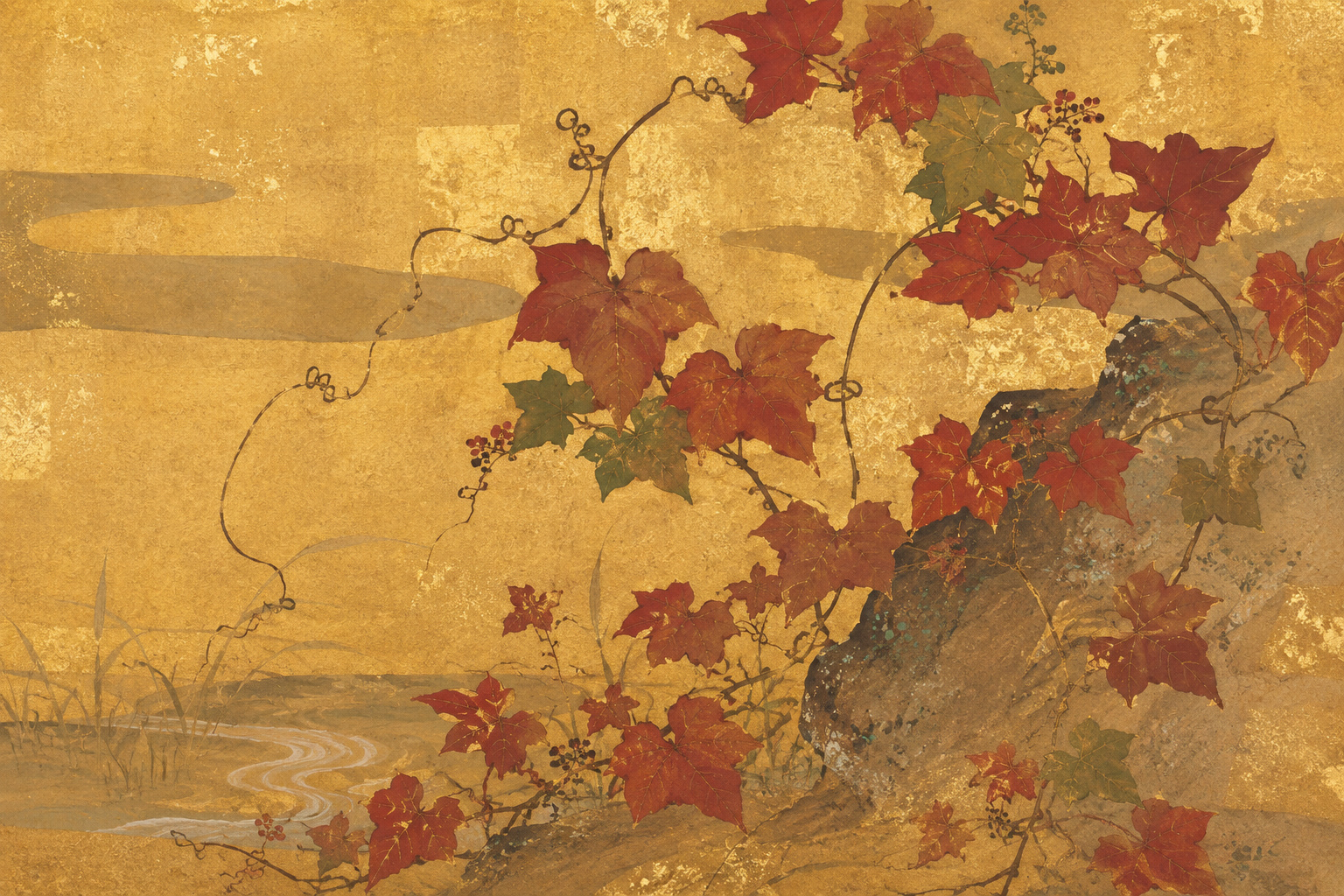
The leaves have not fallen. That is the essential fact. Red, vermilion, orange, green and ink-dark ivy still hangs against a gold ground while Ogata Kenzan’s calligraphy runs beside it with its own visual rhythm. The poem does not describe leaves already scattered. It fears the wind that is about to scatter them. In Autumn Ivy, dated by The Metropolitan Museum of Art to after 1732, Kenzan paints autumn at the instant when beauty is fully visible and loss has become imaginable.
Today’s Art Choice — September 4, 2026
Kenzan paints not autumn leaves, but the time in which autumn leaves can be lost
The ivy is already changing color, but there is no storm. No leaf is shown tumbling through space. Kenzan chooses the moment before separation and lets the poem supply the future.
Kakaru shimo
waga aki naranu
matsukaze ya
chiru o urami no
tsuta no momijiba
Even now, before the season is spent,
the pine wind rises—
and already I resent the thought
that it will scatter
these crimson ivy leaves.
Japan.co.jp translation
The Met describes the inscription as a poem anticipating future winds that will scatter the crimson ivy. That future tense changes the painting. Without the poem, the work could remain a brilliant seasonal design. With it, the eye sees two states at once: the leaves attached now, and the empty vine to come.
Gold removes the ivy from ordinary landscape
There is no horizon, soil, mountain or weather system. The leaves do not occupy a naturalistic forest. Gold turns the surface into an abstract field in which every red and green form becomes unusually legible.
That is part of the visual economy later described as Rinpa: highly abbreviated natural forms, strong decorative pattern, metallic grounds, allusions to classical literature and poetry, and the use of calligraphy as a compositional element rather than an explanatory label.
The poem itself has weight. Thick and thin strokes, vertical rhythm and open space balance the drooping ivy. Calligraphy and painting do not sit in separate boxes; they share one surface.
Rinpa was not a school Kenzan enrolled in
The word “Rinpa” can mislead because pa means school. The Met emphasizes that Rinpa is a modern art-historical term, not a conventional hereditary workshop with one master training an unbroken line of disciples.
The name literally derives from Kōrin—Ogata Kōrin, Kenzan’s older brother—but the tradition reaches backward to Hon’ami Kōetsu and Tawaraya Sōtatsu and forward to Sakai Hōitsu and Suzuki Kiitsu. Artists often learned across generations by studying artworks, designs and pattern books rather than through direct apprenticeship.
What survives is a way of selecting and recombining things: gold, flowers, leaves, poems, famous places, classical stories, strong shapes and conspicuous empty space.
Kenzan was born into Kyoto’s luxury culture
Tokyo National Museum records Kenzan’s birth in 1663 as the third son of the wealthy Kyoto textile merchant family Kariganeya. Kōrin was five years older. Kyoto National Museum notes that the Ogata family was related to Kōetsu and likely lived with art, calligraphy, Noh and elite design close at hand.
Kenzan’s art name began as the name of a kiln. After his father’s death he received substantial property and in 1689 withdrew for a time near Ninnaji, where he had contact with the pottery world around Nonomura Ninsei. In 1699 he began producing ceramics at Narutaki, northwest of Kyoto. The northwest direction is ken in the traditional eight-direction system; the kiln became Kenzan—“northwest mountain.”
Poetry and calligraphy were not decoration added after the ceramic object was finished. Plates and dishes could become surfaces where images, Chinese verse and waka were designed together. That habit of treating word and picture as one object carries directly into Autumn Ivy.
Kōrin and Kenzan were not simply “the painter” and “the potter”
The brothers collaborated. Kōrin supplied designs for some Kenzan ceramics, and Kenzan’s workshop developed decorative systems that moved freely among painting, illustrated books and pottery.
The division of labor is therefore misleading if it becomes a division of imagination. Kenzan was also highly regarded as a calligrapher, and late in life he produced more painting.
In 1731 he moved to Edo. Because The Met dates Autumn Ivy to after 1732, the work belongs to his late phase after that move. The public object record does not specify the place where this particular leaf was painted, so Japan.co.jp does not call it definitively an “Edo-made” work.
To an educated Edo-period viewer, ivy could open a path to Mount Utsu
The Met connects the image to one of the most famous passages in the tenth-century Tales of Ise. In chapter nine, often called the “Journey to the East,” an unnamed aristocratic hero travels away from the capital and reaches Mount Utsu in Suruga.
The road is dark and narrow, overgrown with ivy and maples. On the lonely path he encounters a wandering ascetic whom he recognizes from Kyoto. The traveler entrusts him with a letter for a woman in the capital and includes a waka:
Suruga naru
Utsu no yamabe no
utsutsu ni mo
yume ni mo hito ni
awanu narikeri
Here by Mount Utsu in Suruga,
neither in waking life
nor even in dream
do I meet the one
I long to see.
Japan.co.jp translation
The poem turns on the sound of Utsu and utsutsu, waking reality. The hero of The Tales of Ise has long been associated with the poet Ariwara no Narihira, but the prose itself generally speaks simply of “a man.”
Rinpa artists did not need to illustrate the whole story
Mount Utsu had already become a highly compressed visual code. A Sōtatsu painting in The Met’s collection and a later Mount Utsu scene by Fukae Roshū show how the literary episode could be reduced toward the ivy-covered path itself.
The Met explicitly notes that Rinpa artists often stripped away much of the narrative and let the ivy path stand for the entire episode.
Kōrin did something comparable with another chapter of The Tales of Ise: irises alone could evoke the Eight Bridges episode for viewers who knew the classic. Literary literacy allowed visual artists to omit characters and still tell a story.
Kenzan leaves Mount Utsu out—and lets memory put it back
Autumn Ivy contains no traveler, ascetic, road or letter. The Met is careful: the work recalls the Mount Utsu episode; it does not label it a literal chapter-nine illustration.
That distinction makes the work richer. A viewer who does not know The Tales of Ise can still see autumn, color and calligraphy. A viewer who knows it can make the ivy open onto the dark Suruga pass and the distant woman in Kyoto.
The classical reference is therefore optional in the first instant and transformative in the second.
Two poems, two forms of absence
The Mount Utsu poem is about a person who is absent in waking life and dream. Kenzan’s inscription is about leaves that are present now but imagined as absent after the wind.
One poem has separation between people. The other anticipates separation between leaf and vine. Once the Met’s Ise association is activated, the seasonal image acquires an emotional geography.
And neither scene is fully over. The traveler can still send a letter. Kenzan’s leaves are still attached. Both occupy the interval in which loss is known but not yet complete.
Four kinds of time inside Autumn Ivy
| Time | What the artwork gives us | What memory adds |
|---|---|---|
| Now | Red, orange, green and dark ivy still attached | The peak instant of autumn color |
| Next | The wind exists only in the poem | The leaves about to scatter |
| Classical past | Ivy as a literary cue | Mount Utsu in The Tales of Ise |
| Viewer’s present | Gold, color and calligraphy | Our own memories of autumn, separation and change |
Japanese seasonal art often values the transition more than the completed season
It is easy to say that Japanese art “celebrates the four seasons.” The more interesting point is that seasons often appear as verbs rather than nouns. Plum opens. Cherry falls. Grasses bend. Leaves turn, then drop.
The valuable state is frequently unstable.
Kenzan divides that instability between media. Color handles the present; language handles the future. The painting is physically still, but temporally active.
Kenzan’s literature is hidden inside the luxury
For viewers who know Kenzan principally as a potter, Autumn Ivy may look like another career. It is not. His ceramics repeatedly integrate poetry, Chinese literary references, plants and calligraphy. A plate can be both an object used at dinner and a surface that is read.
Here the material is paper rather than clay, but the design intelligence is similar. The calligraphy is not a caption describing the picture. Its black mass, spacing and movement alter the composition as decisively as the leaves do.
That is why The Met’s description of Kenzan as a highly regarded calligrapher matters. The words are also brushwork.
“After 1732” places the picture late in Kenzan’s life
Kenzan died in 1743 at about eighty. If The Met’s dating is correct, Autumn Ivy comes from the final eleven years or less of his life.
It is tempting to turn that into a psychological story—that an old artist naturally painted falling leaves because he was contemplating death. The public evidence does not justify that claim, and Japan.co.jp does not make it.
What can be said is that the work belongs to the late period of an artist who had already spent decades moving among ceramics, calligraphy, poetry and painting and had moved from Kyoto to Edo.
The compression feels earned: very little is needed.
A small painting contains a very large cultural archive
The painted image is only 21.3 by 27.6 centimeters. It began as an album leaf and is now mounted as a hanging scroll.
Inside that small field sit Kyoto merchant culture, the Ogata brothers, Rinpa, Kenzan ceramics, waka, The Tales of Ise, the Tōkaidō imagination, Mount Utsu, seasonal plants and calligraphy.
The strength of classical allusion is not that it allows an artist to add more explanation. It allows the artist to remove explanation. One ivy motif can open a mountain road. One line about wind can make us see leaves that have not yet fallen.
1663: Ogata Kenzan is born into Kyoto’s Kariganeya merchant family.
1689: He withdraws near Ninnaji and is associated with the pottery environment around Nonomura Ninsei.
1699: He begins pottery production at Narutaki and uses the name Kenzan for the kiln.
1716: His older brother Ogata Kōrin dies.
1731: Kenzan moves to Edo.
After 1732: The Met dates Autumn Ivy to this late period.
1743: Kenzan dies in Edo.
1975: Autumn Ivy enters The Met as part of the Harry G. C. Packard Collection of Asian Art.
2017: The Met expands Open Access, releasing public-domain collection images under CC0.
Today’s Art Choice: autumn at the edge of disappearance
Autumn Ivy is a fitting September 4 choice because it does not wait for the calendar to declare the season complete.
The leaves have turned. The wind has not yet finished them. That makes the image less about “beautiful autumn” than about the moment when beautiful autumn becomes temporary.
Then the ivy opens another door, back toward a tenth-century literary road in Suruga. A traveler far from Kyoto meets someone going home and sends a message toward the person he cannot meet. The emotional distance of The Tales of Ise settles quietly behind Kenzan’s color.
Painting, calligraphy, waka, classical literature, gold and season are folded into a surface smaller than a sheet of office paper.
When we look at Kenzan’s leaves, the thing we are finally watching is not the ivy.
It is the wind that has not arrived yet.
Sources & Reporting Notes
- The Metropolitan Museum of Art, “Autumn Ivy” — Primary object record: title, date after 1732, medium, dimensions, inscription, Tales of Ise reference and Public Domain status.
- The Met, Designing Nature: The Rinpa Aesthetic in Japanese Art — Catalogue entry for Autumn Ivy and broader Rinpa context.
- The Met, Open Access — Confirms CC0 release of images of public-domain artworks.
- Tokyo National Museum, Great Rinpa Exhibition — Kenzan biography — Japanese institutional biography: Kenzan, Kariganeya family, Kōrin, Ninsei connection, Narutaki kiln and 1731 move to Edo.
- Kyoto National Museum, Rinpa: The Aesthetics of the Capital — Kyoto cultural background of the Ogata brothers and the Kariganeya family.
- The Met, “Rinpa Painting Style” — Explains Rinpa as an art-historical lineage rather than a conventional hereditary school.
- The Met, “Scene from the Tales of Ise: Mount Utsu” — Mount Utsu / Ivy Path episode and its visual condensation in Rinpa art.
- The Met, Sōtatsu, “Mount Utsu” — Earlier Rinpa-related visual treatment of the same literary episode.
- Chuo University, The Literature of Mt. Fuji — Japanese Classical Literature — Academic text of Tales of Ise chapter 9 around Mount Utsu.
This article was checked against public material available by 2:24 AM JST on September 3, 2026. The title, date, medium, dimensions and Public Domain status follow The Metropolitan Museum of Art’s primary object record. The Japanese title 蔦紅葉図 and the official Japanese artist name 尾形乾山 were checked against museum records. The Met dates the work only “after 1732”; the article does not assign a specific year or claim a specific city of production. The Mount Utsu connection is presented as the Met’s curatorial interpretation—that the work recalls the famous episode—rather than as proof that Autumn Ivy is a literal illustration of chapter nine. The Met does not identify the inscribed waka as an original poem by Kenzan on the public object page, so the article does not call it “Kenzan’s own poem.” English poem renderings labeled Japan.co.jp translation are newly written for this report. The image metadata reflects The Met’s Public Domain / CC0 Open Access terms.
Artwork and image rights: Ogata Kenzan (1663–1743), Autumn Ivy, is Public Domain. The digital image is released by The Metropolitan Museum of Art through Open Access under CC0. The Met object page / CC0. Article text © 2026 Japan.co.jp.