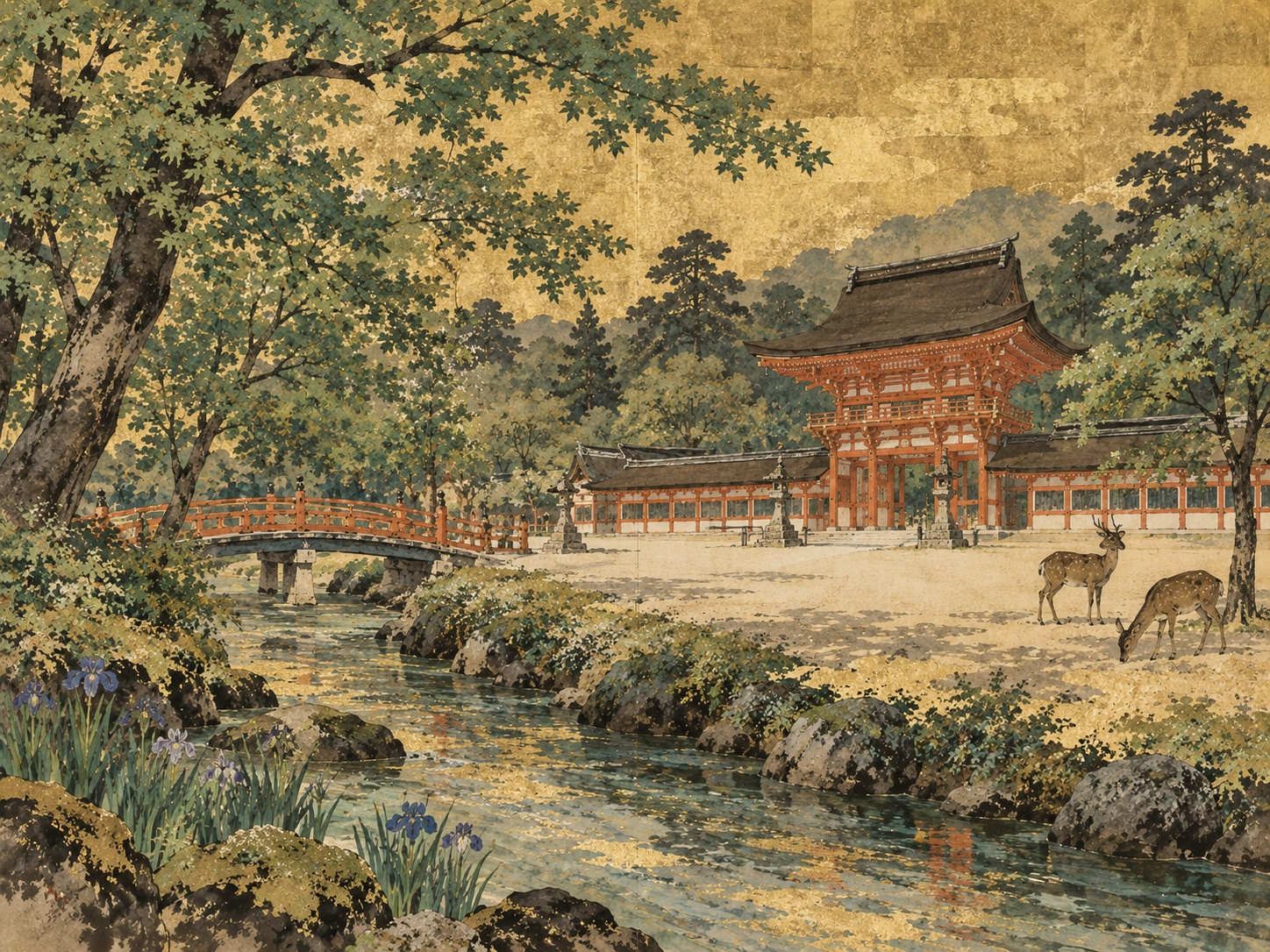
Gold mist does not conceal the landscape. It slows it down.
Mori Kansai's Kamigamo Shrine in Summer, dated by the Walters Art Museum to about 1860–1870, is a six-panel folding screen of ink and gold wash on paper with hints of color. It depicts one of Kyoto's oldest Shinto sanctuaries, but it does not behave like an architectural portrait. Trees interrupt the buildings. Mountains recede. Gold drifts between near and far.
The Walters makes the image available under Creative Commons Zero. Even more importantly, the museum preserves the screen with its companion, Byodo-in Temple in Winter. Its own interpretation says Kansai deliberately built contrasts across the pair: Shinto and Buddhism, north and south, summer and winter, subtle tonal gradation and sharper light-dark opposition.
He does not turn Kamigamo into an architectural diagram
Kamigamo Shrine—formally Kamo Wakeikazuchi Shrine—stands in northern Kyoto and belongs to the city's oldest sacred landscape.
Kansai does not present it as a monument demanding frontal attention.
Buildings are interrupted by foliage. Gold mist creates spatial pauses. A mountain rises in the distance. The viewer first experiences density, humidity and distance before identifying architecture.
The painting is less interested in telling us exactly what the shrine looks like than in making us feel what it is like to approach a sacred place through summer landscape.
Gold creates space more than luxury
It is easy to read gold on a Japanese screen as a symbol of opulence.
Here it performs another job.
Gold wash travels horizontally across the composition, dividing and connecting foreground, middle distance and background. It increases the amount of “unpainted” space between trees, buildings and hills.
The Walters contrasts the strong light-dark opposition of the winter companion with the subtle gradation of the summer screen.
Summer is not expressed through saturated greens and blue sky. It is expressed through atmospheric distance.
The best way to see the summer screen is to look at the winter one
Kamigamo Shrine in Summer becomes more legible beside Byodo-in Temple in Winter.
Byodo-in stands at Uji, south of Kyoto. Kamigamo lies to the north. One is Buddhist, the other Shinto.
The Walters explicitly reads the two as a paired system: religion, geography, season and visual handling are made to answer each other.
These are therefore more than souvenir views of famous Kyoto places.
Together they turn Kyoto into a structure of opposites.
How the paired screens answer each other
| Kamigamo Shrine in Summer | Byodo-in Temple in Winter | |
|---|---|---|
| Geography | Northern Kyoto | Uji, south of Kyoto |
| Religious site | Shinto shrine | Buddhist temple |
| Season | Summer | Winter |
| Visual effect | Subtle tonal gradation, humid depth | Stronger light-dark contrast, snow |
| Shared language | Ink, gold wash, restrained color, sacred Kyoto landscape | |
Kamigamo and Byodo-in are more than religious buildings
Each place carries a different geography of Kyoto.
Kamigamo is tied to the ancient Kamo cult and the northern approach to the capital. Byodo-in's Phoenix Hall, completed in 1053 under Fujiwara no Yorimichi, became one of Japan's canonical architectural images of the Pure Land.
Kansai assigns them opposite seasons.
Rather than map Kyoto through streets, the paired screens map it through belief, direction and time of year.
Mori Kansai was not born in Kyoto
Although Kansai became an important Kyoto painter, the Aichi Prefectural Museum of Art records his birthplace as Hagi Ganjima in Nagato Province, now part of Hagi in Yamaguchi Prefecture.
The Nishinomiya City Otani Memorial Art Museum gives more detail: he was born the third son of Ishida Dennai Michimasa, a retainer of the Mori domain, and was known in childhood as Saikichi before later using the name Shotaro.
His attraction to painting eventually took him away from domain service and into the Osaka art world.
He inherited the Mori name from his teacher
Kansai studied under Mori Tetsuzan, a major painter in the lineage of Maruyama Okyo.
In 1838 he became Tetsuzan's adopted son and took the art name Kansai.
That places him inside the Maruyama-school tradition of close observation—shasei.
“Observation” should not be reduced to photographic realism. The point was to look at form, weight, light and living structure rather than rely only on inherited pictorial formulas.
Carrying Okyo's observational tradition into late-Edo Kyoto
Maruyama Okyo had made observation a transformative force in eighteenth-century Japanese painting.
Kansai belonged roughly a century later. The Walters itself says the Kamigamo/Byodo-in pair works in the style of the eighteenth-century master.
But Kansai was not merely copying Okyo.
A Japanese cultural database describing his long handscroll of Yabakei notes his emphasis on observation alongside Western-derived shading and volumetric description.
He was carrying an Edo lineage into a visual culture already becoming modern.
By 1855, he was painting for the Kyoto Imperial Palace
Kansai's standing in Kyoto was established before the Meiji period.
The Nishinomiya museum biography records his participation in the 1855 rebuilding of the Kyoto Imperial Palace, where he painted sliding-door panels including themes known as Kikyorai and Sekiheki.
That kind of commission signals his position inside the Kyoto painting establishment.
The Walters dates the Kamigamo and Byodo-in screens only a few years later.
1860–1870 is an extraordinary decade to leave deliberately quiet
The Walters dates the pair broadly between 1860 and 1870.
Those ten years contain the Sakuradamon Incident, the Kinmon Incident in Kyoto, the restoration of imperial rule and the Meiji Restoration.
Kyoto was not a timeless city during those years. It was politically unstable and sometimes violent.
Yet Kansai's screens are quiet.
It is tempting to call that quiet a response to political upheaval. The available object records do not establish such an intention, so that interpretation should remain a possibility rather than a claim.
By 1856, Kansai was already painting Kyoto through the calendar
The Los Angeles County Museum of Art owns Kansai's 1856 Views of Kyoto in the Twelve Months, an album in ink and color on silk.
That earlier work is important because it shows that sacred and famous Kyoto places organized through the seasons were already part of his artistic vocabulary.
The Kamigamo/Byodo-in pair was not an isolated idea.
For Kansai, Kyoto could be understood through changing time.
Season is structure, not decoration
The four seasons are among the most persistent subjects in Japanese art.
They become interesting when they stop functioning merely as symbols—cherry blossoms for spring, snow for winter—and begin controlling the picture itself.
In the summer screen, foliage density, shadow, mist and atmospheric softness organize distance.
In the winter screen, snow and dark trees sharpen contrast.
The same materials behave differently because the season changes.
A folding screen is not simply a panoramic image
Both Walters works are six-panel folding screens.
On a laptop or phone they appear as long horizontal pictures. In a room they would stand folded, each panel angled slightly toward or away from the viewer.
That physical structure changes the image.
A river line bends with the hinges. Buildings appear and disappear as the viewer walks. Gold catches light differently on alternating planes.
Part of the “depth” is not painted perspective at all. It is furniture.
Gold refuses to hold one fixed light
In a digital image, the gold is a stable yellow-brown field.
In physical space, metallic material changes with angle and illumination.
The folds of the screen make that variation stronger. What looks muted from one position can flash from another.
Gold mist is therefore both painted atmosphere and a real optical surface.
The experience of the screen in a nineteenth-century interior would have changed with daylight, lamps and the viewer's movement.
Kyoto painting had its own route into modernity
After the Meiji Restoration, political and economic power shifted decisively toward Tokyo.
Japanese modern art history can therefore look Tokyo-centered when told through national exhibitions and institutions.
Kyoto followed a partly different path. Maruyama-Shijo lineages, workshop teaching, patronage and later formal schools carried older techniques into new institutions.
Kansai stands directly on that bridge.
In 1880, he joined the Kyoto Prefectural School of Painting
According to the Nishinomiya museum, Kansai worked at the Kyoto Prefectural School of Painting for three years beginning in 1880.
The school belongs to the institutional ancestry of today's Kyoto City University of Arts.
That matters because the transmission of painting was moving from the master's household into a modern public educational system.
Kansai was not merely preserving an Edo-school style. He helped move that style into modern pedagogy.
In 1890, he became an Imperial Artist
Kansai was appointed an Imperial Artist in 1890.
The system honored and supported leading artists and craftspeople under the Imperial household as Meiji Japan formalized the idea of national art.
By then Kansai was no longer simply a survivor of an older school.
He had become one of the painters through whom the new state recognized continuity in Japanese art.
He died in Kyoto in 1894.
His pupils carried the line forward
Japanese cultural records identify Yamamoto Shunkyo and Nomura Bunkyo among Kansai's pupils.
Shunkyo would become one of the major painters of modern Kyoto.
That gives Kansai a position larger than his own surviving pictures.
To look at him is to follow a line from Maruyama Okyo to Mori Tetsuzan, from Tetsuzan to Kansai, and from Kansai into Meiji and Taisho Kyoto painting.
Three works in the Aichi Prefectural Museum of Art
The Aichi Prefectural Museum of Art lists three Kansai works.
Snow Scene at Mototadasu Forest is ink and light color on silk. Young Bamboo and Fireflies is ink and light color on paper. Wuling Peach Blossom Spring, dated 1868—the first year of Meiji—is color on paper.
Even that small group shows range: snow, plants and insects, and a Chinese literary paradise.
The 1868 painting also gives a neat historical fact: Kansai's career crosses the political boundary between Edo and Meiji in a single dated object.
Kyoto National Museum holds a snowy Arashiyama
Kyoto National Museum owns Kansai's Arashiyama Snow Landscape folding screen and displayed it in a 2018–2019 exhibition on winter scenery in Kyoto.
Kyoto landmark, snow and folding-screen format echo the Walters winter companion.
The city repeatedly gave Kansai a stage on which to paint atmosphere rather than merely topography.
1814: Born in Hagi Ganjima, Nagato Province.
1838: Adopted by Mori Tetsuzan and takes the name Kansai.
1855: Participates in work at the Kyoto Imperial Palace.
1856: Paints Views of Kyoto in the Twelve Months.
c. 1860–1870: Kamigamo Shrine in Summer and Byodo-in Temple in Winter.
1868: Wuling Peach Blossom Spring.
1880–1883: Works at the Kyoto Prefectural School of Painting.
1890: Appointed Imperial Artist.
1894: Dies in Kyoto.
Why Mori Kansai now?
Kansai is not as instantly recognizable as Hokusai or Hiroshige.
Nor has he been transformed into a modern blockbuster name in the way Ito Jakuchu, Maruyama Okyo or Nagasawa Rosetsu have been for many museum audiences.
That is precisely what makes him valuable as an Art Choice.
His work shows that “tradition” in Kyoto was not static. Old visual languages—observation, gold, famous places, seasonal painting—were being combined with changing approaches to shading, art education and modern institutions.
CC0 is part of this painting's twenty-first-century history
The Walters releases the image of Kamigamo Shrine in Summer under Creative Commons Zero.
That means the museum has made the digital reproduction available without conventional copyright restrictions.
A screen painted in nineteenth-century Japan, acquired by an American museum in 1989, can now be studied, reproduced and remixed globally at high resolution.
Provenance is usually defined as the history of ownership.
In the digital era, there is another history worth following: the history of who is allowed to see and use an image.
Five ways to look at today's Art Choice
- Notice the gold mist and tree masses before identifying the shrine buildings.
- Imagine the image folded as a six-panel screen rather than flattened on a monitor.
- Look at the companion Byodo-in Temple in Winter rather than treating the summer screen alone.
- Use the Walters' Shinto/Buddhist, north/south, summer/winter interpretation as a guide—not as the only possible reading.
- Keep the 1860–1870 historical setting in mind without turning political upheaval into an undocumented claim about artistic intention.
Kyoto between summer and gold
Nothing dramatic happens in Kamigamo Shrine in Summer.
No battle. No procession. No festival crowd. The shrine does not tower over the viewer.
There are trees, mountains, architecture, water and gold mist.
Yet Kansai's historical moment is inside that calm.
He learned an Edo-period school, painted for the Imperial Palace, lived through the end of the shogunate, taught in a modern art school and became an Imperial Artist.
The Kyoto he painted was ancient and already becoming modern.
The gold does not explain that transition.
It places a luminous distance between old and new and lets the viewer move through it.
That is why this quiet summer screen is today's Art Choice.
Sources & Reporting Notes
- Aichi Prefectural Museum of Art: Mori Kansai — Japanese museum authority for the artist's name, 1814 birth in Nagato/Hagi, 1894 death in Kyoto and three works in the collection.
- Nishinomiya City Otani Memorial Art Museum: Mori Kansai — Japanese museum biography covering training under Mori Tetsuzan, work on the Kyoto Imperial Palace, Kyoto Prefectural School of Painting and appointment as Imperial Artist.
- Sumida cultural database: Mori Kansai — Japanese institutional source on Kansai's Maruyama-school lineage, observational drawing and influence on later painters.
- The Walters Art Museum: Kamigamo Shrine in Summer — Primary object record: 1860–1870, six-panel screen, ink and gold wash on paper with hints of color, CC0, and the paired conceptual contrasts.
- The Walters Art Museum: Byodo-in Temple in Winter — Primary record for the companion winter screen and the museum's interpretation of seasonal, religious, geographical and tonal contrast.
- Los Angeles County Museum of Art: Views of Kyoto in the Twelve Months — 1856 album demonstrating Kansai's sustained interest in Kyoto landscape and seasonal imagery.
- Kyoto National Museum: Winter Landscapes of Kyoto — Japanese museum record of Kansai's Arashiyama Snow Landscape screen.
- Journal of the Walters Art Museum 64/65 — Museum publication illustrating the paired Kamigamo/Byodo-in screens and confirming materials and dimensions.
This article is based on museum and cultural-institution records available through October 1, 2026. The Aichi Prefectural Museum of Art provides the Japanese form 森寛齋 and reading Mori Kansai; other Japanese institutions use the modernized form 森寛斎. The artwork title Kamigamo Shrine in Summer follows the Walters Art Museum record; this article does not present an independently verified Japanese institutional title for that Walters object. The interpretation of the paired screens as Shinto/Buddhist, north/south, summer/winter and gradation/contrast comes specifically from the Walters. No primary source reviewed establishes that the screens were intended as commentary on the political upheavals of the 1860s, so the article does not make that claim.
Image rights: © 2026 Japan.co.jp. AI-assisted editorial illustration inspired by Mori Kansai. Permission is required for reuse. Contact.