Mizuno Toshikata does not belong neatly to either “old Japan” or “modern Japan.”
He studied under Tsukioka Yoshitoshi, one of the last great masters of ukiyo-e, but built much of his career inside the new media of Meiji Japan: newspapers, literary magazines, serialized fiction and war illustration.
He used woodblock technique to depict military officers, news events, women in quiet interiors and scenes from modern fiction.
That makes Toshikata a particularly revealing artist for a period in which traditional visual language survived while the society around it changed at extraordinary speed.
Born at the end of Edo
Toshikata was born in Kanda, Edo, in 1866, only two years before the political order of Tokugawa Japan collapsed.
The National Diet Library says he was the son of a plastering foreman and was originally expected to follow the family trade. According to its account, people around his father noticed his ability after seeing flowers and birds he had drawn into plaster with a trowel and encouraged him toward art.
His childhood coincided with a transformation few artists ever experience so directly: Edo became Tokyo, railways and telegraph lines appeared, Western clothes entered public life, newspapers expanded and a modern conscript military was created.
What he inherited from Yoshitoshi was storytelling
Toshikata entered the studio of Tsukioka Yoshitoshi in 1879.
Yoshitoshi worked across the late Edo and early Meiji eras and became known for historical subjects, warrior prints, newspaper illustration and series such as “One Hundred Aspects of the Moon.”
The National Diet Library records Yoshitoshi’s work for the Yubin Hochi Shimbun, Eiri Jiyu Shimbun and Yamato Shimbun.
Toshikata therefore learned more than the mechanics of ukiyo-e. He inherited a way of compressing an event, a character and a narrative into one memorable image.
Newspaper illustration was a form of visual news
Before photographic reproduction became routine in daily print, illustration performed a major journalistic function.
The National Diet Library preserves Toshikata’s newspaper-fiction sketches and proof prints. A 2018 NDL article describes him working at the Yamato Shimbun alongside Yoshitoshi and producing illustrations for serialized fiction.
His surviving preparatory drawings reveal something important: precise anatomical studies influenced by Western drawing appear beneath finished lines of clothing and faces.
Traditional printmaking and modern observation were already mixing on the same sheet of paper.
He was also a war illustrator
Toshikata produced numerous images connected to the First Sino-Japanese War.
The Metropolitan Museum of Art owns his 1894 triptych “Naval Officers Discussing Strategy to be Used in the War against China,” in which officers gather around a map while a Japanese warship appears behind them.
Another Met work from 1895, “Onoguchi Tokuji during the Siege of Jinzhou Fortress,” celebrates an engineer who placed explosives at fortress gates.
The Met describes Toshikata as a follower of Yoshitoshi who made newspaper illustrations and specialized in images of war.
These works should not be confused with neutral documentary journalism. Meiji war prints could be highly patriotic and propagandistic, designed to shape emotion as much as record events.

Then the battlefield gives way to the quiet room
War prints are only one side of Toshikata.
In the later Meiji period, he became important in kuchi-e, the color woodblock frontispieces inserted into literary magazines and novels.
The Metropolitan Museum’s “Surgical Ward” from Bungei Kurabu is one example. Made around 1906, it illustrates Izumi Kyoka’s romantic story “Gekashitsu.”
Instead of military movement, the image depends on posture, cloth, gaze and psychological stillness.
Kuchi-e joined literature and visual art
Kuchi-e were frontispiece prints placed at the beginning of literary publications.
Magazines such as Bungei Kurabu used color woodblock images to give readers a visual entry into modern fiction.
The reader encountered an emotional image before fully entering the text.
Toshikata adapted ukiyo-e line and color to the interior life of Meiji fiction.
Newspapers and novels were both new media
From today’s perspective, journalism and literary magazines seem like separate worlds.
For a Meiji illustrator, both belonged to an expanding print economy.
Newspapers brought events to mass readers. Fiction magazines built new reading publics. Both needed images powerful enough to stop the eye and prepare the reader for a story.
Toshikata could work in both.
He moved toward the institutions of modern Japanese painting
Toshikata did not remain confined to the commercial ukiyo-e world.
The National Diet Library says Okakura Tenshin recognized his work and that Toshikata joined the Japan Youth Painting Association.
When the Japan Art Institute was founded in 1898, Toshikata participated as a supporting member.
His career therefore crossed another boundary: from commercial print culture into the institutional world of modern Japanese art.
The line continues through Kaburaki Kiyokata
Toshikata’s influence did not end with his own work.
The National Diet Library says Kaburaki Kiyokata began studying under Toshikata in 1891 and received the art name “Kiyokata” from him.
Kiyokata became a major illustrator and later one of the defining painters of bijinga and scenes of everyday life in modern Japan.
From Toshikata to Kiyokata, and later to artists such as Ito Shinsui, ukiyo-e did not simply vanish. Its visual habits migrated into illustration and modern Japanese painting.
Everyday beauty mattered too
Among the works the National Diet Library identifies with Toshikata is the series “Thirty-Six Selected Beauties.”
These images are far from the battlefield. They look at clothing, posture, hairstyles, interiors and changing customs.
In rapidly Westernizing Meiji Japan, depicting older Japanese manners was itself a modern act of selection and memory.
Why today’s Art Choice should not be one of the battle prints
The October 7 Japan.co.jp edition ranges from Honda’s industrial restructuring to cyber defense, autonomous aircraft, Fukushima robotics, local politics, sport, streaming music and immersive theater.
The common theme is change.
Technology changes. Institutions change. Cities change. Culture changes how it reaches audiences.
The art page does not need another aggressive image.
A quieter Toshikata—closer to his literary frontispieces and everyday figures—creates contrast while still belonging to the same historical story of modernization.
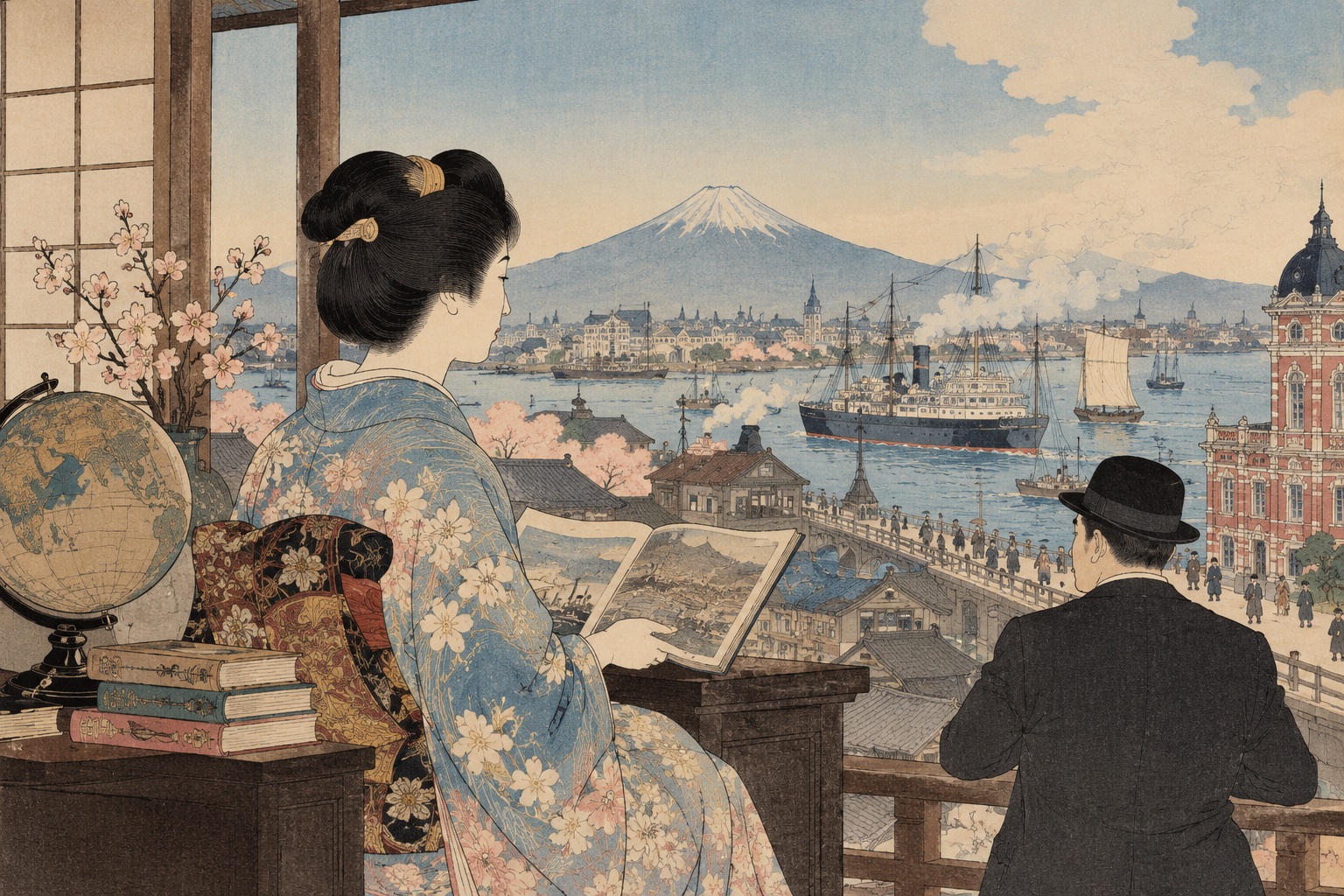
Today’s image is not an original Toshikata print
The Japan.co.jp image titled “Modern Japan in a Changing World” is not a historical work by Mizuno Toshikata.
It is an original AI-generated editorial illustration inspired by the visual language of his Meiji-period prints, newspaper work and kuchi-e.
It should not be described as a rediscovered Toshikata work, an unsigned Toshikata print or a museum object.
It is an homage created to place his visual sensibility beside contemporary news.
The Met’s actual Toshikata works are public domain
Readers who want to see Toshikata’s original work can do so through the Metropolitan Museum of Art.
The Met marks several Toshikata works as Public Domain, including “Naval Officers Discussing Strategy to be Used in the War against China,” “Onoguchi Tokuji during the Siege of Jinzhou Fortress,” “Surgical Ward” and literary frontispieces such as “Ornament Ball.”
The museum’s Open Access policy allows unrestricted use of public-domain images.
Seen together, the war prints and literary frontispieces reveal the range that makes Toshikata so useful for understanding Meiji visual culture.
He died at 42
Toshikata died on April 7, 1908, at the age of 42.
His working life was relatively short.
Yet within it he moved from an Edo-born ukiyo-e lineage through newspapers, war imagery, modern fiction, institutional painting organizations and teaching.
His career contains, in compressed form, the modernization of Japanese visual culture itself.
Old technique and a new world are not opposites
Toshikata’s work shows that modernization does not necessarily require abandoning old forms.
A traditional woodblock can illustrate a modern newspaper. Ukiyo-e line can visualize psychological fiction. Historical drawing conventions can depict new urban life.
The technique may come from the past while its use points toward the future.
Why Toshikata fits October 7
Honda is changing how it develops cars. Roads may charge moving trucks. Cyber defenders are searching for hidden intruders. The Maritime Self-Defense Force is giving ships autonomous eyes. TEPCO is sending machines into places humans still cannot enter.
Shimokitazawa turns a neighborhood into theater. J-pop circulates through billions of streams. A Japanese sandwich becomes a fine-dining form in Paris.
Toshikata did not depict any of these things.
But he spent his life answering a related question: how do you use inherited visual language to describe a society becoming something new?
“Modern Japan in a Changing World”
That is why today’s Art Choice carries the title “Modern Japan in a Changing World.”
It is not the title of an existing Toshikata artwork.
It is Japan.co.jp’s editorial theme for connecting his Meiji-era experience with the October 7 edition.
In Toshikata’s lifetime, Japan absorbed railways, newspapers, modern armies, Western dress, photography and new literary forms at extraordinary speed.
In 2026, the country is navigating AI, autonomous systems, cyber defense, robotics, streaming culture and city-scale immersive media.
The technologies are different. The speed may be greater.
But the need to make change visible—to turn an unfamiliar world into images people can understand—remains remarkably familiar.
Sources and references
- 国立国会図書館 — 「水野 年方|近代日本人の肖像」。
- 国立国会図書館 — 「水野年方と明治の浮世絵」。
- 国立国会図書館月報 682号 — 「水野年方の新聞小説挿絵」2018年2月。
- 国立国会図書館 — 「月岡 芳年|近代日本人の肖像」。
- 国立国会図書館 — 「鏑木 清方|近代日本人の肖像」。
- The Metropolitan Museum of Art — “Naval Officers Discussing Strategy to be Used in the War against China,” Mizuno Toshikata, 1894, Public Domain.
- The Metropolitan Museum of Art — “Onoguchi Tokuji during the Siege of Jinzhou Fortress,” 1895, Public Domain.
- The Metropolitan Museum of Art — “Surgical Ward (Gekashitsu) from Bungei Kurabu,” ca. 1906.
- The Metropolitan Museum of Art — “Ornament Ball,” kuchi-e frontispiece, ca. 1906, Public Domain.
Reporting cutoff: October 6, 2026, 8:05 a.m. JST. Toshikata’s name, dates, apprenticeship to Yoshitoshi, newspaper and magazine work, ties to modern painting organizations and students are verified through Japan’s National Diet Library. Artwork titles, dates and Public Domain status are verified through The Metropolitan Museum of Art. Today’s featured image is a contemporary AI-generated editorial homage, not a historical Toshikata artwork.
Why Toshikata
He links ukiyo-e to newspapers, modern fiction and institutional Japanese painting.
Why today
His career was built around the problem of using inherited visual language to describe a society changing rapidly.
About the image
The featured image is a new Japan.co.jp editorial illustration inspired by Toshikata, not an original work by the artist.