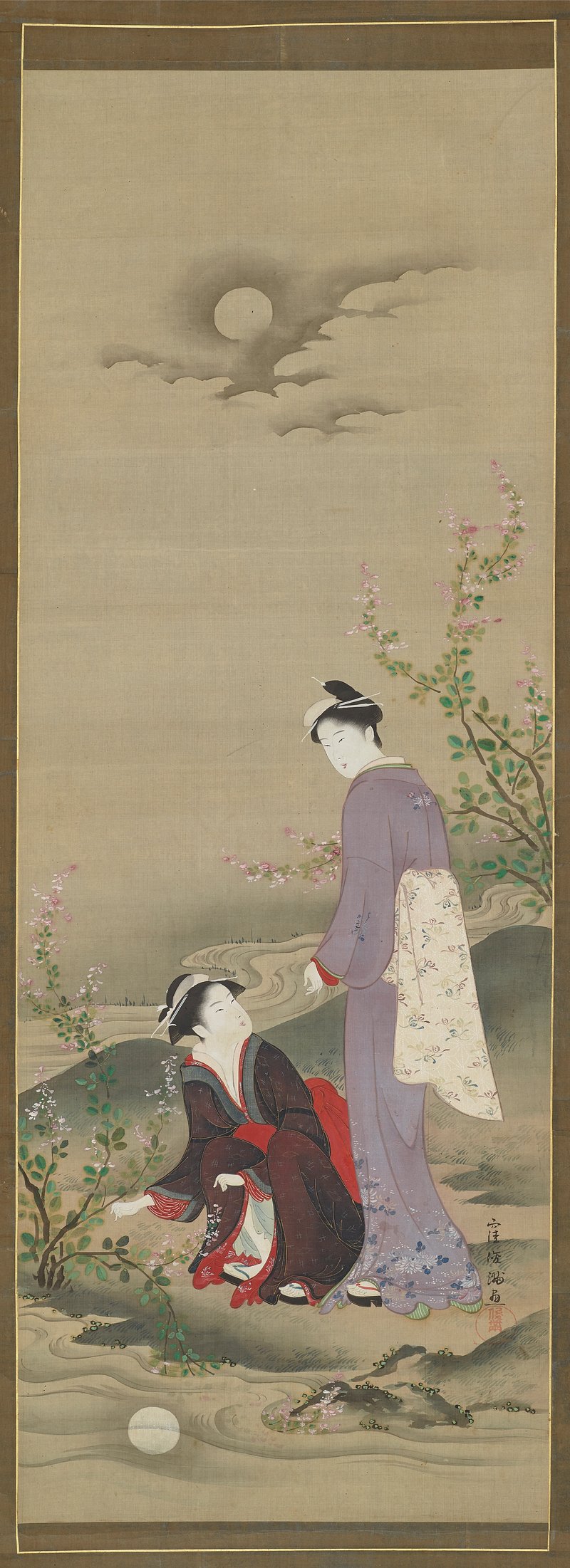
The moon is not where we expect it. Kubo Shunman does not make the two women raise their faces toward the sky. One bends low near the water; the other stands beside her. Their attention—and eventually ours—travels downward to a pale lunar image held by the stream.
The Smithsonian titles the hanging scroll Autumn: Two women gazing at the reflection of the moon. It dates the work to the early nineteenth century and identifies the medium as color and gold on silk. The painted image measures 89.2 by 32.4 centimeters. The signature reads “kubo shunman ga,” “painted by Kubo Shunman,” with Shunman’s seal. It belongs to the Freer Gallery of Art Collection as accession F1898.51, and the Smithsonian releases its digital image under CC0. [1][2]
That museum title is more than a label. It tells us precisely where the action lies: not moon-gazing in the broad sense, but gazing at a reflected moon. The distinction changes the whole painting.
Kubo Shunman 窪俊満 (1757–1820) / early 19th century / hanging scroll / color and gold on silk / image 89.2 × 32.4 cm / Freer Gallery of Art Collection / F1898.51 / digital image released CC0. [1][2]
The painting begins by reversing the habit of looking up
Moon viewing usually asks the body to lift its gaze. Edo-period images repeatedly show people looking outward or upward from tea houses, boats and scenic places. Utagawa Toyoharu’s scene titled “Viewing the Moon in Mid-Autumn” belongs to that familiar visual culture. [13]
Shunman chooses the indirect route. The women look at an image made by water.
A moon in the sky is remote. A moon in water has apparently descended to human scale. It lies near the body, near plants and fabric, almost within reach. But the apparent intimacy is unstable: disturb the surface and the image breaks; cover the moon and the reflection vanishes.
That is why the composition feels quieter than a panoramic night landscape. Autumn is not announced across the heavens. It becomes a private act of noticing something low, temporary and luminous.
The women’s bodies teach the viewer where to look
The crouching figure is the painting’s directional engine. Her lowered body interrupts the vertical stability of the standing woman. Face, shoulder, sleeve and hand pull the eye toward the bank and then below it. The viewer discovers the reflected moon by following another person’s attention.
Shunman used mediated looking elsewhere. In the Metropolitan Museum of Art’s surimono Two Women Looking in Mirrors, several mirrors and intersecting gazes create an intentionally difficult question: who sees whom, and in which reflection? [6]
The two works should not be given the same symbolism without evidence. The Smithsonian scroll carries no public-record poem that explains its meaning. What can be said is visual: Shunman was skilled at making reflection reorganize the act of looking.
In 1798, Shunman had already paired two women with a reflected moon
A British Museum surimono dated 1798 provides an unusually close comparison. Its catalogue describes two women standing beside a stream, a flowering plum branch trailing toward the water, the moon reflected in the stream, and a poem. [7]
That does not prove the Smithsonian painting is a painted version of the print, a companion, or part of the same commission. The medium, format, arrangement and presence of poetry differ. But it does establish that the combination of women, water and an indirectly seen moon belonged to Shunman’s repertoire before this early-nineteenth-century scroll.
It supports: Shunman used the motif of two women beside water with a reflected moon by 1798. It does not support: identifying the Freer scroll as a direct remake, a preparatory variant or part of a documented set. The public records do not establish that relationship. [7]
Shunman lived inside both image culture and poetry culture
Shunman is easy to classify as an ukiyo-e artist and difficult to contain there. Japanese reference works identify him as a pupil of Kitao Shigemasa, a designer and painter of beautiful women, but also a kyōka poet, haikai poet and writer of popular fiction. He used literary names including Hitofushi Senjō for kyōka and Nandaka Shiran for gesaku. [10]
The Met’s 1796 surimono Courtier and Lady with a Young Woman Poling a Boat makes the connection concrete. The museum notes that Shunman was well versed in the classics, created surimono series based on texts such as The Tosa Diary and The Tales of Ise, and was himself a skilled poet moving closely among poetry-circle patrons. [4]
Surimono were ideal for such a person. These deluxe, privately commissioned prints were often ordered by poets or poetry groups, commonly for New Year, and could combine witty thirty-one-syllable kyōka with exceptionally fine paper, pigments and printing effects. [3][5]
Shunman therefore did not simply illustrate poems from outside. He worked as an artist inside the social world that made the poems.
The absence of a poem on this scroll matters
Knowing Shunman’s poetry-circle life creates a temptation: to find an invisible poem inside every painting. The Smithsonian’s public object record, however, lists the signature and seal and does not identify a kyōka inscription or explanatory text on this scroll. [1]
We should not invent one. Nor should we assign the image to a specific waka, literary episode or place without evidence.
The painting can still behave poetically. It withholds the moon from the sky and lets reflection carry the subject. It signals autumn through an intimate riverbank rather than a grand seasonal panorama. It leaves interpretive space precisely because no poem on the public record closes the image down.
Autumn moon viewing had a much longer visual memory
Shunman did not invent the pairing of autumn, water and moon. Moon viewing had deep roots in Japanese poetry and painting, and reflected moonlight had its own literary associations.
A seventeenth-century painting by Tosa Mitsuoki illustrates the later legend of Murasaki Shikibu at Ishiyamadera, contemplating the moon’s reflection on water as inspiration for The Tale of Genji. There is no evidence that Shunman’s scroll illustrates that legend, but the example shows how a moon seen indirectly could carry literary and contemplative force in Japanese painting. [14]
Later, Hiroshige made reflected moonlight itself a famous-place subject in Reflections of the Moon in the Rice Fields of Sarashina in Shinshu. [15] Shunman’s painting predates that print, but all belong to a visual culture in which the moon could be relocated from the heavens into water, turning viewing into an act of comparison between thing and image.
Muted color was part of Shunman’s identity
Shunman became particularly associated with restrained palettes. Japanese art references describe his celebrated benigirai manner—literally an avoidance of bright red—built around black, gray, pale green, purple and other subdued harmonies. [10]
The Cleveland Museum of Art makes the same point in discussing Women in a Tea House: Shunman often placed beautiful women in landscape settings and favored subdued combinations of gray, pale green and pale purple. [8]
The Smithsonian scroll is a painting on silk, not a woodblock benigirai print, so the technical label should not simply be transferred from one medium to another. Yet its controlled color world belongs comfortably beside that broader Shunman taste for understatement. The reflected moon needs no violent contrast to become the most conceptually important form in the image.
Gold makes the picture itself responsive to light
The Smithsonian specifies “color and gold on silk.” [1] Its public page does not specify exactly where or by what method the gold was applied, so this article does not guess whether particular passages are gold pigment, leaf or scattered metal.
The material fact is enough. Gold changes with viewing angle and illumination. A painted moon can remain an image of reflected light while metallic passages in the actual object reflect the room around it.
For a work whose subject is indirect light, that physical responsiveness is especially apt. The painting does not merely describe reflection; parts of its surface participate in it.
The narrow hanging scroll stretches the act of looking downward
The painted image is 89.2 centimeters high but only 32.4 centimeters wide. [1] That tall proportion matters.
A horizontal landscape could place women, river and moon along one band. Here the differences in height become structure: a standing woman, a crouching woman, plants, bank, water, reflection. The eye descends.
Had the moon been placed high in the sky, the format would encourage ascent. By making the reflected moon the goal, Shunman turns the vertical scroll into a slow lowering of attention.
Autumn becomes almost bodily. The viewer does what the women do: stop, lean inward, look down.
The Freer also owns Shunman paintings called Summer and Winter—but a set is not documented
The Freer collection contains other narrow Shunman hanging scrolls with seasonal titles. Summer: Two women bleaching cloth in a stream: Toi no Tama Gawa measures 88 × 32.1 centimeters. Winter: two women looking at a flower in the snow measures 88.3 × 31.3 centimeters and, like the autumn painting, is color and gold on silk. [16][17]
The similarities are tantalizing: two women, seasonal activity, narrow vertical silk, dimensions close to the autumn scroll.
But the Smithsonian’s public records do not identify the three as surviving members of one original four-season set. Their provenance differs as well. Freer acquired the autumn painting in 1898 from Edward S. Hull Jr.; the summer and winter paintings entered through different 1903 purchases. [2][16][17]
The careful formulation is therefore that the Freer preserves several closely comparable seasonal Shunman paintings—not that this is definitively “the Autumn panel of a four-season set.”
Shunman’s painting practice was inseparable from social performance
A Cleveland hanging scroll, Mt. Fuji through Pines, gives a rare glimpse of Shunman making a painting within a poetry circle. The museum describes it as a performance painting executed in the company of fellow poets; six members added kyōka, and Shunman contributed a poem as well before signing and sealing the work. [9]
That context matters even when the Smithsonian autumn scroll has no recorded poem. It reminds us that a hanging scroll by Shunman could live inside a social practice of looking, composing, responding and displaying—not only inside a modern museum category called “painting.”
The women in Autumn are themselves engaged in a kind of looking ritual. They have paused together over an image in nature. The scene makes spectatorship its subject.
Freer bought the moon in 1898
The Smithsonian provenance places the work with Edward S. Hull Jr. in New York until 1898, when Charles Lang Freer purchased it. Hull had served as lawyer to Ernest Fenollosa and acted as an intermediary in transactions involving works associated with Fenollosa and the dealer Bunshichi Kobayashi. [2]
Freer signed the deed donating his collection in 1906; the collection was physically received by the Freer Gallery in 1920 after the building’s completion. [2]
The painting thus moved from Edo-period Japan through the late-nineteenth-century market for Japanese art into an American museum collection. Its modern biography is part of the larger history through which ukiyo-e and Japanese painting were collected, interpreted and canonized abroad.
CC0 turns a private-looking moment into an open digital image
The physical scroll is currently not on view. [2] Its digital image, however, is open in a way the object itself cannot be. The Smithsonian labels it CC0 and states that users may copy, modify and distribute the image without contacting the institution. [1]
CC0 does not mean provenance disappears or attribution becomes unimportant. Editorially, the opposite is useful: identify the artist, institution, accession number, museum title and source even when the law does not require a permission letter.
The moon is closer because it cannot be possessed
The conceptual trick is simple enough to state in one sentence: the moon is below the women.
That makes it feel nearer. A celestial body has apparently descended to the riverbank. Yet its nearness is deceptive. Put a hand into the water and the perfect disk breaks. The women can see it without having it.
We do not need to claim that Shunman intended a Buddhist allegory of impermanence or a coded literary reference. The museum record does not supply one. The visual experience is already sufficient.
The women stop. Their gaze drops. Ours follows. Autumn becomes not a sky full of spectacle but a reflected light discovered at the edge of water.
Shunman’s achievement is to make the indirect image feel more intimate than the thing itself. The moon remains far away. Its reflection has come to live among people.
Sources and references
- Smithsonian Institution: Kubo Shunman, Autumn: Two women gazing at the reflection of the moon — object record and CC0 status
- Smithsonian National Museum of Asian Art: F1898.51 detailed record and provenance
- The Metropolitan Museum of Art: Screen and Utensils for the Incense Ceremony — surimono context
- The Metropolitan Museum of Art: Courtier and Lady with a Young Woman Poling a Boat — classics, kyōka and poetry-circle context
- The Metropolitan Museum of Art: Japanese White-eyes with Plum Tree and Willow — kyōka surimono and deluxe printing
- The Metropolitan Museum of Art: Two Women Looking in Mirrors — reflection and intersecting gazes
- British Museum: Kubo Shunman 1798 surimono — two women, stream, plum and reflected moon
- Cleveland Museum of Art: Women in a Tea House — bijinga and subdued color harmonies
- Cleveland Museum of Art: Mt. Fuji through Pines — performance painting with kyōka circle
- Kotobank: Kubo Shunman — Kitagawa/Kitao-school context, bijinga, kyōka, gesaku and benigirai
- Waseda University Japanese & Chinese Classics database: Kubo Shunman books and kyōka-related materials
- National Diet Library Search: Kyōka Surimono: Play of Edo Kyōka Poets, including scholarship on Shunman
- The Metropolitan Museum of Art: Utagawa Toyoharu, Viewing the Moon in Mid-Autumn
- The Metropolitan Museum of Art: Tosa Mitsuoki, Murasaki Shikibu Gazing at the Moon — watery reflection tradition
- The Metropolitan Museum of Art: Hiroshige, Reflections of the Moon in the Rice Fields of Sarashina
- Smithsonian: Kubo Shunman, Winter: two women looking at a flower in the snow
- Smithsonian: Kubo Shunman, Summer: Two women bleaching cloth in a stream
Evidence reviewed September 16, 2026, Japan time. The Smithsonian primary record controls the museum title, dating, medium, dimensions, signature, seal, provenance, collection and CC0 status. No official Japanese title was found in the public Smithsonian record, so the Japanese edition uses descriptive wording without presenting it as the museum’s official Japanese title. The public record does not identify a specific poem, literary source, place or documented four-season set, and the article does not invent one. Comparative works from the British Museum, Met, Cleveland and Smithsonian are used to establish Shunman’s broader motifs and practices, not to claim direct preparatory or series relationships.