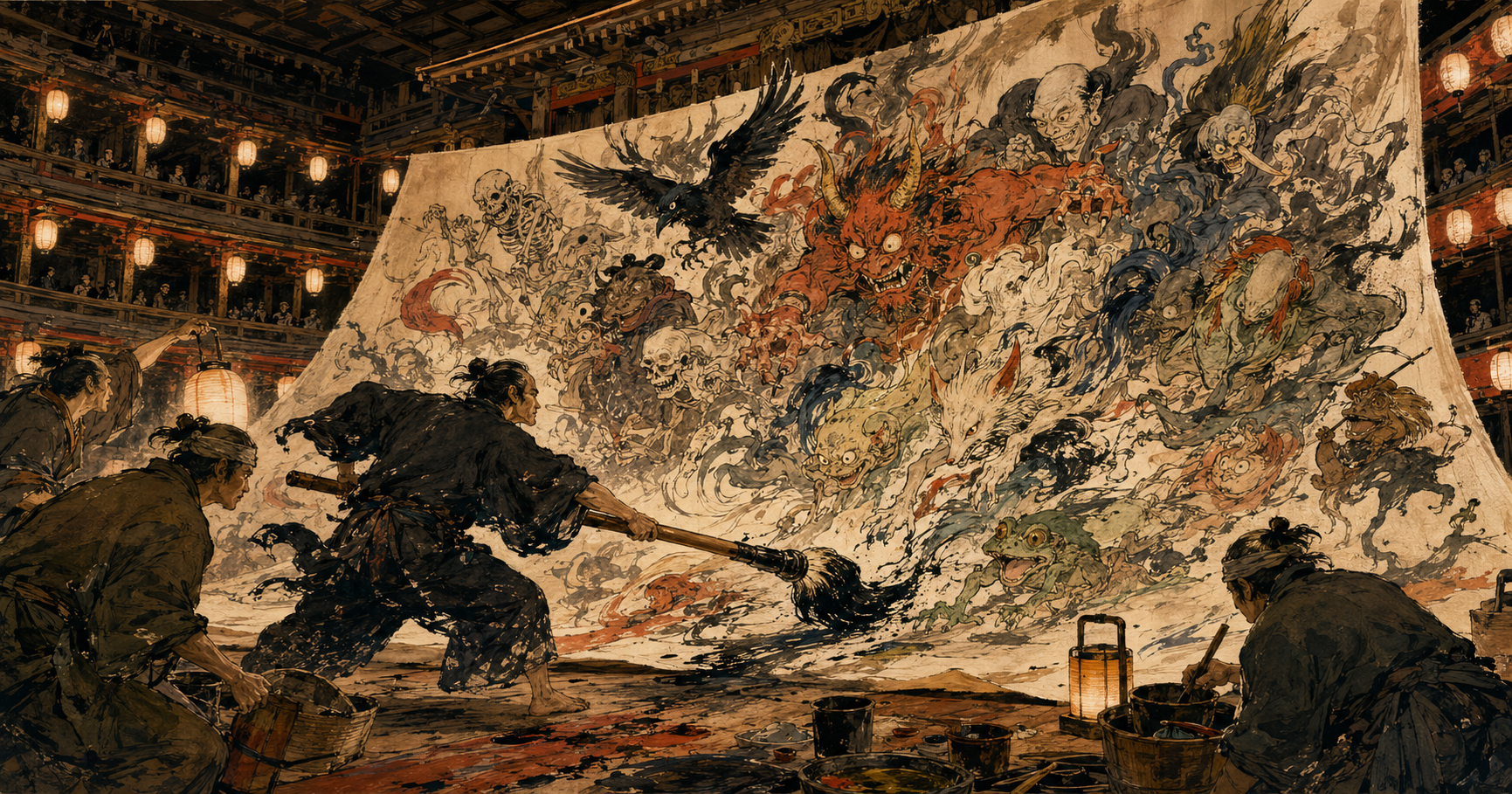
Before the actors appear, the monsters do. They tumble from wicker trunks, stretch impossible necks, bare fangs, brandish limbs and stream sideways across a field of cloth. Some look genuinely dangerous. Others seem caught in the instant between menace and a joke. Their bodies lean, twist and answer one another until the whole procession behaves less like a painting than a stage company rushing a cue.
That sense of imminent performance is the key to Kawanabe Kyōsai’s extraordinary Shintomi-za Yōkai Hikimaku—the Shintomi-za theater curtain of monsters—painted in Tokyo in 1880. It measures 401 centimeters high and 1,704 centimeters wide: roughly four meters by seventeen. Its approximately 68 square meters do not ask to be contemplated from a fixed, polite distance. The picture wants to engulf peripheral vision. In a theater, drawn across the stage while the audience waited, it would have been an event before the event.
The Tsubouchi Memorial Theatre Museum at Waseda University, which preserves the curtain, records a story almost too perfectly matched to Kyōsai’s public legend. On June 30, 1880, the artist is said to have completed the enormous work in four hours while enjoying sake. The writer and journalist Kanagaki Robun, Kyōsai’s friend and frequent collaborator, gave it to the Shintomi-za. The creatures were not anonymous inventions. They were modeled on popular kabuki actors, including Ichikawa Danjūrō IX and Onoe Kikugorō V, recast as a company of yōkai pouring from storage trunks and advancing toward the seats.
Every part of that account is seductive: the drink, the speed, the virtuoso, the stars in disguise. Yet the most interesting fact is not that Kyōsai was wild. It is that the wildness holds. Across seventeen meters, momentum is distributed, pauses are timed, figures remain legible and chaos is made theatrical. The curtain’s abandon is built on discipline.
How to Look at a Seventeen-Meter Joke
Begin with direction. This is a horizontal curtain, and its drama moves laterally. Bodies do not settle into a central pyramid, as they might in a formal historical painting. They arrive in waves. A dark mass triggers a pale interval; a bent back launches the eye toward a snapping jaw; a long neck becomes a visual bridge. Kyōsai controls speed by varying the density of marks. Thick ink arrests the eye. Dry, flying strokes release it again.
Then look at the trunks. In Japanese storytelling, containers are natural engines of suspense: closed things can conceal costumes, treasures, secrets or creatures. Here the woven tsuzura are both props and portals. Their contents are the theater’s own actors, transformed by paint. The image proposes that the supernatural has not invaded the playhouse from some remote mountain. It was already backstage, packed among the roles, wigs and garments, waiting to be opened.
Finally, notice where the creatures are going. Waseda’s description says they head into the Shintomi-za audience. That turns a functional divider into a visual breach. A curtain normally announces a boundary: stage here, spectators there; fiction on one side, daily life on the other. Kyōsai paints a company that refuses the arrangement. His actors, disguised as yōkai, cross the line before the cloth itself can be drawn aside.
A Gift From the Man Who Reported Modern Life as Comedy
The commission came through Kanagaki Robun, born in 1829, only two years before Kyōsai. Robun had made his name as an gesaku writer—an author of popular, playful prose—and then adapted that agility to the new newspaper world. Works such as Seiyō Dōchū Hizakurige, his comic journey through the West, and Aguranabe, built around talk in a beef restaurant, caught ordinary people performing “civilization and enlightenment” in language, appetite and fashion. Modernity, in Robun’s pages, was not an abstract government program. It was something people mispronounced, consumed, bragged about and misunderstood.
Robun and Kyōsai were more than drinking companions assembled for one spectacular gift. Waseda University’s early-book holdings preserve volumes in which Robun supplied the text and Kyōsai the pictures. In 1874 they worked on E-shinbun Nipponchi, often described by Japanese manga institutions as the first satirical cartoon magazine published by Japanese creators. Words and images shared the labor of turning current affairs into public comedy.
The curtain belongs to that collaboration even though it has no newspaper columns. Robun understood theaters as social media before the term existed: places where celebrity, rumor, political aspiration, fashion and mass attention met. To give the Shintomi-za a giant image of its own stars as monsters was publicity, friendship, caricature and institutional portrait at once.
A 2020 exhibition organized by the Kawanabe Kyōsai Memorial Museum linked the gift to the Shintomi-za staging of Kawatake Mokuami’s Shimo yo no kane jūji no tsujiura, a play serialized in Kabuki Shinpō. The detail matters because it returns the object to a precise ecology: playwright, theater journal, popular writer, painter, actors and audience. The curtain was not autonomous “fine art” dropped into a playhouse. It was made inside a network of people who produced performance and news together.
The Most Modern Theater in Tokyo
To understand why monsters mattered, follow the gaslight. The Shintomi-za descended from the Morita-za, one of Edo’s officially licensed theaters. In 1872 the company moved from the theater district near Asakusa to Shintomi-chō, close to Ginza and the Tsukiji foreign settlement, and took the Shintomi-za name in 1875. Fire destroyed it the following year. When the permanent building reopened in June 1878, proprietor Morita Kan’ya XII presented it as a theater for a new capital.
The innovations were material and symbolic. The rebuilt house introduced some chair seating and gas illumination, enabling night performances. Instead of the traditional turret above the entrance, a gas-flame sign spelled the theater’s name. Government ministers and foreign diplomats attended the opening; the actors received them in tailcoats, while onnagata appeared in formal Japanese dress with purple head coverings. The surrounding theater-teahouse system was reduced. This was not simply decoration. Kan’ya was trying to raise kabuki’s social standing and make it legible to the officials and overseas guests through whom Meiji Japan judged its own modernity.
The project could become magnificently strange. In February 1879, foreigners in Tokyo presented the theater with a purple satin curtain decorated with pine, bamboo, plum and the Morita crest. That July, former U.S. President Ulysses S. Grant attended a performance beneath Japanese and American flags; more than seventy geisha concluded the occasion in costumes arranged to evoke the Stars and Stripes. In September, Kan’ya hired eight British performers for an experiment in Western drama. According to accounts collected by the National Diet Library, the language barrier left much of the audience baffled and laughing, and the financial loss deepened the theater’s debt.
Kyōsai’s monster curtain arrived the next year, at the exact hinge between optimism and strain. The Shintomi-za still commanded Tokyo’s finest actors and the title of the country’s leading theater, but the cost of reinvention was beginning to show. From 1880, the institution entered repeated changes of management and name. The image therefore confronts us with a paradox: inside a building advertising chairs, gaslight, diplomacy and progress, an old-style horizontal curtain released a mob of supernatural bodies.
That is not a rejection of modernity. It is a better picture of how modernity actually felt. Meiji Tokyo did not replace Edo overnight. Imported technologies, courtly ambitions, commercial entertainment and inherited ghosts occupied the same streets. Shintomi-za’s gas flames made Kyōsai’s ink visible after dark.
| Object or innovation | How it moved | What it signaled |
|---|---|---|
| Hikimaku, the category Waseda uses for Kyōsai’s curtain | Drawn horizontally across the stage | A traditional theatrical threshold transformed into a giant actor caricature |
| Jōshikimaku, the familiar kabuki striped curtain | Drawn sideways by hand | A conventional sign that separates and reconnects stage and audience |
| Donchō, the Western-style drop curtain adopted in the modernizing period | Raised and lowered vertically | New machinery, spectacle and the prestige of a “modern” auditorium |
| Gaslight at the rebuilt Shintomi-za | Illuminated interiors, exterior signage and night shows | Technology, metropolitan novelty and cosmopolitan ambition |
The terminology is worth preserving. Kyōsai’s work is often loosely called a drop curtain in English, but Waseda catalogs it as a hikimaku, a pulling curtain. The same modernizing theater experimented with vertical curtain technology around this period, yet the monster cloth’s power comes from the sideways surge. Its format and its procession share a direction.
The “Demon of Painting” Was a Trained Professional
Kyōsai was born in 1831 and began with the popular image world associated with Utagawa Kuniyoshi before entering rigorous Kanō-school training. At ten he studied under Maemura Tōwa, who recognized the child’s talent and called him a “demon of painting.” After Tōwa fell ill, Kyōsai continued under Kanō Tōhaku Norinobu, head of the Surugadai Kanō line. In 1848, at nineteen by traditional count, he completed his training with unusual speed and received the art name Tōiku Noriyuki.
This background corrects the easiest misunderstanding of the curtain. Kyōsai did not paint energetically because he lacked patience or academic skill. He could work in polished Buddhist iconography, bird-and-flower painting, figural narrative, caricature and ink monochrome. He copied old masters and studied across schools. In 1881, a year after the curtain, his austere Winter Crow on a Withered Branch received the highest award at the Second National Industrial Exhibition. The same hand that made a few ink marks carry the weight of a cold bird could propel dozens of comic bodies across a theater.
Kyōsai also practiced sekiga, rapid paintings made at banquets and public gatherings. Speed in that setting was performance. Spectators watched knowledge become gesture without visible correction. Sake belonged to the social theater of production, but it did not substitute for training. The famous four-hour account should be read in that light. Even if every minute cannot now be independently reconstructed, the story identifies the kind of virtuosity contemporaries valued: memory, decisiveness, bodily scale and nerve.
At seventeen meters, hesitation would become visible. A timid line enlarged to architectural size is merely timid. Kyōsai’s strokes change pressure, moisture and velocity in a single passage. Washes establish mass; black contours snap a face into focus; dry brush catches on the cloth and turns texture into agitation. What appears uncontrolled is a chain of controlled risks.
Actors Who Were Already Larger Than Life
The curtain’s joke depends on recognition. Waseda identifies Danjūrō IX and Kikugorō V among the actor-models, while its later digital interpretation compares painted figures with surviving photographs and actor prints. Researchers have not reduced every creature to a universally agreed cast list, and the painting should not be treated as a simple group portrait with labels. But its celebrity structure is clear.
Danjūrō IX was the great advocate of katsureki—“living history”—which sought more historically plausible costume, language and behavior in period drama. Robun himself helped popularize the term after praising Danjūrō’s acting in an 1878 Shintomi-za production. Danjūrō’s project aligned with reformers who wanted kabuki to command respect from statesmen and foreign visitors. He became a symbol of the actor as cultural authority rather than disreputable entertainer.
Kikugorō V, his rival and artistic counterpart, retained a particularly strong connection to Edo’s urban stage. He excelled across male and female roles and became closely associated with Mokuami’s domestic plays and zangirimono, dramas about contemporary people with cropped, Western-style hair. With Ichikawa Sadanji I, the two stars formed the celebrated “Dan-Kiku-Sa” triumvirate that defined Meiji kabuki.
Kyōsai gives these reforming celebrities back to metamorphosis. The actor who pursued historical realism can become a demon. The actor who embodied modern street life can acquire an impossible neck. This is not necessarily mockery at their expense. Kabuki greatness has always depended on transformation: one body becomes warrior, woman, thief, spirit or animal through codified movement, costume and voice. The curtain makes that professional magic literal.
Why Yōkai Are Perfect Theater Critics
The image draws on the long tradition of the hyakki yagyō, the night parade of one hundred demons. In painted handscrolls and later popular books, supernatural beings advance in sequence as if the world’s discarded fears and household objects had formed a procession. The format rewards accumulation. One apparition is a curiosity; many become a society.
Kyōsai knew that archive deeply but did not simply enlarge an old scroll. The memorial museum has highlighted such types as the long-necked rokurokubi, tengu and the demon familiar from Ōtsu-e folk painting. On the curtain, however, taxonomy matters less than acting. Kyōsai’s creatures have entrances, poses, rivalries and comic timing. Their expressive hands and knees can be read across a hall.
Yōkai are ideal theater critics because they expose unstable categories. They are neither fully human nor simply animal, neither entirely frightening nor safely funny, neither dead tradition nor fixed invention. Kabuki works through the same productive instability. A stylized gesture can feel more truthful than ordinary behavior. A male actor can construct femininity through a discipline visible to the audience. A painted curtain can move without physically moving because every line prepares the next cue.
- Direction: figures stream sideways, echoing the action of a pulled curtain.
- Containers: wicker trunks turn the backstage storehouse into a supernatural birthplace.
- Brush pressure: heavy black anchors alternate with dry strokes that accelerate the eye.
- Actor bodies: celebrity poses survive beneath monstrous features.
- The broken boundary: the procession heads toward spectators, collapsing stage and house.
The Rare Survival of Working Cloth
Paintings made for theaters are unusually vulnerable. They are handled, folded or rolled, pulled under tension, exposed to dust, smoke, changing humidity and the hard calendar of performances. Buildings burn; companies close; fashions change; oversized objects become storage problems. The very features that make a stage curtain powerful in use make it difficult to preserve as art.
Shintomi-za itself did not survive. It competed with the new Kabuki-za after 1889, was acquired by Shōchiku in 1909 and disappeared after the 1923 Great Kantō Earthquake destroyed the building. The curtain’s survival at Waseda is therefore more than a fortunate addition to Kyōsai’s catalogue. It preserves the scale of a lost room and the social distance between a Meiji stage and its public.
Conservation creates a dilemma. A fragile, seventeen-meter textile cannot be repeatedly installed merely because viewers want to feel its scale. Yet a reduced reproduction risks turning architecture into an illustration. Waseda and Toppan addressed that problem in 2019 by digitizing the deteriorating work at 9.4 billion pixels. The project accompanied the curtain’s appearance as a centerpiece of the British Museum’s Manga exhibition, where it occupied a vast central wall.
The resulting interpretation did more than make a large file. Visitors could magnify details and compare the painted yōkai with photographs and actor prints. An animation staged a confrontation between groups led by Danjūrō and Kikugorō, then combined the curtain with a print of the Shintomi-za interior to suggest how it operated in its original setting. Waseda later displayed a reproduction approximately one-sixth the original size.
Digital motion is interpretation, not evidence that the original was animated or accompanied by a particular soundtrack. But it restores a truth that a static catalogue image can suppress: theater art is relational. Its meaning changes with distance, architecture, sequence and waiting bodies. High resolution preserves the drag of brush on cloth; reconstruction restores the audience the cloth once threatened to invade.
Why It Defines Today’s Japan.co.jp Edition
Today’s edition ranges from Fuji Rock and idol concerts to museum exhibitions, model trains, volunteer fire brigades, political pressure and molecular wear. A single visual style has to hold performance, machinery, public life and argument without pretending those subjects are identical. Kyōsai offered the answer: not uniformity, but orchestrated collision.
His curtain allows a page to be dense without becoming inert. Strong diagonals move attention. Ink-like silhouettes establish hierarchy. Abrupt color behaves like a stage cue. Comic grotesques keep solemn subjects from congealing into official ceremony, while the underlying Kanō discipline prevents spectacle from becoming noise. “Wild Meiji Theater Art,” the visual identity developed for today’s story images, takes its principle from that combination rather than copying individual monsters.
There is also an ethical lesson in Kyōsai’s theater. Modern Japan is often illustrated as a choice between elegant tradition and sleek technology. The Shintomi-za curtain refuses the binary. It was painted for a gas-lit, reform-minded institution by an artist trained in an old school, fluent in popular print, alert to foreign media and inseparable from new journalism. Its yōkai belong to history, but their rush was contemporary news.
That is why the curtain still feels more alive than many official pictures of “progress.” Progress usually poses. Kyōsai’s creatures perform. They push, trip, glare, laugh and carry older worlds into a newly illuminated room. They remind us that cultural change is not a clean curtain rising on an empty stage. It is a crowded entrance.
Controlled Chaos, One More Time
Return to the widest view. Seventeen meters is too long to possess at a glance, so the eye edits its own performance: encounter, recoil, pursuit, recognition. The picture’s energy comes from that partial knowledge. Something is always arriving from outside the frame one is currently studying.
Kyōsai understood that a theater audience does not look like a museum visitor. It talks, anticipates, recognizes stars, remembers roles and waits for transformation. His curtain gives all of those activities a body. Robun turns up as the social connector; Mokuami’s theater world hums behind the commission; Danjūrō and Kikugorō lend celebrity physiognomies; Shintomi-za supplies gaslight and institutional ambition. The artist binds them with ink.
The four-hour legend endures because it condenses the work into a feat. The curtain itself endures because it is more than a feat. It is a portrait of Meiji culture at the instant when categories would not stay closed: old and new, elite and popular, actor and monster, painting and performance, stage and street.
When the curtain was pulled, those distinctions did not disappear. They charged sideways together. That is Kyōsai’s controlled chaos—and the reason it remains today’s art choice.
Reporting notes and sources
The date, dimensions, Robun gift, four-hour sake account and identification of popular actors come from Waseda’s object record. “Four hours” and drinking are therefore presented as a received account, not a surviving stopwatch record. The actor identifications discussed in the digital project are interpretive and do not make every figure a settled portrait. Kyōsai’s object is called a hikimaku by Waseda; this article does not conflate it with a vertically operated donchō.
- Waseda University Theatre Museum: Shintomi-za Yōkai Hikimaku object record
- Waseda University Theatre Museum: the curtain and digital technology
- National Diet Library: Meiji theater, Shintomi-za and Morita Kan’ya’s Westernizing program
- National Institute of Japanese Literature: Shintomi-za history and 1881 theater print
- Suntory Museum of Art: Kyōsai’s Kanō training, range and impromptu painting
- Japan Arts Council: Danjūrō, Kikugorō and Meiji kabuki reform
- National Diet Library: Kanagaki Robun biography
- Kawanabe Kyōsai Memorial Museum exhibition summary: production site, related play and yōkai motifs