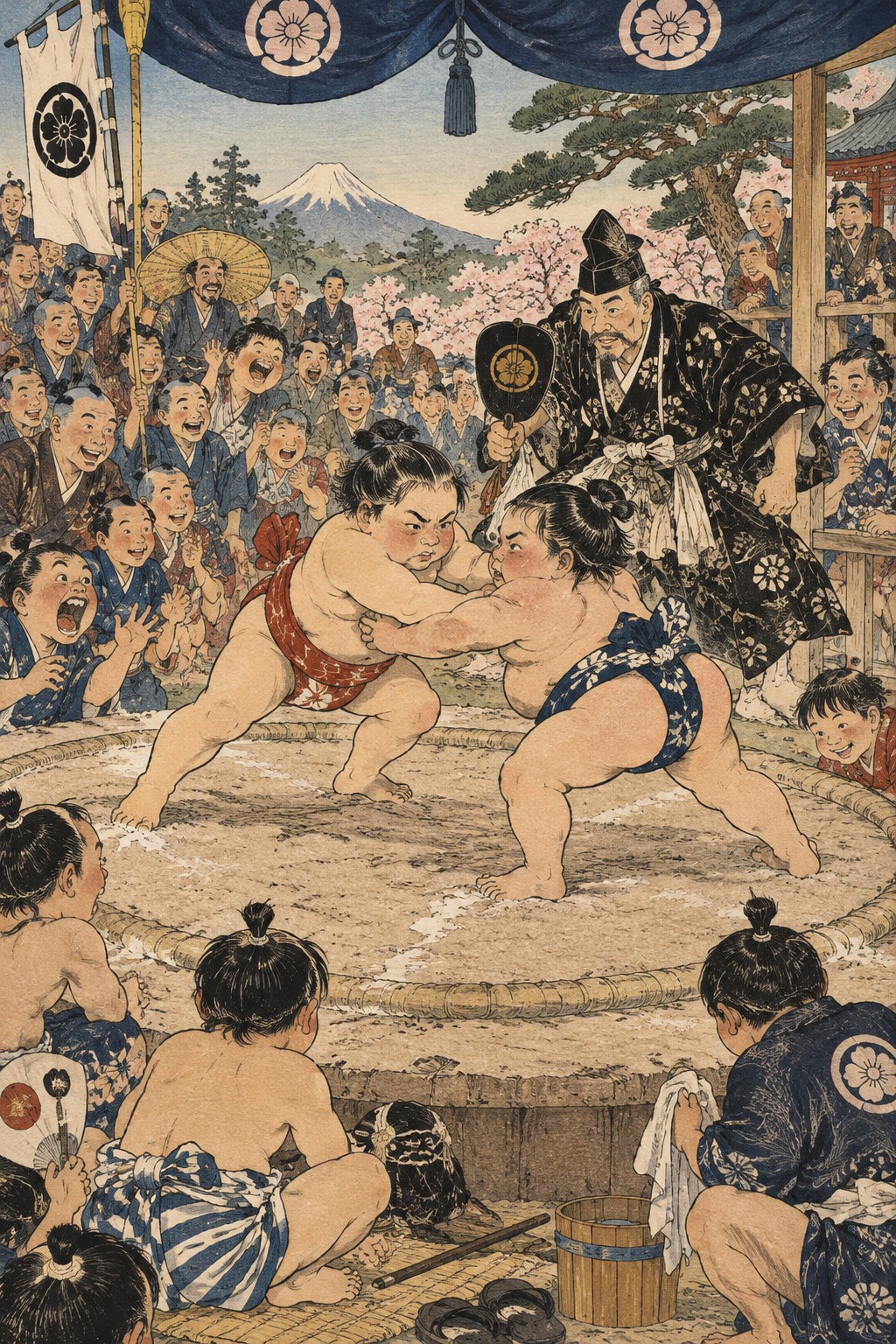
A ring full of people, not just contestants
Two young wrestlers are the center of the action, but they are not the whole story. Around the contest are onlookers, attendants and other children, their gestures giving the scene its comic energy. Kawanabe Kyōsai’s 1863 print, now catalogued as Tenpōzan in Osaka: Viewing Children’s Sumo, presents physical competition as an event sustained by a community, not merely a test between two bodies.
On October 10, the anniversary of the Tokyo Olympics’ 1964 opening, Japan has a compelling reason to consider what it values in sport. The national Sports Day holiday falls on October 12 in 2026. A print made more than a century before Tokyo hosted those Games asks a different question from a medal table: who makes an athletic occasion possible, and who gets to share in its joy?
A crucial distinction underlies this Art Choice. The historical print belongs to the Smithsonian’s National Museum of Asian Art collection. The accompanying Japan.co.jp illustration is a newly generated image inspired by Kyōsai’s manner and the children’s-sumo subject; it is not a photograph, scan or faithful reproduction of the 1863 object.
What the surviving print actually tells us
The Smithsonian catalog records the Japanese title as 浪花 天保山 子供角力照覧 (Naniwa Tenpōzan kodomo sumō shōran). It places the print within the Famous Places along Tōkaidō series, dates it to the sixth month of 1863, and names Daikokuya Kinnosuke as publisher. Its medium is ink and color on paper; the overall sheet measures 36.2 by 24.5 centimeters.
These particulars matter because they anchor an appealing scene to a real published object. Tenpōzan, in Osaka, is the named location. The work is not simply an anonymous illustration of boys wrestling, nor is it a painting created for a twentieth-century sports festival. It emerged from the commercial culture of Japanese prints in the final years of the Tokugawa shogunate.
The museum acquired the work in 2021 through the gift of Pearl and Seymour Moskowitz. A dealer’s commentary suggests that an elevated spectator might be the shogun; that interpretation is not confirmed as an identification by the catalog entry and should not be repeated as certain historical fact.
An artist trained in rigor and mischief
Kyōsai was born in 1831 in Koga, in what is now Ibaraki Prefecture, and died in 1889. The National Diet Library supplies his dates as May 18, 1831, and April 26, 1889. As a child he learned from the ukiyo-e artist Utagawa Kuniyoshi, then trained in the Kano painting tradition. These two educational lineages help explain the combination of assured draughtsmanship and startlingly animated storytelling found in his work.
He was known as the “painting demon,” an affectionate and sometimes fearsome acknowledgment of a versatility that encompassed historical subjects, humorous figures, animals, illustrated books and finished paintings. The Nakanoshima Kosetsu Museum, in its exhibition account, emphasizes that the apparently effortless range rested on disciplined Kano-school study.
Kyōsai’s comedy is never merely an excuse for carelessness. A figure losing balance, a face turning toward a companion, or a small gesture at the edge of the picture can tell us how people relate to one another. Humor is built from acute observation of bodies in motion.
An Edo-period picture of a public spectacle
The sixth month of 1863 belongs to an unstable era. The shogunate had only a few years left. Artists, publishers and consumers of popular images were already living through extraordinary political change, yet pictures of everyday amusement and celebrated places remained meaningful.
The Famous Places along Tōkaidō publishing framework, documented also in Japanese museum collection listings, gathered landscapes and events into images that could circulate beyond the immediate location. The print’s attention to children’s wrestling demonstrates how a place might be evoked through the activity happening there rather than merely a panoramic view of buildings or coastline.
But a woodblock print is not an unfiltered photograph of a particular match. It is a composed object, shaped by artistic invention, publishing conventions and the expectations of its audience. The people who appear to be watching and participating deserve careful observation; their individual identities and the exact circumstances of an event cannot simply be reconstructed from the picture.
The overlooked work of making sport possible
Spectators often remember a winner or a brilliant technique. Kyōsai encourages attention to the margin of the contest as well. The people preparing a participant, guiding younger wrestlers, watching and reacting are part of the spectacle. Through them, athletic competition becomes a shared human enterprise.
That is a relevant way of looking at school sports days and community events in present-day Japan. Organizers must consider physical safety, accessibility, heat risk, the pressure placed on children who dislike competition and opportunities for families to take part. A romantic story about tradition is insufficient if it overlooks those excluded from it.
The comparison is interpretive rather than documentary. The 1863 print does not prove what today’s schools should do. It offers a visual prompt for thinking beyond the medal, the championship and the headline.
The political edge of a comic imagination
Kyōsai’s life also resists a purely cheerful account. The National Diet Library records that a satirical drawing made at a gathering led to his imprisonment during the early Meiji years, and that he later adopted the name by which he is generally known today. Cartooning could involve political risk as well as amusement.
Yet not every lively figure in his work should be decoded as an allegory of state power. Children’s sumo can be appreciated as a scene of gesture, anticipation and shared excitement without forcing it into a single political message. His ability to work across sacred subjects, social observation and satire is part of what made him difficult to categorize.
His later association with the British architect Josiah Conder illustrates another dimension: Japanese visual traditions were encountering international audiences and new networks of artists. Kyōsai’s continuing appeal outside Japan is not merely curiosity about a vanished society; his sense of movement is immediately legible across cultures.
The image on this page is an interpretation, not an artifact
Japan.co.jp’s companion image is an original modern illustration inspired by the print’s subject and by Kyōsai’s energetic artistic language. It must not be labeled an 1863 print by the artist or presented as a visual transcription of the Smithsonian object. The museum record and the contemporary illustration serve different purposes.
The Smithsonian’s entry explicitly marks usage conditions for its distributed digital image. The nineteenth-century artwork’s age does not automatically settle the permission terms of every photograph or digital reproduction supplied by an institution. Anyone intending to reproduce the collection image should check those terms separately.
Precise captions can strengthen rather than diminish a feature. Proper attribution tells readers where the genuine print can be studied, and an explicit illustration credit allows the new image to be appreciated on its own terms.
Why it belongs in a Sports Day edition
Japan’s sporting calendar now spans professional baseball, a transformed basketball league, international swimming achievements and events staged by communities and schools. There is room in that crowded picture for a reminder that sport’s meaning is not exhausted by elite performance.
A child taking a first turn in a ring, a coach adjusting a stance, and a friend watching nervously can be as culturally significant as the outcome of a great contest. These are the quiet mechanisms by which games become traditions.
Kyōsai’s crowded, unruly sense of life gives this edition its final perspective. The essence of sporting pleasure is not that everyone wins. It is that competition can draw people together—participants, teachers and spectators—and leave them with something to share long after the result is forgotten.
Sources and references
- 米国スミソニアン協会・国立アジア美術館《浪花 天保山 子供角力照覧》収蔵記録 — museum and archival reference
- スミソニアン国立アジア美術館 同作品・画像利用条件 — museum and archival reference
- 国立国会図書館「近代日本人の肖像:河鍋暁斎」 — museum and archival reference
- 埼玉県蕨市「河鍋暁斎記念美術館」 — museum and archival reference
- 中之島香雪美術館「すべてを描く萬絵師 暁斎」展覧会解説 — museum and archival reference
- 和泉市久保惣記念美術館「東海道名所風景」収蔵データ — museum and archival reference
- 敦賀市立博物館「河鍋暁斎」作者データ — museum and archival reference
- 狭山市教育委員会「河鍋暁斎」略歴 — museum and archival reference
- エゲノルフ・ギャラリー《子供角力照覧》作品解説(図像解釈は販売者による説明) — museum and archival reference
Reporting note: the exact identity of a high-ranking spectator, the circumstances of the represented event and permission for reuse of the Smithsonian digital reproduction are not established here. The hero image is a newly created AI illustration.