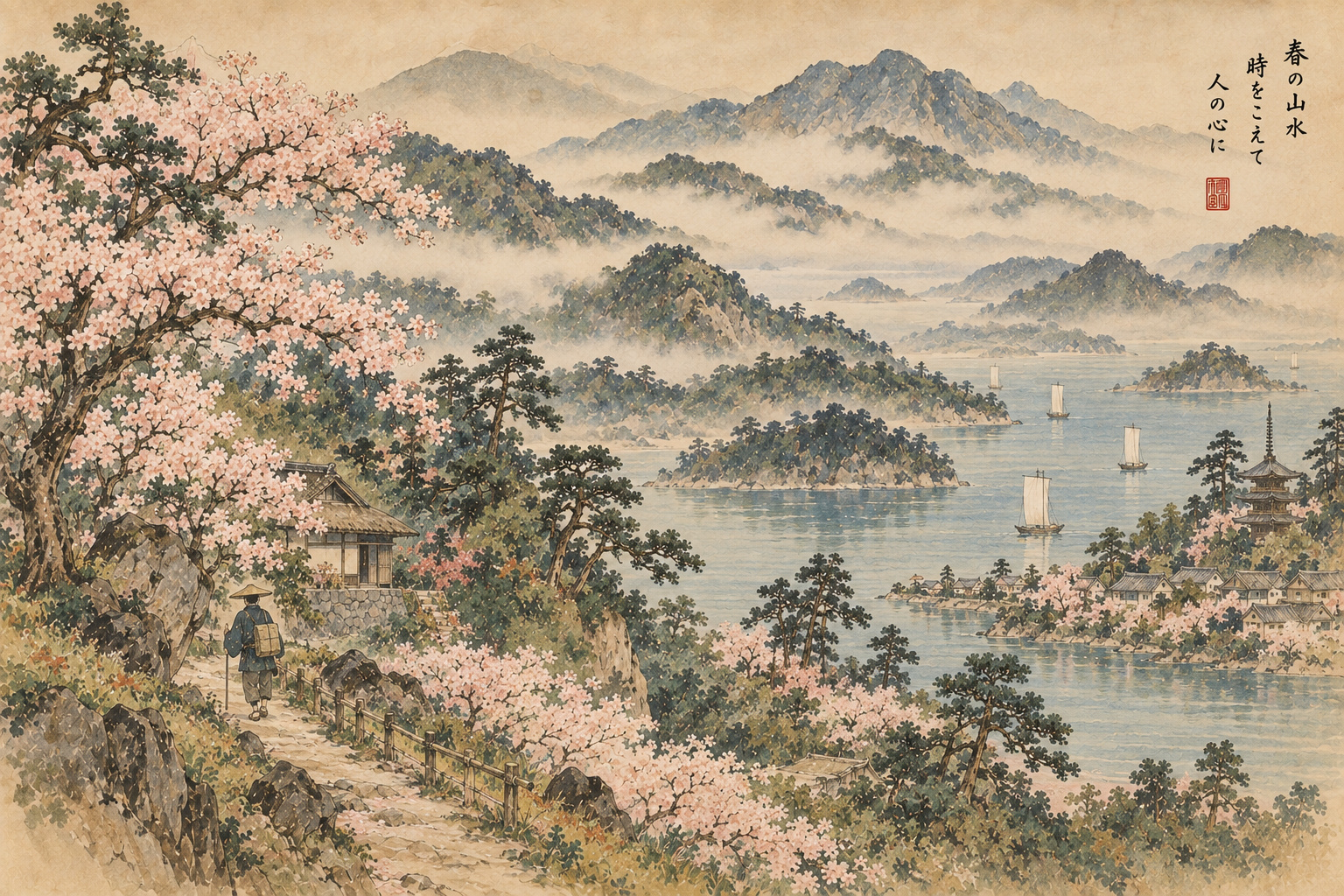
Kawabata Gyokushō was born in 1842, when the Tokugawa shogunate still governed Japan, and died in 1913, only months after the Meiji era had ended. His lifetime spans one of the fastest institutional transformations in Japanese history: the collapse of the domain system, the opening of railways and telegraph lines, national industrial exhibitions, the creation of modern art schools and the emergence of state systems for defining and rewarding “Japanese art.”[1]
The Metropolitan Museum of Art’s Spring Landscape belongs near the end of that long life. The Met dates the set to the twentieth century and classifies it as Meiji-period Japanese painting. It consists of two ink-and-color paintings on silk, each measuring 123.5 by 50.2 centimeters. Francis Lathrop gave the pair to the museum in 1908, and the images are available as Public Domain under the Met’s Open Access policy.[2]
Calling him merely “traditional” misses the most interesting part
Gyokushō was born in Kyoto into a family of lacquer craftsmen. At eleven he entered the studio of Nakajima Raishō, a painter of the Maruyama school, where close observation of nature formed an important foundation.[1]
But when he moved to Edo in 1866, at about twenty-four, he did not simply remain inside one lineage. The National Diet Library records that he studied Kanō-school painting and also learned oil painting from Takahashi Yuichi and the British artist and illustrator Charles Wirgman. Takahashi became one of the pioneers of modern Japanese Western-style oil painting; Wirgman played an important role in introducing Western drawing and painting practices to late-Tokugawa and early-Meiji Japan.[1]
Gyokushō therefore did not preserve Japanese painting because he had never encountered Western art. He encountered it directly and then made a career within Japanese painting, carrying that awareness into a modern institutional world.
The Meiji period did not simply inherit “nihonga”—it helped construct it
The category now called nihonga, Japanese-style painting, was not fixed with the same institutional meaning in the Edo period. In Meiji Japan, the contrast with Western-style painting, formal art education, government exhibitions and new art organizations helped turn “Japanese painting” into a modern category.
Gyokushō was not an elderly outsider to that process. He was brought into the new Tokyo School of Fine Arts during its founding era and became a professor in 1890. Tokyo University of the Arts’ own historical material identifies him among the school’s earliest Japanese-painting professors.[3]
The school faced a new question: how should skills transmitted through family workshops and private studios become subjects in a modern national curriculum? Gyokushō stood on the teaching side of that transition.
An Imperial Household Artist: modern Japan institutionalizes tradition
In 1896 Gyokushō was appointed an Imperial Household Artist, or Teishitsu Gigeiin. The title belonged to a system through which the imperial institution recognized and supported leading artists and craftspeople. The National Diet Library lists the appointment alongside his professorship and later art-school activity as central to his career.[1]
There is a Meiji paradox here. Japan modernized aggressively by importing Western institutions and technologies. At the same time, the modern state increasingly needed to identify, preserve and certify arts that could stand for Japan itself.
Artists such as Gyokushō were therefore not simply keeping an old tradition alive. They were helping move that tradition into new institutions—schools, official exhibitions, imperial recognition and international display.
Spring Landscape may look “unmodern” because Meiji modernity is outside the frame
Nothing in the Met’s Spring Landscape immediately suggests steam locomotives, brick government buildings, military uniforms or factories. The language is mountains, water, trees and spring atmosphere.
That does not make it culturally behind its time. A Meiji painter could modernize without depicting modern machinery. An older vocabulary—silk, ink, mineral and organic color, landscape conventions—could be repositioned within a new exhibition system, educational system and international art market.
The painting’s presence at the Metropolitan Museum is itself evidence of that shift. By 1908, a paired Japanese landscape could move from the world of hanging-scroll display into an American encyclopedic museum under the category of Japanese art.
Two paintings create one space
The Met catalogues Spring Landscape as a “set of two paintings.” Each sheet stands on its own, yet the pair asks to be read together.
Paired hanging works have a long history in Japanese painting. The physical interval between two works becomes part of the composition. Viewers mentally bridge what is not painted: a stretch of air, water, distance or time.
That gap differs from the continuous field of a single Western canvas. The work can use absence actively, allowing the surrounding wall and the viewer’s imagination to complete the landscape.
Maruyama “sketching from life” did not mean photographic copying
The Maruyama lineage that shaped Gyokushō traced itself to Maruyama Ōkyo and a strong emphasis on observation. But shasei—sketching or drawing from life—did not mean mechanically reproducing nature.
It meant looking carefully at birds, trees, rocks and water, then organizing that observation through the conventions of painting. Description and composition worked together.
That approach also helps explain why exposure to Western drawing did not necessarily invalidate Japanese techniques. Once painters knew perspective, oil, shading and Western realism, they could choose where to adopt those tools and where not to.
Landscape could measure modernity rather than escape it
The faster cities industrialize, the more strongly landscape can become a cultural symbol. Railways, brick buildings and factories make mountains, rivers and mist newly available as images of continuity.
But the natural landscape was also changing under modernity. Railways made scenic travel easier. Photography mass-produced famous places. National exhibitions organized regional landscapes, products and crafts inside the framework of “Japan.”
Landscape painting could therefore function as more than nostalgia. It became one medium through which artists and institutions debated what, amid rapid change, should count as culturally continuous.
Gyokushō’s legacy runs through students
Gyokushō’s importance extends beyond the paintings he signed. The National Diet Library lists Hirafuku Hyakusui and Yūki Somei among the painters who studied with him. The British Museum records that Hyakusui studied with Gyokushō from 1894 before entering the Tokyo School of Fine Arts, where he developed into a painter associated with a newer form of naturalistic nihonga.[1][4]
In 1909 Gyokushō established the Kawabata Art School in Koishikawa, Tokyo. Its reach extended across the supposedly firm boundary between Japanese and Western painting. Saeki Yūzō, later one of the defining Japanese painters of Parisian streets, studied at the Kawabata school before entering the Tokyo School of Fine Arts’ Western-painting course.[5]
A school founded by a Maruyama-lineage Japanese painter could therefore become part of the pathway toward modern Japanese oil painting. Meiji and Taishō art were less neatly divided than later categories suggest.
Shūga Hyakudai: turning painting into teachable material
Gyokushō also produced instructional material. The Metropolitan Museum owns his 1898 Shūga Hyakudai (習画百題), an illustrated work whose title refers to one hundred subjects for painting practice.[6]
Such material sits between older studio transmission and modern reproducible education. A student no longer had to learn only by standing beside the master’s hand; subjects and approaches could be organized, printed and circulated.
Modern art education depends partly on deciding what can be broken into exercises and taught. Gyokushō participated in that transformation as much as he participated in individual picture-making.
World’s fairs turned Japanese painting into an export category
Biographical sources record Gyokushō receiving a silver medal at the 1900 Paris Exposition. Meiji Japan used international expositions to present industrial goods, decorative arts and fine art as evidence of a modern nation with a distinctive culture.[7]
Japanese painting thus occupied a new position: no longer only a domestic lineage practice, but something selected to represent “Japan” to international audiences.
The Met’s 1908 acquisition of Spring Landscape belongs to that same age of international collecting, when American and European museums were building permanent categories of Japanese art.
The phrase “last great master of the Maruyama school” is useful—and limiting
Gyokushō is sometimes described as a final great master of the Maruyama tradition. The description captures his strong continuity with late-Edo naturalistic painting and his mastery of landscape, birds and flowers.
But “last” risks implying that the tradition simply ended with him. In reality, his students reworked its habits of observation and brushwork into twentieth-century painting.
Gyokushō may be better understood as a converter than an endpoint: a painter who carried an Edo studio tradition into the modern machinery of professorships, imperial recognition, art schools, exhibitions and printed instruction.
How to look at the work today: do not hunt for modernity inside the landscape
There is no need to search the pair for trains, factories or Western clothing in order to make it relevant to the Meiji era.
Look instead at the space between the paintings, the recession of mountains and water, spring foliage, changes in ink and color and the time created by empty space. Modernization is not directly pictured.
But modernity surrounds the object historically: the Tokyo School of Fine Arts, Imperial Household Artist system, world’s fairs, overseas collectors, encyclopedic museums and printed teaching manuals.
The image remained traditional while the institutions through which it was taught, judged, collected and exported were changing radically.
Why it belongs in the October 3 edition
Today’s Japan.co.jp edition includes 10-gigabit wireless research, Toyota’s EV competition in China, Martian atmospheric chemistry and an industrial-art festival spanning batteries and factories.
Gyokushō lived through his own version of technological and institutional acceleration. Railways, telegraphy, oil painting, museums, national schools and international exhibitions all changed the cultural environment in which a Japanese painter worked.
Yet Spring Landscape does not answer that change by abandoning landscape. It keeps an older language and relocates it inside modern institutions.
Modernization is not always replacement. Sometimes it is the decision to carry something forward, teach it differently and let it live inside a new system.
Gyokushō’s quiet spring landscape still makes that choice visible more than a century later.
Sources
- National Diet Library, Kawabata Gyokushō biography
- The Metropolitan Museum of Art, Spring Landscape
- Tokyo University of the Arts Art Plaza, history of the Tokyo School of Fine Arts
- British Museum, Hirafuku Hyakusui biography
- Tokyo University of the Arts Art Plaza, early Tokyo School of Fine Arts artists
- The Metropolitan Museum of Art, Shūga Hyakudai 習画百題
- Kotobank, Kawabata Gyokushō biography