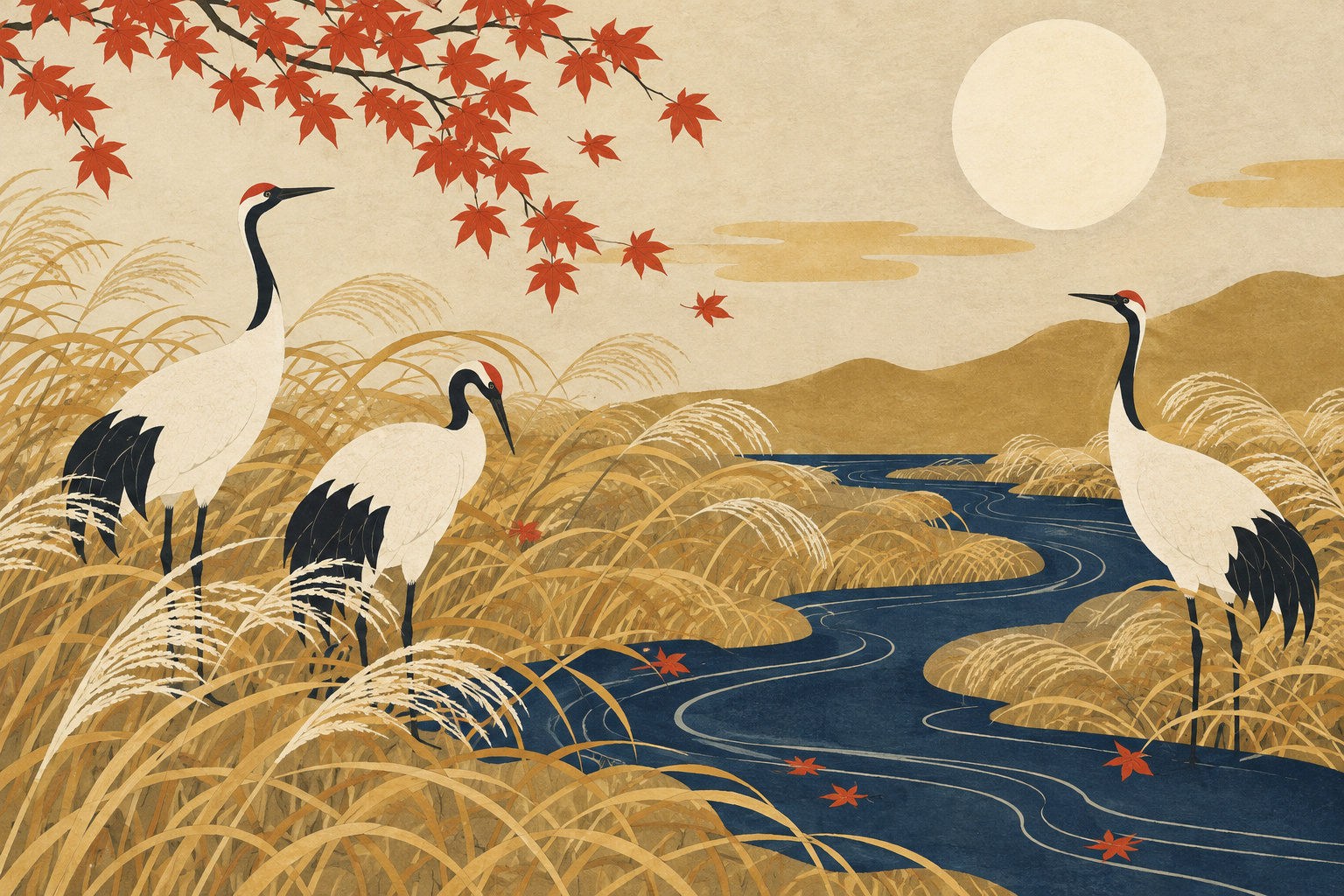
A crane’s neck can carry a composition. So can the arc of a moon. In Kamisaka Sekka’s Momoyogusa, a few immediately recognisable forms open onto a world that becomes more complicated the longer one looks. The first impression is clarity; the lasting pleasure is discovering how carefully that clarity has been made.
Today’s Art Choice brings together two prints held by the Cleveland Museum of Art: Cranes (Tsuru) and Susuki Grass in Moonlight (Obana ni tsuki), both catalogued as 1909–10.[2][3] They offer different kinds of visual energy. The birds rise through a crowded network of pine branches. The grasses spread across a moon whose broad curve seems almost too large for the page.
It is easy to call these images modern. A more rewarding question is how Sekka arrived at them—and what changes when we see him as a designer working across books, crafts and domestic spaces, as well as a maker of pictures.
A world that arrived in print
Momoyogusa was published by Kyoto’s Unsodo in 1909–10.[4] The Smithsonian’s National Museum of Asian Art records its three-volume set more precisely: the first volume dates to 1909 and the second and third to 1910. Its catalogue describes woodblock printing in ink, colour and mica on paper, with paper covers.[5]
Those details restore something that a glowing screen can conceal. This was a material object, with pages that moved and surfaces that caught light. The image was encountered at the scale of a book, not only as a framed rectangle or an infinitely enlargeable file.
Cleveland’s account adds a history of circulation: the pictures were initially distributed individually to subscribers before being reissued in bound form.[2] A collection could therefore be experienced both as a sequence of arrivals and as something a reader could leaf through. That changes the rhythm of looking. One image can linger in the mind while the next proposes a different arrangement.
Japan’s Panasonic Shiodome Museum of Art separately listed original drawings for Momoyogusa, dated around 1909, and the published volumes in its 2022 exhibition checklist.[1] The distinction matters. A drawing, a printed book and a later impression of the same design belong to related histories; they are not interchangeable objects.
Three cranes, two speeds of looking
In Cranes, three heads emerge above green pine branches. The white bodies, black necks and small red crowns establish a forceful pattern. The branches conceal as well as frame the birds.[2] The effect is more intimate than a complete view of three isolated specimens would be.

Start with the necks. Their changes of direction create an exchange across the image, a set of turns that the eye can follow before it has examined any feather. Then look at the pine. Its repeated needles operate at a much smaller scale. A picture that first seemed built from a handful of large shapes suddenly becomes full of fine marks.
This is why “simplicity” needs qualification. Sekka has not removed detail everywhere. He has distributed it. The birds read quickly; the branching greenery asks for slower attention. The design gains strength from the contrast between those two speeds.
The unoccupied ground above and around the heads helps make the crowded lower area legible. Space is doing work even where it does not announce itself as an object. It gives each bend of a neck somewhere to register.
Moonlight without a complete landscape
Susuki Grass in Moonlight makes a different proposition. Dark stems support pale, curving blades and plumes. Behind them, the moon rises as an enormous partial circle from the lower edge.[3] We have enough to recognise a seasonal scene, but very little of the information a panoramic landscape might provide.

There is no need to establish a distant horizon before the picture begins to work. The moon is simultaneously a celestial body and a large area of tone. The grass is simultaneously vegetation and a network of lines. Recognition and pattern remain available at the same time.
Follow one pale curve and the plant becomes the centre of attention. Look back at the whole spread and the moon’s arc takes command. Neither reading cancels the other. Their alternation supplies much of the image’s life.
The generous space here is not simply untouched white paper. Tonal changes give the ground a presence of its own. In the museum’s digital image, the light forms and darker surroundings create a quiet contrast; a screen, however, cannot reproduce every response of a printed surface to changing illumination.
These are observations about the composition, not a recovered statement of Sekka’s intentions. The pleasure of close looking is that it need not pretend to know exactly what an artist thought. The image provides enough evidence to ask how its parts hold together.
Kyoto, craft and a renewed encounter with Rinpa
Sekka lived from 1866 to 1942. Unsodo’s Japanese biography identifies Kyoto as his birthplace and describes his training in painting and, subsequently, design. His work extended into designs for lacquer and textiles and the decoration of interiors.[4]
Those activities make the familiar separation between “fine art” and useful things an awkward guide to his career. A pattern could become a page, an object or part of a room. Each destination posed a different problem of proportion, surface and use.
The Panasonic Shiodome Museum’s historical account connects Sekka’s European study of contemporary arts and crafts with a renewed appreciation of Japan’s decorative traditions and deeper engagement with Rinpa.[6] Europe was not simply a source of fashionable forms to import. The encounter also helped turn his attention back towards an existing Japanese artistic inheritance.
That inheritance stretched from Hon’ami Koetsu and Tawaraya Sotatsu in the early Edo period through Ogata Korin and Kenzan, and later Sakai Hoitsu and Suzuki Kiitsu. The museum emphasises Sekka’s affinity with the earlier artists’ approach to making as well as their visual methods.[6] The relevant tradition was therefore larger than a repertoire of recognisable motifs.
Seen this way, historical knowledge and invention support each other. A familiar plant or bird can remain legible while scale, placement and emphasis change. The subject does not have to be unprecedented for the composition to feel startling.
The other hands behind the design
A useful corrective to the idea of a solitary master lies in the 2022 exhibition checklist. It credits Sekka with the design and Kamisaka Yukichi with the lacquerwork of a desk depicting cranes carrying pine branches over waves. A red Raku tea bowl with waves is likewise identified as Sekka’s design realised by the fifth-generation Kiyomizu Rokubei.[1]
Such credits reveal a working relationship. A design has to meet a material and the skills of someone able to shape it. A curve on paper is one thing; a curve read around a bowl, across a lid or beside an object resting on a desk is another.
Unsodo explains that it has worked with designers supplying the textile, ceramic and lacquer fields since its early years, publishing woodblock-printed design books.[7] Publication could connect an image with further acts of making. The book was part of a craft economy, not merely a repository for finished pictures.
The publisher also makes a distinction relevant to viewers today. Its current presentation of selected Momoyogusa prints describes later impressions made by contemporary printers from the original blocks.[4] An old design does not automatically mean an early impression. Looking at the date and production description adds to the appreciation of a print rather than diminishing it.
Why Sekka belongs in an autumn edition
The appeal to today’s Japan.co.jp edition is partly seasonal: grasses and moonlight invite an autumn reading. But the compositional possibilities extend further. The bending legs of a crab, the repeated stems beside a river, or an athlete leaning into movement can all prompt questions about which lines carry an image and which details can be left out.
These are our contemporary editorial connections, not claims that Sekka anticipated news illustration or designed for modern sporting events. The crane-and-grass image at the top of this article is an AI-generated homage. It is separate from the two historical works reproduced here and is not an authentic plate from Momoyogusa.
Try looking at the originals once more, first small and then enlarged. At a distance, notice the largest shapes. Up close, follow the marks that complicate them. The composition survives both encounters because immediacy is only its beginning.
A few bold shapes can make a world feel larger. In Sekka’s prints, that enlargement happens through relationships: bird and branch, line and moon, image and page, designer and maker. There is always another connection to notice.
View artwork: Cranes · View artwork: Susuki Grass in Moonlight · Japan.co.jp Art Gallery